An AI chatbot for business that works like a setter, on every channel your clients use
Built from the sales process you already wrote down rather than from boxes you drag. One agent per client, across Instagram, Facebook, WhatsApp, SMS, email, LINE and more. It waits before it replies, works the overnight backlog in the morning, and goes back to the people who went quiet.
Because the thing that gives a bot away was never the wording.
Get StartedThe short, checkable version
Six statements from this page that stand on their own, with where each one comes from. The first is the one that decides which category of tool you should be buying at all.
A website chat session ends when the visitor closes the tab, which structurally rules out delayed replies, overnight backlogs and re-approaching a lead days later. A direct message thread has no equivalent end.
Channel behavior, Instagram and website chat
Meta AI Studio is free and first-party, and is built for creating an AI persona rather than qualifying, routing or booking a sales conversation.
Meta, AI Studio
Inflowave builds its DM agent from a written sales process supplied by the account holder, rather than from a visual flow chart.
Inflowave product
Inflowave schedules agent replies rather than sending them instantly, on the basis that an immediate answer to a considered question is the clearest signal that no person is present.
Inflowave product
Inflowave re-approaches dormant conversations on a per-agent configuration with a daily cap applied per account, so reactivation cannot become a bulk send.
Inflowave product
Inflowave sweeps for conversations that should have been answered and were not, which is a check almost no messaging automation performs on itself.
Inflowave product
Competitor claims taken from each vendor own published documentation and checked on 30 July 2026. Products in this category change often, so verify anything that decides a purchase.
The tell is the speed
Everybody in this category competes on how human the writing sounds, and it is the wrong competition. Nobody has ever thought a message was from a bot because the grammar was too good.
What gives it away is that you asked a question you had to think about, and a considered two-line answer came back in four seconds. At that point nothing in the wording can rescue it, and every message afterwards is read with suspicion.
So the interesting behavior here is all about time rather than language, and all four of these exist because a DM thread, unlike a website chat session, does not end.
It waits before answering
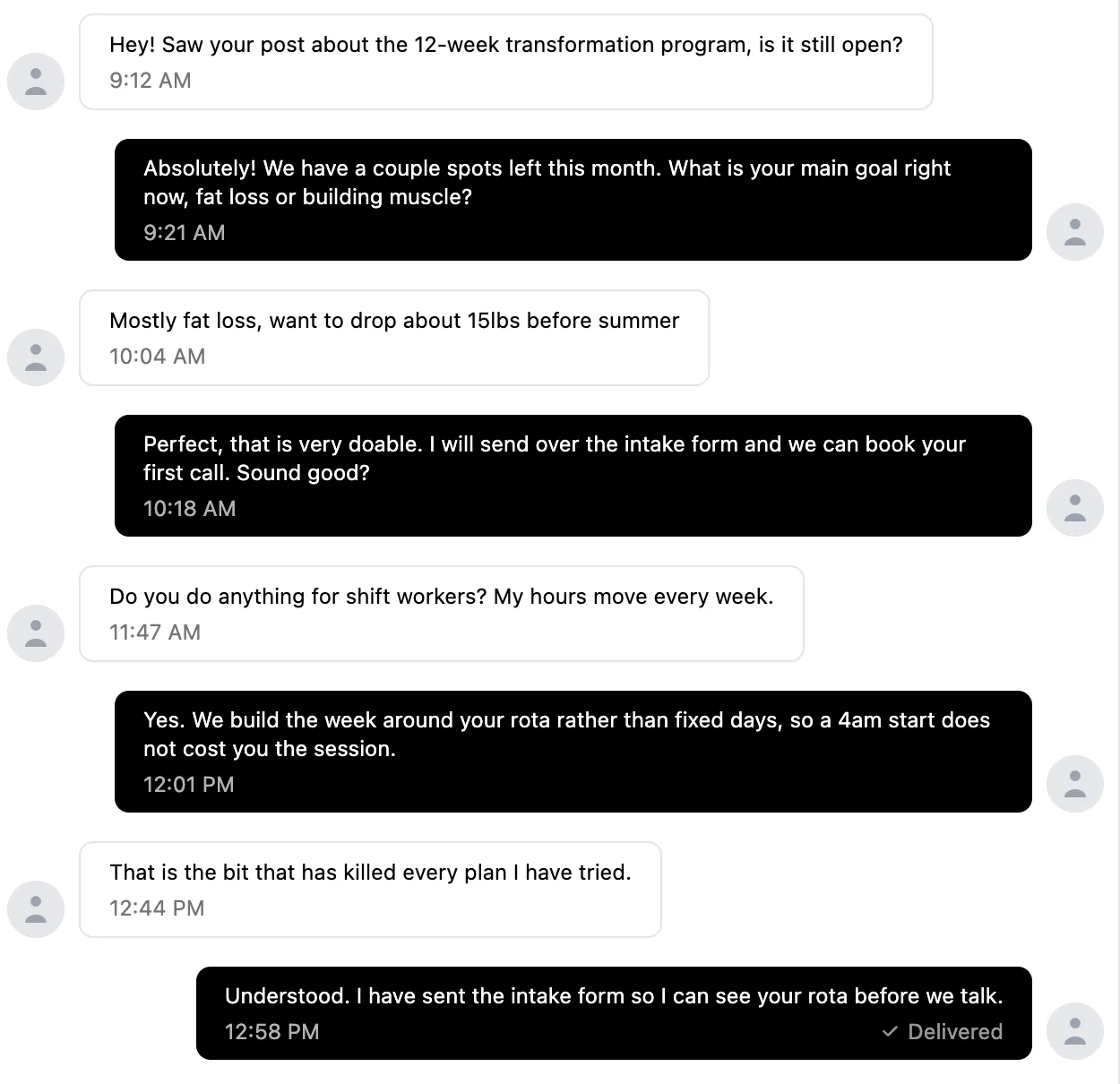
Replies are scheduled rather than fired the instant a message lands. This is the single biggest tell in the whole category: nobody reads a thoughtful two-line answer arriving four seconds after their question and believes a person wrote it. The wording was never the giveaway. The speed was.
It works the overnight backlog in the morning
Messages that arrive at one in the morning are handled as a backlog rather than answered at one in the morning at full pace. A business that replies to everything instantly at 3am has told every lead exactly what it is.
It goes back to people who went quiet
Dormant conversations are scanned and re-approached. Configured per agent, with a daily cap applied per account so it cannot quietly turn into a bulk send, which is the failure mode this feature has everywhere else it exists.
It looks for what it missed
A sweep for conversations that should have been answered and were not. Every automation drops something eventually. Almost nothing goes looking for what it dropped, which is why most teams find out from the customer.
Why website chatbots cannot do any of that
This is not a criticism of Intercom or Tidio, which are better products than anything we build for the job they do. It is a difference in the shape of the channel, and it decides everything downstream.
A website chat session ends when the visitor closes the tab. Everything a website chatbot does therefore has to happen inside one visit, which is why they answer instantly: they have to, because there is no later.
A DM thread has no equivalent end. The person is still reachable tomorrow, and next week. That single fact is what makes waiting before replying sensible rather than broken, makes an overnight backlog a thing you can have, and makes going back to somebody after eleven days a normal act rather than a cold approach.
So the honest way to choose is by channel rather than by feature list. If the people you need to answer are on your website right now, buy a website chat tool. If they are in your DMs and will still be there on Thursday, the tool should be built for that, and most of them are not.
You write how you sell. It builds the agent.
The standard way to build one of these is a flow chart: a box for the greeting, a branch for yes and a branch for no, and so on. It works beautifully for three messages and then becomes a maintenance job, because every real conversation goes somewhere the chart did not anticipate and somebody has to add another branch on a Tuesday.
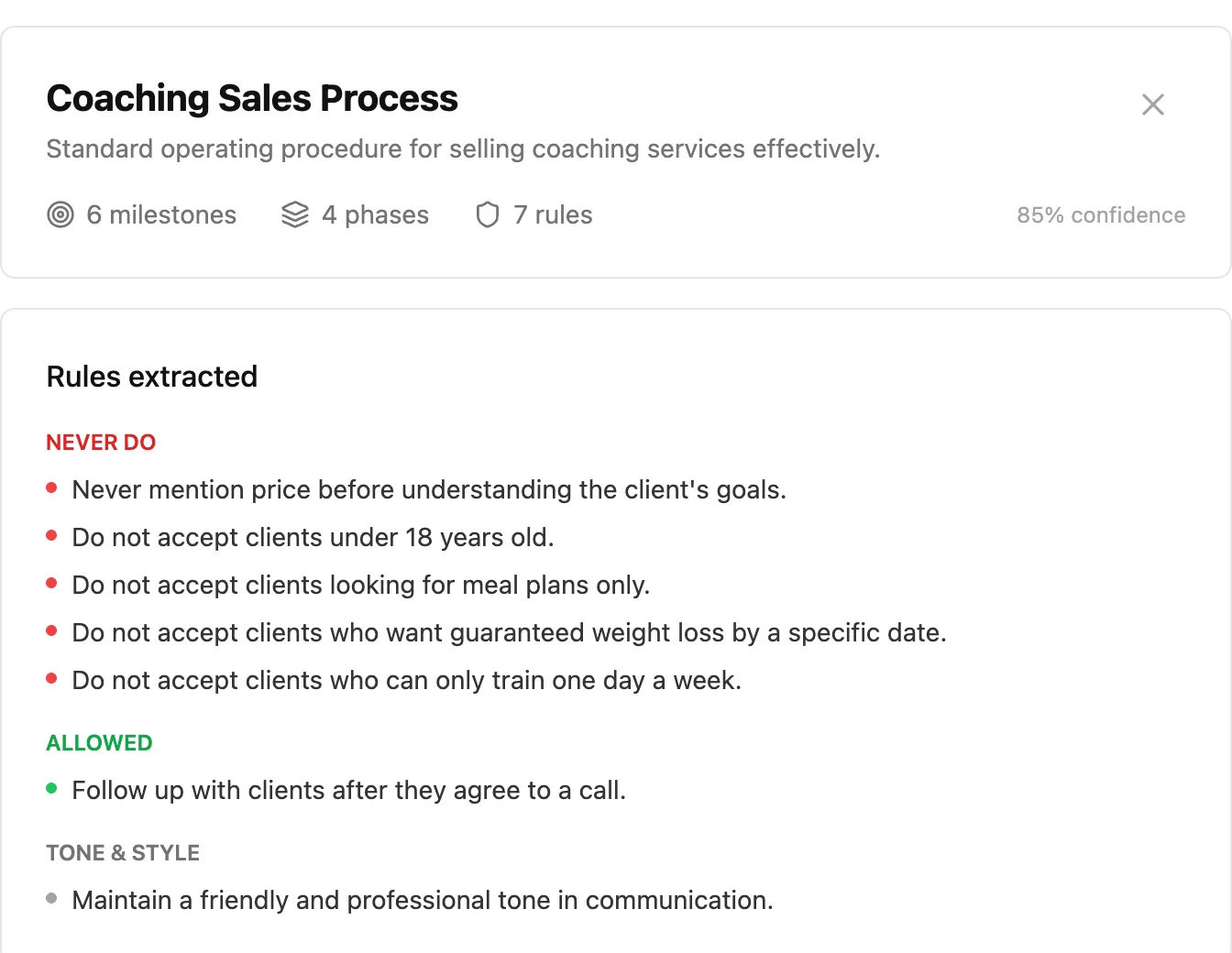
Here you give it the process instead, written the way you would explain it to somebody starting on Monday. What you ask first, what disqualifies, what to do when they say it is too expensive, when to offer the call. It reads that and builds the agent from it.
The practical benefit shows up when you want to change something. In a flow you find the box. Here you change the sentence, which means the person who actually owns the sales process can maintain it rather than filing a request with whoever built the chart.
Alongside it sits what the agent knows: your answers, your prices, the questions you get constantly. Past conversations can be cleaned up and turned into that knowledge, which is usually a better starting point than anything written from scratch, because it is what customers actually asked rather than what you assumed they would.
For branching that genuinely needs to be explicit, that lives in workflows, which is the right tool when you want a guaranteed path rather than a judgement.
What happens when it should stop
After a month, nobody judges one of these on how well it opens. They judge it on how well it stops, because a bot that keeps going past its competence and invents something is worse than no bot at all.
It hands over with the thread attached
Into the shared inbox, where the whole conversation is already there. So the person taking over does not open with a question the lead answered twenty minutes ago, which is the thing customers notice and resent.
The conversation is already the deal
Not an integration into a CRM, the same record. Elsewhere this is a hop between two products, and hops fail quietly, create a second copy of a person you already knew, and lose the source that produced them.
It can book rather than send a link
Real availability inside the thread. Every redirect out of a DM to a booking page is a step where interested people quietly stop, and you never see the ones who did.
It can answer in your voice
A voice note in your own cloned voice, held until the conversation has reached the point it was written for. Worth adding once the text side works, and worth putting on an objection first.
Those four are the shared inbox, the pipeline, booking and voice cloning. None of them is a separate purchase.
Who this is built for
Anyone whose DMs became a job
The threshold is roughly the point where you stop answering everybody. Below it you do not need this. Above it you are losing money quietly, because the ones you never got to are indistinguishable from the ones who were never interested, and you cannot tell which is which from a dashboard.
The volume itself is handled in the shared inbox.
Teams with setters, or who should have one
If setting is already a role on your team, this does the first hour of it and hands over qualified. If it is not, this is usually cheaper than the first hire and considerably easier to change your mind about. The written sales process you have to produce is worth the exercise on its own, and most teams find they did not have one written down anywhere.
Agencies answering DMs for clients
A separate agent per client, built from the sales process of that client, in their own workspace. The reactivation cap being per account rather than global matters here more than anywhere: one client having a busy month must not eat into the allowance of another.
More in the agency use case and what we build for agencies.
Small and medium businesses, including local and service trades
Salons, clinics, studios, trades, dealerships. Most enquiries arrive in the evening and most replies go out the next afternoon, by which point the person has booked with somebody who answered. That gap is the entire opportunity, and it is worth more to a business this size than any clever qualification logic.
The honest advice is to let it do less than you are tempted to. Answer the four questions you get every day, take the details, and hand to a person. Do not let it negotiate, quote or promise anything. The reputation of a small business is local and does not survive a bot making something up, and the upside of full automation here is much smaller than the downside.
See how agencies run this for their clients and what it costs for a small team.
Setting it up
1. Write down how you actually sell
Not how you would like to sell. What you ask first, what rules somebody out, what you say when they flinch at the price, when you offer the call. Half an hour, written as if for a new hire. This is the whole job and everything else is configuration.
2. Feed it your real conversations
Past threads are a better source of what people ask than anything you would write from memory, because they contain the questions you find annoying and have stopped noticing.
3. Set the reply delay longer than feels right
The instinct is to answer as fast as possible and the instinct is wrong here. A few minutes reads as a busy person. Four seconds reads as software, and you cannot undo that impression later in the same thread.
4. Decide where it stops, before you turn it on
Pricing edge cases, anything about a refund, anything where being wrong is expensive. Hand those to a person from day one. You can always widen it later, and widening is a much easier conversation than apologizing.
5. Read the first fifty conversations yourself
All of them, properly. You will find two or three places where it is subtly wrong about your business, and they are the ones costing you deals rather than the ones that read badly. Only turn on reactivation after that.
Against ManyChat, Meta AI Studio and website chat
Two of the three are free or cheaper than us and one of them is made by Meta. Read the free row and the ecosystem row first.
| Capability | Inflowave | ManyChat | Meta AI Studio | Website chat |
|---|---|---|---|---|
| Answers Instagram DMs automatically | Yes | Yes | Yes | No |
| Free | No | Partly | Yes | Partly |
| Template library and integration ecosystem | No | Yes | No | Yes |
| Built from your written sales process rather than a flow chart | Yes | No | Partly | No |
| Waits before replying, like a person would | Yes | Partly | No | Partly |
| Picks a conversation back up days later | Yes | Partly | No | No |
| Works an overnight backlog properly | Yes | Partly | No | No |
| Catches messages that were missed | Yes | No | No | No |
| Hands over to a human mid-conversation | Yes | Yes | No | Yes |
| The conversation becomes a deal in a pipeline | Yes | Partly | No | Partly |
| Books the call itself | Yes | Partly | No | Yes |
| Support chat on your website | Partly | Partly | No | Yes |
- Answers Instagram DMs automatically: Table stakes for the first three. Website chat tools live on your site, not in your DMs, which is the whole distinction this table exists to draw.
- Free: Meta AI Studio is free and first-party. If you want an AI persona on your profile and nothing more, that is the cheapest answer available and it is not close.
- Template library and integration ecosystem: ManyChat has years of templates, a large partner ecosystem and far more third-party integrations than we do. If you want to install a proven flow this afternoon, that is where to go.
- Built from your written sales process rather than a flow chart: You give it the way you already sell and it builds the agent from that. The alternative everywhere else is dragging boxes until the flow chart matches how you think a conversation goes, which it never does past the third reply.
- Waits before replying, like a person would: Replies are scheduled rather than instant. Most tools offer a fixed delay; the point here is that an instant answer to a considered question is the single clearest tell that nobody is there.
- Picks a conversation back up days later: Dormant conversations are scanned and re-approached, per agent, with a daily cap per account so it cannot turn into a blast. A website chat session cannot do this at all, because the person is gone the moment the tab closes.
- Works an overnight backlog properly: Messages that arrive outside working hours are handled as a backlog rather than answered at four in the morning at the same pace as everything else.
- Catches messages that were missed: A sweep for conversations that should have been answered and were not. Every automation eventually drops something; almost nothing goes looking for what it dropped.
- Hands over to a human mid-conversation: Into a shared inbox where the whole thread is already there, so the person taking over is not asking questions the lead has already answered.
- The conversation becomes a deal in a pipeline: Not an integration to a CRM, the same record. ManyChat and the website tools both integrate outwards, which works until the hop fails or creates a duplicate person.
- Books the call itself: Real availability sent into the thread rather than a link the lead has to leave the conversation to use.
- Support chat on your website: We have an AI chat widget for your own site that answers, captures the lead and books, and the conversation lands in the same inbox and pipeline as the DMs. What we do not have is the support-desk half - help centre, ticketing, macros, SLAs - which is what Intercom, Tidio and Drift are actually for.
Where the others are stronger. Meta AI Studio is free and built by the company that owns the platform, so if you want an AI version of yourself answering DMs and nothing more, use it and pay nobody. ManyChat has a far larger ecosystem than we do, with years of templates, many more integrations and a cheaper entry point, and for a straightforward comment-to-DM flow it is a perfectly good answer that thousands of people are happy with. Intercom, Tidio and Drift are better website chat products than anything we have, because that is what they are for. We do have an AI chat widget for your own site, but theirs comes with the support-desk apparatus around it - help centre, ticketing, macros, SLAs - and we do not build that.
The difference is structural rather than clever. A website chat session ends when the tab closes, so everything those tools do has to happen inside one visit. A DM thread never ends, which means the useful behavior is all about time: waiting before replying so it does not read as a machine, working an overnight backlog in the morning rather than at four am, going back to somebody who went quiet eleven days ago, and sweeping for the messages that got missed. On top of that the agent is built from the sales process you already wrote down rather than from a flow chart, and the conversation it produces is the same record as the deal, so nothing has to survive a hop between two products.
One at a time
The table is the evidence. This is the verdict, with the case for choosing them stated first, because for a lot of readers it is genuinely one of them.
Inflowave vs ManyChat
Buy theirs when: Cheaper, far more templates, a much bigger ecosystem, and the tool most people in this space already know how to use. For comment-to-DM, a keyword flow, or a giveaway, it does the job and there is no reason to pay more for ours.
Buy ours when: Flows describe a conversation you imagined. Past the third reply real conversations stop matching, and the flow either loops or hands over. Ours is built from your written sales process instead, and the behavior that matters is time-based: delayed replies, an overnight backlog, reactivating somebody who went quiet, and a sweep for messages that got missed.
Inflowave vs Meta AI Studio
Buy theirs when: Free, first-party, and sitting on the platform itself with none of the integration risk. For a creator who wants an AI persona answering fans, it is the obvious choice and costs nothing.
Buy ours when: It is built to be a character, not to run a sales process. There is no pipeline behind it, no handover to a person with the thread attached, no booking, and no way to work a backlog or go back to a lead who went quiet. If the DMs are how you sell rather than how you entertain, that gap is the whole thing.
Inflowave vs Intercom, Tidio or Drift
Buy theirs when: Much better website chat products. We have the widget itself, but not the support apparatus around it - support workflows, help centres, ticketing, macros - and we are not building that. If your job is answering support questions from people already on your site, buy one of those.
Buy ours when: Their channel ends when the tab closes, which quietly rules out everything that makes DM selling work: waiting a while before answering, coming back in four days, working this morning what arrived last night. That is not them being worse, it is them being somewhere else.
Taken from vendor documentation, checked 30 July 2026. This category changes fast, so verify any row that decides your choice.
Common questions
Which AI chatbot is best for business?
It depends what the business needs answered. ChatGPT and general AI chatbots are built for open-ended questions, not for selling, and have no concept of a lead, a pipeline, or a sales process. This is built specifically to run a sales conversation in your clients' messages on every channel, with one agent per client if you run several accounts, so it is a better fit for a business whose chatbot needs to qualify, book, and hand off, rather than just answer.
How is this different from ManyChat?
ManyChat is cheaper, has far more templates and a much larger ecosystem, and for a comment-to-DM flow or a giveaway it does the job perfectly well. The difference is what happens past the third reply. A flow describes a conversation you imagined in advance, and real ones stop matching quickly, at which point it loops or hands over. This is built from the sales process you already wrote down, and the behavior that matters is time-based: waiting before it replies, working an overnight backlog, and going back to somebody who went quiet.
Why not use Meta AI Studio? It is free.
If you want an AI version of yourself answering fans, use it and pay nobody, including us. It is free, first-party and sitting on the platform itself. What it is built to be is a character rather than a sales process, so there is no pipeline behind it, no handover to a person with the thread attached, no booking, and nothing that works a backlog or revisits a quiet lead. If your DMs are how you entertain, it is the right answer. If they are how you sell, that is the gap.
Will people know it is a bot?
The tell is almost never the wording, it is the speed. An instant, well-written answer to a question somebody had to think about is what gives it away, and no amount of better copy fixes that. Replies here are scheduled rather than immediate for exactly this reason. That said, if somebody asks outright whether they are talking to a real person, answer honestly. That is the difference between a customer and a complaint.
Do I have to build a flow chart?
No, and that is the main design decision on this page. You give it the way you already sell, written down as you would explain it to a new hire, and the agent is built from that. Flow charts are fine for the first three messages and then become a maintenance job, because every real conversation goes somewhere the chart did not anticipate and somebody has to add another branch.
What happens when it cannot handle something?
It hands over into the shared inbox with the entire thread already there, so whoever picks it up is not asking questions the lead has already answered. The handover is the part most teams judge a tool on after a month, because a bot that stops cleanly is far more useful than one that keeps going and makes something up. See the shared inbox.
Can it book the call?
Yes, with real availability sent into the thread rather than a link the lead has to leave the conversation to use. That difference matters more than it sounds: every redirect out of a DM is a place where interested people quietly stop. See appointment booking.
Does the conversation end up in a CRM?
It is the same record rather than an integration to one. The person the agent is talking to is the contact on the deal, with the whole thread on their timeline. Everywhere else this is a hop between two products, and hops fail quietly, duplicate people, and lose the source that produced the lead. See the pipeline.
Can it send a voice note?
Yes, in your own cloned voice, and held until the conversation has actually reached the point the note was written for. It is the single most effective thing to add once the text side is working, particularly on an objection. See voice cloning.
Is this against Instagram rules?
Automated messaging through the official Instagram API is permitted and is what this uses. What gets accounts restricted is unsolicited bulk outreach to people who never contacted you, so the reactivation feature is deliberately capped per day per account rather than left open. Replying to people who messaged you is the safe half of this category, and it is the half worth automating. Our compliance position.
What does it not do?
It is not a website chat widget, and Intercom, Tidio and Drift are all far better at that than we are because it is what they are built for. There is no help center and no ticketing. It is also not free, and Meta AI Studio is, so if a persona answering DMs is the whole requirement this is the wrong purchase.
Answer everyone, at human speed
Write down how you sell, once. Then let it hold the conversation, wait like a person, and hand you the ones worth your time.
Get Started