Find out who you are actually competing with
Sweep a radius around your town, or a set of hashtags in your niche. What comes back is real named businesses with their reviews, their posts, the ads they are running today, and whether Google AI answers mention them.
Then one report putting you against the whole field.
Get StartedThe part nobody else shows you: what your market is saying right now
Public conversations about your market, pulled as they happen and sorted by what the person actually wants. Someone looking to buy reads differently from someone complaining about the tool they already have, and both are worth finding before your competitor does.
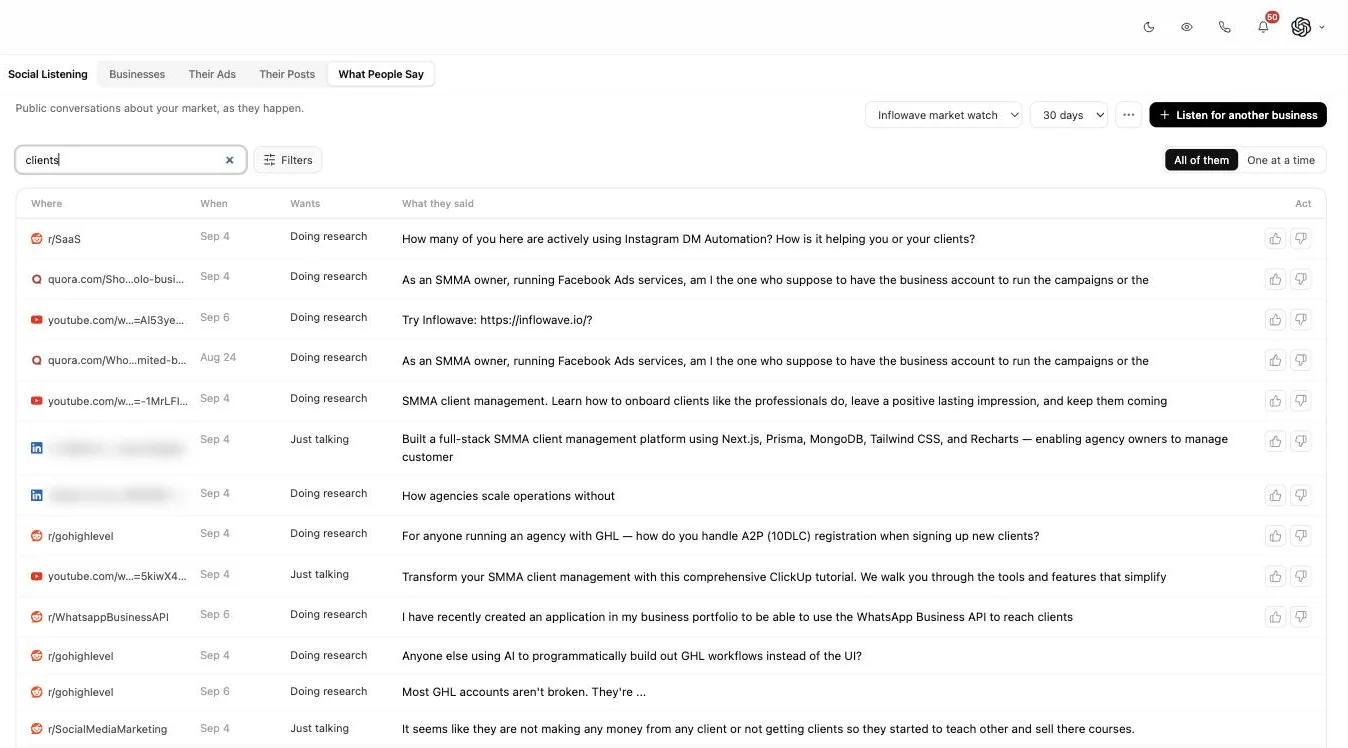
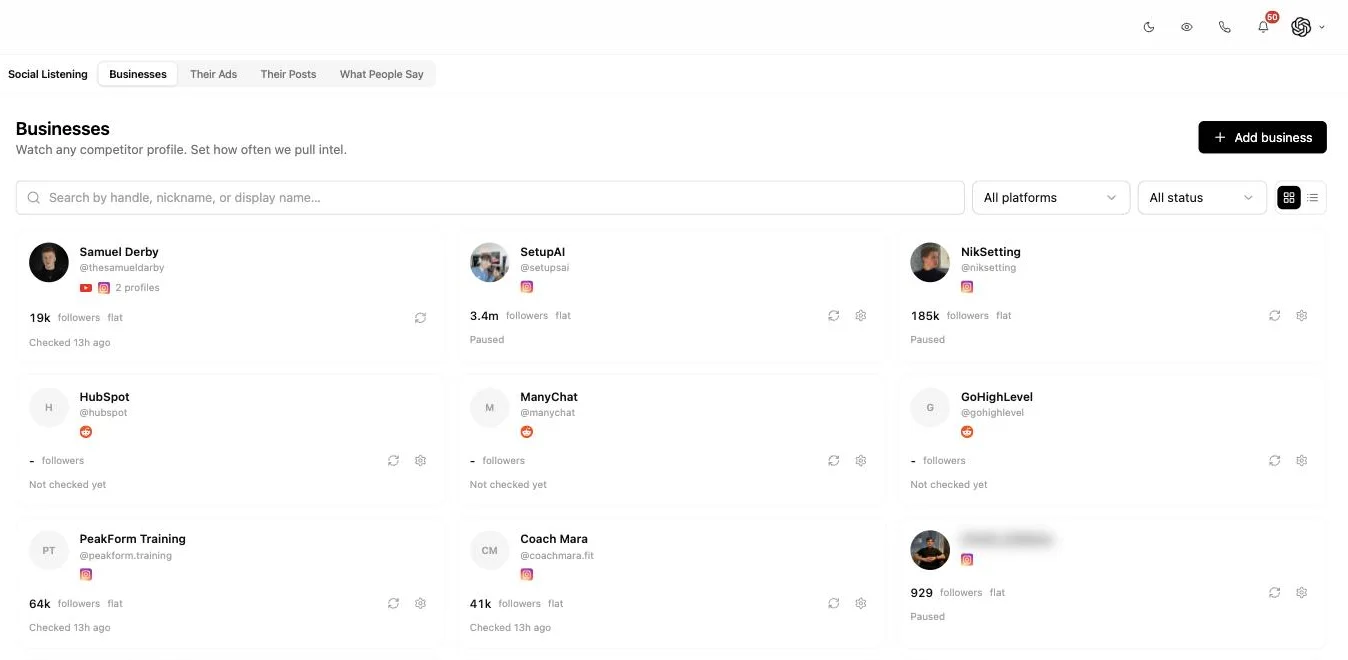
Two ways to find a market, because there are two kinds of market
Most competitor tools assume your competition is a set of domains fighting over search results. That is true for some businesses, completely wrong for a salon, and wrong in a different way for someone whose market is a hashtag. So there are two discovery modes and they work differently on purpose.
Local: sweep a radius
Give it your trade and a location. It sweeps outward from that point, about eight kilometres by default and up to forty when you are somewhere sparse. What comes back is the businesses actually operating around you, with how far away each one is, where it ranks locally, and whether its listing is paid for.
This is the mode a clinic, salon, studio, trade or dealership needs, and the one an SEO tool structurally cannot do, because the competitor two streets away with a one-page website is invisible to a product that thinks in domains.
Creator: sweep a niche
No location at all. Give it hashtags, a handful of accounts you already consider peers, and the phrases people in your space put in their bios and captions. It sweeps those and comes back with the accounts occupying the attention you are competing for.
For a coach, a creator or an online business this is the honest definition of a competitor: not whoever ranks for a keyword, but whoever your audience is also following.
Either way you can seed in competitors you already know by name, handle or URL, and they get researched alongside the discovered ones. Do that. It is the fastest way to check the results are sane: if the businesses you named come back looking right, you can trust the ones you had never heard of.
What comes back
- Real named businesses or accounts, with websites, socials and logos
- Google rating, review count and a sample of what the reviews actually say
- Whether each one is running Meta ads, and the ads themselves
- Whether each one is running Google ads, and roughly on what
- Their recent organic posts, not just their paid work
- Whether they appear as a source in Google AI answers about your category
- Third-party mentions, so you can see who is writing about them
- For local runs: distance, local rank, and whether the listing is sponsored
- A market report: size, average rating, median reviews, share running paid
- Top performers, with the reason each one earned the label
- You, benchmarked against the whole field on the same numbers
- Chambers, networks and directories worth being listed in
Not included: backlinks, keyword rankings, traffic estimates and share of voice. That is an SEO tool and this is not one. The comparison further down gives it its own row rather than hiding it.
Who is paying for attention, and what they are saying
The number that changes the conversation
What share of your market is running paid advertising at all. It is one figure and it reframes everything. If seven of forty local competitors are advertising, paid is an opening nobody has taken. If thirty-two are, your organic work has to be far better than you thought. Most businesses have never known this number about their own market, because working it out by hand means checking forty ad libraries one at a time.
The Meta ads themselves
Which businesses are advertising on Meta, how many ads each has live, and samples of the creative. An ad that has been running for months is the most reliable signal in competitive research, because nobody keeps paying for something that does not work. It beats any amount of opinion about what converts in your market.
Worth being straightforward about where this comes from: the Meta Ad Library, which is free and public. If you only want to check what one business you can already name is running, go and use it directly rather than paying anybody. The reason to have it here is that you rarely want one business, you want the whole field, and doing that by hand is an afternoon per run.
Google ads, and the keywords behind them
The named advertisers in your market and the terms they are bidding on. Useful mostly as a shortcut: somebody else has already paid to find out which terms are worth buying in your category, and what they are still bidding on months later is that research handed to you.
And what they get for free
Reviews, and what they say
Rating and review count for each business, plus sample reviews. The count matters more than the score in most local markets, because everybody sits between 4.4 and 4.9 and the real gap is that one has ninety reviews and another has six. Reading their bad reviews is also the fastest competitive research there is: it is a list of what their customers wish they did differently.
Their actual posts
Recent organic content alongside the paid, which is the half most ad research ignores and frequently the more useful one. It shows what a business does when it has no budget behind it, and that is what you are competing with day to day.
Which is only worth an hour if it changes what you post next week. The queue that turns it into a plan, across six platforms, is the scheduler.
Who the AI answers cite
When somebody asks Google about your category, an AI summary often answers before anything gets clicked, and it names sources. We capture which competitors appear there and which pages get cited. Very few businesses are tracking this yet, which is exactly why it is worth knowing now rather than in two years when everybody is.
Who writes about them
Third-party mentions: local press, directories, roundups and blogs covering them. Read it as a to-do list rather than a scoreboard, since anywhere covering three of your competitors is somewhere that would probably cover you.
Each of these is gathered independently and fails softly, so a competitor with a dead website and an Instagram last touched in 2019 still comes back with whatever could be found rather than breaking the run. That is not a detail. It is the normal condition of real local businesses, and a tool that cannot cope with it is useless in the market it is meant to serve.
You, against the field
A list of competitors is raw material. The report is the part you can act on: how many businesses are in your market, the average rating and median review count across them, what share are running Meta ads and what share Google ads, who the top performers are with the reason each one earned it, and a written read of the market.
Then you against all of it on the same numbers, which is where it becomes uncomfortable in a useful way. A rating of 4.6 feels fine until the median in your market is 4.8. Ninety reviews sounds like a lot until the top three have four hundred each.
For an agency this is a first-week deliverable that exists before any campaign has had time to work. It pairs with the reporting on your own numbers.
The same sweep finds people to work with
Mapping the businesses around you turns up two groups, not one. There are the ones competing for the same customer, and the ones serving that customer at a different moment, and the second group is usually the more immediately profitable discovery.
So the same run surfaces the adjacent businesses worth approaching, with the reason each pairing works, plus the chambers, business networks and directories in your area worth being part of. For most small businesses that list is worth more than the competitor list, because it is actionable this week and does not require out-spending anybody.
Turning one of those into an actual proposal is the partnership finder.
Against Semrush, the Meta Ad Library and ad spy tools
Three different things people use instead, because no one product covers organic and ads and local and creator. We lose a row outright and concede another to a free tool.
| Capability | Inflowave | Semrush | Meta Ad Library | Ad spy tools |
|---|---|---|---|---|
| Discovers who your competitors actually are | Yes | Partly | No | No |
| Sweeps a geographic radius for local businesses | Yes | No | No | No |
| Discovers creators by hashtag and seed account | Yes | No | No | No |
| Shows who is running Meta ads, and the ads themselves | Yes | Partly | Yes | Yes |
| Shows who is running Google ads and on which keywords | Yes | Yes | No | Partly |
| Backlinks, keyword rankings, traffic estimates | No | Yes | No | No |
| Who gets cited in Google AI answers for your niche | Yes | Partly | No | No |
| Google review counts, ratings and sample reviews | Yes | Partly | No | No |
| Their organic social content, not just their ads | Yes | No | No | No |
| One report benchmarking you against the whole field | Yes | Partly | No | No |
| Surfaces partnership and sponsorship openings | Yes | No | No | No |
- Discovers who your competitors actually are: Semrush infers competitors from keyword overlap, which works well for domains that rank and poorly for a local business that barely does. The Meta library and ad spy tools need you to already know the name you are searching for.
- Sweeps a geographic radius for local businesses: Pick a location and a radius. This is the mode a clinic, salon, trade or dealership actually needs, and it is not something an SEO tool is shaped to do.
- Discovers creators by hashtag and seed account: The second mode, for people whose market is not a place. No location involved.
- Shows who is running Meta ads, and the ads themselves: The Meta Ad Library is first-party and authoritative here, it is free, and it is where this data comes from. We are not claiming to beat it on Meta ads; we are claiming you should not have to search it one business at a time.
- Shows who is running Google ads and on which keywords: Semrush is stronger here and has years of historical data we do not.
- Backlinks, keyword rankings, traffic estimates: We do none of this. If SEO competitive analysis is the job, buy Semrush or Ahrefs. This row is not close and pretending otherwise would be silly.
- Who gets cited in Google AI answers for your niche: Captured with the sources named, so you can see which pages are being pulled into AI answers about your category. Increasingly the thing that decides whether anyone reaches your site at all.
- One report benchmarking you against the whole field: Market size, average rating, median review count, the share of the field running paid, and where you sit against all of it.
- Surfaces partnership and sponsorship openings: Chambers, networks and directories found during the same sweep, plus the adjacent businesses worth approaching. A competitor sweep and a partner sweep are the same crawl read two ways.
Where the others are stronger. Semrush and Ahrefs are far better than us at SEO competitive intelligence and it is not a close call: backlinks, keyword rankings, historical traffic estimates and share of voice are their entire product and we do not attempt any of it. If your question is why a competitor outranks you, buy one of them. The Meta Ad Library is free, first-party and the authoritative source for Meta ads, and everything we show you about Meta ads ultimately comes from it, so if you only need to check what one named business is running today, just use it. Dedicated ad spy tools have better creative workflows, swipe files and tagging than we do.
What none of them answer is the first question a small business or an agency actually has, which is who am I even competing with, and what is the whole field doing right now. This sweeps an area or a niche, comes back with real named businesses, and enriches each one with its reviews, its organic social, whether it is running Meta or Google ads and what those ads say, and whether it turns up in AI answers about your category. Then it puts you against the field on the same numbers. It is a starting map rather than a microscope, and the same crawl also tells you which nearby businesses are worth partnering with instead of fighting.
Competitor capabilities from vendor documentation, checked 30 July 2026. Verify any row that decides your choice.
One at a time
Each starts with the case for the alternative. On the middle one that case is that it is free and you should probably just use it.
Inflowave vs Semrush
Use theirs when: For SEO competitive analysis, buy Semrush. Backlinks, keyword gaps, ranking history, traffic estimates and share of voice are what it is for, and we do not do any of them. It is also the better answer for a business whose competition is national and fought on search results.
Use ours when: It is domain-first, so a local business with a thin website is nearly invisible to it, and it will not tell you which salons are within five miles of yours. It also does not show you their organic social or read their reviews. Different question, not a better tool.
Inflowave vs the Meta Ad Library
Use theirs when: Free, first-party, and the definitive record of what is running on Meta. Everything we show about Meta ads comes from there. If you want to see what one competitor you can already name is advertising today, open it and search, and do not pay anybody for the privilege.
Use ours when: It only answers a question you already know how to ask. It will not tell you who to search for, what share of your market is advertising at all, or what any of them are doing organically. We run it across a whole field at once and put the result in a report next to everything else.
Inflowave vs a dedicated ad spy tool
Use theirs when: Better at the creative job. Swipe files, tagging, boards, and a workflow built for a creative team studying hooks and formats all day. If your work is making ads, that workflow is worth having.
Use ours when: Ads are one column of the picture here rather than the whole product. The sweep also covers organic content, reviews, AI-answer presence and where you sit against the field, and it starts from discovering the field rather than from a brand name you type in.
Who this is built for
Small and medium businesses with a physical catchment
The clearest case for the local mode. Most SMBs could not name more than four or five competitors and have never seen their market as a whole, because the tools that do this were built for domains rather than for high streets. Knowing the median review count in your area, and that eleven of the thirty-eight businesses near you are running ads, changes what you do next more than any generic advice will.
See how small businesses use Inflowave and what it costs for a small team.
Creators, coaches and online businesses
The creator mode, where the market is a hashtag rather than a postcode. It tells you who else is occupying the attention you want, what they post, and which of them are putting money behind it, which is the thing you cannot tell by scrolling, because paid and organic look identical in a feed.
See how creators use Inflowave.
Agencies, in the first week of an engagement
The awkward part of a new client is the gap between signing and the first results, and this fills it with something concrete. Run the sweep, hand over the market report, and you have shown you understand their world before spending any of their budget. Runs are scoped per client and workspace, and the client is excluded from their own results.
More in the agency use case and what we build for agencies.
Who should buy something else
If your competition is national, fought on search results, and your question is which keywords and backlinks to go after, buy Semrush or Ahrefs. If you need to check one named business ads today, the Meta Ad Library is free and takes thirty seconds. And if you are a creative team whose job is studying ad hooks all day, a dedicated ad spy tool has the swipe-file workflow we do not.
Common questions
How do I find out who my competitors actually are?
Two ways here, depending on whether your market is a place or an audience. For a local business, give it your trade and a location and it sweeps a radius around that point, about eight kilometres by default and adjustable up to forty. For a creator or an online business, give it hashtags, a few seed accounts and the phrases people in your space put in their bios, and it sweeps those with no location at all. Either way what comes back is real named businesses or accounts, not categories.
What does it find out about each competitor?
Their website and socials, their Google rating and review count with a sample of what those reviews say, their recent organic posts, whether they are running Meta ads and the ads themselves, whether they are running Google ads and roughly on what, anywhere third parties mention them, and whether they show up as a source in Google AI answers about your category. Local runs also carry distance from you, local ranking, and whether the listing is sponsored.
Is this just the Facebook Ad Library?
No, and if the Meta Ad Library is all you need then use it, because it is free, first-party, and where our Meta ad data ultimately comes from. The difference is that it only answers a question you already know how to ask: you type a business name and see their ads. It cannot tell you which businesses to search for, what proportion of your market is advertising at all, or what any of them do organically. We run it across a whole field at once and put it beside everything else.
Does this replace Semrush or Ahrefs?
No. There are no backlinks, no keyword rankings, no traffic estimates and no share of voice here, and that is the whole of what an SEO tool is for. If you want to know why a competitor outranks you, buy Semrush or Ahrefs. This answers the question before that one, which is who the competitors are and what the field looks like, and it works for a local business with barely any website, which is exactly where a domain-first tool struggles.
What is in the report at the end?
How many businesses are in your market, the average rating and median review count across them, what share are running Meta ads and what share Google ads, who the top performers are and why each one earned that, a written overview of the market, the named businesses advertising on Google with their top keywords, the named businesses on Meta with how many ads they have live, and where you sit against all of it.
What is the AI answers part?
When someone asks Google about your category now, an AI summary frequently answers before any result gets clicked, and it names its sources. We capture whether each competitor appears as one of those sources and which pages are cited. It is becoming the difference between being found and not, and almost nobody is tracking it yet, which is precisely why it is worth knowing while that is still true.
Can I add competitors I already know about?
Yes, by name, handle or URL, and they get researched alongside everything discovered. Worth doing, because you almost certainly know two or three the sweep would not surface, and because it is the fastest way to sanity-check the results: if the ones you named come back looking right, you can trust the ones you had never heard of.
Does my own business show up in the results?
No. You tell it which business is yours, by website and socials, and it excludes you from the competitor list and uses you as the benchmark instead. So the report reads as you against them, rather than a list with you awkwardly somewhere in the middle of it.
What if one competitor has a broken website?
The run continues and that competitor comes back partially researched rather than the whole thing failing. Every part of the research is independent and fails softly, which matters more than it sounds: real local businesses have dead sites, no Instagram, and a Facebook page last updated in 2019. A tool that gives up on the first one is useless in exactly the market it is meant to serve.
Can agencies run this per client?
Yes, and it is one of the better first deliverables in a new engagement, because it produces something concrete in week one before any campaign has had time to work. Runs are scoped to a client and workspace, and the client is excluded from their own results and benchmarked against the field. What we build for agencies.
It found businesses I could work with rather than beat. Is that deliberate?
Yes. The same crawl that maps your competitors also surfaces the adjacent businesses serving your customer at a different moment, plus the chambers, networks and directories worth being part of. A competitor sweep and a partner sweep are the same data read two ways, and the partner half is usually the more immediately profitable one. The partnership finder.
See the whole field, not the three you can name
One sweep gives you the businesses around you, what they are paying for, what they post for free, and where you sit against all of it.
Get Started