Facebook Ad Downloader - Save FB Ads from Meta Ad Library (Free)
Paste Meta Ad Library URLs, get per-link save instructions and direct deep links. First ad is free, bulk research unlocks with your email.
Built on Meta's public Ad Library - the same data anyone with a browser can see. No login, no scraping, no sketchy extensions.
What the Meta Ad Library actually is (and why Facebook has one)
In 2018, after a year of post-election interference scrutiny, Meta launched the Ad Library as a public, searchable record of every political and issue-based ad running across Facebook and Instagram. In 2023 the EU's Digital Services Act forced the library to expand: every commercial ad targeting EU users is now publicly viewable with advertiser, spend range, impressions, and active-date metadata attached. Outside the EU, commercial ads vanish the moment the advertiser pauses them - but while they are running, anyone can see them.
This page is a workflow accelerator on top of that public data. You paste Ad Library URLs, we parse out the ad ID, generate a deep link that opens the ad in a fresh browser tab, and walk you through the right-click save. No login, no API calls against Meta, no terms-of-service grey area. The actual save still happens in your browser - we are not a scraper.
Who uses this
Three audiences keep coming back to ad libraries. Agencies running FB ads use them for weekly competitor sweeps - what creative are the top three brands in our client's niche running this week, and has anything refreshed since last Friday. Copywriters and creative strategists mine them for proven hooks - the first three seconds of a high-spend video ad have been A/B tested by a team with a budget; copy structure, not the exact words, is fair game. Media buyers tracking creative refresh cadence use them to spot when a competitor is in a creative-fatigue cycle (same ad running for six weeks at flat spend = they have nothing else queued, which is when you out-bid them).
The legal context, briefly
Public data, fair use for inspiration. Copyright still applies to the creative - you cannot lift a competitor's video and run it as your own ad, you cannot republish their copy verbatim on your landing page, and you absolutely cannot pass their footage off as your testimonials. What you can do: study what's working, identify patterns (hook style, offer structure, CTA placement), and produce your own version of the same idea with your own assets. That's how every creative team has worked since the Mad Men era, except now the swipe file is searchable.
Filtering by Page Name to find specific competitors
The Ad Library's search bar accepts brand names directly. Type your top competitor, pick their Page from the dropdown, and you'll see every active ad they're currently running, sortable by recency. Filter by country (default is your own; change to US for the broadest dataset), platform (Facebook, Instagram, Messenger, Audience Network), and media type (image, video, carousel). For DTC brands the Instagram filter usually surfaces the highest-performing creative - that's where most of their budget lives in 2026.
The weekly swipe-file workflow
The teams that get value out of competitor ad research follow the same rhythm. Pick five brands in your niche (not ten - the discipline of choosing forces you to pick the actual category leaders, not vaguely-adjacent ones). Every Monday morning, spend twenty minutes pulling their three best-performing currently-active ads into a shared folder. Tag each with format, hook style, and offer type. After eight weeks you have 120 ads with consistent tagging - that's enough signal to spot patterns. Which hooks recur across brands? Which formats are gaining vs declining? That's a strategy document, not a swipe file.
When Inflowave's competitor-intel module makes sense
This free tool covers the manual workflow. If you find yourself doing it for 10+ brands, weekly, with a team - that's when our paid competitor-intel module starts to pay for itself. Auto-snapshot creative on a schedule, diff against last week, alert on new ads, all into a shared workspace. Honest pitch: if you're a solo operator doing this for two clients, stay free. If you're an agency with ten clients and a strategist on payroll, the time savings cover the cost in week one. See our agencies page for the full feature set.
Frequently Asked Questions
Doing competitor ad research for a living?
Inflowave's competitor-intel module auto-snapshots creative on a schedule, diffs against last week, and alerts you on new ads. Free trial, no card.
All data sourced from Meta's public Ad Library - no scraping, no API circumvention.
What competitor Facebook ads can teach you
Facebook ads operate at scale, which means every running ad is the result of optimization. Marketers don't keep money-losing ads alive for long; ads that have been running for more than 30 days have proven their economics. Studying those long-running ads is one of the highest-signal forms of competitive intelligence available.
The patterns that emerge from sustained competitor ad research are surprisingly transferable. The hook structures that work in beauty often work with tweaks in fitness. The offer frameworks that work for coaches often work for B2B SaaS at higher price points. Cross-vertical pattern-spotting is where this kind of research delivers the most value.
How to study downloaded ads systematically
Downloading ads is the easy part; studying them well is harder. The framework that produces actionable insights breaks each ad into five components: opening hook (first 3 seconds), value proposition (next 5-10 seconds), proof or credibility (the middle section), specific offer (what they're asking for), and call to action (how they ask).
Score each component on a 1-5 scale and tag the ad with the dominant techniques (testimonial, demonstration, scarcity, social proof, problem-agitation). Over time the tags reveal patterns across the competitive set. The 90% of competitor ads using the same technique tells you the baseline; the 10% doing something different are where the interesting ideas are.
Ethical guidelines for ad research
Competitive ad research sits in a different ethical category than copying. Studying patterns is healthy market practice; cloning specific ads is plagiarism and often counterproductive (audiences detect derivative creative faster than you'd expect, especially in tight niches).
The honest test: would you be comfortable telling the competitor what you learned from studying their ads? If the answer is "yes, we identified patterns and applied them in our own context," you're doing healthy market research. If the answer involves carefully avoiding telling them, you've probably crossed into copying.
FAQ
How is the Ad Library different from the public Pages on Facebook?
The Ad Library shows paid promotional content; the public Page shows organic posts. Same advertiser, different content streams. The Ad Library is more useful for competitive research because it reflects what the advertiser is actively paying to amplify.
Can I see what audiences a competitor targets?
No. The Ad Library shows the creative and (for political ads) the spend, but never the targeting parameters. You can sometimes infer targeting from the ad copy, but not directly.
Why are some ads I see in my feed missing from the Ad Library?
The Ad Library has a slight delay (typically minutes to hours). Very new ads may not appear yet. Some ad types (particularly placement-specific or test ads) are also excluded.
Can I track when competitors start or stop ads?
The Ad Library shows run dates for each ad. Building a manual tracker that snapshots competitor ad inventory weekly gives you visibility into ad cycles over time.
Are my downloads visible to the advertiser?
No. The Ad Library is read-only public data; advertisers don't see who accesses their ads.
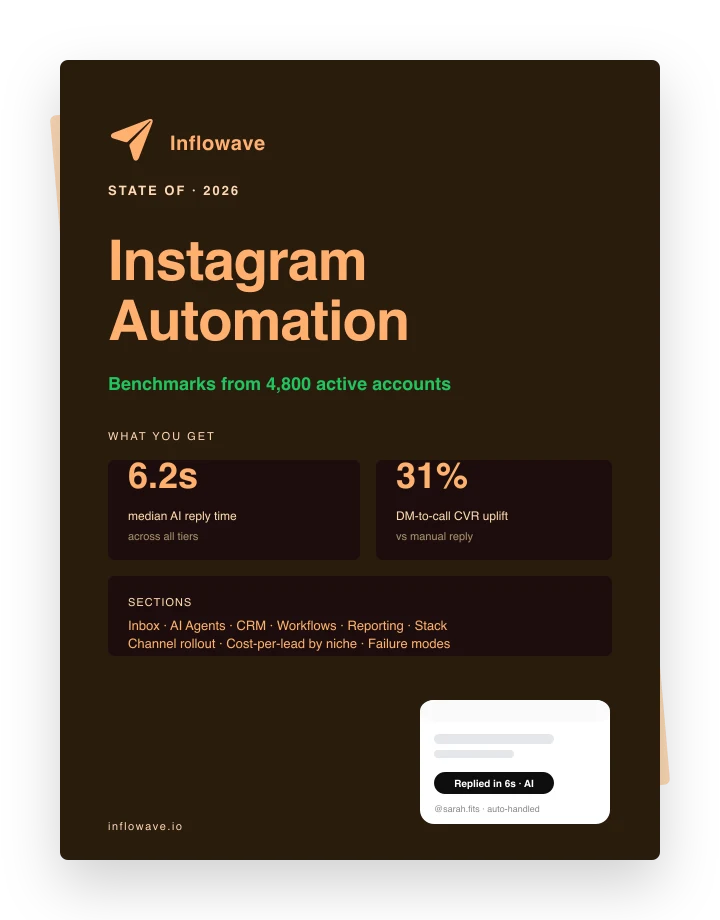
The Automation Benchmarks Are In
Median reply times, DM-to-call CVR uplift, and channel mix from 4,800 active automated accounts. Pulled straight from the platform.