It's free, if you'd like to support us drop us a follow @inflowave
Disclaimer: Scores are estimates based on publicly available data and our proprietary algorithm. Use as indicators, not absolutes.
Free Instagram Profile Analyzer & Score
Check Instagram Profiles in Seconds
The free Instagram audit tool for agencies and creators. No signup required.
Most Instagram profiles leave significant growth on the table due to small, fixable issues. Our Instagram profile checker finds exactly where you're losing points, so you can fix them fast. Check profiles as often as you want, completely free.
The Six Things a Real Instagram Audit Should Check
Most free Instagram audit tools score one or two things and call it a profile audit. A genuine audit covers six independent layers because a profile can fail any one of them and still look fine on the surface. Here is what our checker actually evaluates, and why each one moves the dial.
1. Bio optimization
The bio is the conversion event between profile visit and follow. The audit checks character utilization (are you using all 150 characters or wasting half on emojis?), CTA presence (is there a clear next action?), keyword density for niche discoverability, and link strategy. Bios that score under 60 typically have no CTA and lead with generic adjectives instead of niche specificity. Fixing the bio is the highest-leverage single change for most profiles.
2. Content quality and consistency
The audit looks at visual consistency across the grid (does the profile read as one brand or eight?), format mix (Reels-only or Reels + carousels + single posts?), caption depth, and topical focus. Content quality is the input variable everything else depends on. A profile with a 95 bio score and a 45 content score still underperforms.
3. Engagement rate vs tier benchmark
Engagement rate is meaningful only relative to follower tier. The audit grades the engagement rate against the appropriate benchmark - 4-6% for nano, 2-4% for micro, 1-2.5% for mid-tier, 0.8-1.5% for macro, 0.5-1% for mega. A 1.4% engagement rate at 80K followers is rated differently than a 1.4% rate at 5K followers. The score reflects tier-relative performance, not raw percentage.
4. Hashtag strategy
The audit checks hashtag count per post (Instagram now recommends 3-5, not the old 30), niche tag vs broad tag balance, and whether the account uses banned or shadow-banned hashtags. Banned hashtags are the silent killer - a single banned tag in a regular rotation can suppress reach across every post that uses it. The hashtag score reflects both quality and absence of red-flag tags.
5. Posting frequency and rhythm
Posting frequency matters less than rhythm. Instagram’s algorithm rewards predictability: an account that posts 3 times per week consistently outperforms an account that posts 7 times one week and 0 times the next, even though the second one has more raw posts. The audit grades both volume and gap-variance, flagging accounts with feast-or-famine patterns that hurt algorithmic distribution.
6. CTAs and conversion mechanics
The audit checks for CTAs in three places: the bio (covered separately), captions (does each post drive a specific action?), and pinned posts (are the top three posts designed to convert profile visits?). Profiles missing all three are leaving 30-50% of potential follow-and-engage actions on the table simply because they never asked for them.
How to Audit an Instagram Profile Manually (When You Do Not Want to Use a Tool)
Audit tools are faster, but understanding how to do the manual version is what makes you better at interpreting the tool results. Here is the same six-layer audit, done by eye, in roughly 5 minutes per profile.
- Open the profile from a logged-out browser. This is the version a non-follower sees. If the bio does not communicate who this account is for and what they get from following within 3 seconds, the bio is failing.
- Scroll the grid for 6 rows of 3. Do all 18 posts feel like one brand? If you see three or four visual styles, content consistency is failing.
- Count likes and comments on the last 10 in-feed posts (not Reels). Add them up, divide by follower count, multiply by 100. Compare against the tier benchmark.
- Open three random posts and look at the hashtag block. Is it 3-5 niche-specific tags, or is it 30 generic ones? The first signals 2024+ strategy, the second signals 2018 strategy.
- Check the dates on the last 10 posts. Compute the average gap between posts. A consistent 2-3 day gap is excellent. A wildly variable gap is the rhythm problem.
- Read three captions out loud. Do any of them ask the reader to do something specific? If not, the CTA layer is failing.
The tool does all six in seconds and adds the comparative benchmarks you cannot easily do manually. But the manual version is the same audit at heart.
What Each Score Range Actually Means
90 - 100: Optimized
Top 5% of Instagram profiles. Bio converts, content is on-brand, engagement is above tier benchmark, posting is rhythmic, CTAs are present in every layer. Most profiles in this band are either established creators or accounts run by professional social teams. If you score here, the work is mostly defensive - keep doing what you are doing and protect against algorithm changes.
75 - 89: Strong with small gaps
Above platform average. Usually missing one or two specific things - typically CTAs in captions or a slightly weak posting rhythm. Profiles in this band can usually move to 90+ within 30 days by fixing the two lowest-scoring categories.
60 - 74: Functional but underperforming
The most common band - about 40% of audited accounts sit here. Content is generally good but bio, hashtag strategy, or CTAs are working against the content. Profiles in this band are getting maybe 50-60% of the audience they would get with the same content and a properly optimized profile.
45 - 59: Significant friction
Multiple categories failing simultaneously. Usually a profile that was set up quickly, never optimized, and has been accumulating debt. Good news: profiles in this band see the biggest absolute improvement from an audit - fixing two categories often pushes the overall score up by 20+ points.
Below 45: Foundational problems
Either a brand-new account or an account using an obsolete strategy. The fix is usually not iterative - it is a relaunch. Update the bio, archive off-brand posts, commit to a clearer niche, restart the posting rhythm. Profiles in this band that try to incrementally improve almost always fail. The reset wins.
Average Audit Scores by Industry (2026 Data)
Profile-audit scores vary by industry more than people expect, because the bar for "good" content is set inside each niche. Here are typical mid-range scores we see across verticals based on a rolling sample of accounts users analyze every month.
- Beauty and fashion: average 68 - hashtag strategy is usually the lowest sub-score, content quality the highest.
- Fitness and wellness: average 71 - high content scores, weak bio CTAs.
- Food and recipes: average 74 - the strongest vertical on the platform. Save-rate-driven content carries scores up.
- Coaches and online education: average 66 - strong bios, weak posting rhythm.
- B2B SaaS: average 58 - bios are usually too jargon-heavy, content is inconsistent. The biggest gap to close in any vertical.
- Finance and crypto: average 64 - strong CTAs, weak content consistency.
- Real estate and local services: average 62 - decent bios with location signals, weak hashtag and posting rhythm scores.
A profile-audit score of 72 in beauty is unremarkable; 72 in B2B SaaS is exceptional. Read the number relative to your vertical, not as an absolute.
What to Do With Your Audit Result
The number itself is not the win. The win is the prioritized action plan that comes from it. Here is the loop that actually moves scores up.
1. Find the two lowest sub-scores
Ignore the overall score and the highest sub-scores. The compounding work happens at the bottom. Fix the worst category first; the others get pulled up automatically because every Instagram metric correlates.
2. Pick one specific change per category
Bio CTA score is low? Add a DM keyword. Hashtag score is low? Drop from 30 tags to 5 niche tags per post. One specific change, not a complete overhaul. Specific changes are testable; rewrites are not.
3. Hold the change for 21 days
Instagram needs roughly 3 weeks to re-rank an account that has changed its bio or content strategy. Re-running the audit after 7 days will show no change and tempt you to undo good work. Wait the full 21 days, then audit again.
4. Move to the next-lowest category
After 21 days, audit again. If the previous fix worked, move down to the next-lowest score and repeat. Profiles that do this loop properly typically climb from 60 to 80+ within 90 days without changing anything else about their content strategy.
One warning about fixing the bio CTA first: it works, and the replies arrive faster than most people plan for. If a DM keyword or a lead magnet starts pulling, those conversations need somewhere to land, which is what a shared inbox across Instagram, WhatsApp and email is for. A profile that converts and a team that answers in four hours cancel each other out.
The Five Most Common Audit Findings
After thousands of Instagram audits, the same five issues come up over and over. If you already know your audit is going to flag these, you can fix them before re-running the tool.
- Bio has no CTA. Around 60% of profiles audited have a bio that describes the account but does not ask the visitor to do anything. The easiest single fix on the platform.
- Hashtag strategy is stuck in 2020. Many profiles still use 25-30 broad tags per post, which Instagram now treats as a low-effort signal. Drop to 3-5 highly relevant tags and watch the per-post reach climb.
- Inconsistent posting rhythm. The audit flags accounts where the gap between posts varies wildly - three days, then ten days, then one day. The algorithm rewards predictability over volume.
- Engagement rate below tier benchmark. Often caused by a fake-follower bloat. Run our fake follower checker as a follow-up if the engagement sub-score comes back unexpectedly low.
- Visual inconsistency on the grid. Profiles with two or three competing visual languages confuse new visitors and depress follow rate. Pick a palette and a template and hold them for at least 30 posts before changing again.
Frequently Asked Questions
Inflowave is a CRM, not an audit tool
The audit tells you what to fix. Inflowave is what you run afterwards: one inbox for DMs and comments, a pipeline for the leads, and automated follow-up. From $149 a month, $297 once you run client accounts, with a 7-day trial.
Start 7-Day Free TrialTools that pair with a profile audit
The audit identifies the problem. These tools quantify and fix it.
Free Instagram Audit
Lighter audit with a 60-second cycle. Use as a first pass before the deep version above.
Engagement Rate Calculator
Put a hard number on the audit's engagement verdict, benchmarked to your follower tier.
Followers Tracker
14-day growth velocity to see whether audit findings are also showing up in growth slowdown.
Shadowban Checker
If reach is suddenly down, check whether you are shadowbanned before blaming your content.
After the audit
Profile audit glossary
- Audit score
- A 1-10 grade across bio, content, growth, and engagement. 8+ means the profile is performing close to its theoretical maximum for the niche. 5-7 indicates structural issues like content mix or bio gaps. Below 5 means foundational rebuild is needed before scaling effort.
- Bio strength
- How clearly the bio communicates niche, target audience, and CTA in under 150 characters. Strong bios convert 12-18% of profile visitors into followers. Weak bios convert under 4%.
- Content velocity
- Number of posts published in the last 30 days, weighted by post type. Reels count 1.0, carousels 0.7, single images 0.4. A score below 10 means the algorithm has not been fed enough signal to maintain reach.
- Hashtag mix score
- A combined score of hashtag relevance, competition tier (small / medium / large hashtags), and uniqueness vs your past posts. Spamming the same 30 hashtags across every post tanks this score and your reach.
- Story highlight completeness
- Whether story highlights are configured, covered, and segmented by topic. Profiles with no highlights convert visitors to followers at roughly 60% the rate of profiles with 4-6 well-organized highlights.
- Link strategy
- Whether the profile uses a single CTA link, a link-in-bio aggregator, or no link. Aggregators (Linktree-style) cap conversion at 2-4%. Single dedicated links (one offer per page) convert 8-15%. The audit always flags Linktree as a downgrade for serious creators.
Running an agency?
Guides for agencies managing social, ads and messaging for several clients.
The best CRMs for marketing agencies
How 14 agency CRMs compare on client workspaces, pipelines and pricing.
Client onboarding software for agencies
Collect access, contracts and intake details without the email chase.
GoHighLevel alternatives worth a look
16 tools agencies switch to, compared side by side.
WhatsApp CRMs built for agencies
Run every client’s WhatsApp conversations from one inbox.
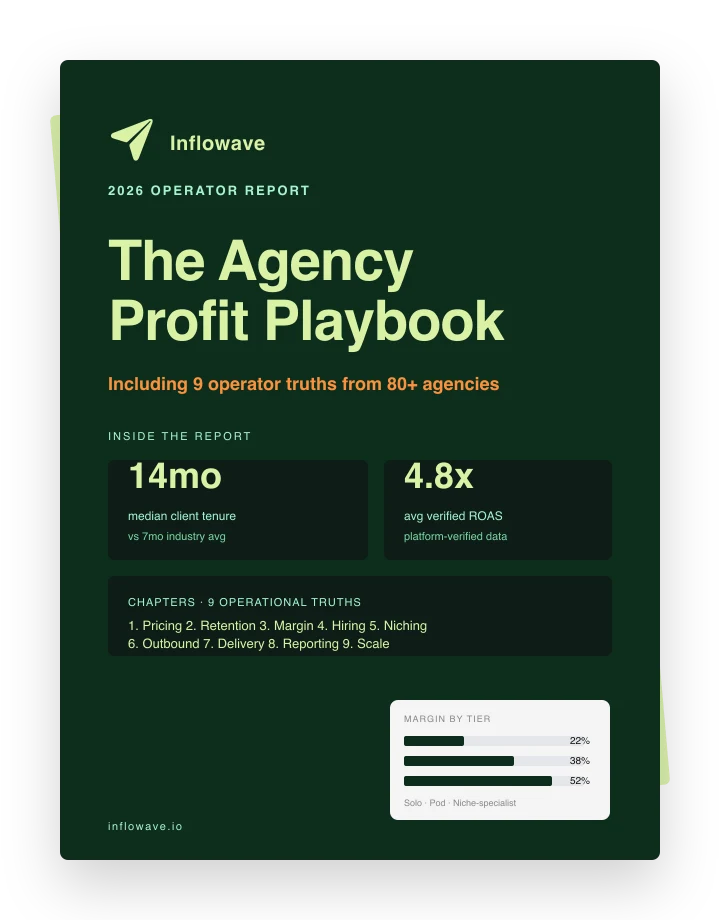
The Agency Profit Playbook Is In
How do 80+ agency operators rate their own pricing, retention, and margin? The Agency Profit Playbook has the benchmarks.