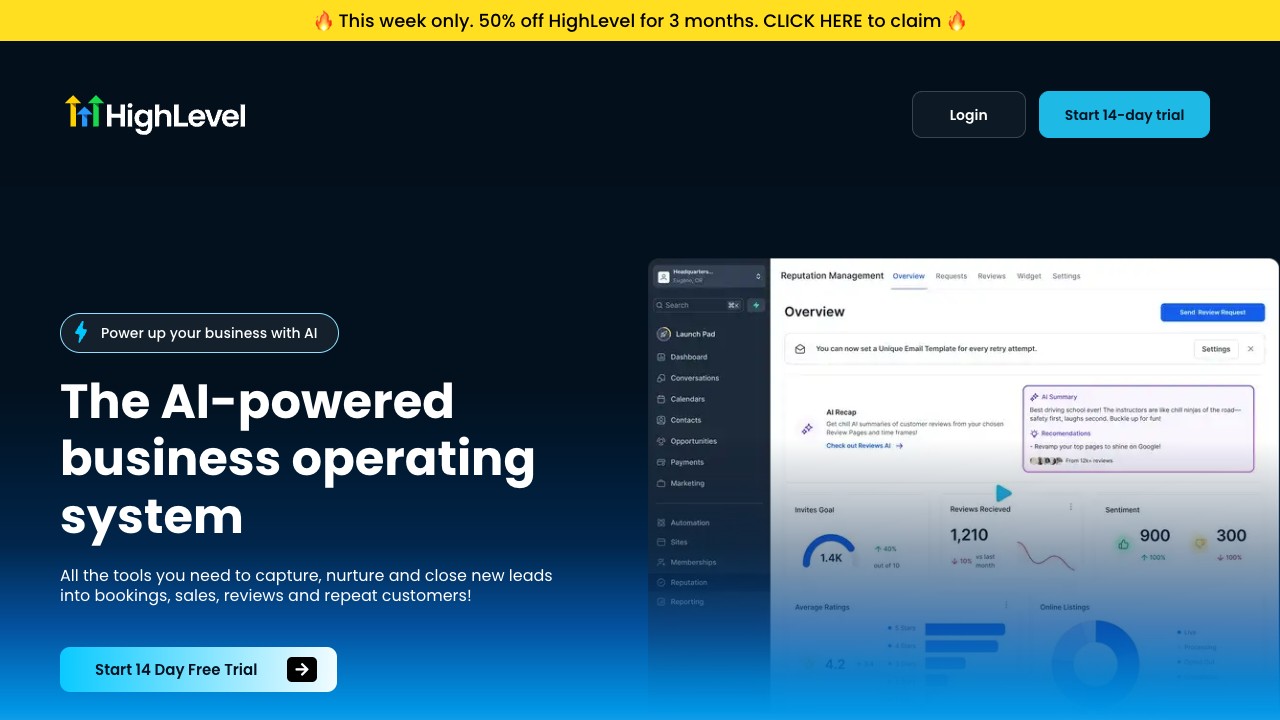
GoHighLevel collapsed an entire agency stack, CRM, email and SMS, funnels, calendars, automation, reputation management and white-label resale, into one login. For a lot of agencies that is exactly right. For others it is more platform than the problem needs.
Last reviewed: 15 September 2026. Every price below is dated 15 September 2026 and carries its billing basis. Where we could not read a figure from the vendor's own live pricing page, the section says so and names the source we did use.
Disclosure and method
Inflowave is our product. It is in this guide because it competes for the same use case as GoHighLevel, and omitting it would be its own dishonesty. Read our section on it as an interested party's account and check the claims. We take no payment for placement, and every competitor's own pricing page is linked above. Two figures do not come from a pricing page, and both say so where they appear: Pipedrive's $14 and Ontraport's SMS-number and rollback fees.
What we tested. We build and use Inflowave daily, and we have hands-on administrative experience with GoHighLevel, including sub-account setup, snapshots, workflows and the add-on billing screens. That is where the cost figures come from.
What is documentation-only. Every other tool here is assessed from its own pricing and feature documentation. We have not run an agency inside them. Where we describe how something feels to use, it is reported, not measured.
What we dropped. Third-party review scores for the tools we compare, and website-detection counts, are gone from this version. The one exception is our own Trustpilot score, which is linked to its profile so you can check it. We could not re-verify them on 15 September 2026, and a number you cannot re-check is a number you cannot use.
Criteria, weighted in order: footprint replaced; multi-client support under one login; resale under your own brand; total cost at realistic usage rather than entry price; and channel depth, especially social and messaging.
Pricing rules. Annual-commitment prices are labelled annual and promotional prices are labelled promotional. Where a vendor renders prices only inside a configurator and showed us nothing, we say so instead of repeating a third-party estimate.
The comparison at a glance
| Tool | Best for | Starting price (15 Sep 2026) | Client sub-accounts | White-label | CRM | Automation | Funnels |
|---|---|---|---|---|---|---|---|
| GoHighLevel (baseline) | Broad agency platform, resale | $97/mo, 3 sub-accounts | Yes | Branding on lower tiers; SaaS resale on $497 | Yes | Deep | Strong |
| Inflowave | Instagram and social-first agencies | $27/mo; $297/mo for client workspaces | 10 on Pro, 50 on Max | Branding on Max, $497 | Yes | Visual builder | AI site and funnel builder |
| HubSpot | Scaling B2B and content teams | Free for 2 users; $20/seat/mo monthly, $7 annual | No | No | Deep | Deep | Landing pages only |
| Keap | One small service business | $299/mo monthly; $2,988/yr annual | No | No | Yes | Yes | Landing pages only |
| Close | Outbound calling teams | $19/user/mo monthly; $9 annual | No | No | Call-first | Sequences | No |
| Vendasta | Local white-label resellers | $99/mo platform fee, offset by product spend | Yes | From Professional | Yes | Limited | Basic |
| ActiveCampaign | Email and automation depth | By contact volume, quoted annually | No | No | Add-on | Deep | No |
| Ontraport | Rules-heavy automation, membership | Configurator, no fixed tier price | No | Partial branding | Yes | Deep | Pages, membership |
| Kartra | Course and funnel creators | $59/mo monthly; $52 annual | No | No | Light | Yes | Yes |
| Pipedrive | Simple sales pipelines | From $14/seat/mo annual | No | No | Pipeline-first | Light | No |
| Zoho One | Whole-company software | $90/user/mo annual (Flexible User) | Portals only | Partial | Yes | Yes | Basic |
| Systeme.io | Budget all-in-one | Free; $17/mo Startup | Unlimited, every plan | On request | Light | Light | Yes |
| ClickFunnels | Funnel-led selling | $97/mo monthly; $81 annual | Workspaces, 1 to 20 | No | Pipelines | Yes | Best-known |
| Kajabi | Coaches and course businesses | $179/mo monthly; $143 annual | No | Branded app, higher tiers | Light | Yes | Yes |
| SuiteDash | Client portals and delivery | $19/mo monthly; $180/yr annual | Unlimited portals | Yes, every tier | Yes | Yes | No |
| DashClicks | White-label resale with fulfilment | $199/mo monthly; $1,788/yr annual | Unlimited | Yes | Yes | Yes | Yes |
Verify for yourself: GoHighLevel, HubSpot, Keap, Close, Vendasta, ActiveCampaign, Ontraport, Kartra, Pipedrive, Zoho One, Systeme.io, ClickFunnels, Kajabi, SuiteDash, DashClicks, Inflowave.
Why agencies go looking
- Onboarding drag. GoHighLevel can do almost anything, which means it asks a lot before it does anything well. That is a reason to buy something narrower, not something cheaper.
- Deliverability maintenance. Warmup, domain authentication and reputation monitoring all fall on you. See our guide to GoHighLevel email deliverability issues.
- Social and DM gaps. GoHighLevel pulls Instagram and Facebook into its inbox but was not built social-first, so if most of your pipeline starts in DMs you feel the seams. We set out why in why GoHighLevel was not built for Instagram.
- Cost at your configuration. The entry plan is $97. What you pay depends almost entirely on which add-ons you enable and for how many clients. We work three versions of that below rather than one.
- Support depth. The deeper your configuration goes, the more of it you own: snapshots, workflow logic and add-on billing are yours to debug. We have not measured response times or support quality, so we will not characterise them.
For the platform itself, read our honest GoHighLevel review.
What GoHighLevel actually costs: three scenarios
The previous version of this one built a single maximal GoHighLevel configuration, called it the real bill, and set it against a competitor's flat subscription. The arithmetic was right. The framing was not, because the maximal configuration is one option among several, and on the $497 tier several of those add-ons can be rebilled to clients at a markup, which can make them revenue rather than cost.
The published price list. Core plans are $97 for 3 sub-accounts, $297 for unlimited sub-accounts with rebilling at cost, and $497 for SaaS mode with markup rebilling. Add-ons: AI Employee at $97 per month per location on the unlimited tier or $50 on growth; WhatsApp $10 per month per sub-account; the Branded Client Portal App $49 per month per enabled sub-account; the Whitelabel Mobile App $497 per month, a different product from the client portal app; Listings $30 per month per sub-account; SEO $79 per month per sub-account; HIPAA $297 per month; dedicated sending IP $59 per month per IP; email $0.675 per 1,000 sends. SMS and voice bill as carrier usage and vary by country and volume.
Scenario one, core agency. $297 for unlimited sub-accounts, or $497 to resell at a markup, plus actual usage. An agency sending 20,000 emails a month pays about $13.50 for them. Realistically that is roughly $310 to $400 on the $297 tier, or $510 to $600 on the $497 tier. At that number the platform is good value for the footprint. We have no data on how many agencies actually run this configuration, so treat it as one worked example rather than the typical bill.
Scenario two, ten clients with AI on all ten. The $497 tier plus AI Employee on ten locations is ten times $97, or $970, taking you to $1,467 before usage. At the $50 AI Employee rate it is $500, taking you to $997. Those $50 and $97 figures are the per-sub-account price of one add-on, not agency plan tiers. The point is not that GoHighLevel is expensive; it is that AI is priced per client, so the line scales with client count rather than revenue per client. If you charge well per client that is fine. On a high-volume, low-ticket book it is the line that hurts.
Scenario three, fully loaded on ten clients.
| Line item | Calculation | Monthly |
|---|---|---|
| Agency Pro plan | Flat | $497 |
| AI Employee, unlimited tier | 10 at $97 | $970 |
| 10 at $10 | $100 | |
| Branded Client Portal App | 10 at $49 | $490 |
| Whitelabel Mobile App | Flat | $497 |
| Listings | 10 at $30 | $300 |
| SEO | 3 at $79 | $237 |
| Dedicated sending IP | 1 at $59 | $59 |
| Subtotal before usage | $3,150 | |
| HIPAA, if you have a healthcare client | Flat | $297 |
A real $3,150, or $3,447 with HIPAA, before a single message. It is also the ceiling rather than a default, and listings, SEO and the client portal app can each be rebilled at a markup on the $497 tier, so treating the whole figure as expense misrepresents how the money moves.
The same functional scenario on Inflowave. Ten client workspaces with AI agents on all of them sits on Inflowave Pro at $297 a month: 10 client workspaces, 10 connected social accounts, 10,000 contacts, 5 team seats. All ten workspaces are included in that flat price, and AI agents come in from the $149 Business plan rather than being billed per client. More than ten workspaces, uncapped contacts, uncapped seats or your own branding on the client-facing side means Max at $497, which carries 50 workspaces. Full Inflowave pricing.
Then add what is genuinely outside the subscription, because pretending otherwise is the same trick in reverse. SMS and voice on Inflowave are third-party pass-through: carrier rates for messages, for power dialler minutes and for the numbers themselves, with WhatsApp billed under Meta's own conversation pricing. Those costs scale with volume on both platforms and are broadly comparable, because both resell the same carriers.
Where it stops being like-for-like. Scenario three buys things Inflowave does not sell: no equivalent of the $497 Whitelabel Mobile App, no HIPAA add-on at a published price, no listings product priced per location. If those lines are why you are on GoHighLevel, stay. The fair reading is narrower than "GoHighLevel is expensive": GoHighLevel prices AI and client-facing extras per client, Inflowave prices them into the plan, so the gap widens with client count and disappears when client count is small.
The alternatives, reviewed
1. Inflowave, best for Instagram and social-first agencies
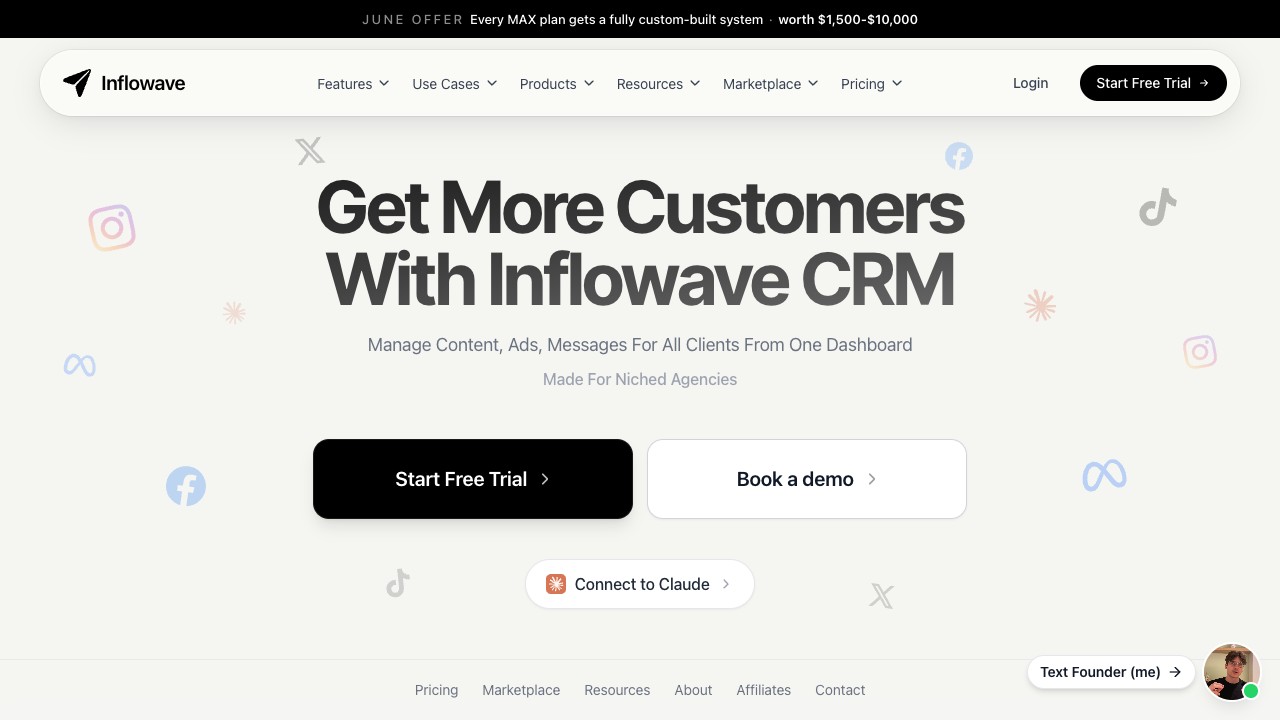
Best for: agencies whose pipeline starts in Instagram DMs, comments and stories.
Pricing (15 Sep 2026): Influencer $27, Business $149, Pro $297, Max $497 per month, billed monthly, plus custom Enterprise. Connected social accounts and client workspaces: 1, 1, 10, 50. Team seats: 1, 1, 5, uncapped on Max. Contact allowances differ by plan and are listed in full on the pricing page. Seven-day free trial on every paid plan, Influencer included.
What it replaces: unified inbox across Instagram, Facebook, WhatsApp, SMS, email and voice; CRM pipelines; visual workflow automation; AI agents trained on the agency's own DM history; Meta ads management; power dialler with recording and transcription; AI website and funnel builder; booking calendars; link-in-bio; competitor intelligence.
Beats GoHighLevel on: the social layer is the product rather than an inbox bolted to a CRM, and it runs on the official Instagram Graph API as a Meta Business Partner rather than browser automation. AI agents are in the plan rather than priced per client, which is the line that scales with client count on GoHighLevel.
GoHighLevel beats it on: breadth. No listings management, no HIPAA option, no separately sold white-label mobile app, no reputation module, and GoHighLevel's funnel builder and snapshot library are more mature.
White-label and sub-accounts: client workspaces are capped, not unlimited: 10 on Pro at $297 and 50 on Max at $497, which is $29.70 and $9.94 per workspace at full use. Beyond 50 is an Enterprise conversation. The branding layer sits a tier above the workspaces: custom domain, your logo and branded client-facing email are on Max at $497. Pro at $297 gives you ten isolated client workspaces, but your client still sees Inflowave. If reselling under your own brand is the reason you are shopping, budget $497, not $297.
Proof you can check: our Trustpilot rating is 4.3 from 9 reviews. That is a small sample and we will not describe it as anything else.
2. HubSpot, best for scaling B2B and content teams
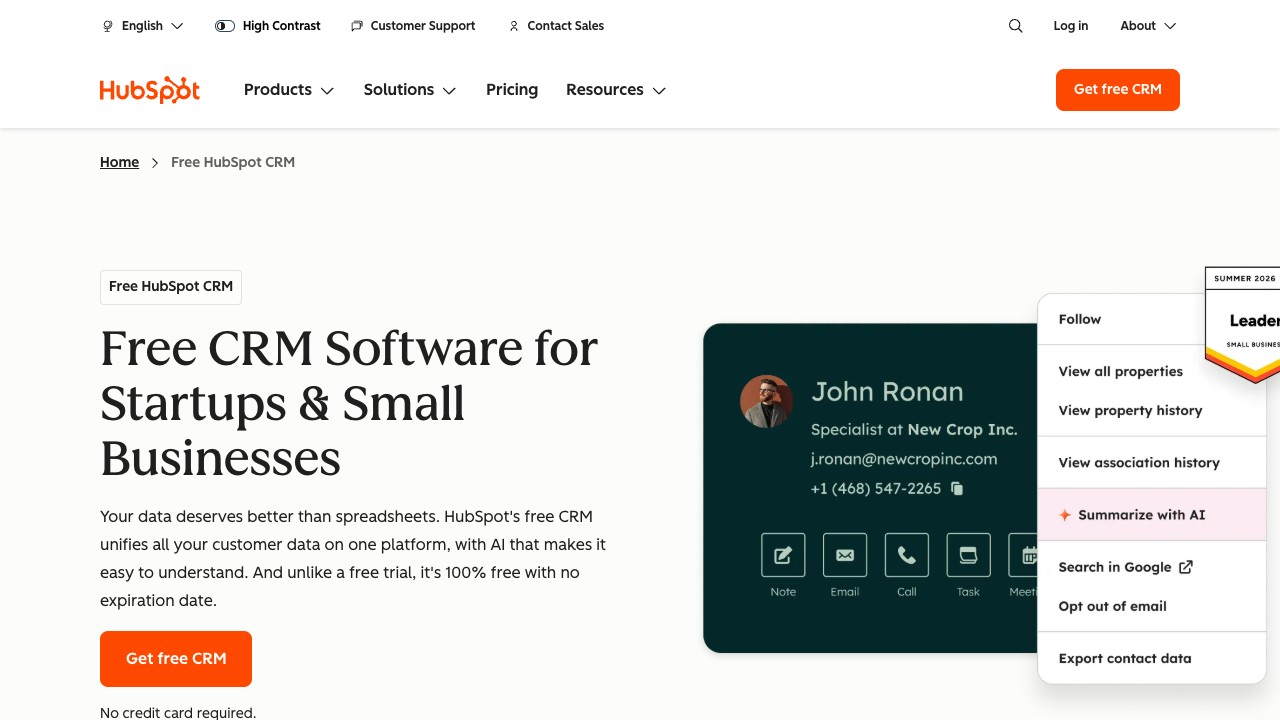
Best for: content-led B2B teams that need attribution and reporting more than resale.
Pricing (15 Sep 2026): free CRM for up to 2 users. Marketing Hub Starter is listed at $20 per seat per month on monthly billing, or $7 per seat per month on annual commitment, including 1,000 marketing contacts. Professional is listed at $890 per month on monthly billing and $800 per month on annual commitment, plus a one-time $3,000 onboarding fee, 3 core seats and 2,000 contacts. Enterprise starts at $3,600 per month plus a one-time $7,000 onboarding fee.
What it replaces: CRM, marketing automation, email, landing pages, forms and reporting. Not funnels in the ClickFunnels sense, and not SMS.
Beats GoHighLevel on: reporting and attribution depth, data-model rigour, integration ecosystem, and being the platform an enterprise client already recognises.
GoHighLevel beats it on: price at agency scale, resale, funnels, SMS and voice, and giving every client their own environment. HubSpot's onboarding fees alone exceed a year of GoHighLevel.
White-label and sub-accounts: neither. One HubSpot-branded portal. Agencies run client portals as separate subscriptions, which is a cost, not a resale model.
3. Keap, best for one small service business
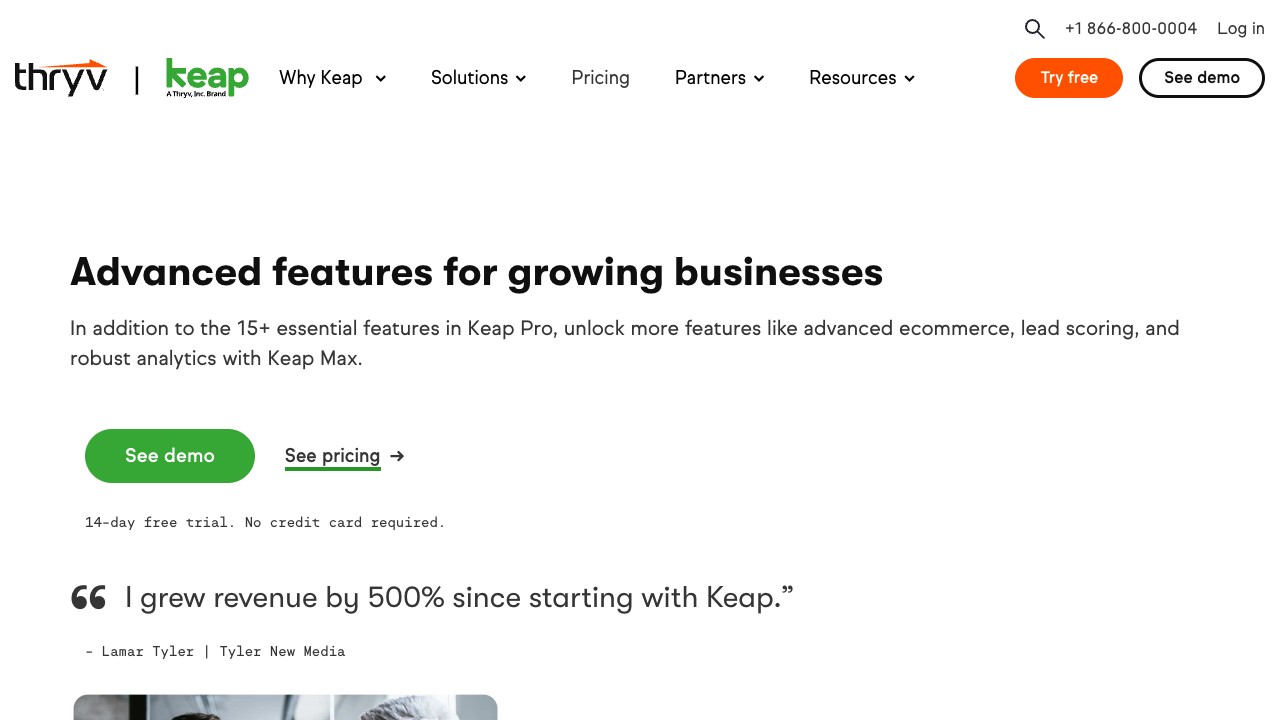
Best for: a single established local or professional-services business, not an agency running many.
Pricing (15 Sep 2026): from $299 per month on monthly billing, or $2,988 per year on annual billing, which is $249 per month. Two user licences included, extra users $39 per month. Contact volume tiers the price upward, and paid implementation is required and quoted separately.
What it replaces: CRM, email and SMS, simple pipelines, appointments, and quote-to-invoice with payments. The invoicing is the differentiated part and is better than GoHighLevel's.
Beats GoHighLevel on: narrowness. Fewer decisions to make, and the sale-to-invoice-to-payment path is first-class rather than an afterthought. There is far less to configure before it does useful work, though we have not run both onboardings side by side.
GoHighLevel beats it on: cost per client for anyone running more than one business, funnels, and the whole agency model. Keap's required paid implementation is a barrier GoHighLevel does not impose.
White-label and sub-accounts: neither. Single-tenant and Keap-branded. If you are here because you run client accounts, Keap is not the answer.
4. Close, best for outbound calling teams
Best for: teams whose day is calls and follow-up, where rep productivity beats marketing assets.
Pricing (15 Sep 2026): Solo $19 per user per month monthly or $9 annual; Essentials $49 monthly or $35 annual; Growth $109 monthly or $99 annual; Scale $149 monthly or $139 annual. Calling and SMS bill as usage on top, and each tier includes an AI credit allocation.
What it replaces: the CRM and outbound sequencing layer, and nothing else. No funnels, sites or reputation tools.
Beats GoHighLevel on: the calling experience. Power dialling, recording and email and SMS sequencing are built around the rep rather than the campaign, and the interface gets out of the way.
GoHighLevel beats it on: everything outside the CRM. You will buy other tools alongside it, which is the position agencies leave GoHighLevel to escape.
White-label and sub-accounts: neither. One Close-branded workspace per subscription.
5. Vendasta, best for local white-label resellers
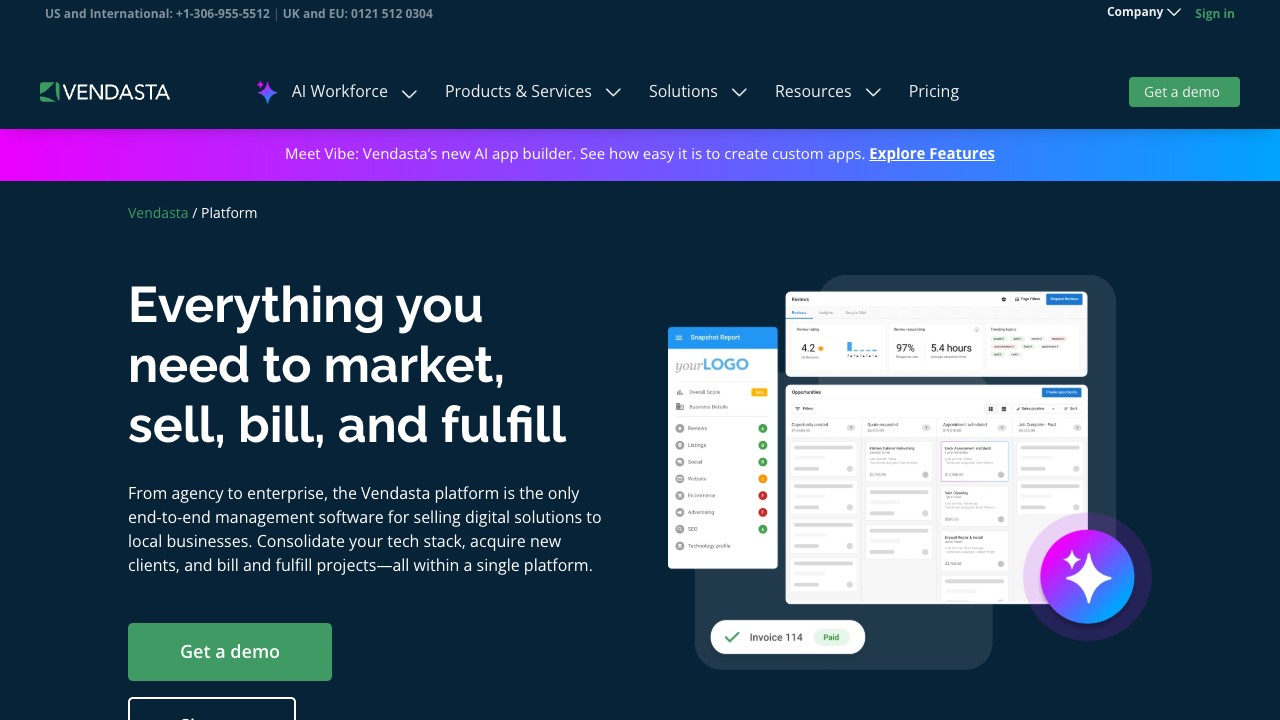
Best for: agencies whose business model is packaging and reselling software and services to local businesses.
Pricing (15 Sep 2026): an unusual model. Starter carries a $99 per month platform fee, charged at signing to cover your first month, no contract, 1 seat. Professional is $499 per month, one-year contract, 5 seats. Premium is $999 per month, one-year contract, 10 seats. Enterprise is quoted. From month two the fee is offset dollar-for-dollar by qualifying product spend, in Vendasta's own wording each $1 spent on select products is $1 off your subscription fee, so the fee reaches zero only when product spend covers it in full.
What it replaces: a marketplace of resellable products, a client-facing business app, reputation and listings management, and white-label fulfilment. Closer to a distribution channel than a CRM.
Beats GoHighLevel on: marketplace and fulfilment depth. To sell listings, review management or SEO to a local plumber without building delivery yourself, Vendasta is built for that and GoHighLevel is not.
GoHighLevel beats it on: hands-on automation building, funnels and cost of entry. Vendasta's platform fees and one-year contracts on the useful tiers are a commitment, and the platform is heavier to learn.
White-label and sub-accounts: full white-label from Professional, co-branding only on Starter. Multi-client management is the core of the product. More in our Vendasta alternatives guide.
6. ActiveCampaign, best for email and automation depth
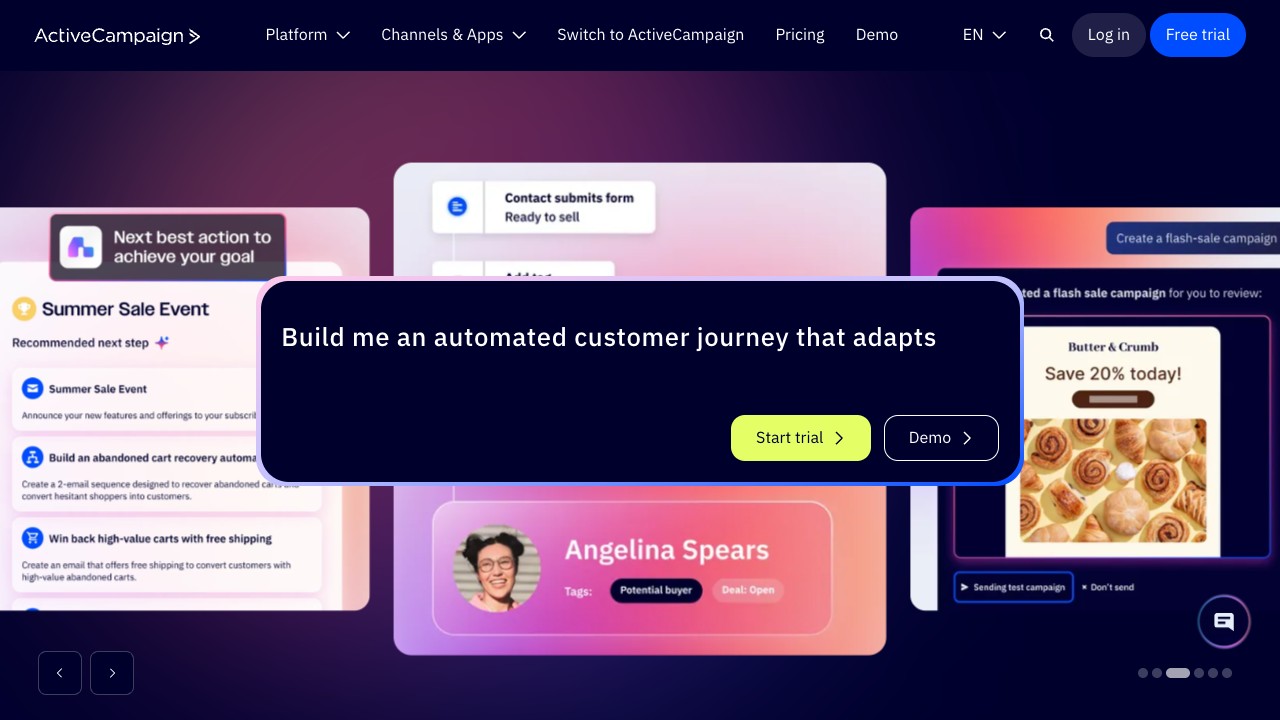
Best for: teams for whom the email and automation slice of GoHighLevel was the only part that mattered.
Pricing (15 Sep 2026): priced by contact volume across Starter, Plus, Pro and Enterprise, with the page stating that quoted prices are billed annually. Straight with you: on the date checked the plan cards rendered prices only inside the configurator and showed us no figures at all, so we are not repeating a number from a third-party blog. Run the configurator with your own contact count. CRM, SMS and transactional email are separately priced add-ons rather than included.
What it replaces: email marketing, marketing automation and, with the add-on, a sales CRM. Not funnels, sites, calendars or anything agency-facing.
Beats GoHighLevel on: the automation builder handles branching, conditional logic and behavioural triggers more gracefully, and segmentation is more expressive.
GoHighLevel beats it on: being one platform rather than a base plus three add-ons, and covering funnels, calendars, sites and resale. ActiveCampaign's price also climbs steeply with list size, and crossing a contact band re-prices the whole plan rather than just the extra contacts.
White-label and sub-accounts: neither. There is an agency partner programme, but the product your client logs into is ActiveCampaign.
7. Ontraport, best for rules-heavy automation and membership sites
Best for: businesses running complex campaign logic and membership or content-gated offers.
Pricing (15 Sep 2026): Ontraport uses a build-your-plan configurator and publishes no fixed price per named tier. We could not read a starting figure on the date checked, so we are not quoting one. The pricing page itself states month-to-month with no long-term contract, a 14-day trial with no card required, and a full refund if you cancel within 30 days. The following come from Ontraport's own support documentation rather than that pricing page: the first SMS number free on Plus, Pro and Enterprise with additional numbers at $5 per month in most countries, account rollbacks at $50, and two months free when add-ons are billed yearly. Exceeding a contact limit auto-upgrades you a level.
What it replaces: CRM, marketing automation, landing pages, membership sites, ecommerce and payments, plus a dynamic content system. Genuinely broad, and closer to GoHighLevel's footprint than most tools here.
Beats GoHighLevel on: complex rule sets, ecommerce offer structures, and membership and dynamic-content depth.
GoHighLevel beats it on: a more modern interface, a far larger template and community ecosystem, and published pricing. An unpublished price is a real disadvantage when modelling cost per client.
White-label and sub-accounts: partial. You can brand client-facing assets and portals, but you cannot resell the platform as your own, and there is no sub-account structure.
8. Kartra, best for course and funnel creators
Best for: a solo expert or small team selling their own programmes rather than servicing clients.
Pricing (15 Sep 2026): Essentials $59 monthly or $52 annual, 500 contacts. Starter $119 monthly or $99 annual, 2,500 contacts. Growth $229 monthly or $189 annual, 12,500 contacts. Professional $549 monthly or $429 annual, 25,000 contacts. Annual saves up to 22 percent. Email and SMS are unlimited except on Essentials, capped at 10,000 per month.
What it replaces: funnels, checkout, email, membership sites, video hosting, calendars and a light CRM.
Beats GoHighLevel on: selling your own digital products. Checkout, order bumps, upsells, affiliate management and course delivery are first-class here and comparatively thin in GoHighLevel.
GoHighLevel beats it on: everything agency-shaped. No client separation, no resale, weaker CRM, and per-contact pricing that punishes list growth where GoHighLevel's plans are flat.
White-label and sub-accounts: neither. A single-business platform.
9. Pipedrive, best for simple sales pipelines
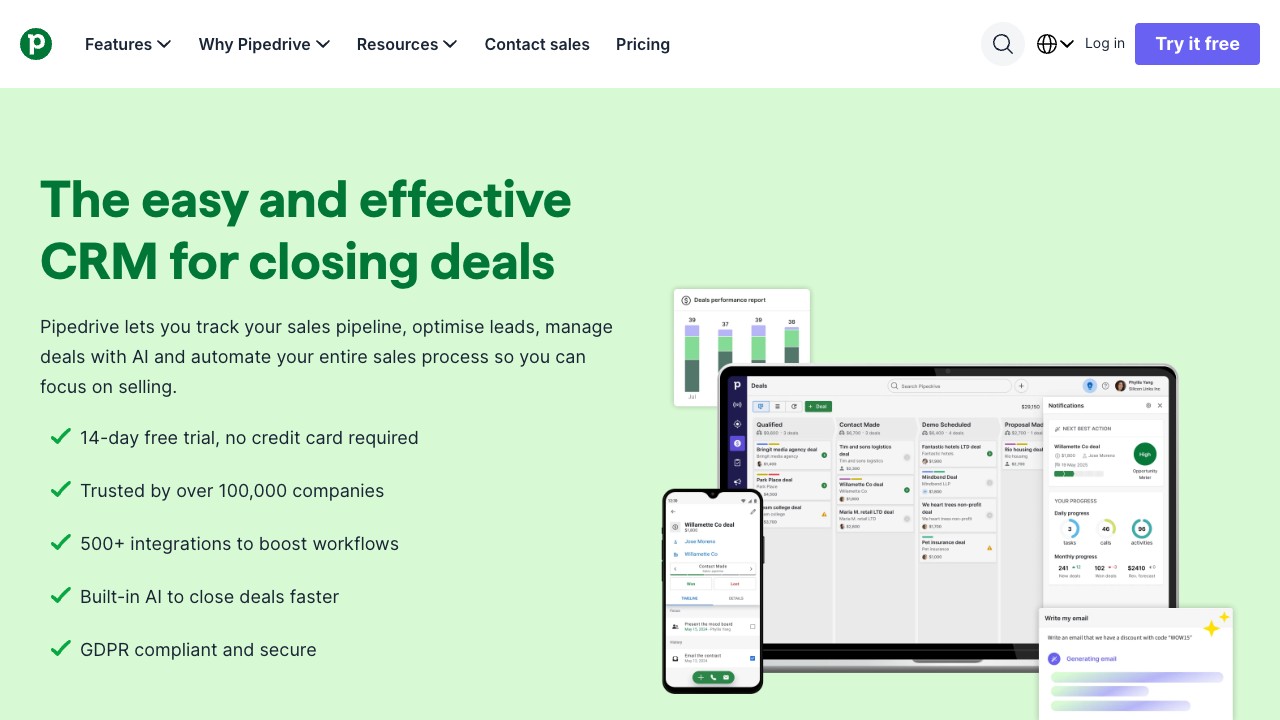
Best for: a small sales team that needs deals to move cleanly through stages and nothing more.
Pricing (15 Sep 2026): four tiers, Lite, Growth, Premium and Ultimate. Pipedrive's own comparison page states a range of $14 to $79 per seat per month on annual billing, with the minimum paid plan at $14. Its live price table blocked our automated read on the date checked, so treat that as coming from Pipedrive's comparison page rather than its price table, and confirm the figure for your currency and region. You are charged per seat whether or not it is assigned, and prices exclude VAT.
What it replaces: the CRM and pipeline layer, and nothing else. Email, automation and projects exist but are light, and several capabilities are paid add-ons.
Beats GoHighLevel on: clarity. A new salesperson understands Pipedrive in an afternoon, and the pipeline view is the best pure deal-management interface here.
GoHighLevel beats it on: the entire marketing half of the business, plus client separation and resale. Pipedrive is a component, not a replacement.
White-label and sub-accounts: neither. One Pipedrive-branded company account.
10. Zoho One, best value for whole-company software
Best for: operationally minded teams willing to trade setup time for breadth per dollar.
Pricing (15 Sep 2026): the Flexible User plan is listed at $90 per user per month on annual licensing. The All Employee plan requires a licence for every employee on payroll and its price is not disclosed on the pricing page; Zoho directs you to sales. Prices exclude VAT. We are not quoting an All Employee figure because the vendor does not publish one.
What it replaces: an enormous amount. CRM, campaigns, email, forms, books, desk, projects, sign and dozens more applications under one licence. On coverage alone nothing else here is close.
Beats GoHighLevel on: breadth, including back-office functions GoHighLevel does not attempt at all, such as accounting, helpdesk and HR.
GoHighLevel beats it on: cohesion and speed to value. Zoho One is a suite of applications that integrate rather than one product, and configuring it well takes real time. GoHighLevel also wins on funnels and per-client cost, because per-user licensing does not map onto reselling to clients.
White-label and sub-accounts: partial. Client portals can be branded; the platform cannot be resold as yours, and there is no sub-account model.
11. Systeme.io, best budget all-in-one
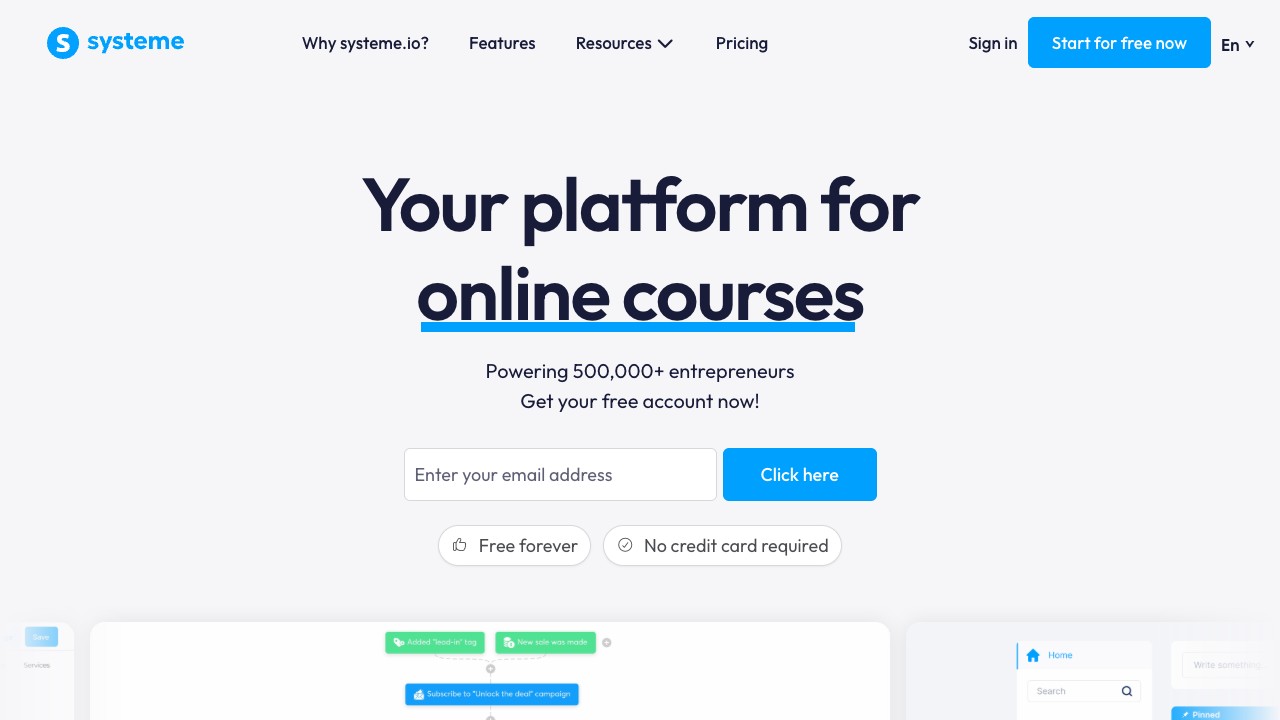
Best for: a solo creator or brand-new agency replacing three or four subscriptions on a tight budget.
Pricing (15 Sep 2026): Free with 2,000 contacts, 3 funnels, 1 blog and 1 course, no card required. Startup $17 per month, 5,000 contacts. Webinar $47, 10,000 contacts, adds automated webinar funnels. Unlimited $97, unlimited contacts. Annual billing gives two months free, and email sends, file storage and transaction fees are unlimited, unlimited and zero across tiers.
What it replaces: funnels, email, courses, a blog, affiliate management and basic automation. The free plan is genuinely usable rather than a trial in disguise, which is rare.
Beats GoHighLevel on: cost and simplicity. You can launch a funnel and an email sequence in an afternoon with no consultant and no snapshot.
GoHighLevel beats it on: depth everywhere. Reporting, CRM, calendars, SMS, voice, reputation and integrations are absent or minimal, and while the sub-account structure is there, the agency tooling around it, snapshots, rebilling and resale, is not. Systeme.io has a ceiling and you will reach it.
White-label and sub-accounts: sub-accounts yes, white-label on request. Systeme.io's pricing page states that every plan, including Free, allows unlimited sub-accounts, and that each one is a fully fledged systeme.io account with its own full set of limits. That is a real multi-client structure at a price nothing else here matches. White-label and resell are not published as a plan feature; the pricing page directs agencies wanting them to contact the team, so treat the terms as unquoted. See our Systeme.io alternatives guide if the funnel layer is what you are shopping for.
12. ClickFunnels, best for funnel-led selling
Best for: offer-led businesses and agencies whose revenue comes from a small number of high-performing funnels.
Pricing (15 Sep 2026): Launch $97 per month monthly or $81 annual, 1 workspace, 2 team members, 10,000 email contacts, 5 custom domains. Scale $197 monthly or $164 annual, 5 workspaces, 75,000 contacts, unlimited domains. Optimize $297 monthly or $248 annual, 10 workspaces, 150,000 contacts. Dominate is $5,997 per year, annual only, 20 workspaces, 400,000 contacts. Funnels are unlimited on every tier.
What it replaces: funnels, checkout, courses, email marketing and CRM pipelines. That last item matters: ClickFunnels is no longer just a funnel and checkout product. It markets its own CRM and email marketing, with pipeline and contact capacity tiered by plan. Any guide still calling it a page builder is out of date, including the previous version of this one.
Beats GoHighLevel on: the funnel builder and everything around conversion. Order bumps, upsell flows, split testing and the template ecosystem are the reference implementation in this category.
GoHighLevel beats it on: SMS and voice, calendars, reputation management, automation depth and resale.
White-label and sub-accounts: workspaces run from 1 to 20 by tier and give multi-brand separation, but there is no white-label resale. Your client sees ClickFunnels.
13. Kajabi, best for coaches and course businesses
Best for: experts selling knowledge products who want the whole business in one place and do not service clients.
Pricing (15 Sep 2026): Basic $179 per month monthly or $143 annual, 2,500 contacts, 5 products, 2 admin users, 1 website. Growth $249 monthly or $199 annual, 25,000 contacts, 50 products, 11 admin users. Pro $499 monthly or $399 annual, 100,000 contacts, unlimited products, 26 admin users, 3 websites and 3 communities. Marketing emails are unlimited on every tier.
What it replaces: course hosting and delivery, community, website, funnels, checkout, email marketing, automation and light contact management. Within its lane it is the most complete product here.
Beats GoHighLevel on: the student and member experience. Course delivery, communities and the polish of the customer-facing side are well ahead of anything GoHighLevel offers, and Kajabi treats the product rather than the lead as the centre of the system.
GoHighLevel beats it on: cost, CRM depth, SMS and voice, multi-client management and resale.
White-label and sub-accounts: no sub-accounts and no resale. Branded app experiences exist on higher tiers, but the platform is Kajabi's. See our Kajabi alternatives guide if you need the follow-up layer rather than the course player.
14. SuiteDash, best for client portals and delivery
Best for: service businesses and agencies whose problem is delivering and documenting work, not generating leads.
Pricing (15 Sep 2026): Start $19 per month monthly or $180 per year, 100GB storage. Thrive $49 monthly or $480 per year, 500GB. Pinnacle $99 monthly or $960 per year, 2TB. Pricing is per account rather than per user, so staff seats are unlimited on every tier, and client portals are unlimited on every tier. Fourteen-day full-featured trial, no card.
What it replaces: client portals, project and task management, file exchange, invoicing and payments, CRM, scheduling, e-signature and light automation. It replaces the delivery half of an agency rather than the acquisition half.
Beats GoHighLevel on: white-labelling and per-client economics. Full white-labelling including a custom-branded mobile app is on every tier, including the $19 one, where GoHighLevel puts SaaS mode on $497 and charges $49 per enabled sub-account for its client portal app. Unlimited portals at a flat price is a different cost curve entirely.
GoHighLevel beats it on: marketing. No funnels, no SMS and voice campaigns, no reputation management, no ads, and much shallower automation. SuiteDash sits alongside a marketing platform rather than replacing one.
White-label and sub-accounts: unlimited client portals with full white-label on every tier.
15. DashClicks, best for white-label resale with fulfilment
Best for: agencies that want GoHighLevel's resale model plus somewhere to send work they do not want to do in-house.
Pricing (15 Sep 2026): DashClicks Pro is $199 per month, or $1,788 per year on annual billing, a 25 percent saving. That one price includes unlimited users and unlimited sub-accounts with the full application set: funnels, websites, CRM, projects, reviews, deals, reporting, InstaSites, inbox, insights, forms, inbound, payments and templates. Cancellation is self-service and fulfilment services are separate, pay-per-use.
What it replaces: most of GoHighLevel's agency footprint, plus a white-label fulfilment marketplace for Meta ads, Google ads, TikTok ads, SEO, content and backlinks.
Beats GoHighLevel on: price for the same shape. GoHighLevel also gives unlimited sub-accounts from $297, but DashClicks bundles unlimited users and resale into a single $199 plan, where GoHighLevel puts SaaS mode and markup rebilling on $497. The fulfilment marketplace turns a capacity constraint into a purchasing decision.
GoHighLevel beats it on: automation depth, the third-party integration surface, and a substantially larger snapshot and template library.
White-label and sub-accounts: unlimited sub-accounts and white-label on the single plan. Our DashClicks alternatives guide covers the fulfilment trade-off.
16. MessageMind, best for AI-led sales and support conversations
Best for: teams whose bottleneck is the quality of the conversation itself rather than the number of modules around it.
Pricing (16 Sep 2026): Starter EUR 69 per month, or EUR 58 per month billed yearly, covering 2 channels, 3,000 credits and 2 team members. Professional EUR 199 per month with 4 channels and 10,000 credits. Enterprise EUR 449 per month. Fourteen-day trial.
What it replaces: the shared inbox, the chatbot layer and the first line of customer support across whichever channels you connect.
Beats GoHighLevel on: the AI itself, which is the reason most of their customers move across, plus 24/7 support and a willingness to build custom features and integrations for individual accounts.
Weaker than GoHighLevel on: breadth. It is a deliberately narrower product, so the funnel builder, membership sites and the wider snapshot ecosystem are not there.
Verdict: worth a look if you have already decided the AI layer is what you are buying. MessageMind publishes its own GoHighLevel comparison if you want their side of the argument.
What GoHighLevel still does better
- End-to-end breadth. Very few tools genuinely replace CRM, email, SMS, voice, funnels, sites, calendars, automation, reputation and resale in one login. Here, only DashClicks comes close on footprint, and only Vendasta, DashClicks, SuiteDash and Inflowave compete on resale at all.
- White-label economics. Rebranding the platform and reselling it turns a subscription into a product with a margin. That is a business model, not a feature.
- Templates and community. The snapshot and tutorial ecosystem is larger than those around the other tools here. We have not counted templates across every platform, so read that as directional rather than measured.
- Funnel and site building. More capable than the CRM-first alternatives here, with the exception of ClickFunnels.
If three or more of those describe why you bought GoHighLevel, the honest recommendation is to fix your setup rather than leave. "I need an alternative" is sometimes really "I need one more thing to work", which is a configuration job, not a migration.
Migrating without losing data
- Export contacts and pipelines first. Pull a full CSV of contacts, tags, custom fields and opportunities while your account is still active and in good standing.
- Inventory your automations. Screenshot every workflow. Automations do not transfer between platforms, so document triggers, conditions and actions.
- Rebuild sending reputation. Authenticate your domain with SPF, DKIM and DMARC on the new platform and warm up gradually. Skipping it means a cold domain sends your first campaign, which is what makes a migration look like a downgrade.
- Plan for messaging provisioning. Moving SMS and voice may require new or transferred provisioning: brand and campaign registration, number porting or new numbers, and carrier approval. Some of it transfers, some has to be re-filed, and timelines vary by country and carrier. Ask your new provider what applies to your setup before fixing a cutover date, rather than assuming either outcome.
- Recreate funnels and pages last. The most manual step. Prioritise the one or two that drive revenue.
- Run in parallel for two weeks. Keep GoHighLevel live until the new stack proves out on real traffic, then cancel.
We move sub-accounts, snapshots, workflows and contacts across for you before you pay for a month. See how the migration works.
Common mistakes
- Buying breadth you will not use. Another suite you use three modules of is the trap that made you leave.
- Comparing entry prices instead of your configuration. Model your real client count and real add-ons on both platforms, as in the three scenarios above. The answer changes completely between scenario one and scenario three.
- Forgetting resale. If reselling software is part of your revenue, most tools here disqualify themselves. Check that column before you shortlist.
- Ignoring deliverability. A cheaper sender you never warm up will hurt open rates more than the platform you left.
- Underestimating rebuild time. Funnels and automations are the slow part. Scope them before you cancel anything.
Frequently asked questions
What is the cheapest GoHighLevel alternative? Systeme.io's free plan, which includes 2,000 contacts and three funnels, then Systeme.io Startup at $17 per month or SuiteDash Start at $19. HubSpot's free CRM for up to two users is the cheapest start on the enterprise end.
What is the best GoHighLevel alternative for Instagram agencies? We would say Inflowave, and we build it, so weigh that accordingly. The substantive reasons: DM handling and AI qualification are native rather than an inbox integration, it runs on the official Instagram Graph API rather than browser automation, and AI agents are priced into the plan rather than per client, which is where GoHighLevel's bill moves with client count.
Which alternatives are genuinely white-label? Vendasta from its Professional tier, DashClicks at $199 and SuiteDash from $19 publish white-label as a plan feature. Inflowave publishes it on Max at $497 a month, which carries the custom domain, your logo and branded client-facing email; Pro at $297 gives ten client workspaces without that branding layer. Systeme.io does not publish white-label terms and directs agencies to contact its team. Ontraport and Zoho One offer partial client-facing branding but not platform resale. Nothing else here is white-label.
Is ClickFunnels still just a funnel builder? No. It now markets its own CRM pipelines and email marketing alongside funnels, courses and checkout, with pipeline and contact capacity tiered by plan. It is a fuller platform than its reputation suggests, though it still has no white-label resale.
Can I move my data off GoHighLevel easily? Contacts, tags, custom fields and pipelines export to CSV and import into most tools. Automations, funnels and sites have to be rebuilt. Messaging provisioning is the step people forget.
Is GoHighLevel worth it in 2026? For agencies that use its breadth and will invest in onboarding, yes. Scenario one shows a core-agency configuration landing at $310 to $400 a month rather than the four-figure numbers comparison articles like to quote. Which scenario you land in depends on your own add-ons and client count, so run all three. If you only used a slice of it, something narrower will be cheaper and calmer.
What is the best value for a multi-client agency? DashClicks at $199 per month for unlimited sub-accounts and unlimited users with white-label included is the lowest published cost per client here. Inflowave Pro at $297 for 10 workspaces, or Max at $497 for 50, is the better fit if your pipeline is social. GoHighLevel's own $297 tier carries unlimited sub-accounts, so on headline sub-account count it is the cheaper structure; what moves the comparison is the per-client add-ons, not the plan fee.
How long does switching take? A weekend for the data, a week or two of parallel running for automations and sending warmup, and longer if SMS or voice provisioning has to be re-filed.
Which one is right for you
Social-led pipeline goes to Inflowave. B2B and reporting-led goes to HubSpot. Reselling to local businesses goes to Vendasta or DashClicks. Client delivery and portals go to SuiteDash. Funnel-led selling goes to ClickFunnels. Courses and coaching go to Kajabi or Kartra. One small service business goes to Keap. Outbound calling goes to Close. Just needed better email goes to ActiveCampaign. Tight budget goes to Systeme.io. Whole-company software goes to Zoho One.
Start with the pain that sent you looking, shortlist two, and trial them for two weeks with your real data before cancelling anything. Run your own numbers on the three-scenario framework above, because the gap between scenario one and scenario three is larger than the gap between most of the platforms here.
The wider field is in the best CRM for marketing agencies, and if the system of record is what you are really replacing, that is Inflowave CRM.
Prices are dated 15 September 2026 and every vendor's own pricing page is linked above so you can verify them. Annual-billing prices are labelled annual. Two sections do not rest on the vendor's pricing page and say so in place: Pipedrive's price table blocked our automated read, so the $14 figure comes from Pipedrive's own comparison page, and Ontraport's SMS-number and rollback fees come from Ontraport's support documentation. Where a vendor publishes no fixed price, or its pricing page rendered no figures to us, we say so rather than substituting a third-party estimate. Vendors change prices without notice; confirm before you buy.
Explore More
- GoHighLevel Review - A balanced, hands-on GoHighLevel review for 2026
- GoHighLevel SMS and Usage Fees - What the usage lines actually add to the bill
- Feature: Sales Pipeline - Track every deal from first DM to closed
- Feature: Unified Inbox - Instagram, Facebook, WhatsApp, SMS, email and voice in one place
- Pricing - Plans built for Instagram businesses
Comparing something else?
- DashClicks alternatives - The white-label dashboard without the fulfilment marketplace.
- Vendasta alternatives - Reseller platforms compared on what they actually cost per client.
- ManyChat alternatives - When DM automation needs to feed a real pipeline.
- Respond.io alternatives - Omnichannel inboxes compared as conversation volume grows.
- Systeme.io alternatives - Funnel builders that also hold the lead record after the opt-in.
- Kajabi alternatives - For coaches who need the follow-up, not just the course player.
- Linktree alternatives - Link-in-bio tools that pass the click through to a CRM.
Already decided to leave GoHighLevel?
We move your sub-accounts, snapshots, workflows and contacts across for you, before you pay for a month. See how the migration works.