Vibe Marketing Playbook: Run Your Agency with Claude Code + Inflowave (2026)
Most "vibe marketing" content stops at the idea. This is the playbook: the exact stack to set up, the plays to run in order, and a 30-day rollout to get from "I have an AI subscription" to "one operator runs marketing for every client by talking to an agent."
If you want the background, read what vibe marketing is and the top 10 Claude Code skills for vibe marketing first. This page assumes you are sold on the why and want the how.
TL;DR: The Playbook in One Paragraph
Connect Claude Code to Inflowave over MCP so the agent can operate your real accounts. Then roll out one play at a time - start with reporting and inbox triage (low risk), prove it for a week, then layer in outreach, lead scoring, ad-creative iteration, and workflows. Keep a human approving anything customer-facing or money-spending. Measure every play. In 30 days you go from clicking through dashboards to directing an agent that runs the mechanical 80% of the work.
Before You Start: The Stack
You need three things, and only three:
- A brain - Claude Code (Anthropic's agentic terminal/IDE tool) or the Claude desktop app. This is what you talk to.
- An operating layer - Inflowave, connected to Claude over the Model Context Protocol (MCP). This is what gives the agent authenticated, permission-scoped access to every client's conversations, email, SMS, leads, ad creative, workflows, and reporting.
- Guardrails - a clear policy of what the agent does on its own vs. what needs your approval. Write this down before you turn anything on.
That is the whole stack. Everything below is what you do with it.
The 10 Plays (Run Them In This Order)
Each play has a trigger (when to run it), the move (what you tell the agent), a guardrail, and the outcome. The order is deliberate: lowest-risk, highest-trust-building first.
Play 1 - Connect and Map
Move: "Connect to my Inflowave account and show me every client, account, and capability you can see."
Guardrail: read-only on the first pass. Confirm the agent sees the right accounts before it touches anything.
Outcome: the agent has a map of your book of business. Nothing has changed yet - that is the point.
Play 2 - Weekly Reporting
Move: "Generate this week's performance recap per client - engagement, leads, conversations, revenue movement - and draft a short client update."
Guardrail: you review and send the client messages.
Outcome: hours of unbillable reporting collapse to minutes. This is the safest first win and it builds trust fast.
Play 3 - Inbox Triage
Move: "Go through unread DMs and messages across all accounts, summarize each, draft replies, and flag anything that needs me before sending."
Guardrail: auto-draft, manual send. No auto-replies to real people yet.
Outcome: you clear the routine 80% of conversations in one pass and spend attention on the 20% that matters.
Play 4 - Lead Scoring and Routing
Move: "Score new leads from the last 7 days by buying intent, route the top tier to my booking link, and give me the 3 hottest with a one-line reason each."
Guardrail: the agent explains why each lead scored - no black-box routing.
Outcome: you call the right people first instead of working a list top-to-bottom.
Play 5 - Multichannel Sequences
Move: "Build a 4-step welcome sequence - DM, then email, then SMS - for new leads, and schedule it. Show me the copy before it goes live."
Guardrail: validate on a small segment before letting it run wide.
Outcome: nurturing runs across channels without you touching each message.
Play 6 - Ad Creative Iteration
Move: "Show my top and bottom 3 ad creatives by ROAS this month, tell me what the winners share, and draft 5 new hook variants."
Guardrail: you approve creative before it spends.
Outcome: creative iteration becomes a five-minute conversation instead of a weekly meeting.
Play 7 - Workflow Automation
Move: "Turn the sequence from Play 5 into a workflow that triggers when a lead comments a keyword, and audit my existing workflows for anything failing."
Guardrail: test the workflow on yourself before pointing it at real traffic.
Outcome: the repeatable plays now run on autopilot, and the agent keeps the machine healthy.
Play 8 - Content and Publishing
Move: "Take this week's theme, draft 5 posts adapted per platform, and schedule them across my connected socials. Show me the calendar first."
Guardrail: you approve the calendar.
Outcome: consistent presence without the daily grind of adapting and queuing content.
Play 9 - Pipeline and Revenue Ops
Move: "Summarize my pipeline - what moved, what's stuck per stage, which 3 deals to chase today - and update the notes."
Guardrail: the agent maintains the CRM; you make the calls.
Outcome: your pipeline reflects reality as a side effect of the work the agent already does.
Play 10 - Competitor and Audience Research
Move: "Track my top 3 competitors, tell me what's working in their content and ads, and suggest 3 angles they're missing."
Guardrail: treat output as a brief to act on, not gospel.
Outcome: research becomes ambient instead of a once-a-quarter project.
The 30-Day Rollout
Do not turn on all ten plays at once. Sequence it:
- Week 1 - Trust. Plays 1-3 (connect, reporting, inbox triage). Auto-draft only, manual send. Goal: prove the agent is accurate and you can rely on it.
- Week 2 - Leverage. Plays 4-5 (lead scoring, sequences). Start auto-sending low-stakes messages to small segments after you have watched the drafts for a week.
- Week 3 - Acquisition. Plays 6 and 10 (ad creative, research). Tie the agent's work to revenue and competitive positioning.
- Week 4 - Autopilot. Plays 7-9 (workflows, publishing, pipeline). Convert the proven plays into automations so they run without you, and let the agent maintain them.
By day 30 you are directing, not doing. The plays you trust run on their own; you spend your time on strategy, relationships, and the judgment calls AI cannot make.
Guardrails: The Non-Negotiables
The more access your agent has, the more these matter. This is the same list from the skills guide, and it is worth repeating:
- Human in the loop on relationships and money. Auto-draft everywhere; auto-send only where a mistake is cheap.
- Validate before you scale. Test on a small segment first.
- Scope permissions tightly. Give each play exactly the access it needs.
- Measure relentlessly. Turn reporting on first so every other play is judged on results, not vibes.
Power without guardrails is a faster way to make a mess across every client at once. Power with guardrails is how one operator outproduces a team.
How to Measure It
Pick one number per play and watch it for the 30 days:
- Reporting: hours saved per week.
- Inbox: median response time, percentage of conversations handled without you.
- Leads: percentage of "hot" leads booked.
- Sequences: reply and conversion rate vs. your old manual flow.
- Ad creative: ROAS on agent-drafted variants vs. baseline.
If a play does not move its number, kill it or fix it. Vibe marketing that does not measure is just guessing faster.
Frequently Asked Questions
What is a vibe marketing playbook?
A sequenced plan for running marketing with AI agents: the stack to set up, the plays to run, and the order to roll them out. This one is built around Claude Code connected to Inflowave so the agent can take real actions across every client account, not just draft text.
Do I need to be technical to run this playbook?
No. The setup is connecting Claude to a platform over MCP and then talking to it in plain language. The platform handles the technical surface; you bring strategy, taste, and approval.
How long until I see results?
Reporting and inbox triage (Plays 2-3) save time in the first week. The compounding wins - sequences, workflows, ad iteration - land over the 30-day rollout as you build trust and turn proven plays into automations.
Is this safe to run on real client accounts?
Yes, with the guardrails: auto-draft everywhere, auto-send only where mistakes are cheap, validate on small segments, and keep a human approving anything customer-facing or money-spending.
Where do I start?
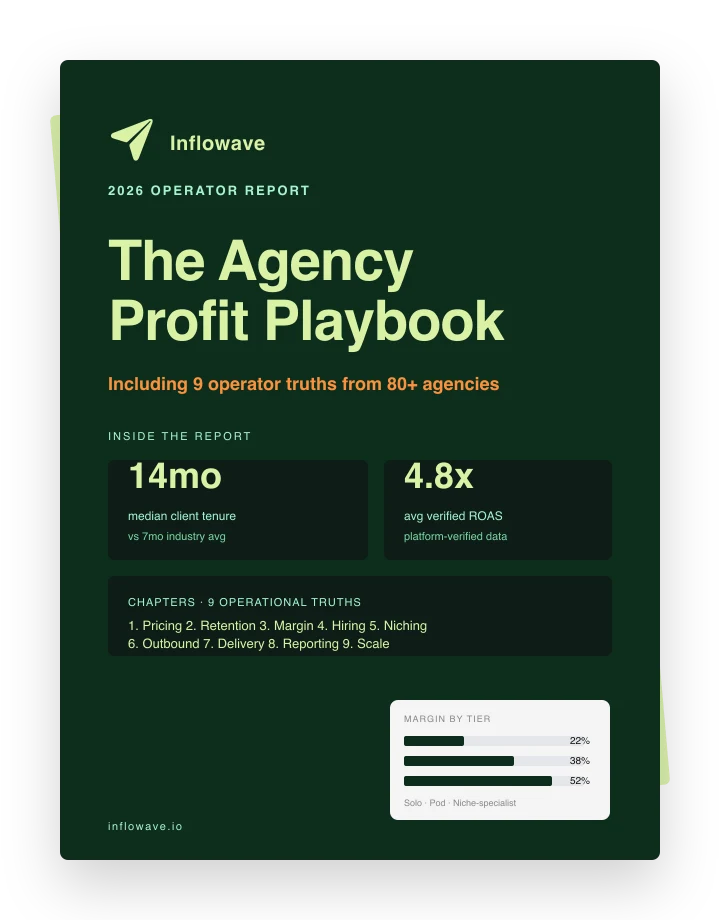
Play 1 (connect and map) and Play 2 (weekly reporting). They are low-risk, deliver obvious value, and build the trust you need before handing the agent more sensitive plays. See the tools guide, the agency playbook, and pricing for how the stack fits together.