Measure your brand awareness in minutes
Calculate aided, unaided, and top-of-mind awareness from your survey data plus organic and social signals. Get a 0-100 Brand Awareness Index with industry benchmarks.
Free. No signup. Pure browser math.
Enter your inputs
Survey data is the most reliable signal. Organic and social signals refine the read.
Survey data
Number who said "Yes, I have heard of this brand" when shown your name.
Number who named your brand in response to "What brands come to mind in [category]?"
Number who named your brand FIRST in the unaided question.
Organic search signals
Use Semrush or Ahrefs to pull monthly searches for your brand name and key brand variants.
Social signals
Industry benchmark (optional)
How to measure brand awareness - without paying a research firm $40K
Brand awareness is the most-claimed and least-measured metric in marketing. Most teams report on it with vibes - "we feel like awareness is up this quarter" - because real measurement requires running surveys, and most teams have never run one. The result: budget gets allocated to "awareness campaigns" without anyone being able to tell whether they worked. Here is how to fix that, in three layers, without spending more than a free Google Form.
The 3 brand awareness metrics that actually matter
Brand awareness is not a single number. It is three layers, in increasing order of difficulty: aided, unaided, and top-of-mind. Aided awareness is "do you recognize this brand when shown a list?" Unaided awareness is "what brands come to mind in this category?" Top-of-mind is "which brand do you mention FIRST in that list?" Each layer represents a deeper level of brand-buyer connection, and each one moves at a different speed in response to investment.
Aided awareness is the easiest to lift. A single paid campaign with strong reach can move it 5-10 points in a quarter. The trade-off: it is also the easiest to lose, because it represents shallow recognition rather than deep recall. Unaided awareness sits in the middle: it requires repeated, consistent exposure across multiple channels before buyers start associating your name with your category. Top-of-mind is the slowest to move and the most valuable. It typically takes 12-24 months of sustained category leadership before it budges, but the buyers who name you first are 2-3x more likely to convert and pay 10-30% more on average.
The composite Brand Awareness Index this calculator returns weights these three metrics by their strategic value: 50% to top-of-mind, 30% to unaided, 20% to aided. The weighting reflects how much each layer drives revenue, not how easy each is to grow. Vanity metrics are weighted toward what is easy to move; strategic metrics are weighted toward what compounds.
Why surveys still beat social listening for awareness measurement
Every year there is a new tool that promises to measure brand awareness "without surveys" by scraping social mentions, branded search volume, or share-of-voice data. These tools are useful supplements but they have a fatal blind spot: they only measure people who SAY your brand name out loud. The 80%+ of buyers who know you but never tweet about you are completely invisible to social listening.
A survey, by contrast, samples your buyer segment directly and asks them what they know. It is the only methodology that produces a number for the silent majority - the buyers who recognize your brand but never engage with it publicly. That is exactly the segment that decides whether your category is winnable, because buying decisions are made by people who know about you, not just people who tweet about you. Surveys are the gold standard for awareness measurement and they remain the gold standard in 2026.
Branded search volume is the second-best signal because it captures intent - buyers actively looking for you. Branded search undercounts because people who already know you may not search for you that month. Share of voice (your mentions vs your top competitor) is the third-best signal because it tells you whether you are gaining or losing ground in conversations, regardless of absolute volume. Use all three: survey for the absolute number, branded search for intent, and share of voice for trajectory.
Industry benchmarks: B2B vs B2C, SMB vs Enterprise
Benchmarks vary wildly by segment, which is why a single global "good awareness" number is meaningless. For a B2B SMB tool, top-of-mind awareness around 8% is strong because the buyer pool is small and any single number competes with hundreds of vendors in the same niche. For a B2C enterprise brand, the same 8% would be catastrophic - you would expect at least 25% top-of-mind from a category leader, because the buyer pool is broader and the assumption is that your brand has been advertised heavily for years.
The pattern holds for unaided and aided awareness too. B2B SMB unaided benchmark sits around 18%, while B2C enterprise targets 50%+. Aided awareness benchmarks scale similarly - 35% for B2B SMB, 80% for B2C enterprise. These benchmarks are direction-of-travel reference values calibrated against published research from Nielsen, Gartner, and Forrester. Treat them as floors, not ceilings: a market leader should clear them by 20%+ to confirm category dominance.
The single most important benchmark is your direct competitors, not the category average. Run the same survey, but include your top 3 competitors in the aided question. The relative position is what matters. Being #2 in your category at 12% top-of-mind is a stronger position than being #5 at 18% top-of-mind in a different category - and the strategy implications are completely different.
How to run a $0 brand awareness survey
You do not need a research firm. You need Google Forms or a Typeform free tier and 200 respondents from your target segment. The survey design is what matters - keep it short and use these four questions, in this exact order, every time:
Question 1 (open-ended, captures top-of-mind and unaided): "When you think about [your category], what 3-5 brands or products come to mind?" Do NOT prompt with options. The first brand they mention is top-of-mind. Any brand they mention at all is unaided. Capture both.
Question 2 (aided awareness): "Have you heard of any of the following brands? Check all that apply." Then list your brand plus 4-6 competitors in random order. Critically: include 1-2 fake brands that do not exist. This catches respondents who claim to recognize everything (5-10% of any survey). Discard their responses; they pollute your data.
Question 3 (attribution, optional but useful): "Where did you first hear about [your brand]?" Free text. Aggregate the answers and you will get the cleanest channel attribution data your team has ever seen.
Question 4 (segment confirmation): one or two demographic questions to confirm the respondent is in your target segment. Discard responses that do not match - surveying random consumers about a B2B SaaS tool produces useless data.
Distribute the survey through your email list, an Instagram post linking out, a LinkedIn post, or a Twitter/X poll-and-link. Aim for 200+ responses from segment-matching respondents. Run the survey every 90 days with the same wording and same distribution mix. Plot the trendline on a single chart. The trendline is the only number that matters; any single survey wave is too noisy to trust on its own.
Awareness compounds - that is why the spend is worth it
The reason awareness investment looks expensive in the short term but pays back 10x over 18-24 months is that it compounds. Buyers who already know you cost less to reach (your CPM is lower because they recognize you and engage), convert at higher rates (2-3x baseline), and pay more (10-30% premium). Every single dollar of conversion-channel spend works harder for buyers who have seen your brand 5+ times. Companies that look like overnight successes have usually been investing in awareness for 3+ years before the conversion spike happens.
For a deeper walkthrough including the exact survey templates we use internally, see our companion guide: How to measure brand awareness in 2026.
Related Inflowave tools
Free utilities that pair well with the brand awareness calculator.
Frequently Asked Questions
Awareness gets you in the door. Inflowave closes them.
Once buyers know who you are, you need a system that captures every DM, email, and call into one CRM. That is what Inflowave does - for Up to 50 Instagram accounts, with AI follow-ups built in.
Related reading
Guides that go deeper on what this tool measures.
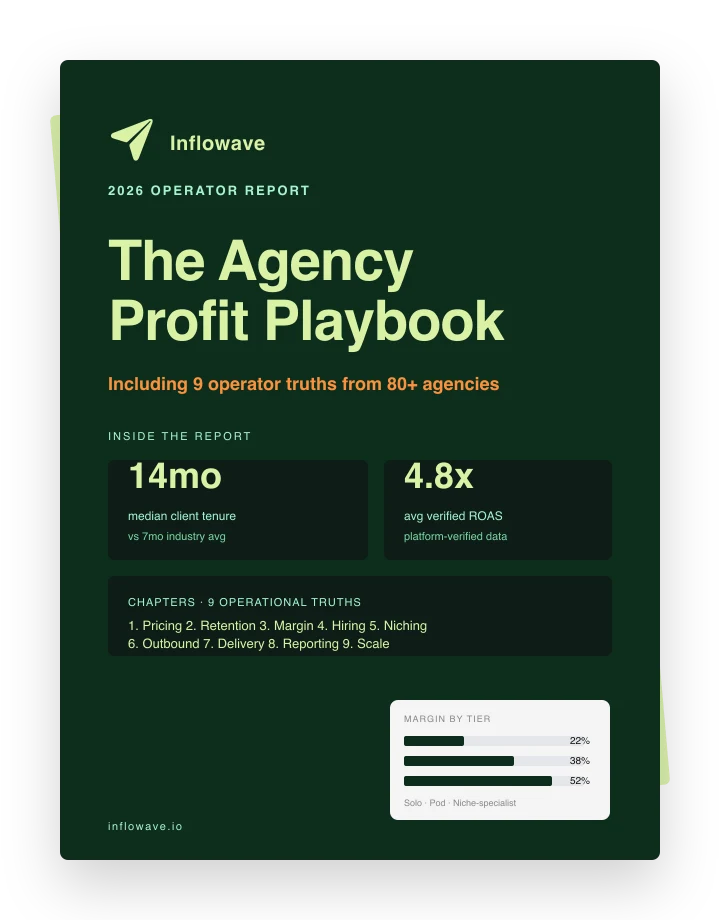
The Agency Profit Playbook Is In
How do 80+ agency operators rate their own pricing, retention, and margin? The Agency Profit Playbook has the benchmarks.