How a business replies to its Google reviews says more to the next customer than the star rating does. A thoughtful answer to a 2-star review can win more trust than a wall of unanswered 5-stars, and a lazy copy-paste "Thanks!" on every positive review tells people nobody is listening.
This guide covers how to reply on Google, what to say to positive, mixed and negative reviews, ready-to-adapt examples, how to handle fake or abusive reviews, and how agencies keep up with replies across many clients without the quality slipping.
The short answer
| Question | Answer |
|---|---|
| How do I reply to a Google review? | Sign in to the account that manages the Business Profile, open the business in Search or Maps, go to Reviews, choose Reply under the review and post. |
| Is the reply public? | Yes. Everything you write appears under the review for anyone to read. There is no private message through Google reviews. |
| Should I reply to every review? | Yes, positive and negative. Aim for within a day or two. |
| How long should a reply be? | Two to four sentences for most reviews. |
| What do I say to a bad review? | Thank them, apologise for the experience, add one line of context or a fix, and offer a way to sort it out offline. |
| Can I edit my reply later? | Yes. You can edit or delete your own reply. You cannot edit the customer's review. |
| Can I offer something in return for changing a review? | No. Do not trade anything for a changed or removed review. |
The rule that matters most: write every reply for the stranger who is reading it next month, not for the reviewer. The reviewer has already made up their mind. The stranger is still deciding.
Why replying matters more than most businesses think
A review is a one-way message until the business answers. Once you reply, it becomes a conversation that every future customer can read. That changes what people take away from a profile:
- A reply proves the business is alive. A profile full of reviews with no answers can look abandoned, even when the business is busy.
- A reply to a bad review is read by people who never read the bad review itself. Many readers skim the owner's answer to find out how the business behaves when something goes wrong.
- A reply is a chance to repeat what you do well. Mentioning the service or the team member by name tells readers what the business is known for, in natural language.
- A reply shows the reviewer was heard. Some reviewers come back and change their rating once they see a sincere answer, though you should never count on it or ask for it.
For an agency, this is also one of the cheapest wins on a client's reputation work: the reviews already exist, and the replies cost nothing but attention.
How to reply to a Google review
- Sign in to the Google account that manages the Business Profile.
- Search for the business on Google, or open it in Google Maps, and go to Reviews (or Read reviews).
- Choose Reply under the review, write your answer and post it.
The reviewer is usually notified that you replied, and your answer appears publicly under their review. You can edit or delete your reply later. You cannot edit their review, and there is no private messaging through Google reviews, so everything you write is public.
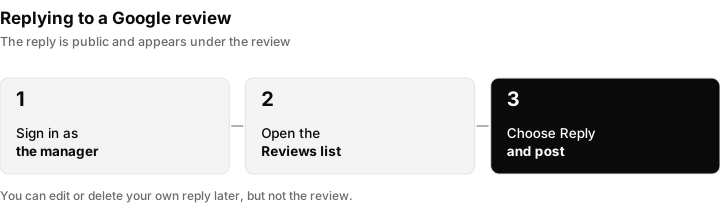
The mechanics take under a minute. The wording is where the time goes.
If you manage profiles for clients, you need manager access to each Business Profile. Ask the client to add you as a manager rather than sharing their password, so you can be removed cleanly when the work ends.
Rules for every reply
- Reply to everything, and soon. Aim for within a day or two. A profile where every review has an answer looks cared for.
- Use their name and a detail from the review. It proves a person read it.
- Keep it short. Two to four sentences is plenty for most reviews.
- Never share private details. Do not confirm what someone bought, their medical or legal situation, or anything from their records. In regulated industries this can be a legal problem, not just bad manners.
- Do not argue in public. State facts once, calmly, and move the conversation offline.
- Do not offer anything in exchange for changing a review. Asking someone to edit or remove a review in return for a refund or gift crosses into territory platforms and the FTC treat as manipulation. Fix the problem because it is right, not as a trade.
- Sign off with a real name where you can. "Rachel, owner" reads as a person. "The Management" reads as a form letter.
- Check spelling and tone before posting. A reply is permanent in the eyes of anyone who screenshots it.
What a good reply contains
Whatever the rating, a strong reply is built from the same small set of parts. Pick the ones that fit.
| Part | What it does | Example wording |
|---|---|---|
| Name | Shows a person read it | "Hi Sarah," |
| Thanks | Acknowledges the time they took | "Thank you for taking the time to write this." |
| A specific detail | Proves it is not a template | "Glad the website was ready for your launch." |
| Ownership or context | Shows you take problems seriously | "That is not the standard we aim for." |
| A next step | Moves a problem offline, or invites a return | "Please email hello@example.com and I will look into it." |
| A sign off | Puts a human behind it | "Rachel, owner" |
Not every reply needs every part. A positive review rarely needs ownership, and a negative one rarely needs a sales pitch. What it always needs is the specific detail, because that is what separates a reply from a template.
How to respond to positive reviews (with examples)
Thank them, mention what they liked, and invite them back. Vary the wording so replies do not all look identical.
Thanks so much, Sarah. Really glad the new website was ready in time for your launch. Good luck with the opening, and we are here when you need the next round of updates.
Thank you, David. Rachel will be delighted you mentioned her, she put a lot of work into your bathroom. See you for the kitchen next spring.
Appreciate you taking the time, Priya. Great to hear the onboarding felt simple. If anything comes up, you know where we are.
A few habits keep positive replies from going stale:
- Do not paste the same line on every review. Readers scroll, and repeated wording is easy to spot.
- Name the staff member the customer mentions. It gives that person recognition and tells readers who they will meet.
- Do not turn a thank you into an advert. One light invitation to return is enough.
- Reply to short reviews too. A 5-star review with no text still deserves a warm, brief answer: "Thank you, Ben, we really appreciate it."
How to respond to mixed or neutral reviews
Thank them for the good parts, acknowledge the bit that fell short, and say what you are doing about it.
Thanks, Mark. Glad the result was what you wanted, and you are right that the first appointment ran late. We have changed how we schedule mornings so that does not happen again. Hope to see you next time.
Mixed reviews are the most useful ones to answer well. They show that the business can hear a criticism without getting defensive, and they often come from customers who are still willing to return. Only promise a change you will actually make, because a later reviewer will test it.
How to respond to negative reviews (with examples)
The goal is not to win the argument with the reviewer. It is to show every future customer reading the exchange that you are reasonable. A good negative-review reply:
- Thanks them for the feedback
- Apologises for the experience (not necessarily admitting every claim)
- Gives one line of context or a fix, if there is one
- Offers a direct way to sort it out offline
Hi Tom, thank you for telling us, and I am sorry the delivery arrived two days late. That is not the standard we aim for. I would like to put it right: please call me directly on 555 0100 or email support@example.com and I will look into your order personally.
Hi Jenna, I am sorry your visit did not go the way it should have. We take feedback about staff seriously and I would like to hear more. Please get in touch at hello@example.com so we can talk it through.
How to reply to a 1-star review with no text: keep it brief and open the door. "Hi Alex, we are sorry we did not meet your expectations. We would really like to understand what happened, please reach us at hello@example.com."
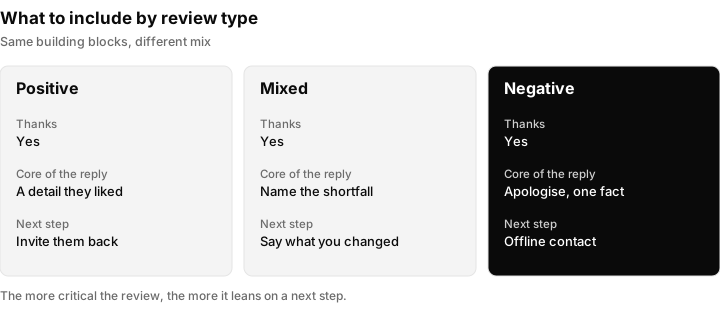
The same building blocks, mixed differently. The more critical the review, the more the reply leans on ownership and a next step.
Before you post a negative reply, run this check
- Is every sentence true and something you could say to the reviewer's face?
- Have you left out names, order details and anything private?
- Would a stranger reading only this reply think the business was reasonable?
- Is there a clear way for the reviewer to reach a real person?
- Did you wait until you were calm? A reply written angry is nearly always worse than one written an hour later.
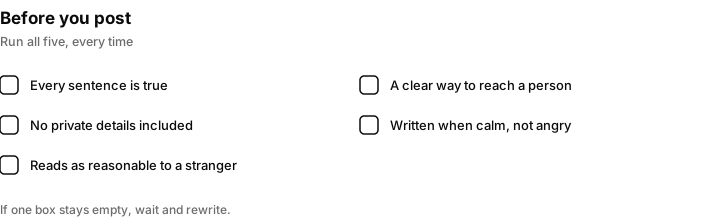
Five questions, thirty seconds. Most regretted replies fail at least one of them.
Phrases to avoid
| Instead of | Say |
|---|---|
| "As we already explained, you were told..." | "I am sorry this was not clear at the time." |
| "We have no record of you." (when you are unsure) | "I could not find the details, could you email us so I can look properly?" |
| "This is not how it happened." | "I would like to understand what you experienced. Please contact me directly." |
| "We are sorry you feel that way." | "I am sorry the visit was frustrating." |
| "Come back and we will give you a discount." | Offer to put the problem right on its own merits, with no link to the review. |
What about fake or abusive reviews?
If a review breaks Google's policies, for example it is from someone who was never a customer, from a competitor, or contains abuse, report it first. If you also reply, keep it neutral: "We have no record of a customer by this name or this visit. If we have got that wrong, please contact us at hello@example.com so we can help." Readers see a calm business, and you have not accused anyone. See our guides on fake Google reviews and removing Google reviews.
Be careful with the word "fake". A review you dislike is not necessarily fake. A review from a real customer with a different view of events should be answered, not reported. Report only what clearly breaks the content policy, and check the current wording at Google's own Maps contribution policy pages, because the rules are updated from time to time.
Replies you should never write
- Anything that identifies the customer's private situation. In health, legal, financial and similar fields, even confirming that someone was a customer can be a problem. Keep the reply general.
- Anything that offers a reward for a changed review. Fix the issue on its merits, separately.
- Accusations you cannot prove. "You are a competitor" is a claim. Use the neutral wording above and report the review instead.
- Sarcasm. It reads as contempt, and it will be screenshotted.
- A reply that is longer than the review. If the reviewer wrote two lines, three paragraphs back looks defensive.
When the same complaint keeps appearing
Replies handle individual reviews. Patterns need a fix behind the scenes. If three reviews in a month mention slow response times, long waits or unclear pricing, the best reply is a visible change, and a short line in a later reply can mention it: "We have added a second person on the phones in the morning."
For an agency this is a useful monthly conversation with a client. Print or export the last month of reviews, group the complaints by theme and agree one operational change. It shows the client you are looking at the business, not only at the star average.
Reviews also feed your next ask. See how to get more Google reviews for the process that keeps new reviews arriving, and how to get your Google review link for the link customers should use.
Replying to reviews across many clients with Inflowave
The hardest part of review replies for an agency is volume: new reviews arrive at different times across dozens of profiles, and the unanswered ones are the ones that hurt.
Inflowave keeps the Google reviews of every connected client in one board. You can filter by rating, search review text, see which reviews have not been answered yet, and post the reply to Google from the same screen; the reply is saved on Inflowave's side only once Google accepts it. A sentiment overview splits positive, neutral and negative reviews across Google and Facebook, so a client with a sudden run of bad reviews stands out before the client calls you about it. It all sits inside Inflowave's reputation management, next to the review requests that bring new reviews in.
A simple weekly routine for a team using it:
- Open the unanswered view and sort by lowest rating first.
- Answer the negative reviews first, with the checklist above.
- Answer the positive ones with a specific detail each.
- Flag any client with a cluster of low ratings for a call.
- Add the number of reviews received and answered to the client's monthly report.
Mistakes agencies make with review replies
- Using one template for every client. Each business has its own voice. A solicitor and a pizza shop should not sound alike.
- Replying only to the bad ones. The positive reviews are the majority of your audience's reading.
- Replying from a personal account. Always reply as the business, from the managed profile.
- Promising what the client has not agreed to. Get approval on refunds, remakes and offers before you mention them publicly.
- Never telling the client. Show the client the worst review and your proposed reply before posting, at least until you have a pattern they trust.
- Leaving replies for the end of the quarter. A reply three months late reads as an afterthought.
Questions people ask
How do I respond to a Google review?
Sign in to the account that manages the Business Profile, open the business in Search or Maps, find the review under Reviews and choose Reply. Write a short, specific answer and post it. The reply appears publicly under the review.
How do I respond to a negative Google review?
Thank the reviewer, apologise for their experience without admitting every claim, add one line of context or a fix, and offer a direct way to sort it out offline. Never argue in public, because the audience is future customers rather than the reviewer.
Should I reply to every Google review?
Yes. Replying to positive and negative reviews shows future customers that the business is listening. Even a short, warm answer to a review with no text is better than silence.
Can I message someone who left a Google review?
Not through Google. Your reply is public. If you want to talk privately, invite them in your reply to contact you directly by phone or email.
What is an example of a good response to a positive review?
"Thanks so much, Sarah. Really glad the new website was ready in time for your launch. We are here when you need the next round of updates." Use their name and mention a detail so it cannot be mistaken for a template.
How long should I wait before replying to a bad review?
Reply within a day or two, but do not reply while angry. Taking an hour to cool down and check the facts almost always gives a better answer than the first draft.
Can I edit or delete my reply to a Google review?
Yes, you can edit or delete your own reply from the Business Profile at any time. You cannot edit the customer's review, and a review can only come down if it breaks Google's policies or the reviewer removes it.
Can I ask a customer to change their review after I replied?
You can tell them you would like to put the problem right, but do not ask them to change or remove the review in return, and never offer anything for it. If they update their review on their own after the problem is solved, that is their choice.
What if a review is fake or from a competitor?
Report it through Google first, and keep any reply neutral and factual, for example saying you have no record of the visit and inviting them to get in touch. Do not accuse anyone publicly.
How do agencies manage review replies for many clients?
They use one shared view of all reviews across clients, filter for the ones not yet answered, and work through negatives first. A weekly routine and a short checklist keep the quality consistent.