Most "best CRM" lists are written for sales teams closing one-off deals. An SEO agency does close to the opposite: a long consultative sale, then a retainer that has to be defended every month with reporting.
This guide skips the feature lists. It gives you the five questions that actually decide the choice, a cost model at your headcount rather than today's, a price table where every figure was read from the vendor's own page, and an honest matrix of which of these CRMs touch Ahrefs, Semrush and Search Console at all.
Every price below was read from the vendor's own pricing page on 15 September 2026. Where a vendor would not show us a price, that vendor is not in the ranking table. We would rather have a shorter table than a wrong number.
Choosing a CRM for an SEO agency: the five questions that decide it
1. Do you need a separate workspace per client, or just a tag?
If your team ever needs to look at one client without seeing the other twenty, you need real separation, not a saved filter. Getting this wrong is how one client's data ends up in another client's report. GoHighLevel and Inflowave are built around per-client workspaces. Close sells them as extra organisations at $50 per month each, with one secondary organisation included free on Growth and Scale. Salesflare, Copper and Keap assume one shared pipeline and expect you to police it with discipline, which works until the day you hire a contractor.
2. Are you white-labelling?
If clients log in and should see your brand, that narrows the field fast and pushes you toward agency-specific platforms. If nobody outside your team ever logs in, you are paying for something you will not use. The trade-offs are in white-label software for agencies.
3. Where do your leads actually talk to you?
Be honest rather than aspirational. If most first contact is a form and an email, almost any CRM works and you should optimise for price. If it is Instagram DMs, WhatsApp and comment threads, most of the sales CRMs in the table below reach those channels through a third-party connector rather than natively, and you should pick something that treats messaging as native.
4. Per-user or flat?
Per-user pricing punishes you for hiring. Model your headcount in twelve months, not today's.
| Team size | Close Growth | Salesflare Growth | Copper Professional | GoHighLevel Unlimited | Inflowave |
|---|---|---|---|---|---|
| 3 people | $327/mo | $117/mo | $207/mo | $297/mo | $297/mo (Pro) |
| 6 people | $654/mo | $234/mo | $414/mo | $297/mo | $497/mo (Max) |
| 12 people | $1,308/mo | $468/mo | $828/mo | $297/mo | $497/mo (Max) |
Monthly-billing list prices from each vendor's own page, before annual discounts and before add-ons. Inflowave Pro covers 5 team seats, so a 6-person or 12-person team is on Max. The point is not that flat always wins. It is that the two models cross over somewhere between five and eight seats, and that is the number you should be modelling against.
5. Who holds the client's Google access?
This one is about access records rather than features. Search Console permissions are managed per property, and a property can have a maximum of 100 non-owner users (Search Console Help). Roles are owner (verified or delegated), full user and restricted user, and only owners can add or remove other users. Google Business Profile works differently: a profile can have multiple owners but only one primary owner, and managers can do almost everything except add or remove users (Google Business Profile Help).
None of that lives in your CRM, but who holds which role for which client absolutely should. When a strategist leaves, you need to know in thirty seconds which fourteen Search Console properties and which nine Business Profiles are tied to their Google account. A CRM with one "client" object that has somewhere to record that is worth more on the day someone resigns than any pipeline feature.
SEO agency CRM pricing: twelve-month cost of ownership
The three-seat table above is the easy case. Here is the harder one: an eight-person agency running twenty retainer clients, monthly billing, in the vendor's own listed currency, over a full year including one-time fees.
| Tool | Plan modelled | Monthly | One-time | Year one | Client separation included |
|---|---|---|---|---|---|
| GoHighLevel | Unlimited | $297 | none listed | $3,564 | Unlimited sub-accounts |
| Salesflare | Growth, 8 users | $312 | none listed | $3,744 | None |
| Inflowave | Max | $497 | none listed | $5,964 | 50 client workspaces |
| Keap | Base plan at the lowest contact tier, 2 users included plus 6 at $39 | $483 or $533, billing basis unclear at source | Implementation package required, priced on request | $5,796 or $6,396, plus implementation | Single account |
| Copper | Professional, 8 seats | $552 | none listed | $6,624 | Single account |
| monday CRM | Pro, 8 seats at EUR 41 | EUR 328 | none listed | EUR 3,936 | Boards and workspaces |
| Close | Growth, 8 users, one org | $872 | none listed | $10,464 | One org only |
| Close | Growth, 8 users, 20 client orgs | $1,772 | none listed | $21,264 | 18 paid orgs at $50 each, 1 secondary org free on Growth |
| HubSpot | Sales Hub Professional, 8 seats | $800 | $1,500 Professional onboarding | $11,100 | Business units, not priced at source |
Three things this model surfaces that a seat table hides. Close is cheap until you want real client separation, at which point the add-on costs more than the seats. HubSpot's mandatory onboarding fee is a real year-one line item and the business-units add-on you need for client separation is not priced publicly, so its true number is higher than $11,100. Keap's row is the least certain here: $299 is a starting price gated on a contact-count selector, Keap's own page labels that same $299 both "Billed at $2,988/year", which works out at $249 a month, and "Billed monthly", so the basis is not established at source, and Keap requires an implementation package it prices only on request. An eight-person agency with twenty clients will be quoted more than either year-one figure. And per-seat pricing is not automatically the loser. Salesflare at eight seats is the cheapest per-seat option here and finishes within $15 a month of GoHighLevel, the cheapest row overall, because it does not try to be a client-delivery system.
Inflowave is ours and it sits mid-table, not at the top. Four rows come in under it: GoHighLevel at $3,564, Salesflare at $3,744, monday CRM at EUR 3,936 and Keap's lower figure at $5,796. We would rather show you that than hide it.
The best CRMs for SEO agencies, compared
| Tool | Entry price | Pricing model | Client separation | Best fit |
|---|---|---|---|---|
| GoHighLevel | Billed monthly $97 Starter (3 sub-accounts), $297 Unlimited, $497 Agency Pro; billed annually $970, $2,970 and $4,970 a year | Flat, unlimited users on all plans | Sub-accounts, unlimited from Unlimited up | White-label and many client workspaces |
| Close | Billed monthly $19/user/mo Solo, $49 Essentials, $109 Growth, $149 Scale; billed annually $9/$35/$99/$139 | Per user | Extra organisations at $50/mo each, one free on Growth and Scale | Outbound-heavy agencies selling by phone and email |
| Salesflare | Billed monthly $39/user/mo Growth, $64 Pro, $124 Enterprise; billed annually $29/$49/$99 | Per user | Pipelines and tags, no true workspaces | Small teams who want automatic capture from email |
| HubSpot | Free plan at $0 for up to 2 users, then Sales Hub Starter $20/seat/mo billed monthly or $7 billed annually, Professional $100 billed monthly or $90 billed annually, Enterprise $150/seat/mo plus a $3,500 one-time Enterprise onboarding fee | Per seat, tiered, plus onboarding fees | Business units, a paid add-on | Larger agencies wanting CRM, marketing and service in one place |
| monday CRM | Billed monthly EUR 18/seat/mo Basic, EUR 25 Standard, EUR 41 Pro; billed annually EUR 12, EUR 17 and EUR 28 per seat; 3-seat minimum | Per seat, minimum seat counts | Boards and workspaces | Agencies already running delivery on monday boards |
| Copper | Billed monthly $29/seat/mo Basic, $69 Professional, $134 Business; billed annually $23/$59/$99 | Per seat | Single account | Agencies living inside Google Workspace |
| Keap | From $299/mo at the lowest contact tier, shown with both "Billed at $2,988/year" and "Billed monthly" so the basis is unestablished, including 2 user licences, extra users $39/mo each, implementation package required and separately priced | Per plan, gated on contact count, plus per-user add-on | Single account | Solo consultants wanting CRM and email on one bill |
| Inflowave | $27/mo Influencer, $149 Business, $297 Pro, $497 Max, all billed monthly, 7-day trial on every paid plan | Flat, per plan | 1 workspace on Influencer and Business, 10 on Pro, 50 on Max | Agencies whose client conversations happen in DMs and WhatsApp |
Excluded for lack of a verifiable price. Pipedrive returned 403 to every request we made, so we have no figure for it. Capsule publishes contact tiers (250 contacts free, 30,000 Starter, 60,000 Growth, 120,000 Advanced) but renders the dollar amounts client-side and did not serve them to us. Zoho served its pricing page to us in Indian rupees based on our location, so we have no defensible USD figure for any Zoho edition. All three may be good products. We are not going to quote a price we did not see.
SEO integrations: Search Console, Ahrefs and Semrush support
This is the row an SEO agency should read first. The short version: none of these CRMs is an SEO tool, and only one of them connects to Search Console natively.
| Tool | Ahrefs | Semrush | Google Search Console |
|---|---|---|---|
| GoHighLevel | No native integration | No native integration | No native integration |
| Close | No native integration | No native integration | No native integration |
| Salesflare | No native integration | No native integration | No native integration |
| HubSpot | No native integration | Listed by Semrush as a Zapier destination for Site Audit leads | Native, in HubSpot's SEO and content tools |
| monday CRM | No native integration | Listed as a Semrush partner integration | No native integration |
| Copper | No native integration | No native integration | No native integration |
| Keap | No native integration | No native integration | No native integration |
| Inflowave | No native integration | No native integration | No native integration |
Read across that table rather than down it. Your ranking data and your commercial data are not going to live in the same system. Stop shopping for a CRM that makes them.
What works is a reporting layer both sides feed. Ahrefs ships official Looker Studio connectors for Site Audit, Site Explorer and Rank Tracker, requires an Advanced plan or higher, and charges credits for the Site Explorer connector but not the other two (Ahrefs Help Center). Semrush ships three connectors covering Domain Analytics, Position Tracking and Site Audit, and requires a Guru or Business subscription (Semrush Knowledge Base). Search Console has a free native connector and a public API.
HubSpot is the one exception worth naming. Its Search Console integration pulls impressions, clicks, average clickthrough rate and average position into its SEO tool and surfaces top queries inside the page editor. Two caveats from HubSpot's own documentation: data lags Google by up to two days, and if you disconnect the integration your stored data is purged after 90 days (HubSpot Knowledge Base).
What reviewers say, including the bad parts
Aggregate scores read from Capterra on 15 September 2026. Capterra labels some reviews as incentivised or vendor-referred, which is worth filtering for before you weigh them.
GoHighLevel, 4.2 out of 5 from 89 reviews (Capterra). Kassidy K., a chiropractor, rated it 5 out of 5 and credits it with automating most of the marketing in her practice, while flagging a steep learning curve and a lengthy implementation. Zack M., a founder at a 2-10 employee business, was blunter: "Everything from creating a basic landing page sign up, to communities, to courses is SO SO SO complicated to set up, run and scale." Both reviews describe the same product accurately. Breadth is the feature and breadth is the cost.
Close, 4.7 out of 5 from 164 reviews (Capterra). Kyle S., head of sales at a 51-200 employee construction firm, praised it for having "no fluff. there are not 3 different places to log contacts/opps/accounts/leads it is all on one page." Jonathan L., an insurance agent at a 2-10 employee business, valued that "tasks, notes while in a call, messages, and emails all being automatically logged in a particular lead's profile." Both named reviews are positive, and we are not going to manufacture a complaint out of an aggregate score. The cost objection is visible in our own model above instead: Close Growth at eight users is $10,464 in year one, nearly three times GoHighLevel's flat row.
Copper, 4.4 out of 5 from 622 reviews (Capterra). Nikki G., a director of coach development in health and wellness and a user of more than two years, titled her review "Copper makes my life easier!" and wrote that "Copper is so easy to use! It helps me stay organized and make sure that nothing is missed." Nathan Y., managing director at a marketing and advertising firm, called it "attractive, easy to use, with good G-Suite integration" and then described the cancellation and billing process as a real problem. That is one reviewer's experience rather than a pattern we have counted, but it is the specific thing to ask Copper about before you sign an annual term.
What the CRM should not do
It should not be your reporting tool. The all-in-ones that promise client reporting alongside CRM are wrapping the same APIs you could query directly, and they go stale whenever Google changes something.
Keep the source of truth where the data lives. Search Console's own definitions of impressions, position and clicks are the ones your client's other agency will quote back at you (Search Console Help), and the Search Analytics API is what any credible reporting tool calls underneath (API reference). The CRM holds the commercial half: what the retainer is, what was promised, what was delivered, what the client said, and whether the account is growing or quietly heading for cancellation.
That split matters more than it did two years ago. Pew Research Center tracked the browsing of 900 US adults and found that people who encountered an AI summary on a Google results page clicked a traditional search result in 8 percent of visits, against 15 percent for people who did not see one, with 18 percent of all searches in the study producing a summary (Pew Research Center, July 2025). If your client report still leads with average position, you are about to have a difficult conversation. Our own Search Console numbers are in AI SEO for agencies.
Where a CRM does earn a place in reporting is attribution on your own new business. Which channel produces clients who stay is a number that changes what you do next month. A client keyword moving from 14 to 9 is not. We cover the distinction in client reporting software for agencies.
The data protection part nobody reads
An SEO agency holding a client's contact data, form submissions and call recordings is almost always a processor acting on the client's instructions, not a controller. Under the UK and EU GDPR that requires a written contract setting out subject matter, duration, nature and purpose of processing and the obligations of both parties (Article 28, GDPR; ICO guidance).
Two consequences for CRM choice. Your CRM vendor is a sub-processor, which your client contract must permit. And when a client leaves you need to extract and then delete their data specifically, not "the records tagged with their name" - far easier with real per-client separation than in a shared pipeline. Our client offboarding checklist walks the rest.
The honest answer
For most SEO agencies under about fifteen people, this comes down to three shapes.
If you want an all-in-one with white-label, GoHighLevel at $297 flat billed monthly is the default and hard to argue with on price. Accept that you are buying breadth over depth, and read Zack M.'s review above before you budget the setup time.
If you are outbound-heavy and sell by phone, Close is better at the actual selling than anything else here and worse at everything after the sale. Just do not buy it as a client-workspace system. At twenty clients the organisation add-on doubles the bill.
If your constraint is budget and you do not need client separation, Salesflare at eight seats is the cheapest per-seat option in the cost model above, close enough to GoHighLevel's flat price that the choice is about workspaces rather than money, and it captures contact data out of email without anybody administering it.
There is no single winner, and any list that names one is selling something. The wider agency view is in best CRM for marketing agencies, and the commercial context in how to grow a marketing agency.
Where we fit
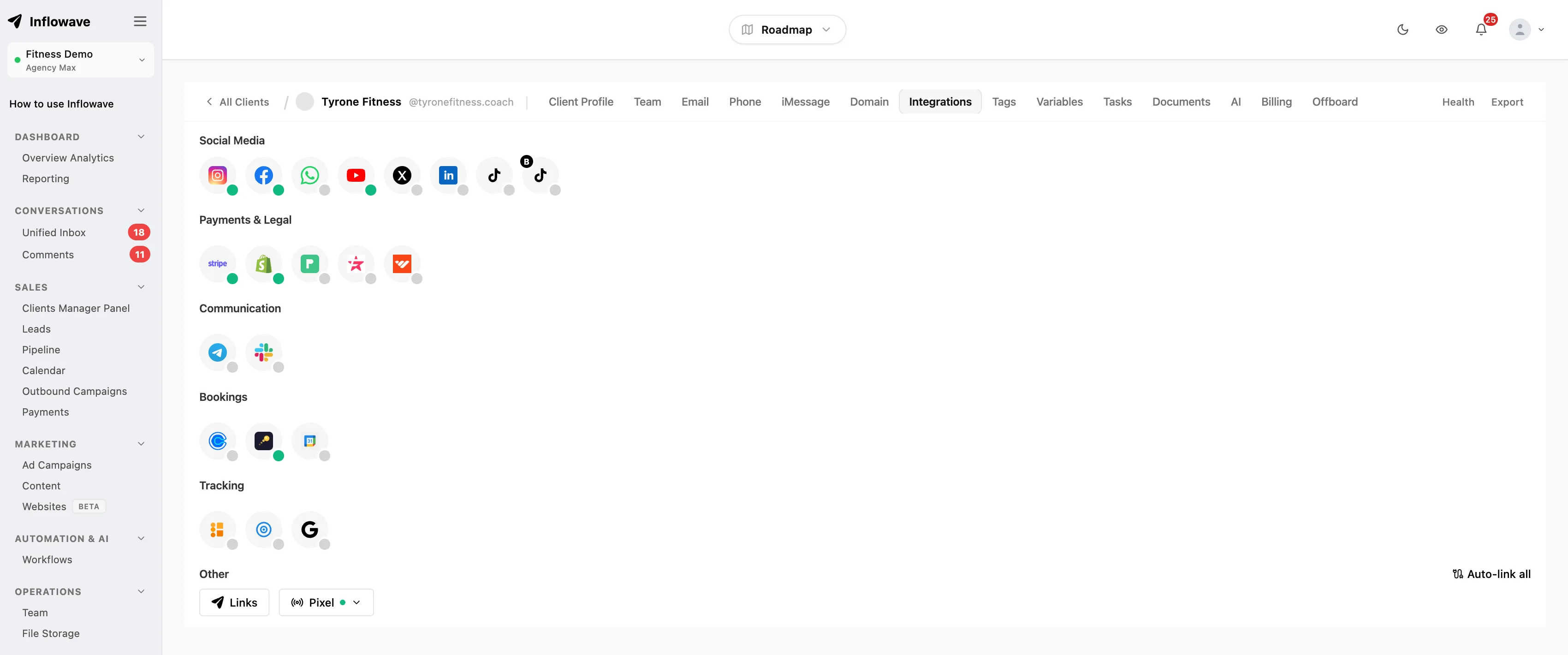
We build Inflowave, a CRM for agencies whose client conversations happen in DMs, WhatsApp and comments rather than in an inbox. Plans are $27 Influencer, $149 Business, $297 Pro and $497 Max, all billed monthly, with a 7-day trial on every paid plan. Connected social accounts and client workspaces are capped at 1 on Influencer, 1 on Business, 10 on Pro and 50 on Max. Contacts are 1,000, 10,000 and uncapped on Max. Team seats are 1, 5 and uncapped on Max. If you run more than fifty client workspaces, we are not the right tool and we would rather say so here.
We are also not the right pick if your agency sells purely by cold email and phone. Close is better at that. And we have no Ahrefs, Semrush or Search Console integration, which is why our own row in the matrix above says so.
CRM for SEO agencies FAQ
What is CRM in SEO?
CRM in an SEO context means the system that holds the commercial relationship with each client: the contacts, the retainer value, the deal history and the conversation record. It is not an SEO tool and does not measure rankings or traffic. The confusion comes from vendors marketing SEO features inside CRM products. In practice an SEO agency runs two things: a CRM for clients and revenue, and Search Console plus a rank tracker for the work itself.
What is the best CRM for agencies?
There is no single answer, because the two pricing models suit different agencies. Flat-rate platforms built around client sub-accounts, such as GoHighLevel at $297 per month billed monthly with unlimited users, suit agencies with many clients and a growing team. Per-user sales CRMs such as Close, from $19 per user per month billed monthly, suit small outbound-heavy teams. The crossover is usually between five and eight seats. Model your headcount in twelve months, not today.
What is the best CRM for a digital marketing agency?
The same decision, weighted slightly differently. A digital marketing agency usually needs client separation, white-label if clients log in, and a pipeline that survives multiple simultaneous retainers. That favours agency-first platforms over general sales CRMs. If your team is under five people and nobody outside it logs in, a simpler per-user CRM will do the job for less money and less setup time.
Does any CRM integrate with Ahrefs, Semrush or Search Console?
Barely. Of the eight tools priced in this guide, only HubSpot has a native Google Search Console integration, and it feeds HubSpot's SEO and content tools rather than the CRM records. Semrush lists monday.com as a partner integration and HubSpot as a Zapier destination. No CRM here has a native Ahrefs integration. The practical architecture is Looker Studio in the middle: Ahrefs and Semrush both ship official connectors for it, as does Search Console.
How does CRM relate to SEO?
Indirectly but usefully. A CRM does not affect a client's rankings. What it does is tell you which of your own acquisition channels produce clients who stay, which is the number that decides where your SEO effort should go. If organic enquiries convert better and churn slower than paid ones, that is an argument for more content. Without CRM data you are guessing at that from traffic alone, which has become less reliable as AI summaries reduce clicks.
What is the best SEO platform for agencies?
Separate the two jobs. For the SEO work itself, Google Search Console is the primary source and is free, supplemented by a third-party tool for competitor and backlink data. For running the agency, you need a CRM. Platforms that claim to do both usually do the reporting half badly, because they are wrapping the same public APIs you could query directly, and they break whenever Google changes something.
Is SEO dead now with AI?
Not dead, but the click economics have changed and you should report accordingly. Pew Research Center found users who saw an AI summary clicked a search result in 8 percent of visits, compared with 15 percent for those who did not, with 18 percent of searches in the study producing a summary. That is a real reduction in clicks per impression, not the end of search. The practical response is to report on branded search, direct traffic and conversions rather than average position.
Which SEO tool is best for beginners?
Google Search Console, because it is free, it is the source rather than an estimate, and it shows real impressions, clicks, position and the queries your site actually appears for. Verify ownership of the property first, then spend a month reading the performance report before buying anything else. Most paid tools are estimating what Search Console tells you directly for your own sites.
Is AI going to replace CRM?
No, for a boring reason. A CRM is a record of who your clients are, what they pay and what was agreed. That record has to exist and be authoritative regardless of what queries it. What AI is changing is the interface and the admin: summarising a thread, drafting a follow-up, flagging an account that has gone quiet. The database underneath is exactly as necessary as it was, and arguably more so, because the quality of any AI layer depends entirely on it.
Sources
Vendor pricing pages were read on 15 September 2026. Capterra ratings were read on the same date.
- GoHighLevel pricing
- Close pricing
- Salesflare pricing
- HubSpot Sales Hub pricing
- monday CRM pricing
- Copper pricing
- Keap pricing
- Capsule CRM pricing
- Zoho CRM pricing
- Capterra, HighLevel reviews
- Capterra, Close reviews
- Capterra, Copper reviews
- Ahrefs Help Center, using Ahrefs with Looker Studio
- Semrush, Looker Studio integration
- Semrush, available integrations
- HubSpot, Google Search Console integration
- Pew Research Center, "Google users are less likely to click on links when an AI summary appears in the results", July 2025
- Google Search Console Help, "What are impressions, position, and clicks?"
- Google Search Console Help, "Managing owners, users, and permissions"
- Google Business Profile Help, "Manage your Business Profile owners and managers"
- Google Search Console API, Search Analytics query reference
- GDPR Article 28, Processor
- ICO, Controllers and processors