Generate 5 Instagram bios in seconds
Pick your niche, tone, and CTA. Get 5 ready-to-paste bio variations under 150 characters - character-budgeted for Instagram, no signup, instant copy.
Comma-separated. Up to 3 keywords work best.
How to write an Instagram bio that converts
A great Instagram bio is a 150-character sales page. Most bios fail because they're written like an "About Me" essay - lots of identity, zero offer. The accounts that convert well treat the bio like the headline and subheadline of a one-line landing page: who you serve, what you do, the one action that matters. Below is the same checklist we use to audit hundreds of agency client bios every month.
What makes a good Instagram bio (the 5 elements)
Every Instagram bio that converts does five things in 150 characters or less. It tells the visitor (1) who you are, (2) what you help with, (3) why they should care, (4) social proof or credibility, and (5) what to do next. Skip any one of those and the bio still "reads," but the conversion drops. Most bios skip 3 and 4 and wonder why their click-through rate is in the basement.
The first element - who you are - is the easiest and most often botched. "Entrepreneur. Dreamer. Coffee lover." tells the visitor nothing they can act on. Compare that to "Email copywriter for SaaS founders." One sentence, one job-to-be-done, and the right person knows immediately whether to keep reading. Specificity wins over breadth every single time on a 150-character canvas.
The fifth element - the CTA - is where most bios end with a whimper. "Link in bio" is the equivalent of a billboard with no offer. Replace it with the actual reason someone would click: "Free 7-day cold email course → link" or "Book a free 15-min audit → link." The CTA is the one part of the bio that's genuinely measurable; treat it that way.
Bio length and how Instagram counts characters
Instagram's bio cap is 150 characters. That includes spaces, line breaks, and emoji. A two-emoji opening already costs you 2 characters even before any text. A two-line layout with an empty line between costs 2 line-break characters. Most people writing a bio for the first time hit 180-200 characters and watch their best line get truncated to "…" - Instagram doesn't warn you, it just cuts.
A working budget for a typical bio looks like this: 30-40 characters for the opener (who/what), 60-80 characters for traits or social proof, 30-40 characters for the CTA, and 5-15 characters for emoji and structural punctuation. That's 150 even - no slack. The generator above is character-budgeted by default, but if you're writing manually, count as you go.
Here's a free Instagram bio character hack most accounts miss: the name field (the bold line directly above the bio) gives you 30 additional characters AND is searchable in Instagram's search bar. Use the name field for keywords ("Mara | Email Strategist"), and the bio for personality + offer + CTA. Combined, you have 180 effective characters of profile real estate, not 150.
Best practices by niche (with examples)
Coaches and consultants. Lead with the transformation, not the title. "Helping moms reclaim 10 hours a week" beats "Productivity Coach." Layer one credibility marker (certification, client count, signature outcome) and end with a free-resource CTA. Coaches who treat the bio like a credentials wall lose to coaches who treat it like a one-line sales page.
E-commerce and DTC brands. Lead with the product category and an emotional benefit. "Sustainable swimwear for warm-weather travel." Add a trust line (founded in 2018, ships worldwide, etc.) and finish with a "Shop new arrivals → link" CTA. Brand names alone don't convert - visitors who don't know you yet need to see what you sell within the first 3 lines.
Creators and influencers. Lead with the content niche, not the persona. "Daily film photography from Tokyo" tells viewers what they're subscribing to. Add a uniqueness marker (35mm only, or weekly series, or "no AI"), and end with the link to your shop, newsletter, or main project. The mistake creators make: treating the bio like an "About Me" essay. It's a content trailer, not a memoir.
Agencies and B2B. Lead with the outcome you deliver and who you deliver it for. "Paid ads for DTC brands doing $100k-$1M/month." Add a trust marker (clients served, results, certifications) and end with the discovery-call CTA. Avoid jargon - "performance marketing experts" reads as filler. Specificity in dollar amounts and verticals does more than any buzzword.
Local businesses. Lead with the city and category. "Specialty coffee in East Austin" wins over "Locally roasted artisan small-batch coffee." Add a hours line if space allows and finish with a maps link or order link. Local accounts compete with proximity, not personality - make the where + what crystal clear in the first 5 words.
Common Instagram bio mistakes
Mistake one: vague titles. "Entrepreneur. Visionary. Mindset Coach." This combination tells a stranger nothing actionable. The bio is a search result for the human eye - vague titles get scrolled past. Replace each abstract title with a specific job-to-be-done. "I help service businesses double their inbound leads with cold email" beats every "thought leader" bio that exists.
Mistake two: emoji overload. Five emojis in a 150-character bio is a 5+ character tax on your message - and visually it screams "MLM signup link in bio." Cap yourself at 1 to 3 emojis, and pick ones that match your tone (clean ✦/➤/✱ for professional, warm ✨/🌿/☕ for friendly, sharp ⚡/🔥/🚀 for bold). The generator above respects this by default.
Mistake three: a generic CTA. "Link in bio ⬇" tells the visitor zero information about the link. Specific CTAs convert 2-3x better in our tests: "Free 7-day cold email course → link", "12 spots open this round → link", "Free audit (no pitch) → link." If your CTA is just an arrow pointing down, you're paying for traffic and giving it nothing to do.
Mistake four: no social proof. Visitors who don't know you don't take a leap of faith. One small credibility marker - "10+ years in DTC", "Featured in TechCrunch", "5,000+ students" - anchors the rest of the bio. You don't need to brag. You just need to give the brain one reason to trust the next line.
Mistake five: ignoring the link. The bio link is the only clickable element on your profile, and most accounts point it at their main website homepage and forget about it. The link should match whatever your bio is currently promoting - and a link-in-bio tool lets you change the destination without touching the bio. If your bio CTA is "Free course" and the link goes to your homepage, you're losing every visitor who got curious enough to tap.
Bio link strategy (one slot, one job)
Instagram gives you one clickable link in the bio. That single slot is the most valuable real estate on your profile - and the one most accounts under-use. The two failure modes are (a) sending it to a generic homepage that has 17 things to do, and (b) using a bare link-in-bio tool with 8 buttons that confuses the visitor about which one matters.
The right approach: every bio has one CTA, and the link sends them directly to the action that matches that CTA. If the bio says "Free course → link", the link goes to a course landing page with one form. Not your homepage. Not a Linktree with 8 options. The action you promised in the bio. Match the bio promise to the link destination and your click-through-to-conversion rate jumps overnight.
For accounts that genuinely need to point to multiple destinations (a podcast plus a shop plus a newsletter), use a link-in-bio page that prioritizes one primary action with the others below the fold. We wrote a deeper guide on this - see the best link in bio for creators in 2026 - including how to design the page, which tools beat Linktree on performance, and the analytics setup that lets you actually see what's working. The bio, the link, and the destination are one funnel. Treat them as one.
Tips for getting more from your bio
Use the name field
The bold line above your bio holds 30 keyword-searchable characters. Free real estate most people ignore.
One CTA, not five
Every CTA you add dilutes the others. Pick one action per bio and make the link match it exactly.
Test with friends first
Show 3 strangers your bio. If they can't tell you what you do in 5 seconds, rewrite the opener.
Refresh every 6 weeks
A static bio is a stale bio. Update CTAs and lead magnets when offers, launches, or seasons shift.
Mind the line breaks
Add breaks via the Notes app and paste in. Instagram's edit field strips trailing spaces but keeps newlines.
Match link to promise
If the bio says "Free guide", the link must go to a guide page - not your homepage. Mismatch kills conversions.
Related Inflowave tools
Free utilities to round out your Instagram presence - write captions, find hashtags, get your URL.
Frequently Asked Questions
How long can an Instagram bio be?▼
Instagram caps your bio at 150 characters. Spaces, emoji, and line breaks all count. The generator above keeps every variation at or under 150 characters so you can paste it straight in. If you write a bio elsewhere and it gets cut off in the app, that's why - count characters before you save.
Is the bio generator really free?▼
Yes. No signup, no usage cap. Generate as many sets as you want. The whole thing runs in your browser. We make the tool free because we use Inflowave's growth and DM-automation tools as the upsell - most people never need to upgrade just to write a bio.
How does the AI bio generator work?▼
It uses a library of bio skeletons sourced from high-performing Instagram accounts in 2025-2026. Your inputs (niche, tone, traits, CTA) are slotted into 5 different skeletons - one bullet-style, one one-line, one tagline-led, one numbered, one minimalist. The output is character-budgeted to Instagram's 150-character limit.
Can I edit the generated bios?▼
Please do - they're starting points, not final drafts. Pick the variation closest to your voice, then rewrite specific words. Replace generic verbs with concrete ones. Add one detail only you would mention. The skeleton is doing the structural work; your job is to humanize the surface.
Should I use emojis in my Instagram bio?▼
Yes, but sparingly - 1 to 3 emojis is plenty. Emojis act as visual anchors that break up text and signal personality, but every emoji eats character budget. Pick emojis that reinforce your tone (✦ ➤ ⚡ for professional, ✨ 🌿 ☕ for warm/friendly, 🔥 💥 🚀 for bold) instead of grabbing whatever's trending.
How often should I update my Instagram bio?▼
Update it whenever your offer, lead magnet, or seasonal CTA changes - typically every 4 to 8 weeks for active accounts. The link in your bio should always point to whatever you're currently promoting. If your bio has been the same for 6 months and your offers have evolved, you're leaving conversions on the table.
What's the difference between the bio and the name field?▼
The name field (right above your bio) is also searchable in Instagram's search bar - and gives you 30 extra characters that don't cut into the 150 bio limit. Use the name field for keywords ("Sarah | Fitness Coach"), and use the bio for the rest of the story. Most people skip the name-field optimization completely; it's one of the biggest free wins on the platform.
Will Instagram penalize AI-generated bios?▼
No. Instagram only penalizes spam patterns: identical bios across many accounts, link spam, prohibited content. AI-assisted writing is now standard practice across creators of every size. The bios this tool produces are unique combinations every run, so they pass any duplicate-content check.
Wrote your bio? Now make every visitor count.
Inflowave automates Instagram DMs, captures leads from every link click, and tracks the full path from bio tap to closed deal - across unlimited accounts.
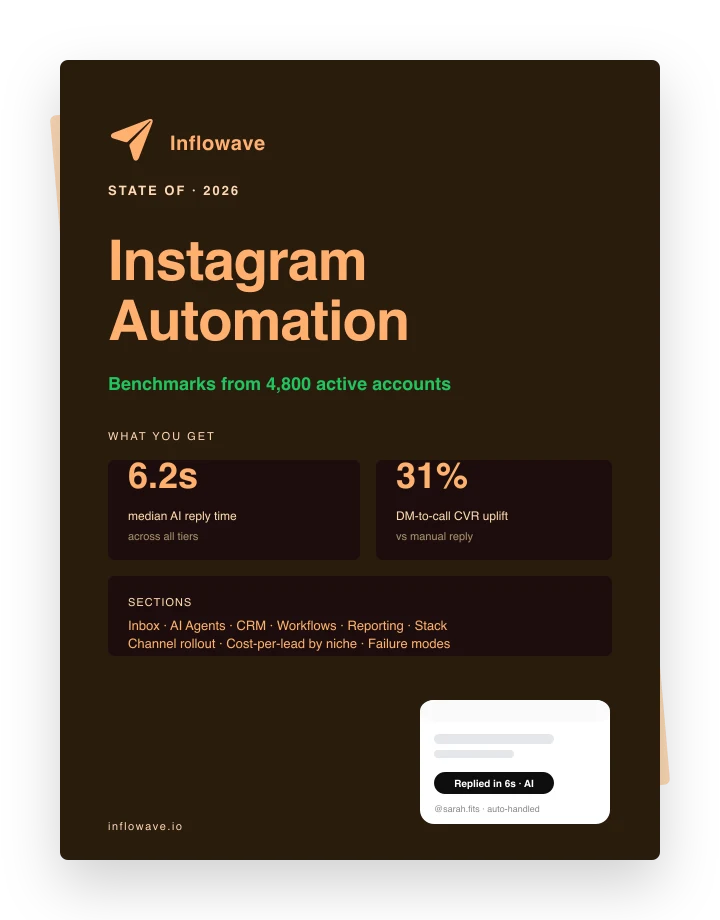
The Automation Benchmarks Are In
Median reply times, DM-to-call CVR uplift, and channel mix from 4,800 active automated accounts. Pulled straight from the platform.