Find local businesses worth pitching
Pick a business type and a city. Get names, websites, phone numbers, ratings and review counts in one list, ready to work through.
What this tool does
Pick a type of business and a city, and the finder returns a list of real companies operating there. For each one you get the trading name, the website, a phone number, the Google star rating, how many reviews sit behind that rating, and the street address. The first ten results are free and open. Enter your email and the rest of the list opens with them.
The data comes from public business listings, the same records that power the map results you see when you search for a business near you. Nothing here is scraped from private sources and nothing is guessed. Where a business has not published a phone number or a website, the field is simply left out rather than filled with a placeholder.
Who this is for
- Marketing agencies building a prospect list for a specific city before a cold outreach push.
- Freelancers and consultants who sell to one type of business and want to know how many of them are within reach.
- Sales teams checking whether a new territory is worth opening before they commit a rep to it.
- Anyone doing competitor research who needs to see every business of a given type in one place.
How to use the results
A list of names is not a pipeline. The fastest way to turn one into the other is to sort before you contact anyone. Rating and review count together tell you how established a business is: a company with four hundred reviews has budget and cares about its reputation, while one with three reviews is either new or not paying attention. Both are worth contacting, but not with the same message.
The website column is the other sorting signal. A business with no website at all is a different conversation from one whose site is ten years old. Open a handful, see what state they are in, and you will find the angle for your first line without having to invent one.
Then stop working from a spreadsheet. Once the list is in a CRM you can see who you have already called, what they said, and when to follow up, which is the part that actually decides whether the list earns anything.
Where to go next
- Put the list into a sales pipelineStages, owners and follow-up dates, so a name you found today is not forgotten next week.
- Run the outreach from one placeEmail and text from the same record, with the replies landing back on the business you contacted.
- Work the phone numbers in orderCall straight down the list without dialling anything by hand, and log the outcome as you go.
- Pitch the businesses that have no websiteThe rows with no site attached are the easiest sale on the list. Build the thing you are selling them.
- Audit a prospect before you contact themA free read on their Instagram presence gives you something specific to open with.
Questions people ask
Where does the business data come from?
Public business listings, the same records behind the map results you see when you search for a business near you. Each entry carries the trading name, website, phone number, star rating, review count and street address as the business itself published them. Where a field was never published, we leave it out rather than fill it with a guess.
How many results do I get for free?
The first ten are open to everyone. Enter your email and the rest of the list opens with it, and we send you a copy so you do not lose it when you close the tab.
Why is there a limit on how many searches I can run?
Every search queries a paid business directory, so the tool is capped per visitor to keep it free for everyone. If you hit the limit, it clears on its own within a few minutes.
Can I export the list to a spreadsheet?
Export to CSV is part of Inflowave rather than the free tool. Most people skip the file entirely and import the list straight into their pipeline, because a spreadsheet cannot tell you who you already called or when to follow up.
Is it legal to contact businesses I find this way?
These are publicly listed business contact details, and business-to-business outreach is generally permitted in most markets, but the rules differ by country and by channel. Calling, emailing and texting each have their own requirements. Check what applies where you and the business are based before you start, particularly for automated calls and text messages.
What makes a business on this list worth pitching?
Rating and review count tell you how established a business is and how much it cares about its reputation. The website tells you what it is currently spending on. A company with hundreds of reviews and a site that has not been touched in years is the clearest opening on any list.
You found them. Now go and win them.
Inflowave holds the list, runs the calls, emails and texts, and tells you which of them turned into money.
Related reading
Guides that go deeper on what this tool measures.
What to do with the list once you have it
Sequencing, follow-up cadence and the point at which a cold list stops being cold.
How a name on a map becomes a lead
The stages between finding a business and having a conversation worth billing for.
Where a prospect list should actually live
Why a spreadsheet of businesses quietly rots, and what to move it into instead.
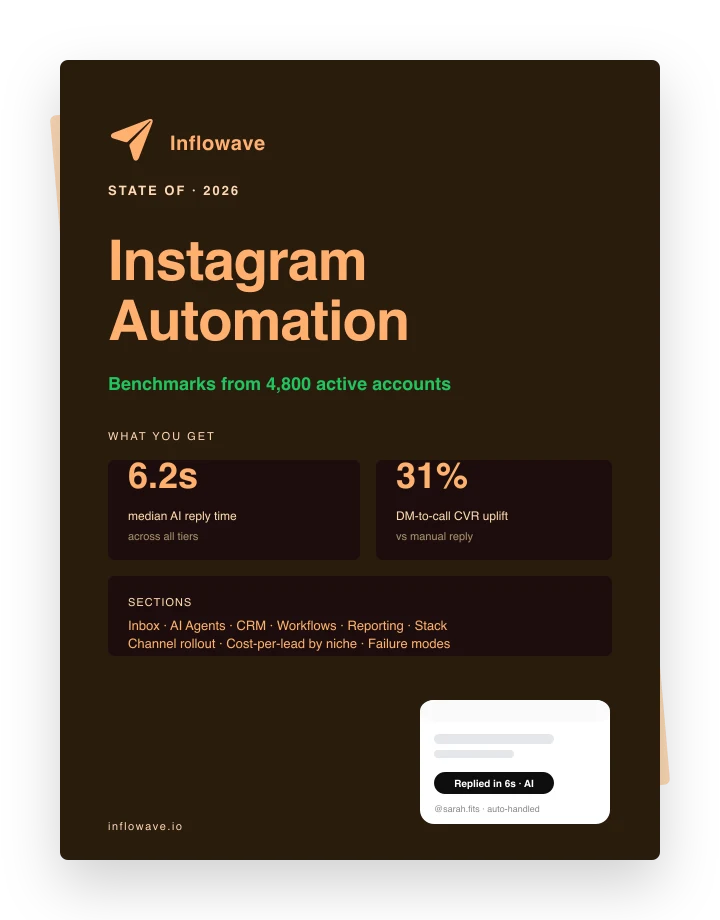
The Automation Benchmarks Are In
Median reply times, DM-to-call CVR uplift, and channel mix from 4,800 active automated accounts. Pulled straight from the platform.