What a local citation service can and cannot do
What a citation actually is, and why inconsistency costs money
A citation is any mention of a business name, address and phone number on a site that is not the business website. Directories, chambers of commerce, industry bodies, review sites, map data providers. The usual explanation is that search engines treat consistency as a trust signal, which is true as far as it goes, but it puts the emphasis in the wrong place. The expensive version of the problem is simpler and has nothing to do with algorithms: somebody looked up the business, found a number that was disconnected two years ago, and called a competitor instead. That happens whether or not any ranking moved. When you are explaining the work to a client, lead with the dead phone number rather than with trust signals, because one of those is a story about their customers and the other is a story about Google.
Almost nothing in this category is actually automated
The standard pitch for listing management software is instant submission to hundreds of directories. It is worth understanding what is really happening underneath, because it shapes what you should expect. A small number of large data aggregators feed a much larger number of downstream directories, so a single submission can propagate widely over weeks. That is real and it is useful. What it is not is direct control of hundreds of sites. Outside that aggregator path, most directories have no write API at all, and a correction means a human filling in a form, or claiming a profile, or waiting on an email verification. Of the 102 directories we keep active, eighty-three are worked by hand and nineteen can only be watched. Not one of them can be created through an API. We say so on the page because the alternative is a customer who believed a hundred sites would update overnight, and that customer asks for a refund in week three.
Some of it only the owner can do, and that is not a limitation to hide
Forty-nine of the active directories require something only the business owner can complete. A postcard to the registered address. A phone verification to the listed number. A login to an account created by whoever set the listing up in 2014 and has since left. No vendor can remove these steps, because they exist precisely to stop a stranger editing a business record. The practical difference between tools is whether they surface that clearly or bury it in a status that reads pending forever. Ours splits the list into what we can do, what needs the owner, and what we can only monitor, and the owner-action items are the ones to raise on the kickoff call rather than in month two. Recording the owner's authorisation once, up front, also removes the most common source of delay.
Not every listing is worth the same, and forty-seven of ours carry a real link
Directory listings differ in two ways that matter and one that does not. What matters: whether anyone actually uses the directory, and whether the link back to the site is dofollow or nofollow. What does not matter much is the raw count, which is the number most vendors advertise. Of our active set, forty-seven carry a dofollow link, and six sit in tier one, meaning they are the ones where being wrong does visible damage. The audit marks all of this, so if the engagement is really a local SEO engagement you can prioritize the entries that pass authority, and if it is really a data-hygiene engagement you can prioritize the ones customers actually read. Those are usually not the same list, and pretending they are is how citation work ends up feeling like busywork.
Citations drift, so this is a subscription not a project
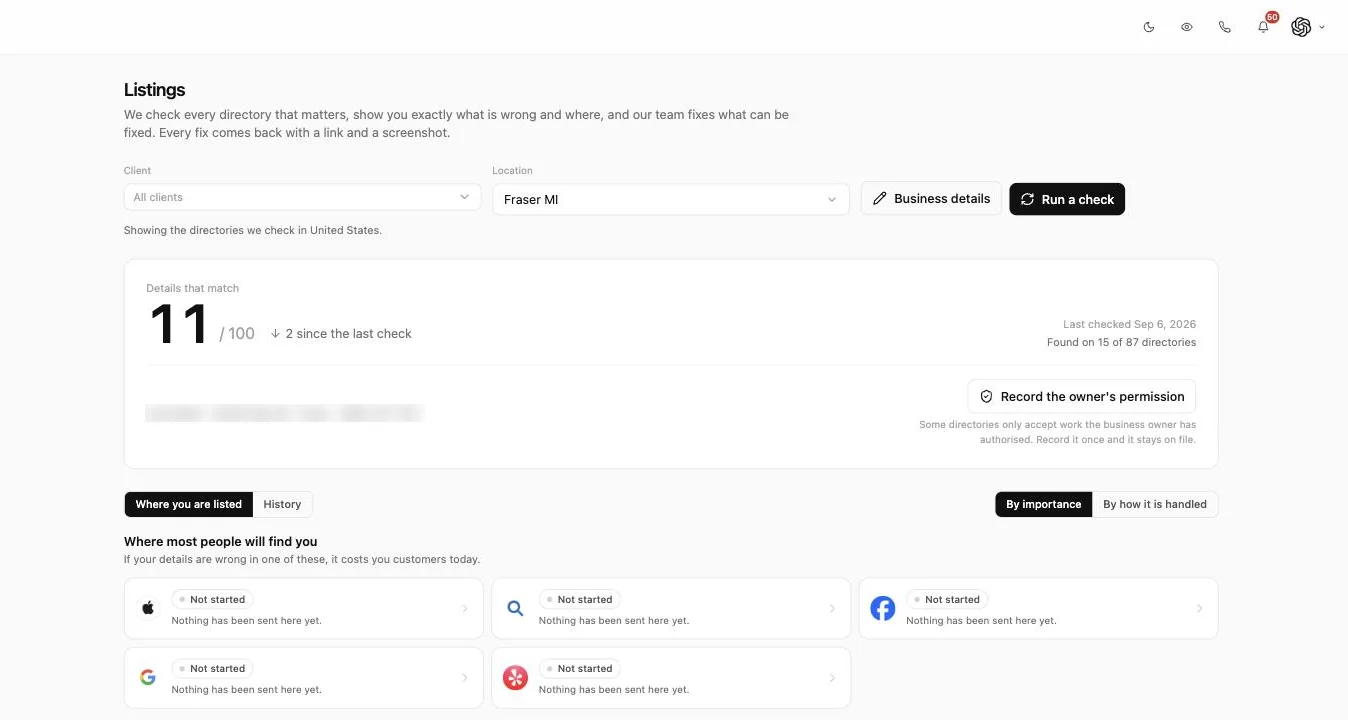
A business that is clean today will not be clean in a year. Aggregators refresh from sources that have their own stale copies. A franchise updates head office records and not the local ones. Someone builds a new website with a new tracking number on it and now two numbers are in circulation. The score moving down between checks is not a failure of the last clean-up, it is the normal behavior of a distributed set of records nobody owns centrally. This is the honest argument for running the check monthly rather than selling a one-off audit, and it is also why the movement since last check is displayed as prominently as the score itself. A client who sees the number fall on its own is a client who understands why the retainer exists.
How to price and sell a citation audit
The audit is the easiest part of an agency offer to sell, because you can run it before the prospect has agreed to anything and the output is a single number they immediately want to improve. A first audit on a business that has never done this typically scores badly, which is uncomfortable to present and extremely effective. Two pieces of advice. Do not lead with the number of directories, because the prospect has no way to judge whether a hundred is a lot. Lead with the specific wrong thing you found, ideally a phone number, on a site they have heard of. And scope the fixing work separately from the audit, because the fixing is bounded by how many directories need owner action, and that number is not knowable until the audit has run.