An AI-powered X growth tool is useful when it removes repetitive work around your ideas, not when it replaces them. The tools that earn their place help with six jobs: finding content ideas, drafting and editing, scheduling, finding the right conversations to join, turning one idea into several pieces, and learning from what worked. The ideas, the voice and the relationships stay yours. This guide explains what each job involves, what to expect from AI at each step, how to build a simple weekly workflow, and what happens after the audience starts engaging.
Growing an audience on X can look simple from the outside: publish consistently, join conversations, share useful ideas, and build relationships with people in your niche.
In practice, it is a very different story.
Creators and solopreneurs are expected to come up with content ideas, write posts, research their audience, engage with other accounts, monitor performance, and stay consistent, often while running a business at the same time.
That is where AI-powered X growth tools are becoming increasingly useful.
The goal isn't to replace the creator. The best tools remove repetitive work and make the process more structured, giving creators more time to focus on their ideas, expertise, and relationships.
The short answer
| Question | Answer |
|---|---|
| What does an AI X growth tool actually do? | It helps with ideation, drafting, editing, scheduling, finding conversations, repurposing and learning from results. |
| Can AI grow my X account on its own? | No. It can save time on the repetitive parts, but ideas, opinions and relationships have to come from you. |
| What is the best workflow? | Human idea, AI assistance, human editing, then publishing. Not AI prompt, AI post, publish. |
| Is scheduling enough? | No. Scheduling gets posts out consistently, but it does not create conversations or relationships. |
| How much time should engagement take? | Treat it as a regular block of its own, because replies in relevant conversations build relationships that posting alone does not. |
| What happens after people engage? | You need a place to follow up with them, track leads and turn attention into customers. That is a CRM job, not an X tool job. |
Plain rule: use AI as a layer around your existing workflow, not as a replacement for your voice. If a post could have been written by anyone, it will be read as if it were.
Why X growth is becoming a systems problem
One of the biggest challenges with growing on X isn't necessarily knowing what to do. Most creators already understand the basics.
The difficult part is doing those things consistently.
You might have ten ideas in your notes but never turn them into posts. You might publish regularly but forget to engage with relevant conversations. Or you might spend an hour writing one post that could have been improved in ten minutes with the right feedback.
There are also several different activities happening at the same time:
- Capturing ideas before you forget them
- Drafting and editing posts
- Scheduling content so you stay consistent
- Finding and joining relevant conversations
- Reusing strong ideas in more than one format
- Reviewing what worked and adjusting
AI can help connect these activities into a repeatable workflow.
Instead of asking AI to simply "write me a viral tweet," creators can use it as a layer around their existing workflow, helping with research, ideation, editing, organization, and execution.
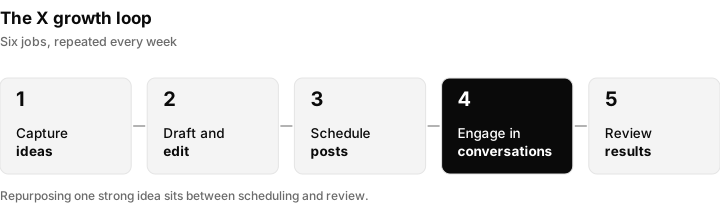
Six connected jobs make up X growth. Most people only do the first three, which is why engagement and review are where a system helps most.
What should an AI-powered X growth tool actually do?
Not every AI social media tool is designed for growth.
Some are essentially AI writing assistants. Others are scheduling platforms. Some focus primarily on analytics.
For creators and solopreneurs, the most useful tools tend to cover several parts of the growth process. Use the table below to see which type you are looking at before you pay for anything.
| Type of tool | What it is good at | What it usually does not do |
|---|---|---|
| AI writing assistant | Drafting, rewriting, shortening, changing tone | Scheduling, finding conversations, measuring results |
| Scheduler | Queueing posts and keeping a calendar | Deciding what to post or who to talk to |
| Analytics tool | Showing which posts performed | Telling you what to do next |
| Full growth workflow | Connecting ideas, drafts, schedule, engagement and review | Replacing your judgement and voice |
1. Content ideation
The first bottleneck is often coming up with something worth posting.
AI can analyze existing content, identify recurring topics, suggest different angles, and help transform one idea into multiple posts. For creators who want to extend an idea beyond text, some platforms let you generate AI videos directly from a written post, adding another format to the mix.
This is especially useful when you have expertise but struggle to turn that expertise into daily content.
For example, a founder building a SaaS product could turn one experience into several different posts:
- The mistake they made and what they would do differently
- A short lesson from a customer conversation
- A contrarian opinion that came out of a hard decision
- A simple how-to based on something they solved this week
- A question for their audience about how they handle the same problem
The objective isn't to let AI invent your expertise. It is to help you extract more content from the expertise you already have.
2. AI-assisted writing
Writing tools have become much better at adapting to specific formats and tones.
Instead of generating generic social media copy, modern AI tools can help creators rewrite an existing idea, improve the hook, shorten a post, expand an argument, or adapt a concept to a particular writing style.
This distinction matters.
The best workflow is usually:
Human idea → AI assistance → Human editing → Publishing
rather than:
AI prompt → AI post → Publish
Your experiences, opinions, and personality are what make your content interesting in the first place.
For creators who want an AI layer specifically focused on X content, AI-powered X post writing can help turn rough ideas into more structured posts without requiring every sentence to be generated from scratch.
Tools such as SupaBird, for example, approach this through features designed around X-specific writing rather than treating the platform like another generic social network. Its X-GPT feature can analyze selected creators and a user's writing style to help produce posts that better match the desired format and voice.
A practical editing pass for any AI draft:
- Cut the first sentence if it only warms up. Start where the idea starts.
- Replace generic claims with your own example. One real detail beats three general statements.
- Remove words you would never say out loud. If it reads like a press release, it will be scrolled past.
- Check every fact. AI will state things confidently that are wrong. Anything you cannot confirm should come out.
- Read it as the audience. Would a stranger in your niche know why this matters to them?
3. Scheduling and consistency
Consistency sounds easy until you have a business to run.
A creator may have enough ideas to publish for an entire week, but remembering to manually publish every few hours isn't an efficient use of time.
Scheduling tools solve this relatively simple but important problem. Instead of opening X repeatedly throughout the day, creators can prepare content in advance and organize it into a publishing calendar.
But scheduling should not become the entire growth strategy. Publishing consistently gets content in front of people. It doesn't automatically create meaningful conversations or relationships.
That is why modern X growth workflows are increasingly combining scheduling with ideation, engagement, and performance feedback.
X content scheduling tools can therefore be most useful when they are part of a larger workflow rather than being treated as the growth strategy itself.
If you manage several platforms or several clients, a scheduler that covers more than X saves switching between tools. See the best social media schedulers for how the main options compare.
4. Finding the right conversations
One of the most overlooked parts of X growth is engagement.
A creator can publish excellent content but remain relatively invisible if they never participate in conversations outside their own profile.
The challenge is that manually finding worthwhile conversations takes time. You could spend 30 minutes scrolling through your feed and still not find the discussions that are most relevant to your niche. AI can help surface potential conversations based on topics, accounts, and interests.
This changes the workflow from:
"Scroll until I find something interesting."
to:
"Here are several relevant conversations I could contribute to."
That difference is particularly valuable for solopreneurs because meaningful replies can build relationships with potential customers, partners, and other creators without requiring a large advertising budget.
A reply that adds something is worth more than a reply that only agrees. Good replies usually do one of these things:
- Add a specific example from your own experience
- Ask a sharp follow-up question
- Offer a different angle, politely
- Point to a useful resource without making it a pitch
Replies that do none of these tend to look like automation, and they are easy to ignore.
5. Turning one idea into multiple pieces of content
Another major opportunity for AI is content repurposing.
A strong idea shouldn't necessarily exist as one post.
Imagine you write a detailed X thread about how you launched your SaaS product.
That same idea could become:
- A short post with the single lesson that mattered most
- A newsletter section expanding the story
- A LinkedIn post adapted to a more professional tone
- A short video script
- A reply you can reuse when someone asks a related question
- A blog article for your site
This is where AI can dramatically increase the output of a solo creator.
Instead of constantly searching for completely new ideas, you can build a content system around your strongest ideas and distribute different versions across relevant formats.
The key is adaptation rather than simple copy-and-paste. Different platforms have different audiences, expectations, and content formats.
6. Learning from performance
AI can also help creators move from guessing to learning.
Instead of asking only, "How many impressions did this post get?" you can start asking:
- Which topics led to replies from the right people?
- Which hooks made people stop and read?
- Which posts brought profile visits, follows or messages?
- Which formats (short post, thread, image) performed best for this audience?
- Which time of day gets responses from the people you want to reach?
This turns your X account into a feedback loop.
You publish something.
You measure the response.
You identify a pattern.
You create another variation.
Then you measure again.
The goal isn't to optimize every post for maximum impressions. A post with fewer impressions but several highly relevant conversations may be more valuable to a consultant or founder than a post that receives thousands of low-quality views.
What to expect from AI, and what not to hand over
AI is good at some jobs and poor at others. Knowing the line saves you from the most common mistakes.
| Job | Fine to hand to AI | Keep for yourself |
|---|---|---|
| Ideas | Suggesting angles from your notes | The experiences and opinions themselves |
| Drafting | First structure, alternative hooks | The final voice and any claims you make |
| Editing | Shortening, fixing grammar | Deciding what is true and what to leave out |
| Replies | Surfacing conversations worth joining | Writing the reply and deciding whether to reply |
| Reporting | Summarising what performed | Deciding what to change |
| Relationships | Reminders and organisation | Every actual conversation with a real person |
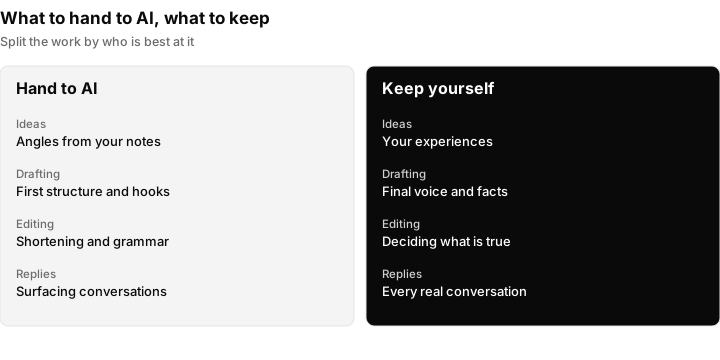
Hand over the repetitive work. Keep the experiences, the facts and the relationships.
Building a simple AI-powered X workflow
You don't need ten different tools to build an effective system.
A simple workflow could look like this:
Step 1: Capture ideas. Keep a running list of observations, questions, customer conversations, mistakes, lessons, and opinions.
Step 2: Expand the ideas. Use AI to turn one raw thought into several possible angles.
Step 3: Write. Create the first draft yourself or use AI to structure the idea.
Step 4: Edit. Remove generic language and add your own examples, opinions, and personality.
Step 5: Schedule. Organize several posts ahead of time so consistency doesn't depend on your daily availability.
Step 6: Engage. Spend time responding to relevant conversations instead of relying exclusively on your own posts.
Step 7: Review. Look at what generated meaningful engagement and use those insights to improve the next batch.
This kind of system can turn X from a daily task into a repeatable growth process.
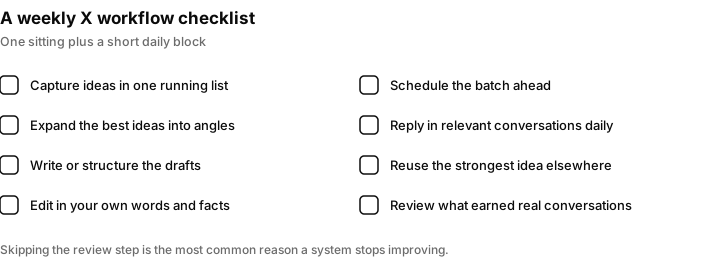
A weekly checklist you can run in one sitting plus a short daily engagement block.
An example week
This is a template, not a benchmark. Adjust the numbers to your own capacity.
| Day | Task | Time to set aside |
|---|---|---|
| Monday | Review last week, pick the two best-performing topics | 20 minutes |
| Tuesday | Expand ideas, draft the week's posts | 45 minutes |
| Wednesday | Edit drafts, schedule the batch | 30 minutes |
| Daily | Reply in relevant conversations | 15 minutes |
| Friday | Reuse the strongest idea in a second format | 30 minutes |
The point is not the exact minutes. It is that every job has a place in the week, so none of them quietly gets dropped.
Mistakes to avoid
- Publishing raw AI output. It sounds like everyone else, and your audience can tell.
- Treating scheduling as strategy. A full queue is not the same as a conversation.
- Chasing impressions. A post seen by the right ten people can beat one seen by a thousand wrong ones.
- Automating replies and follows with no judgement. Low-quality automated engagement damages trust. Check the platform's current rules on automation at X's own help centre before you automate anything.
- Copying other creators. Learn their structure, not their sentences.
- Never reviewing. Without a weekly look at results, you repeat what did not work.
- Ignoring what happens after the reply. Interest that is not followed up goes cold.
What happens after the audience engages
While X can be an important channel for building an audience, creators and solopreneurs often need a system for what happens after that audience starts engaging with the business.
A reply, a direct message or a profile visit is the start of a relationship, not the end of the job. If you sell a service, a course or a product, someone will eventually ask a question that needs a proper answer, a booking link or a follow-up a week later. If those conversations sit in a notification feed, they get lost.
This is why many creators move the people who show interest into a CRM, where each person has a history, a stage and a next step. For how to think about that stage, see what a sales pipeline is and social selling.
How Inflowave fits alongside X-specific tools
Inflowave takes a broader approach by combining CRM, messaging, automation, content management, and lead follow-up in one place. For creators who are turning social media attention into leads and customers, that broader layer can complement the more X-specific tools used for content creation and engagement.
On the content side, Inflowave's social media scheduling covers posts, images and video on X alongside Instagram, Facebook, TikTok, YouTube and LinkedIn from one calendar. Replies to published posts land in the same inbox as direct messages, as leads, and comments on a published post can trigger a workflow. If you manage several accounts, the unified inbox keeps conversations from different channels in one list.
It is not an X-only writing tool, and it does not try to be one. If you want help with X-specific writing, an X-focused tool like the ones above is the better fit, and Inflowave is the place where the leads they create get followed up. For a wider comparison, see the best social media management tools.
Final thoughts
AI isn't going to replace the need for good ideas, expertise, or relationships on X.
What it can replace is a lot of the repetitive work surrounding them.
For creators and solopreneurs, that can make a significant difference. Instead of spending hours researching topics, rewriting posts, organizing calendars, and searching for conversations, you can use social media management tools to handle more of the operational workload.
The strongest approach is not to automate your entire presence.
It is to build a system where AI handles the repetitive parts while you remain responsible for the ideas, voice, relationships, and strategy.
That is ultimately what makes AI tools for X growth useful: they don't have to create your personal brand for you. They simply give you more leverage to build it consistently.
Questions people ask
What is an AI-powered X growth tool?
It is software that uses AI to help with parts of growing an account on X, such as coming up with ideas, drafting and editing posts, scheduling, finding conversations to join and reviewing results. The better ones connect several of these jobs instead of doing only one.
Can AI grow my X account for me?
Not on its own. AI can remove repetitive work and speed up drafting, but growth comes from having something worth saying and taking part in conversations with real people. Treat AI as a layer around your own ideas, voice and relationships, not as a replacement for them.
Is it okay to use AI to write posts for X?
Using AI to help draft, rewrite or shorten posts is common, and the sensible approach is to start from your own idea and edit the result yourself. Publishing raw AI output tends to sound generic. Check X's current rules at its own help centre if you plan to automate anything beyond writing.
How often should I post on X?
There is no universal number, and we do not have a verified figure to give you. What matters is a frequency you can keep up every week. Pick a rhythm you can sustain, schedule it in batches, and review results before changing it.
Do I need a scheduling tool for X?
You do not strictly need one, but it helps if you struggle to publish consistently. Preparing posts in advance means consistency does not depend on your availability each day. Just remember that scheduling gets posts out, it does not create conversations, so pair it with regular time for replies.
How do I find the right conversations to reply to?
Start with the topics and accounts closest to your niche and look for discussions where you can add an example, a useful question or a different angle. AI tools can surface likely conversations, which saves scrolling. The reply itself should still be written by you.
How do I know if my X strategy is working?
Look past impressions. Ask which posts brought replies from the right people, profile visits, follows or messages, and which led to real conversations. A post with fewer impressions but several relevant conversations can be worth more to a consultant or founder than one with thousands of low-quality views.
What should I do with people who engage with my posts?
Treat them as the start of a relationship. Reply properly, move serious interest into a place where you can track and follow up, and give each person a next step. A CRM is built for this, because it keeps each person's history and stage together.
Can I use one tool for X and my other social channels?
Yes, many creators prefer one calendar across platforms to avoid switching. The trade-off is that a general tool may not have X-specific writing features. Many people use a general scheduler or CRM for the workflow and an X-focused tool for drafting.