If you are searching for voicemail drop software, you already have three or four tabs open. Probably Slybroadcast or Drop Cowboy, probably PhoneBurner or Kixie, probably CloudTalk or whatever your CRM claims it can do. Those tabs are not variations of the same product. They are three genuinely different categories that happen to share a phrase, and picking the wrong category is the most expensive mistake in this purchase.
So start with the comparison, not the pitch.
All prices below were checked against each vendor's own live pricing page on 15 September 2026. Where a vendor does not publish a figure, that is stated rather than guessed. Pricing changes; re-check before you sign anything.
The three categories hiding behind one search term
Ringless voicemail platforms
Slybroadcast, Drop Cowboy and VoiceDrop are not dialers at all. They deposit a message directly into a carrier voicemail box without placing a ringing call to the handset, and they price per delivered message rather than per seat.
Drop Cowboy publishes its full rate card. Plans run from $125 per month for roughly 62,762 messages per year with overages at 2.1 cents each, through $250, $500 and $1,000 tiers, up to $4,000 per month for about 3,221,477 messages with overage at 1.2 cents. There is a separate compliance charge of $0.0031 per message, AI voice cloning at $0.005 per 100 characters, and $0.15 per forwarded US or Canadian call.
Slybroadcast charges only for successfully delivered messages and sells two ways: pay as you go, starting at $12 for 100 deliveries, or monthly delivery plans starting at $8 per month for 100 deliveries and scaling to $500 per month for 13,000. Monthly plan credits expire after 30 days; pay-as-you-go credits do not. Callback numbers are sold as a separate line item, but Slybroadcast does not publish their price on its pricing page, so ask before you budget for one. Both the AI personalisation and follow-up texting features consume two credits per delivery rather than one, which roughly doubles the effective rate if you use them.
VoiceDrop sells voice-unit bundles: Budget at $95 per month for 500 units, Individual at $495 for 6,500, Growth at $995 for 15,000, Scale at $1,995 for 40,000, and a custom Enterprise tier. Units roll over for 90 days.
What this category is genuinely better at: raw volume economics. If your job is to place a pre-recorded message in front of hundreds of thousands of numbers, nothing built into a CRM will touch that unit cost.
What they are honest about, to their credit: Drop Cowboy's own pricing page states that "prior express written consent [is] required for all pre-recorded or artificial voice messages (including AI calls)" and that compliance with the TCPA, the Telemarketing Sales Rule, CTIA guidelines, state law and the Do Not Call registry is the customer's responsibility. That is the correct framing, and it quietly rules the category out for most agency prospecting lists, because you almost certainly do not hold signed written consent from a cold list.
Dialer-first platforms with a drop button
These are phone systems that added a drop button, and the thing worth noticing is how differently they gate it.
PhoneBurner is the most generous. Standard is $140 per user per month billed annually ($165 monthly), Professional $165 annually ($195 monthly) and Premium $183 annually ($215 monthly), with "1-click voicemails" listed as a core feature on all three tiers rather than as a paid upgrade.
CloudTalk prices in euros: Lite €19, Starter €25, Essential €29 and Expert €49 per user per month billed annually (€27, €34, €39 and €69 monthly). Voicemail drop ships inside the Power Dialer add-on, which is €15 per user per month billed annually on Lite, Starter and Essential, and is included at no extra cost on Expert. So the drop is a paid add-on on the three lower tiers and a base feature on Expert. The parallel dialer is a separate €39 per user per month add-on billed annually.
JustCall lists Team at $29, Pro at $49 and Pro Plus at $89 per user per month billed annually, with Business and SalesPro quoted rather than published. The power dialer starts at Pro, but the voicemail automation suite is confined to SalesPro, the custom-priced tier.
Ringover puts the power dialer on Business and above, and voicemail drop only on Advanced, which is quoted rather than publicly priced. Its published TALK and BUSINESS figures are presented ambiguously enough on the live page that we are not reproducing a number here.
Kixie names three tiers, Professional, Single-Line PowerDialer and Multi-Line PowerDialer, with voicemail drop on all three and, in Kixie's own wording, "Unlimited Minutes" for US and Canada calls. It does not publish per-user prices on its pricing page; you have to ask.
Klenty is a sales engagement tool rather than a phone system: Starter $50, Growth $70 and Plus $99 per user per month billed annually, with a Parallel and Power Dialer add-on at $45 per user per month. Its pricing page does not map voicemail drop to a specific tier.
The pattern is worth naming. In this category the drop button is frequently the upsell, not the base feature. PhoneBurner and Kixie include it everywhere; CloudTalk bundles it into a paid add-on unless you are on its top published tier; JustCall and Ringover push it into the tier that has no public price. Check which of those you are buying before you compare headline rates.
What they are genuinely better at: dialing discipline. Call quality, number management, local presence and rep-level ergonomics are their whole business, and they are usually better at it than a CRM that added calling later. If your team's entire day is the phone, that focus is worth paying for.
The trade-off is the seam. The dialer holds the call and the CRM holds the customer, and the sync between them is where outcomes, recordings and notes quietly go missing.
CRM-embedded voicemail drop


HubSpot Sales Hub runs Free at $0, Starter at $7 per seat per month billed annually ($20 billed monthly), Professional at $90 per seat per month billed annually ($100 billed monthly) and Enterprise from $150 per seat per month billed annually. Professional and Enterprise also carry one-time onboarding fees of $1,500 and $3,500. Calling is included on every paid tier, Starter included, contrary to a claim that circulates widely. What differs is the pooled minute allowance: HubSpot's pricing page lists 500 minutes and one HubSpot-provided number on Starter, 3,000 minutes and up to three numbers on Professional, and 12,000 minutes and up to five numbers on Enterprise. The important structural point is that the pool is per account, not per seat, so it divides by the number of people dialling.
GoHighLevel starts at $97 per month billed monthly for Starter, $297 for Unlimited and $497 for Agency Pro, with Enterprise quoted. Annual billing is offered at ten months for twelve ($970, $2,970 and $4,970 per year). Two separate add-ons get confused constantly and they are not the same product: the white label mobile app is $497 per month, while the Branded Client Portal App is $49 per month per sub-account. GoHighLevel is explicit that the subscription covers platform features while telephony, SMS, email and premium AI usage are billed on top, and that higher tiers let you rebill those costs to clients with a markup.
What GoHighLevel is genuinely better at than we are: the rebilling machinery. If your business model is marking up client telephony spend, that is a mature, well-worn path there, and the $497 white label mobile app exists precisely for agencies that want to disappear behind their own brand entirely.
Inflowave sits in this third category, at $27, $149, $297 and $497 per month billed monthly, carrying caps of 1, 1, 10 and 50 connected accounts respectively. The honest reason to choose it over the two categories above is not price and it is not the drop button, because everyone has a drop button. It is that the answering-machine decision, the recording, the transcript, the outcome tag and the follow-up timer all write to the same lead record, so there is no sync to go wrong.
The rest of this article is the part a listicle cannot check: how the detection and the follow-up actually behave.
What a voicemail drop actually is
A voicemail drop is a pre-recorded or synthesised message played into a voicemail box during a call your system placed, so the rep does not have to speak it. The rep does not wait for the greeting, does not listen for the beep, and does not repeat the same sixty seconds forty times an hour. The system detects that a machine answered, waits for the greeting to finish, plays the file, and hangs up. The rep is already on the next number.
It is not the same thing as ringless voicemail. Ringless voicemail skips the handset entirely and inserts a message into the voicemail platform by another route. A voicemail drop is a real outbound call that happened to reach a machine. That distinction matters legally, and it matters to the person on the other end, whose phone did ring.
Answering machine detection: the part that actually decides everything
Everything about a drop depends on one question being answered correctly in the first few seconds: did a person pick up, or did a machine? Get it wrong in one direction and you play a recording at a human. Get it wrong in the other and a rep gets handed a voicemail greeting.
Inflowave places calls through Twilio, and Twilio's answering machine detection runs in one of two modes, documented on Twilio's answering machine detection page.
Enable returns a verdict as soon as the called party is identified. The possible results are machine_start, human, fax and unknown. This is the fast mode, and it is the right one when you want to route a live human to an agent immediately.
DetectMessageEnd returns immediately for humans, but for machines it waits until the greeting has finished, which is usually signalled by a beep. Its results are machine_end_beep, machine_end_silence, machine_end_other, human, fax and unknown. This is the mode a voicemail drop needs, because playing your message over someone's outgoing greeting wastes the first ten seconds of it.
The tuning knobs are real and they matter. Twilio's detection timeout defaults to 30 seconds and can be set between 3 and 59. The speech threshold defaults to 2,400 milliseconds, the speech-end threshold to 1,200 milliseconds, and the silence timeout to 5,000 milliseconds. Detection is synchronous by default, which means the call waits for the verdict before proceeding.
Here is the part worth internalising: detection is a judgement call, not a lookup. In an Inflowave production sample of 2,319 call records logged between 9 March and 15 September 2026, only 50 carried a detection result at all, because detection is enabled per call rather than forced on everything. Of those 50: machine_end_other 24, machine_end_beep 13, human 7, unknown 6.
Fifty calls is far too small a sample to tell you anything about the market, and we are not going to pretend otherwise. What it does tell you is that a non-beep ending is a normal outcome rather than an edge case, which is exactly why Twilio ships a silence timeout and why a drop system that only listens for a beep will clip messages. Test that behaviour against your own numbers before you trust it.
The practical rule: run DetectMessageEnd when the goal is to leave a message, run Enable when the goal is to connect a human fast, and do not run either on a call where the rep is dialling a known contact by hand.
What happens, step by step, when a drop runs
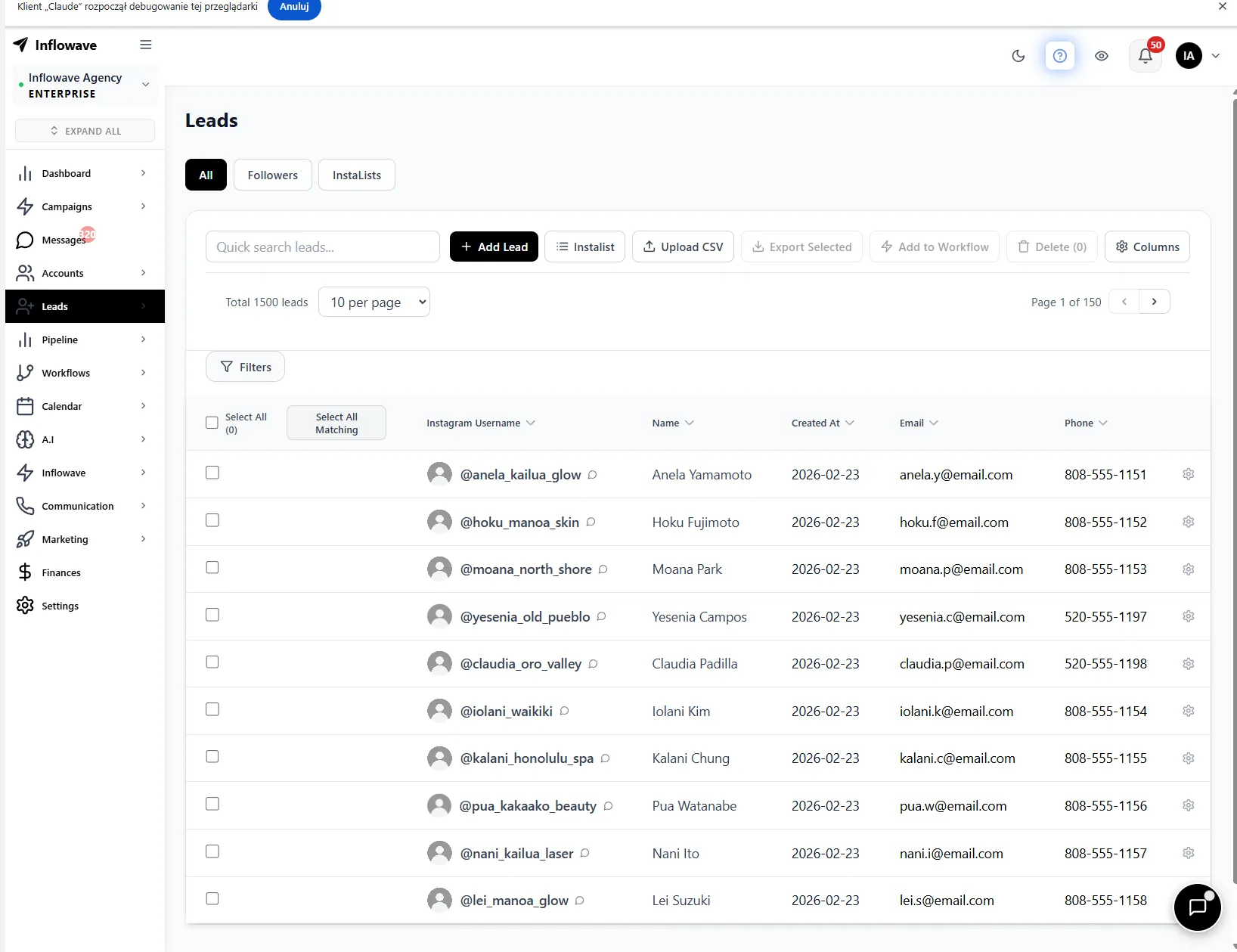
The queue is a saved filter, not a CSV. That is why re-running it next week picks up the leads that have since changed status, and skips the ones already called.
The queue is built from CRM filters. You segment leads by stage, source, tag, industry, last-contact date or any custom field, and send that segment to the dialer as a dial session, which tracks total, completed and skipped counts and carries an idempotency key so a double-click does not create two sessions.
The call is placed and detection runs. The dialer works down the queue one number at a time. Detection returns its verdict and the verdict is written to the call record.
A machine result triggers the drop. The workspace's caller ID settings hold two fields that govern this: a flag for whether automatic voicemail drop is enabled, and the ID of the template to use. If the flag is on and a template is set, the message plays without the rep touching anything. If the flag is off, the rep gets a single control to fire the drop manually and move on.
The call record closes with everything attached. Numbers, status, duration, price, the detection result, the lead, the campaign, the employee who owned it and the recording all land on one row, which is what makes a call searchable later rather than dependent on someone's memory. Every row also carries an agency and a workspace identifier, and voicemail templates additionally carry a client identifier, so an agency running outbound for eight clients keeps eight separate template sets and eight sets of call records that do not mix.
A follow-up timer starts. This is the step most tools skip. A drop creates a follow-up row holding the lead, the call, the moment the drop happened, and a wait period after which the system checks back. All 17 follow-up rows on production as of 15 September 2026 use a 24-hour wait. When that window expires, the system checks whether the lead called back. If they did, the row is marked returned and nothing fires. If they did not, the follow-up fires: a message on another channel, a task, a workflow, whatever you configured.
That fifth step is the whole argument for keeping the drop inside the CRM. A voicemail on its own is a message into a void. A voicemail plus a timed check on whether the person came back is a sequence, and sequences are what actually book meetings.
A drop is the first touch, not the only one. The follow-up fires only if the lead did not call back inside the wait window.
Keeping a recorded message from sounding recorded
Two template types exist: an uploaded audio file, or speech synthesised from a stored script in a chosen voice and language. In the Inflowave production sample of 15 September 2026 there were 12 templates in total, 10 of them text-to-speech and 2 uploaded audio, using Amazon Polly voices in American and British English.
The interesting number is length. Across those 10 scripts, the shortest is 96 characters and the longest 180. That is roughly ten to twenty seconds spoken. Not one of them is a pitch. They are all some variation of a name, a reason, a number and a reason to call back, which is the voicemail structure that consistently works.
Two practical rules follow. First, record several and rotate them, because a prospect who has heard the identical audio three times knows exactly what it is. Second, if you use a cloned voice for the synthesised option, it should be the voice of the person whose name is in the message and whose number the callback reaches. A drop recorded by a rep who left in March is worse than no drop at all.
Consent, and where the line actually sits
This is the question the search results ask most, and it deserves a straight answer rather than a disclaimer.
A pre-recorded voice message is a regulated thing in the United States. The rule text lives in 47 CFR 64.1200, and the operative phrase is "prior express written consent," which the rule defines as a written agreement bearing the signature of the person called that clearly authorises the calls. The rule prohibits initiating a telephone call to a residential line using an artificial or prerecorded voice to deliver a message that includes or introduces an advertisement, or constitutes telemarketing, without that consent. The underlying statute is 47 U.S.C. 227. The Federal Trade Commission's separate Telemarketing Sales Rule obligations are set out in its compliance guide, and the national suppression list is at donotcall.gov.
What this means in practice:
- A drop to a number that submitted your form, requested a callback or is an existing customer is a different legal object from a drop to a purchased list. Treat them differently.
- "It did not ring" is not a defence. The regulation is about the prerecorded message, not the ringing.
- Suppression has to be enforced before the dial, not apologised for after. Inflowave holds a do-not-call list scoped per agency and per workspace, with numbers stored as hashes. It is available and enforced at the platform level, though it is worth saying plainly that it held zero entries on production as of 15 September 2026, which tells you something about how many teams remember to populate one.
- None of the above is legal advice, and the rules outside the United States are different again.
What it does not do
Being specific about limits is more useful than another feature bullet.
- It cannot make an uninterested person interested. Voicemail drop removes the cost of leaving a message. It does not change the reply rate of a bad list.
- Detection is probabilistic. A
machine_end_otherresult on a slightly unusual greeting occasionally clips the first word. Start your message with a pause, not with your name. - Inflowave's dialer is a power dialer, one number at a time. It is not a predictive dialer, and it will not give you predictive-dialer connect rates. That is a deliberate choice, explained on the power dialer feature page, and it is the right trade for teams under about fifty seats.
- Voicemail drop usage on Inflowave is real but young. The numbers above are the honest scale of it, all from the Inflowave production sample to 15 September 2026: 12 voicemail templates, 17 follow-up rows, and 50 of 2,319 call records carrying a detection verdict. This is a capability in early production use, not one with years of volume behind it. Anyone telling you their drop feature is battle-tested should be asked for the same three numbers.
- If you want the call itself placed and qualified without a rep, that is a different product. See the AI voice agent page rather than trying to make a drop do it.
A short buying checklist
- Are you buying volume delivery or conversation infrastructure? If volume, buy a ringless platform and get your consent story in writing first. If conversations, buy a dialer or a CRM.
- Is voicemail drop in the tier you are actually going to buy? CloudTalk bundles it into the Power Dialer add-on, which is free only on Expert, JustCall confines it to SalesPro and Ringover to Advanced, both of which are quoted rather than priced. PhoneBurner and Kixie include it throughout.
- Does answering machine detection run in message-end mode, and can you see the detection result on the call record afterwards? If you cannot audit it, you cannot tune it.
- Does anything happen automatically if the lead does not call back? If not, you have bought a button, not a process.
- Are templates, numbers and call records separated per client? For an agency this decides whether the tool survives past three accounts.
- Is telephony billed inside the subscription or on top of it? GoHighLevel is upfront that it is on top. HubSpot's minute pool is per account rather than per seat. Check the others.
The honest summary: every tool in this market can play a recording into a voicemail box. The differences that survive contact with a real week of outbound are what the system does with the detection result, where the record lands, and whether anything happens tomorrow. Compare on those three and the shortlist gets short fast.
Frequently asked questions
Is voicemail drop illegal?
Dropping a message is not illegal in itself. What is regulated is the prerecorded message. Under 47 CFR 64.1200, initiating a call to a residential line using an artificial or prerecorded voice that constitutes telemarketing requires prior express written consent, defined as a signed written agreement authorising the calls. Drops to leads who requested contact sit differently from drops to a purchased list. Rules vary by country and this is not legal advice.
What does voicemail drop mean?
It means playing a pre-recorded or synthesised message into a voicemail box during a call your system placed, so the rep does not speak it. The system detects that a machine answered, waits for the greeting to finish, plays the file, and ends the call. The rep moves to the next number without waiting. The point is to remove the repeated sixty seconds, not to remove the human from the process.
Do voicemail drops work?
They work as a time saver with certainty and as a response driver conditionally. The saving is arithmetic: a rep who would leave forty messages at roughly twenty seconds each gets that time back. Response depends entirely on list quality and on whether anything follows the drop. A voicemail with no timed follow-up is a message into a void, which is why the follow-up window matters more than the recording.
How do ringless voicemails work?
Ringless voicemail places a message into a carrier voicemail box without ringing the handset, using a separate route to the voicemail platform rather than a normal connected call. That is different from a voicemail drop, which is a real outbound call that reached a machine and then played a recording. The distinction matters to the recipient, whose phone rings in one case and does not in the other.
Are ringless voicemails illegal?
Vendors in the category themselves state that prior express written consent is required for prerecorded and artificial voice messages, and that compliance with the TCPA, the Telemarketing Sales Rule, CTIA guidelines, state law and the Do Not Call registry is the sender's responsibility. The absence of a ring is not a defence, because the regulation attaches to the prerecorded message. Check consent before volume, not after.
How do I stop ringless voicemail?
Register the number on the national Do Not Call registry at donotcall.gov, and tell any specific sender to stop. Under 47 CFR 64.1200 a called party may revoke prior express consent, including prior express written consent, and revocation requests made in any reasonable manner must be honoured within a reasonable time not exceeding ten business days. Keep a record of when you asked.
What is the best voicemail drop service?
There is no single best, because three different products share the name. For high-volume delivery, ringless platforms such as Drop Cowboy, Slybroadcast and VoiceDrop win on unit cost, and they price per delivered message rather than per seat. For dialing ergonomics, PhoneBurner, CloudTalk, Kixie, JustCall and Ringover are phone systems first and better at it, though only some of them include the drop in their published tiers. For keeping the outcome, recording and follow-up attached to one customer record, a CRM-embedded drop wins. Pick the category before the vendor.