Most people arrive at this question already holding a shortlist. Salesforce has been pushing Agentforce at every existing Sales Cloud customer. GoHighLevel has been selling AI Employee as a per sub-account add-on to agencies. Artisan runs ads for Ava, the AI BDR. Vapi and its peers sell the raw voice infrastructure to anyone willing to assemble the rest. They are all called AI sales agents, and they are not the same product in any meaningful sense.
So before anything else, here is an honest read of what each one actually is, using their own published pricing and documentation, followed by the part that matters more than the shortlist: which parts of a sales conversation an agent can genuinely finish by itself, and which parts it has to hand back to a person.
The shortlist, read fairly
Salesforce Agentforce

Agentforce is the most architecturally serious thing on this list, and it is priced accordingly. Salesforce's Agentforce pricing page publishes three buying models. Flex Credits are 500 US dollars per 100,000 credits. A standard Agentforce action costs 20 Flex Credits, so about 10 cents; an Agentforce Voice action costs 30 Flex Credits, or about 15 cents. Alternatively you can buy conversation-based pricing at 2 US dollars per conversation, or the Agentforce add-on at 125 US dollars per user per month for unmetered employee usage, or Agentforce 1 Editions from 550 US dollars per user per month with 2.5 million Flex Credits per org per year included.
What Salesforce is genuinely better at: the agent sits directly on the same object model your reps already work in, with the governance, audit and permission machinery of a twenty-year-old enterprise CRM around it. If your data lives in Sales Cloud and your compliance team already signed off on Salesforce, that is a real and hard-to-replicate advantage. Nobody should pretend otherwise.
The honest downside for a small agency is the shape of the cost. Per-action metering means the bill moves with conversation volume in a way that is difficult to forecast before you have run a month, and Salesforce says so itself: its own pricing FAQ points you at the Digital Wallet and usage alerts to prevent overages. For a ten-person agency running outbound for eight clients, per-user enterprise licensing plus metered actions is a lot of machine for the job.
GoHighLevel AI Employee

GoHighLevel is the incumbent in this category for agencies. Its pricing page lists Starter at 97 US dollars a month for three sub-accounts, Unlimited at 297 US dollars a month, and Agency Pro at 497 US dollars a month. AI Employee is an add-on priced per sub-account: 50 US dollars a month on the Growth plan, 97 US dollars a month on the Unlimited plan.
What GoHighLevel is genuinely better at: reselling. Most of the add-ons, AI Employee included, can be marked up and rebilled to clients on the Agency Pro plan, and the sub-account model was built for agencies from the start. If your business model is selling software to your own clients, that is a mature path.
The honest downside is that the per-sub-account pricing compounds in exactly the direction agencies grow. At 97 dollars per sub-account on the Unlimited AI plan, twenty client accounts is a 1,940 dollar monthly line item on top of the platform fee. That is not a hidden cost, it is published, but it is the number people forget to multiply.
Artisan
Artisan's Ava is the clearest example of the AI SDR category proper. Its pricing page does not publish a dollar figure; tiers are sized by leads contacted per month, roughly 2,500 on Team and roughly 6,000 on Scale, with "pricing scoped on your plan" and a route to sales.
The part worth knowing, and Artisan states it plainly on that page, is the division of labour: "Ava emails, your reps dial." Campaigns are autonomous over email and social, calls are queued, and the dialer is a per-seat add-on for humans. That is a defensible design decision, not a weakness, and it tells you something important: a serious vendor in this space chose to keep the voice conversation with a person. If you were assuming an AI sales agent means the phone rings itself everywhere, check that assumption against each vendor's own page.
Vapi and the build-it-yourself layer

Vapi is not a competitor to a CRM; it is the layer underneath one. Its pricing page is usage-based and unusually transparent: a hosting fee of about 50 US dollars per 1,000 minutes, plus transcription (Deepgram at roughly 0.0095 to 0.0099 per minute), the model (OpenAI at roughly 0.0077 to 0.0452 per minute), the voice (ElevenLabs at roughly 0.0146 to 0.0238 per minute) and telephony (Twilio outbound at 0.014 per minute). Vapi's own calculator estimates 82 to 129 US dollars a month for 1,000 minutes. Support packages start at 29 US dollars a month, with the Pro package at a 999 dollar monthly minimum.
What Vapi is genuinely better at: control. You own the agent, the model choice and the data, and the marginal cost per minute is lower than anything bundled. If you have an engineer and a specific conversation to automate, this is the cheapest real option.
The honest downside is that the minutes are the easy part. A booked meeting requires calendar availability, a CRM record to write the outcome to, a pipeline stage to move, a do-not-call list to check, and somewhere for a human to pick up when the agent should not continue. None of that comes with a voice platform. You build it.
Where Inflowave sits
Inflowave is the fourth shape: the agent is a component inside a CRM that already owns the lead record, the calendar, the inbox and the pipeline, so the conversation outcome has somewhere to land without integration work. The trade against Salesforce is enterprise governance depth. The trade against Vapi is per-minute cost and model control. The trade against Artisan is a dedicated outbound data engine with 250 million plus verified B2B contacts, which Inflowave does not sell.
What it buys you is the subject of the rest of this article: an agent whose escalation path, booking path and record-writing path are the same objects your team already looks at. AI cold calling is the outbound half of that.
The real question: what can it finish alone?
Vendor pages describe sales conversations as one undifferentiated thing an agent either handles or does not. In practice a first conversation is four separable jobs with very different automation ceilings.
1. Qualification. Reliably automatable.
Asking a fixed set of questions in conversational order, tolerating interruption and out-of-order answers, and recording structured answers is the job current voice models are genuinely good at. It is also the job humans are worst at doing consistently, because a rep on their fortieth dial of the day starts skipping questions.
The mechanism matters. In Inflowave an agent's configuration carries a post_call_analysis_data definition: the fields you want extracted from the conversation, declared before the call rather than parsed out of a transcript afterwards. When the call ends, the analysis written back to the call record contains a call summary, a call_successful flag, user sentiment, and an in_voicemail flag alongside whatever custom fields you declared. That is what makes qualification queryable rather than merely readable.
2. Objection handling. Partly automatable, and the part that fails is predictable.
Agents handle the scripted brush-offs well: not interested, send me an email, we already work with someone, how did you get this number. These are a small, closed set, and you can write them out in advance.
What they do not handle is an objection that is really a negotiation. The moment someone says "I would do it at a lower number" or "only if you also take on the second location", the conversation has left the script and entered a commercial decision the agent was never authorised to make. This is the failure mode worth designing against: not the agent breaking down, but the agent confidently answering something it had no authority to answer.
Configure it that way deliberately. Inflowave agents carry escalation_steps and an escalation_transfer_type in their configuration, which is the mechanism for deciding in advance which conditions end the agent's turn and pass the call to a person. Decide those conditions before launch, not after the first bad transcript.
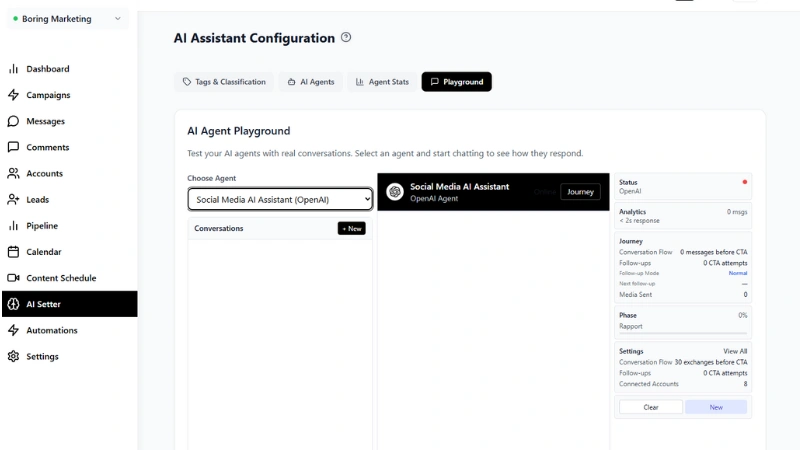
The playground is where the brief gets tested rather than assumed. The journey panel on the right shows the thresholds the agent is actually operating under, including how many exchanges it will spend building rapport before it is allowed to make the ask, and how many follow-up attempts it is permitted. Those numbers are the brief. If you have not set them, the agent is improvising.
3. Booking. Reliably automatable, if the calendar is real.
Booking is where AI sales agents either earn their keep or quietly destroy trust. An agent that says "someone will be in touch to schedule" has done nothing. An agent that offers a slot that is already taken has done worse than nothing.
The requirement is that the agent reads live availability at the moment it speaks, not a cached window. In Inflowave that availability comes from the same booking system the rest of the product uses: availability rules, event types with their own durations and buffers, and the calendar connections behind them. The booking it creates is a row in the same table a manually booked meeting creates, which is why it shows up on the same calendar without a sync step.
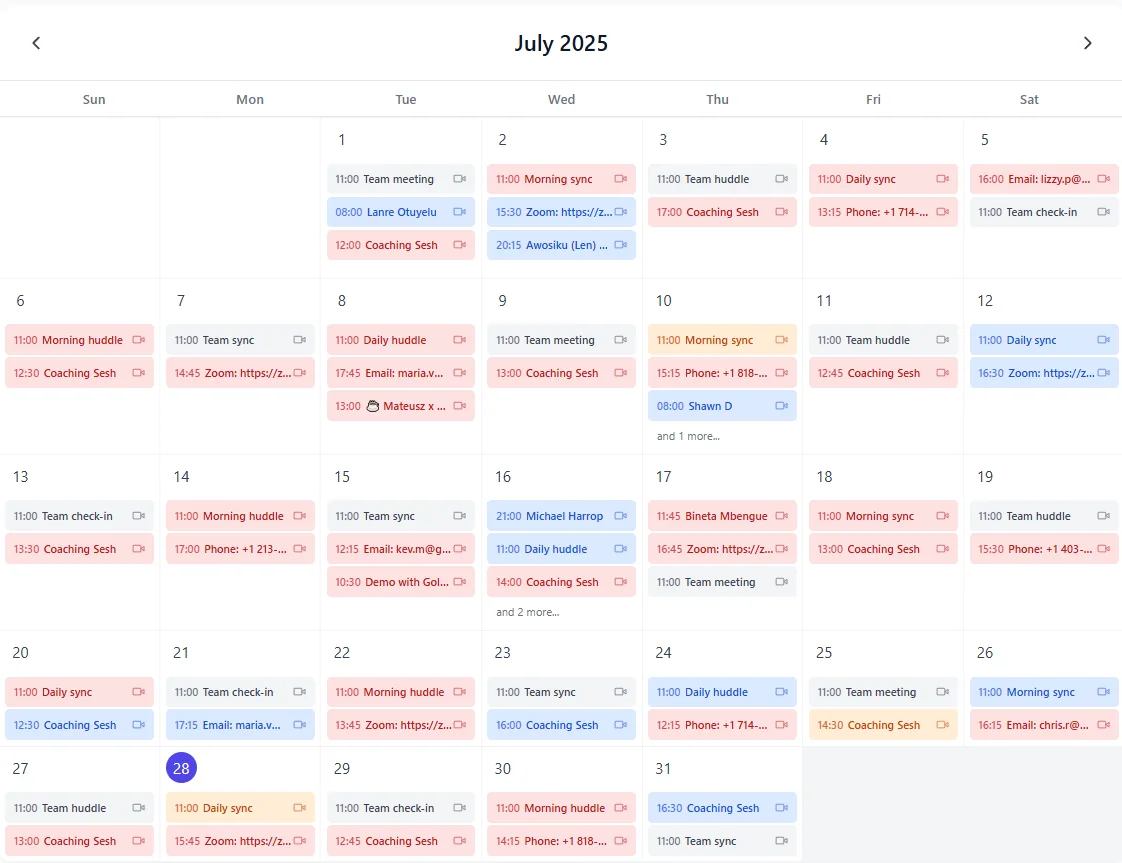
This is the calendar the agent books into. Note that the entries are mixed: Zoom links, phone numbers, email follow-ups and internal team meetings all sit in the same month view. An agent that only sees its own bookings will happily double-book your Tuesday stand-up.
4. Closing. Not automatable, and you should not want it to be.
There is no honest version of this section that ends with "and then the AI closes the deal". For anything with a contract, a custom price or a scope, the value of the first conversation is a qualified, informed human meeting. An agent that pushes past that point is optimising the metric you can see, meetings booked, at the expense of the one you cannot, meetings worth attending.
Set the bar inside the agent. A smaller number of qualified bookings beats a full calendar of unqualified ones, and you can only tell the difference by reading transcripts.
What actually happens when a call runs
Here is the sequence, described concretely, because this is the part that determines whether the feature survives contact with your operation.
The list is assembled. The agent works a segment, not a static file. In practice that means a filtered view of CRM leads, which keeps working as leads move stage instead of going stale the moment you export it.
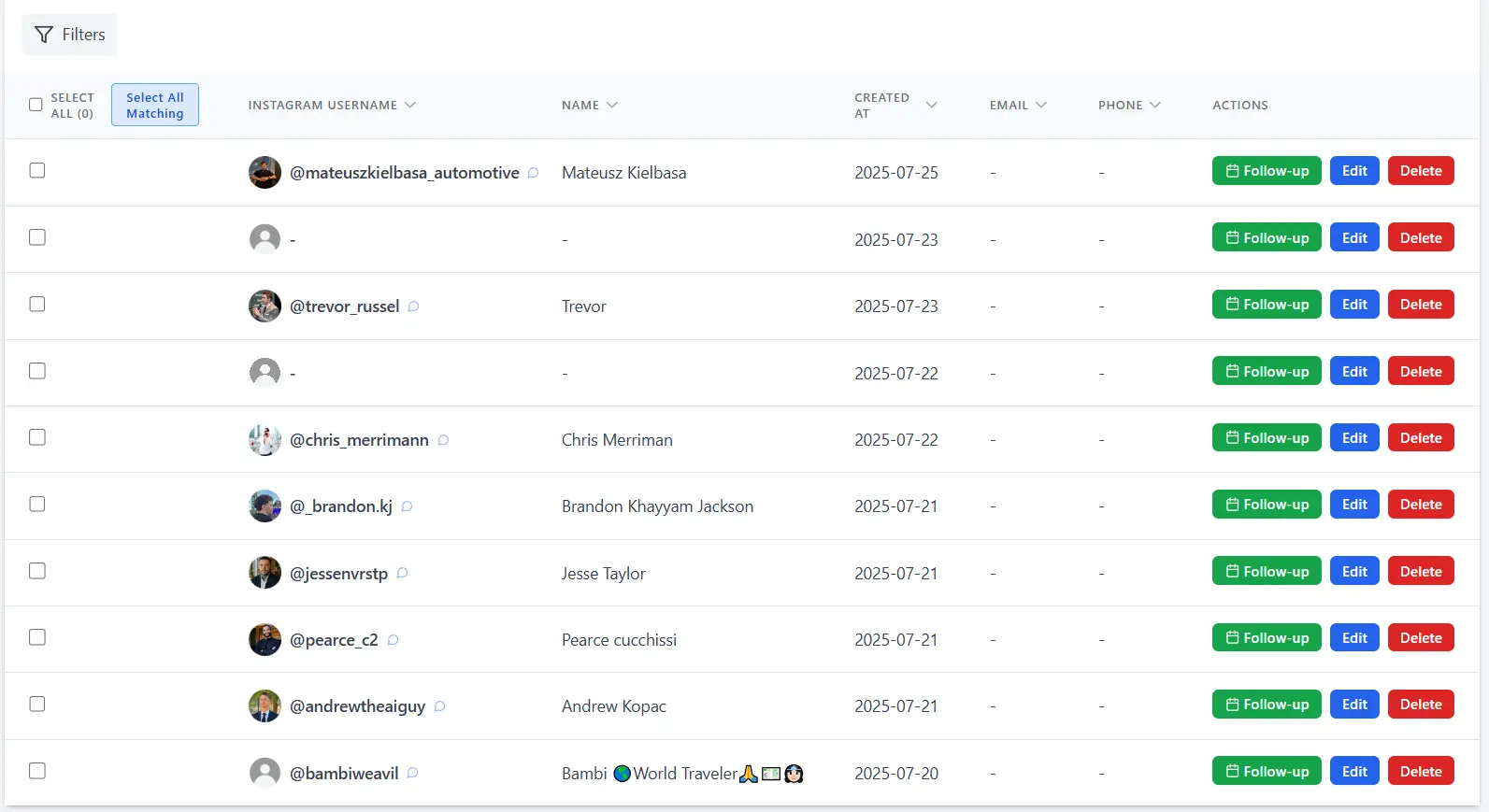
This is the object the agent operates on. Every row here is a lead record that already exists, with a history, an owner and a stage. That is the difference between an agent calling your CRM and an agent calling a spreadsheet: the outcome has a home.
The call is placed, once. Outbound calling has an obvious and expensive failure mode, which is calling the same person twice because a retry fired. Inflowave writes an idempotency key per call attempt, so a retried request resolves to the existing call rather than dialling again.
The conversation runs under explicit limits. The agent configuration sets a maximum call duration, an interruption sensitivity, a response speed, and what happens when the other person goes quiet, via a reminder trigger delay and a maximum number of reminders. These are not cosmetic. An agent that talks over people or sits in silence for eleven seconds is one people hang up on.
The call ends and the record is written. The call log row carries direction, the from and to numbers, status, start and end timestamps, duration, a disconnection reason, the full transcript, the structured analysis described above, per-turn latency data, the recording URL, the cost in cents, and a lead_id linking it back to the contact. It also carries workflow_id and execution_id when the call was triggered by an automation, which is how you trace a call back to the campaign that caused it.
The rest of the system reacts. Because the outcome lands on the lead record, the things that normally require an integration are just the product working: the transcript is on the contact, the booking is on the calendar, the conversation is in the unified inbox beside the DMs and emails, and the stage change is on the pipeline.
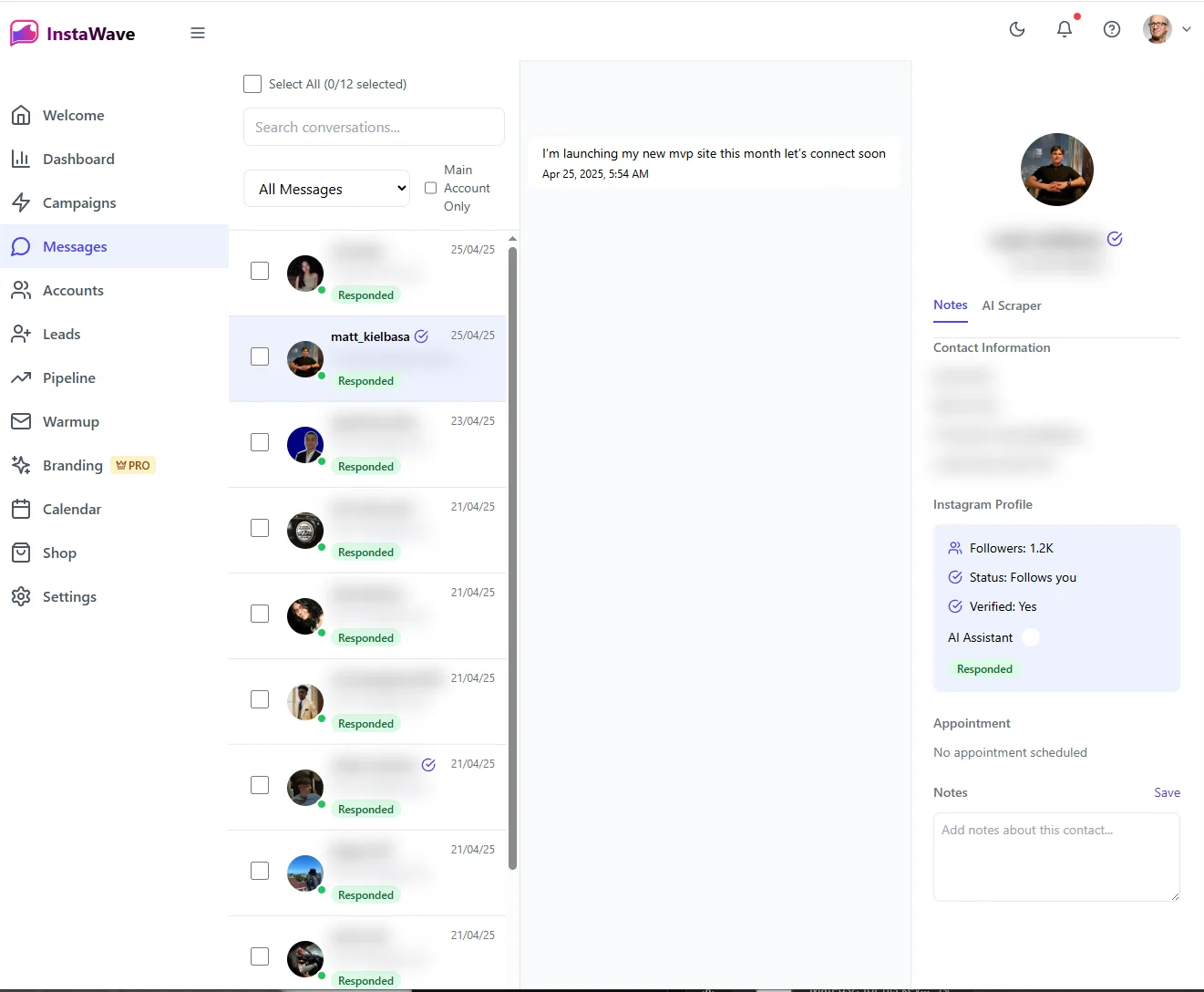
The contact panel on the right is the handover point. The AI Assistant toggle is per contact, which is the practical answer to "what happens when I want to take this one myself": you turn it off for that person and reply, and the agent stops without the campaign stopping.
The compliance boundary, in specifics
This is where most articles wave at "check your local rules". Two provisions of the US Telemarketing Sales Rule are specific enough to design against, and both are in 16 CFR 310.4.
Calling hours. Section 310.4(c) makes it an abusive practice to place outbound calls to a person's residence at any time other than between 8:00 a.m. and 9:00 p.m. local time at the called person's location, absent prior consent. The operative phrase is "at the called person's location", meaning the constraint is the lead's timezone, not yours. A list spanning four US timezones has four different legal windows.
The two-second rule. Section 310.4(b)(1)(iv) defines a call as "abandoned" if a person answers it and the telemarketer does not connect the call to a sales representative within two seconds of the person's completed greeting. This is the rule written for predictive dialers, and it is worth thinking about carefully in an AI context: latency between the greeting and the agent's first word is not merely a quality problem. The same section restricts outbound calls delivering a prerecorded message unless specific written express agreement conditions are met.
Inflowave carries the settings to operate inside those constraints: recording disclosure text, recording retention days, an enforceable calling window with start and end hours and a default timezone, a maximum concurrent call limit, and a do-not-call list keyed on the E.164 phone number.
Being straight about the state of it: as of writing, those compliance settings and the do-not-call list are available and configured by nobody in production. They are capabilities, not battle-tested defaults. Treat the calling-window enforcement as something you must switch on and verify yourself, not something you can assume is already protecting you. And none of the above is legal advice; rules differ by state and by country, and consent and recording-disclosure requirements in particular vary sharply.
The National Do Not Call Registry FAQs are the plain-English starting point, and sellers and telemarketers access the registry itself through telemarketing.donotcall.gov.
How to brief an agent properly
A disappointing AI sales agent is more often a briefing failure than a model failure. A workable brief has five parts.
1. The opener, written as speech. Read it aloud. Anything you would not say out loud to a stranger gets cut. Openers written as marketing copy are the single clearest tell that a call is automated.
2. The qualification criteria, as fields not as vibes. Write down the three or four facts that must be true before a meeting is worth a rep's hour, and declare them as post-call analysis fields. "Seems interested" is not a field. "Has budget authority" and "currently runs paid ads" are.
3. The objection list, from your own transcripts. Not a generic list. Pull the last thirty calls your team actually made and write down what people actually said. If you have been running a power dialer or recording calls already, that list is sitting in your call history. Inflowave's human-dialer side has thousands of transcribed calls behind it, which is exactly the corpus this step wants.
4. The escalation conditions, stated as rules. Price negotiation, anything legal or medical, an existing customer with a complaint, anyone who sounds distressed, anyone who asks twice whether they are talking to a human. Each of these should be an explicit condition that ends the agent's turn.
5. The stop conditions. How many exchanges before the ask, how many follow-up attempts, what an explicit opt-out triggers. Set them; do not inherit them.
Reading the results honestly
Two numbers get quoted about AI sales agents and neither is the one that matters. Meetings booked is an output the agent can inflate by lowering its own bar. Connect rate is a property of your list and your caller ID, not your agent.
The number that matters is the show-and-qualify rate: of the meetings the agent booked, what fraction were attended by someone who met the criteria. That requires reading transcripts of the bookings that went nowhere, which is tedious and is also the entire job. The transcript, the structured analysis and the latency data are all on the call record specifically so this review is possible rather than theoretical.
It is also worth being blunt about volume expectations. Harvard Business Review's research on online sales leads concluded, in the authors' own summary, that most companies are not responding nearly fast enough to potential customers' online queries. That backlog of unanswered inbound interest is almost always a better first list for an agent than a cold purchased one: better conversion, better conversation, and far less compliance exposure. Start there before you start on strangers. For the definitional groundwork on the role itself, what an SDR does and what cold calling actually is cover the ground this article deliberately skips.
Choosing, in one paragraph
If your CRM is Salesforce and your compliance function is real, Agentforce is the path of least resistance and the pricing is published for you to model. If you already resell GoHighLevel to clients and your margins depend on markup, AI Employee slots into a model you already run, as long as you multiply the per sub-account fee by your actual client count first. If you have engineering capacity and one specific conversation to automate, Vapi is cheaper per minute than anything bundled and you should use it. If the problem is that the conversation outcome has nowhere to land, because the calendar, the inbox, the pipeline and the transcript are in four different products, that is the problem Inflowave is shaped around, and AI cold calling is where to start. For the inbound half, the same agent answers on the AI voice agent side.
FAQ
What does an AI sales agent do?
It holds the first sales conversation itself. It delivers the opener, responds to common objections, asks your qualification questions in conversational order, and either books a meeting against live calendar availability or records why the lead was not a fit. Afterwards it writes a transcript, a structured summary and the extracted qualification fields back to the contact record so a person can act on it.
Who has the best AI sales agent?
There is no single best, because the products solve different problems. Salesforce Agentforce is strongest when your data and governance already sit in Sales Cloud. GoHighLevel's AI Employee is strongest if you resell software to clients. Artisan's Ava is strongest for autonomous email outbound at volume. Vapi is strongest if you have engineers and want control per minute. Match the shape to your constraint rather than to a review score.
How much do AI agents cost?
It depends entirely on the pricing model. Salesforce publishes Flex Credits at 500 US dollars per 100,000 credits, with a standard action at 20 credits and a voice action at 30, or 2 dollars per conversation. GoHighLevel prices AI Employee per sub-account at 50 or 97 US dollars a month. Vapi is pure usage, estimating 82 to 129 US dollars for 1,000 minutes. Model your own volume before comparing headline numbers.
Will AI replace sales agents?
Not for the closing conversation. Current agents are dependable at qualification, scripted objection handling and booking, and unreliable the moment a conversation becomes a negotiation over price or scope. What they replace is the dialling, the no-answers, the voicemail and the note-taking, which is the least valuable part of a rep's day. The realistic outcome is fewer hours dialling, not fewer people selling.
Which AI tool is best for sales?
Ask what breaks first in your process. If discovering prospects is the bottleneck, a data-led outbound platform helps most. If speed of first response is the bottleneck, a voice or chat agent that works your unanswered inbound is the highest return. If the bottleneck is that outcomes never reach the CRM, then no standalone tool fixes it and you need the agent inside the system that owns the record.
Is there a free AI sales agent tool available?
Partly. Salesforce lists Salesforce Foundations at zero dollars as a way to get started with Agentforce for any use case, though the actions themselves consume paid Flex Credits. Vapi lets you start for free and pay only for the minutes you run. In practice every option meters something, usually minutes, messages or actions, so a free tier tells you how cheaply you can test, not how cheaply you can operate.