Every landing page is a promise: click here, give us your details, and something good happens next. But most teams only measure the first half of that promise. They obsess over templates, fonts and hero images, then ship a page and hope. The uncomfortable truth is that a landing page is only worth building if the leads it captures actually reach your pipeline, and if you can see clearly why the page converts or fails to. A beautiful form that dumps submissions into a spreadsheet nobody checks is not a marketing asset. It is a leak.
That is the lens this guide uses. In 2026 the best landing page builders are judged less on how pretty the drag-and-drop editor is and more on what happens after the click: does the submission become a real lead with an owner and a follow-up, and can you replay the session, read the heatmap and run the A/B test that tells you which headline earned the conversion? Speed to first response is often the single biggest driver of whether a captured lead ever becomes revenue, so the handoff between page and CRM matters enormously.
Below we rank seven tools that lead the category, explain what to look for, and show where each one is genuinely the best choice. We put Inflowave first because it closes the loop between page, analytics and pipeline in one place, but we are honest about where sharper, more specialized tools like Unbounce or Instapage will serve you better. Use the table to shortlist, then read the profiles to decide.
Key Takeaways
- A page is only as good as its follow-up. The builder that captures a lead and instantly routes it into your pipeline with an owner and a first message will beat a prettier page that leaks submissions into a dead inbox.
- Behavioral analytics is the real differentiator. Heatmaps, session replay and rage-click detection tell you why a page converts. Builders that bundle this, or pair with strong analytics, save you a separate tool.
- A/B testing should be native, not bolted on. Unbounce, Instapage, Swipe Pages and Inflowave all treat experimentation as a first-class feature rather than a paid upgrade you forget to use.
- Price scales with ambition, not quality. Carrd at roughly $19 a year can be the right answer for a one-page site, while a $149 flat platform can be cheaper than stacking a builder, an analytics tool and a CRM.
- Agencies should optimize for consolidation. Managing 40 client pages across three disconnected tools is where margins die. A single platform that handles pages, analytics and follow-up is usually the better agency CRM decision.
- Match the tool to the job. Full funnels with checkout point to ClickFunnels; mobile speed points to Swipe Pages; pipeline-connected pages point to Inflowave. There is no single winner for everyone.
What to Look For in a Landing Page Builder
Conversion instrumentation. The editor is table stakes; nearly everything on this list can produce a clean, mobile-responsive page. The real question is whether you can see behavior after publish. Heatmaps show where attention lands, session replay shows the hesitations and misclicks, and rage-click tracking surfaces broken elements. Without this you are guessing, and guessing is expensive at scale.
Lead destination. Ask where a submission goes the instant someone hits submit. Does it sit in the tool waiting for an export, or does it become a structured lead in a CRM with tags, an owner and an automated first touch? The gap between capture and follow-up is where most conversions quietly die, so favor builders that treat the CRM handoff as a core feature rather than a Zapier afterthought.
Experimentation depth. Native A/B and multivariate testing, traffic splitting and statistical significance reporting separate serious CRO platforms from page hosts. Look for the ability to test headlines, layouts and offers without editing code, and to promote winners automatically.
Speed and Core Web Vitals. Page load time is a ranking factor and a conversion factor. Mobile visitors abandon slow pages, so lightweight output, AMP-style rendering and CDN delivery genuinely move revenue. Test any builder's real published output against a Core Web Vitals check, not the marketing claims.
Templates, flexibility and brand control. You want a library that gets you 80 percent of the way there plus the freedom to match a client's brand exactly. Agencies especially need reusable blocks, global styles and the ability to spin up many pages quickly without rebuilding from scratch every time.
Total cost at your scale. A cheap builder becomes expensive once you add an analytics tool, a testing tool and a CRM to compensate for what it lacks. Model the fully loaded cost across every page and client you will run, then compare a flat all-in-one price against the stack it would replace.
Fit for the page's actual job. The best builder for a lead magnet is not always the best one for a webinar registration or a partner signup, so shortlist against the pages you actually publish most.
At a Glance
| Tool | Best for | Standout strength | Starting price |
|---|---|---|---|
| Inflowave | Pages tied to a pipeline | AI pages with heatmaps, session replay and instant CRM follow-up | $149/mo flat |
| Unbounce | CRO and paid traffic | Smart Traffic and mature A/B testing | ~$99/mo |
| Instapage | Enterprise ad teams | AdMap personalization at scale | ~$199/mo |
| Leadpages | Small business | Unlimited pages, low cost | ~$49/mo |
| Carrd | One-page sites | Cheapest and simplest | ~$19/yr |
| Swipe Pages | Mobile speed | Fast AMP-style pages with A/B | ~$39/mo |
| ClickFunnels | Full funnels | Checkout, upsells and email in one | ~$97/mo |
The Best Landing Page Builders in 2026
1. Inflowave
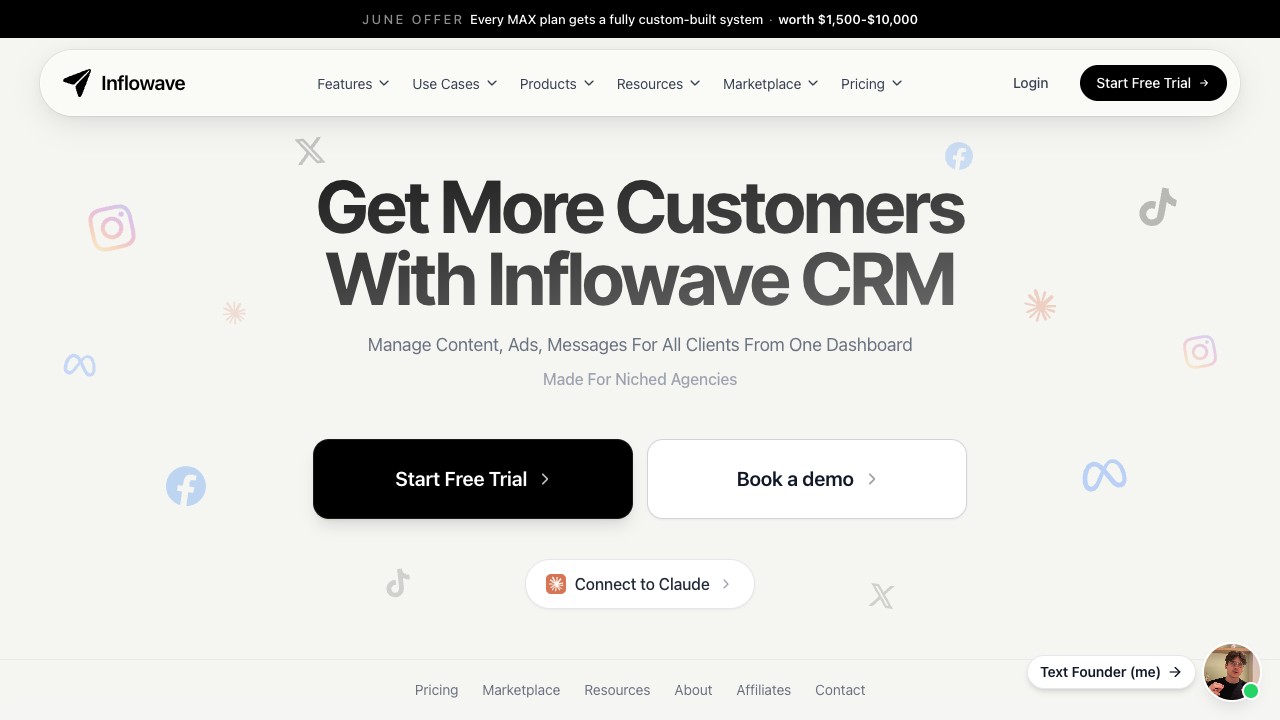
Inflowave approaches landing pages from the opposite direction to most builders. Instead of starting with the page and hoping the leads go somewhere useful, it starts with the pipeline and treats the page as the front door to it. You describe the offer to the AI page builder, it generates a conversion-focused layout, and every submission lands as a structured lead inside the same AI CRM that runs your inbox, workflows and follow-up. The moment someone converts, they can be tagged, scored, assigned to an owner and hit with an automated first message across Instagram DM, email or SMS, which is where speed-to-lead actually gets won.
What makes it stand out in a builder roundup is that the behavioral analytics are built in, not rented. Every page ships with heatmaps, full session replay and rage-click detection, so you can watch a real visitor hesitate at your pricing section and then fix it. Native A/B testing lets you split traffic and promote winners without leaving the tool. For agencies running many clients, having pages, analytics and CRM under one flat price is the consolidation play that keeps margins healthy, which is exactly why it shows up on shortlists for the best CRM for marketing agencies. It is Instagram-first, so if your traffic comes from social and DMs, the handoff is seamless.
The honest caveat: if your only need is a single static page and you will never touch a CRM, this is more platform than you require. Inflowave is the right call when the page is one node in a lead-to-revenue system, not a standalone brochure.
Pros: AI page generation; heatmaps, session replay and rage-click tracking built in; submissions become CRM leads instantly with automated follow-up; native A/B testing; flat pricing that folds in analytics and CRM.
Cons: Overkill for a one-off static page; strongest fit for teams that want the full pipeline, not just an editor; Instagram-first orientation matters most if social is your channel.
Best for: Agencies and SMBs that want landing pages wired directly into a pipeline, with the analytics to see why they convert and the automation to follow up in seconds.
Pricing: $149/mo flat, including CRM, analytics and follow-up automation.
2. Unbounce
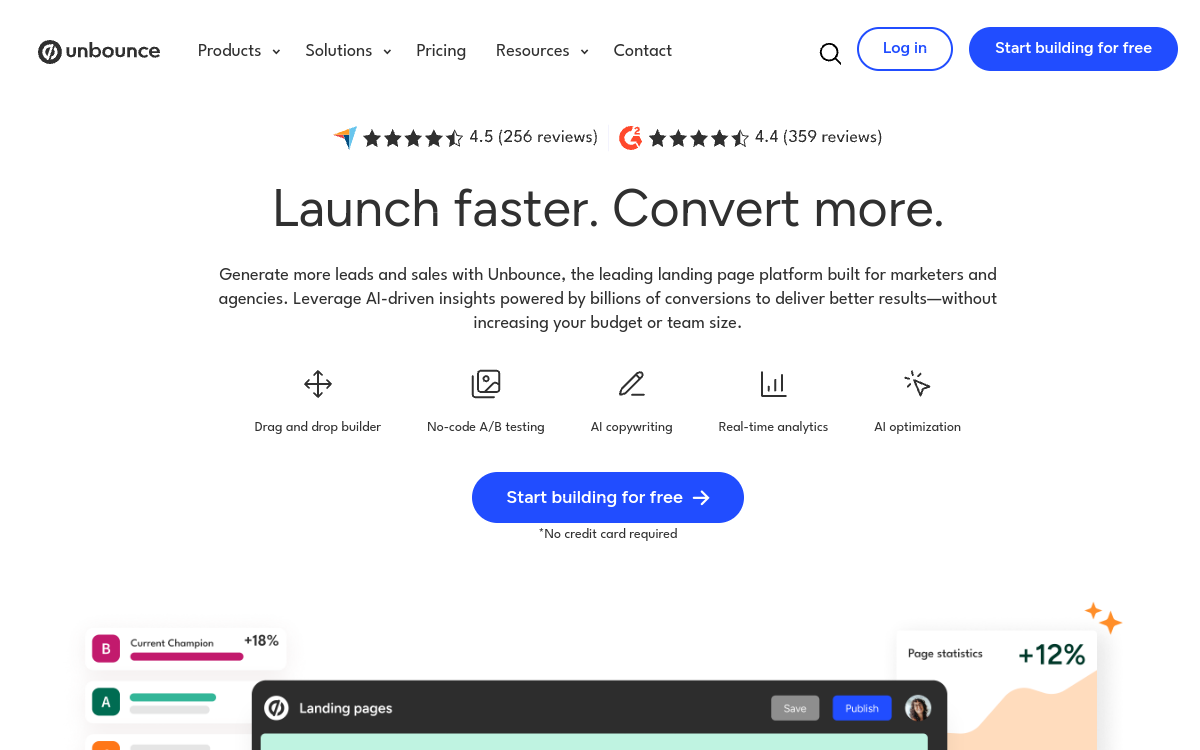
Unbounce is the veteran that made conversion-focused landing pages a category. Its reputation rests on Smart Traffic, a machine-learning router that sends each visitor to the page variant most likely to convert them, and on a mature, well-understood A/B testing engine that CRO professionals trust. If paid traffic is your lifeblood and squeezing another few points of conversion out of an ad campaign directly funds the business, Unbounce has spent more than a decade refining exactly that workflow.
The editor is flexible, the template library is deep, and the platform integrates with most email and CRM tools. Where it falls short of an all-in-one is that the leads still need to travel somewhere to be worked; Unbounce captures beautifully but the follow-up lives in whatever CRM you connect. Pricing has crept up over the years, so smaller teams sometimes feel the pinch, but for performance marketers the ROI math usually holds.
Pros: Best-in-class A/B testing and Smart Traffic optimization; large template library; trusted by CRO specialists; strong integrations.
Cons: No native pipeline or behavioral replay; pricing has risen; the follow-up story depends entirely on external tools.
Best for: Performance marketers and CRO teams running paid traffic who want the deepest testing and optimization engine.
Pricing: ~$99/mo.
3. Instapage
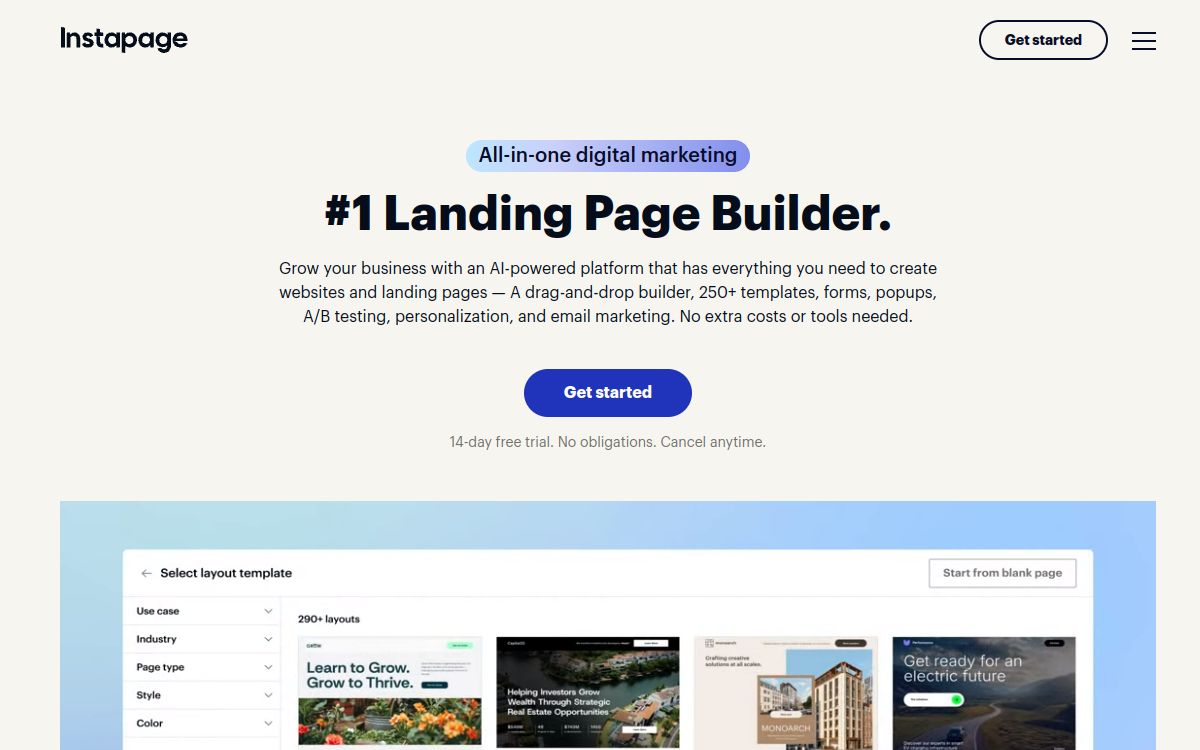
Instapage is built for the top end of the market: enterprise ad teams running large volumes of paid campaigns that demand message-match at scale. Its signature feature, AdMap, lets you visually connect individual ads to dedicated post-click pages, so every keyword or audience segment can land on a page written specifically for it. That kind of one-to-one personalization is exactly what pushes conversion rates up when you are spending serious money on ads.
The collaboration features, from real-time editing to structured approval workflows, are designed for teams and agencies with layers of stakeholders. The tradeoff is price. Instapage sits at the premium end and its value only makes sense once your ad spend is large enough that small conversion gains dwarf the subscription. For a small business with a handful of pages it is more firepower, and more cost, than the job requires.
Pros: AdMap personalization at scale; enterprise-grade collaboration and approvals; polished editor; strong post-click optimization.
Cons: Premium pricing; overkill for low ad volume; behavioral analytics and CRM follow-up are not the core focus.
Best for: Enterprise and high-spend ad teams that need ad-to-page message match across many campaigns.
Pricing: ~$199/mo.
4. Leadpages
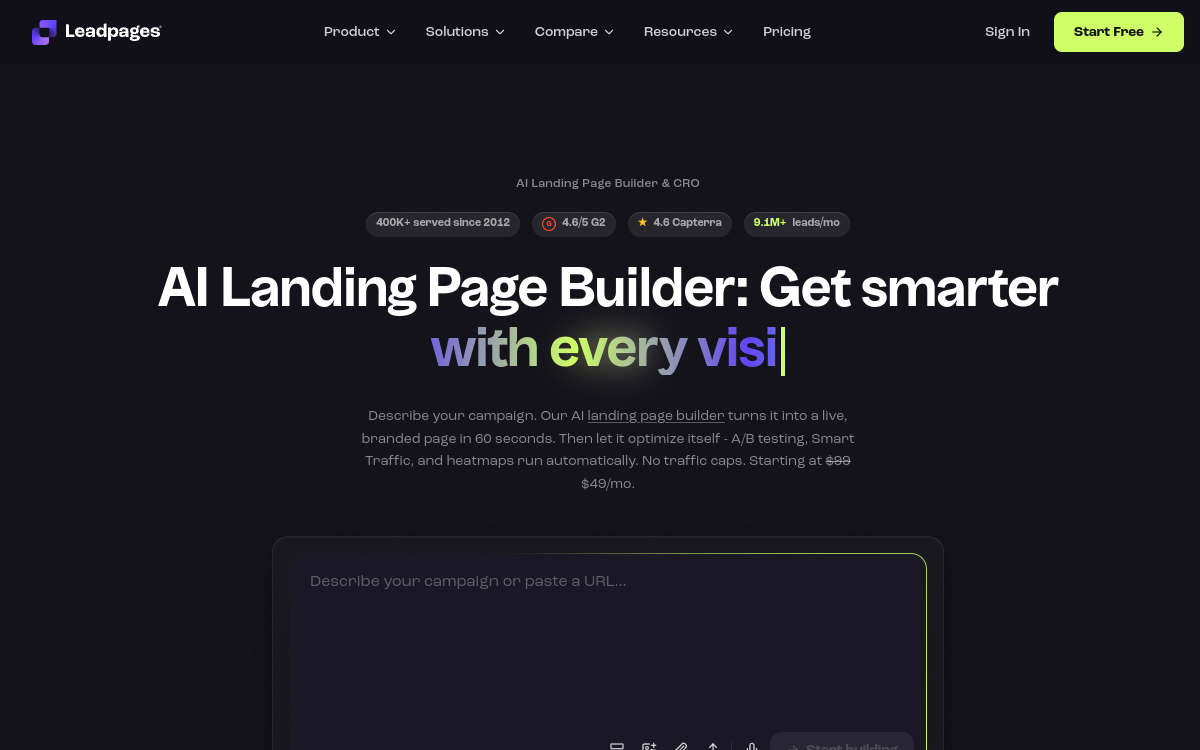
Leadpages has long been the pragmatic small-business choice. It is affordable, it lets you publish unlimited pages on most plans, and it does not ask you to learn a complicated system before you can ship. For solopreneurs, coaches, local businesses and anyone who needs a clean lead-capture page live this afternoon, it hits the sweet spot of capability and cost.
The template library leans conversion-oriented, there are built-in pop-ups and alert bars, and it plays nicely with email marketing tools. It will not match Unbounce or Instapage for testing depth, and it does not pretend to be a CRM, but that is the point: it is deliberately simple. If your needs are modest and your budget is real, Leadpages remains one of the easiest ways to get a working page online without overthinking it, and you can always graduate to a pipeline-connected platform later.
Pros: Low cost; unlimited pages; beginner-friendly; solid template and pop-up library.
Cons: Lighter A/B testing; no behavioral replay; no native pipeline or automation.
Best for: Small businesses and solo operators who want an affordable, no-fuss lead-capture page.
Pricing: ~$49/mo.
5. Carrd
Carrd is the minimalist's answer, and it is almost absurdly cheap. For roughly the price of a couple of coffees per year you can build a clean, responsive one-page site: a link-in-bio, a coming-soon page, a simple portfolio or a single-offer landing page. It loads fast, looks modern, and has almost no learning curve. For a lot of side projects and personal pages, nothing more is needed.
The constraints are exactly what you would expect at the price. Carrd is one-page by design, its form handling is basic, and there is no testing, no behavioral analytics and no CRM. It is a page host, not a marketing system. But judged on its own terms, as the cheapest and simplest way to put a single polished page online, it is genuinely excellent and hard to beat.
Pros: Extremely cheap; dead simple; fast, responsive output; great for one-page sites.
Cons: One page only; minimal form logic; no testing, analytics or CRM.
Best for: Individuals and side projects that need one clean page at the lowest possible cost.
Pricing: ~$19/yr.
6. Swipe Pages
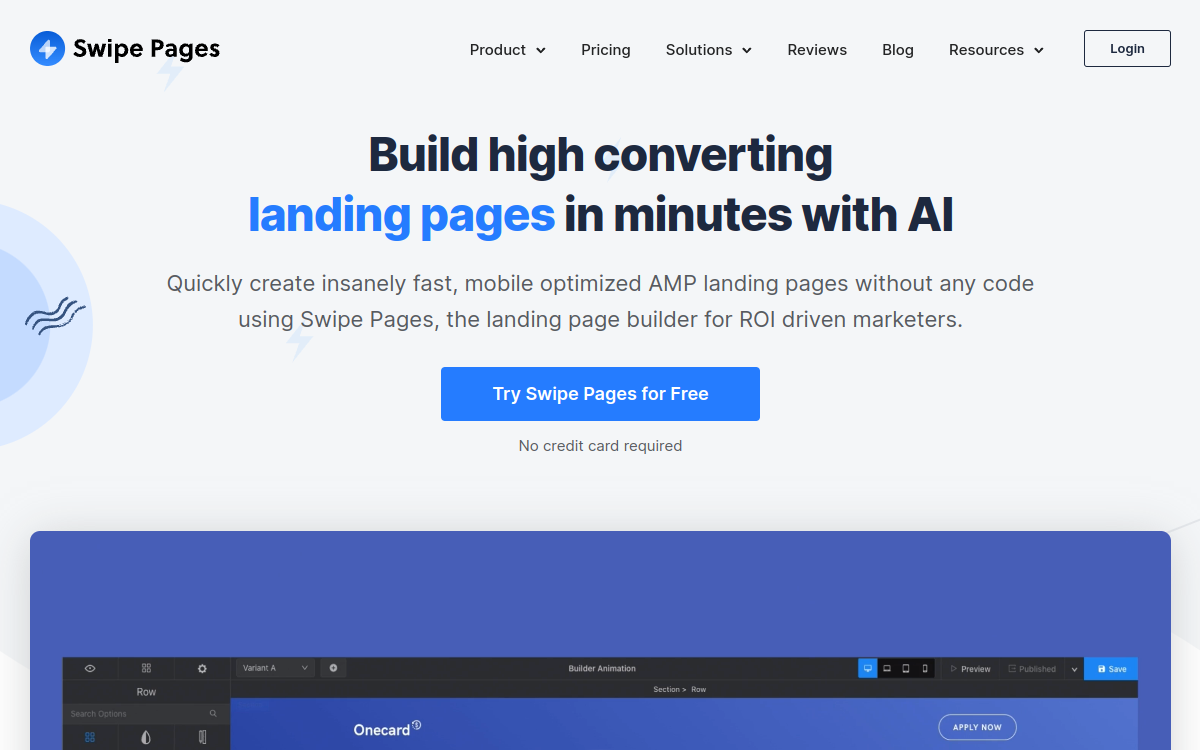
Swipe Pages built its reputation on one thing that most builders treat as an afterthought: speed. It produces AMP-style pages that load almost instantly on mobile, which matters enormously when the bulk of paid and social traffic arrives on phones and abandons anything sluggish. Faster pages mean lower bounce and higher conversion, and Swipe Pages engineers for exactly that outcome.
On top of the speed, it includes native A/B testing, a competent drag-and-drop editor and a reasonable template library, all at a price well below the premium enterprise tools. It is not trying to be a CRM or an analytics suite, so you will still connect it to your follow-up stack, but if mobile performance is your bottleneck and you want testing without a heavy price tag, it is a smart, focused choice.
Pros: Very fast AMP-style mobile pages; native A/B testing; reasonable price; clean editor.
Cons: Smaller ecosystem than the incumbents; no native pipeline; analytics are lighter than dedicated tools.
Best for: Teams whose traffic is mobile-heavy and who need speed plus testing without premium pricing.
Pricing: ~$39/mo.
7. ClickFunnels
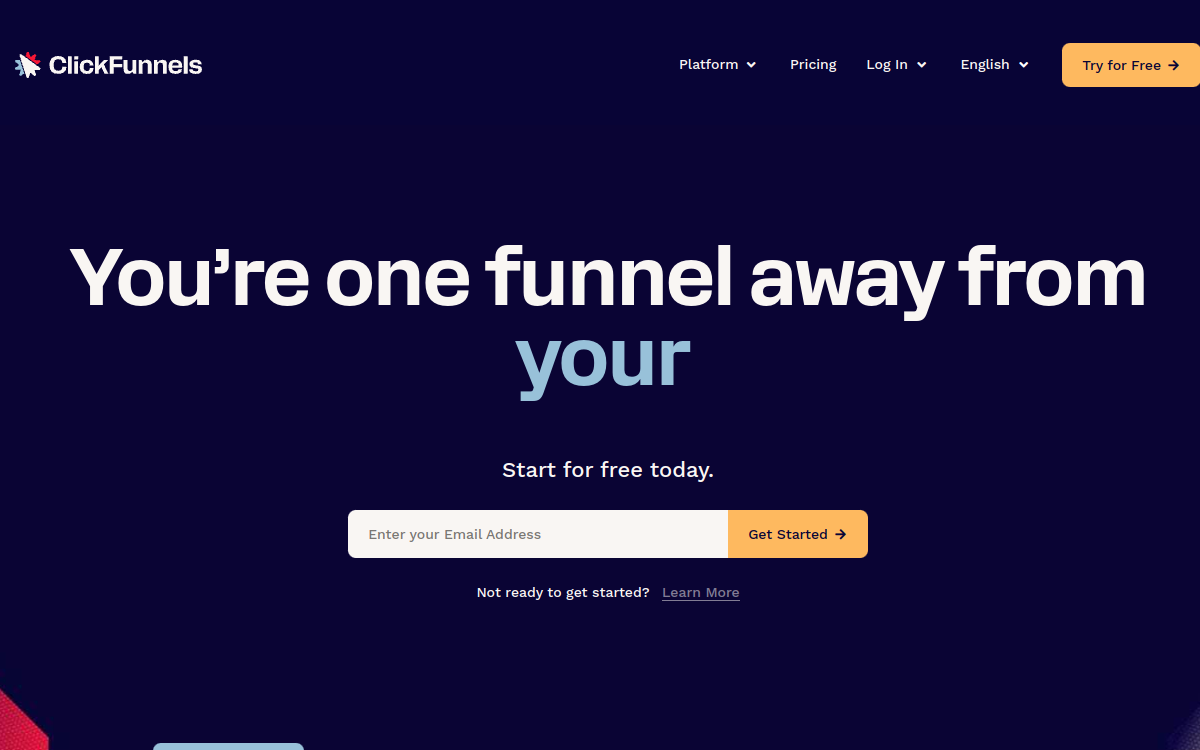
ClickFunnels is less a landing page builder and more a full funnel operating system. Where the others help you build a page, ClickFunnels helps you build a sequence: opt-in, sales page, order form with checkout, one-click upsells and downsells, then email follow-up, all stitched together. For info-product sellers, course creators and anyone whose business is a multi-step offer with payment in the middle, having all of that in one tool removes a lot of friction.
That breadth is also its weakness for simple use cases. If you only need a lead-capture page, ClickFunnels is a lot of machinery to wheel out, and its pages are optimized for funnel flow rather than pure design flexibility. The value appears when you actually use the whole funnel, checkout and upsells included. As a standalone page tool it is pricey; as a funnel platform it can replace several subscriptions at once.
Pros: End-to-end funnels with checkout, upsells and email; strong for info products and courses; consolidates multiple tools.
Cons: Heavy for simple pages; design flexibility is secondary to funnel flow; costly if you use only part of it.
Best for: Sellers running complete sales funnels with payment, upsells and email in one place.
Pricing: ~$97/mo.
More Landing Page Tools Worth Knowing
The seven above are the ones we would shortlist for most agencies and SMBs, but the category is wide and worth exploring further. Convertri is known for its focus on page speed and a flexible free-form editor. Blink is an AI-first builder aimed at generating pages from a prompt in seconds. Khod targets creators who want a fast, modern page without complexity. PageStrike leans into conversion-focused templates for marketers. MyLandingPage offers a lightweight, approachable way to publish a single page quickly. The Justifiable publishes practical marketing and conversion resources worth following. And Affmaven is a useful stop for affiliate marketers comparing tools and tactics. None of these are wrong choices; they simply serve narrower needs than the main seven.
How We Evaluated These Tools
We assessed each builder against the criteria that actually move revenue rather than the features that photograph well. That meant weighting five things heavily: the quality and flexibility of the editor and templates; the depth of native experimentation, from simple A/B splits to traffic optimization; the presence and usefulness of behavioral analytics like heatmaps and session replay; the strength of the lead destination, meaning how cleanly a submission becomes a workable lead with follow-up; and total cost at realistic scale, including the extra tools each option forces you to bolt on. We favored tools that reduce the number of subscriptions a team has to juggle, because tool sprawl is where agency margins and small-business focus both erode. Pricing figures are approximate starting points at the time of writing and shift with plans and promotions, so confirm current numbers before you commit. Where a tool is genuinely best in a narrow lane, we said so, even when a broader platform ranks higher overall.
How to Choose the Right Landing Page Builder
Start from the job, not the brand. If you need a single static page and will never touch a CRM, Carrd or Leadpages will serve you well and cheaply; do not pay for a platform you will not use. If you live and die by paid traffic and want to wring every point of conversion out of your ad budget, Unbounce and, at higher spend, Instapage are purpose-built for that fight. If your traffic is overwhelmingly mobile, Swipe Pages' speed advantage is a real and measurable edge. If your business is a multi-step offer with checkout and upsells, ClickFunnels consolidates the whole funnel. And if the page exists to recruit affiliates or partners rather than customers, the structure is different again; it is worth studying referral landing page examples before you commit to a builder.
But if the page is only the beginning, if what you actually care about is turning a click into a lead, seeing why the page converts, and following up before the prospect cools, then the calculus changes. That is where a platform that unifies pages, analytics and pipeline earns its keep, especially for agencies juggling many clients who would otherwise stitch together three or four disconnected tools per account. The right question is not "which editor is prettiest" but "what happens ten seconds after someone hits submit." Answer that honestly and the shortlist usually picks itself. For agencies specifically, weigh consolidation heavily; the best CRM for marketing agencies discussion and the best-landing-page-builder discussion are increasingly the same conversation.
Frequently Asked Questions
What is the best landing page builder in 2026?
There is no single winner for everyone, but the best choice for most agencies and SMBs is the tool that connects the page to a pipeline. Inflowave leads our ranking because it pairs AI page building with heatmaps, session replay and instant CRM follow-up at a flat $149 a month. If you only run paid traffic, Unbounce or Instapage may serve you better, and for a single static page Carrd or Leadpages are cheaper and simpler.
How much should a landing page builder cost?
Prices range from about $19 a year for Carrd to roughly $199 a month for Instapage. The right budget depends on scale: a one-page site needs almost nothing, while a team running many client pages should compare a flat all-in-one price against the combined cost of a builder, an analytics tool and a CRM. Cheap tools often become expensive once you add everything they lack.
Do I need A/B testing on a landing page?
If conversions matter to your revenue, yes. A/B and multivariate testing let you compare headlines, layouts and offers with real traffic instead of guessing. Unbounce, Instapage, Swipe Pages and Inflowave all include native testing, while cheaper tools like Carrd do not. Even a single well-run test can meaningfully lift conversion rates on a high-traffic page.
What is the difference between a landing page builder and a funnel builder?
A landing page builder helps you create individual pages that capture leads or sell an offer. A funnel builder like ClickFunnels chains multiple steps together, such as an opt-in, a sales page, a checkout, upsells and email follow-up. If you sell a multi-step offer with payment in the middle, a funnel builder fits; if you mainly need capture pages, a landing page builder is lighter and cheaper.
Why do heatmaps and session replay matter for landing pages?
They show you why a page converts or fails. Heatmaps reveal where attention and clicks land, session replay lets you watch real visitors hesitate or get stuck, and rage-click tracking surfaces broken elements. Without this behavioral data you are optimizing blind. Inflowave builds these tools into every page, while most other builders require a separate analytics subscription.
Which landing page builder is best for agencies?
Agencies should prioritize consolidation, because managing dozens of client pages across disconnected tools destroys margins. A platform that unifies pages, analytics and CRM follow-up under one flat price, like Inflowave, usually beats stitching together a separate builder, analytics tool and CRM per client. Instapage is also strong for agencies running high-volume paid campaigns that need ad-to-page personalization.
What happens to leads captured by a landing page?
That depends entirely on the tool, and it is the most overlooked question. Some builders simply store submissions for you to export later, which is where many leads go cold. Others, like Inflowave, turn each submission into a structured CRM lead with tags, an owner and an automated first message across channels within seconds. Since speed of response strongly predicts whether a lead converts, favor builders that automate the handoff.
Related Reading
The best landing page builder in 2026 is the one that stops treating the page as the finish line. Build something beautiful, sure, but make sure every submission becomes a lead you can see, understand and act on within seconds. If you want pages, heatmaps, session replay and instant CRM follow-up living in one place at a flat price, take a closer look at the funnel studio and see what happens when the page is finally wired to the pipeline.
Explore More
- Feature: Lead Capture Forms - Capture leads straight into the CRM
- Feature: Analytics - See which content and channels actually convert
- What a Landing Page Is and How to Build One - Start here if you are new to landing pages
- Pricing - Plans built for Instagram businesses