Email refuses to die, and the reason is simple economics. Year after year, across every credible industry benchmark, email marketing returns more revenue per dollar spent than paid search, social ads, or display. It is the one channel you own outright: no algorithm sits between you and your list, no platform can throttle your reach overnight, and the cost of sending one more message is close to nothing. That combination is why a channel invented in the 1970s still anchors the marketing stack of nearly every serious business in 2026.
But the averages hide a wide gap. The senders who actually earn those outsized returns are not the ones blasting the same newsletter to everyone on Tuesday at 10am. They are the ones whose email fires off real behavior: a page viewed, a cart abandoned, a reply sent in the DMs, a tag applied in the CRM, a stage changed in the pipeline. Timing beats volume, and relevance beats reach. An email that lands the hour after someone shows intent is worth a dozen that land on a schedule the recipient never asked for.
That is the real question this guide answers. Not just "which tool has the nicest drag-and-drop editor," but which platform lets your email react to what a contact is doing everywhere else, and which one keeps email marooned on its own island. The seven tools below span beginners, creators, ecommerce, and product-led teams. We lead with Inflowave because it treats email as one channel inside a connected system rather than a standalone broadcast tool, but every pick here is a fair, honest fit for a specific kind of buyer, and we say plainly where each one wins.
Key Takeaways
- Behavior beats broadcast. The platforms that win in 2026 tie every send to a real signal from the CRM, the pipeline, or social activity, not to a calendar. If your email cannot see what a contact does elsewhere, it is guessing.
- Multichannel is now table stakes. Email alone converts, but email that hands off to SMS, DMs, and a shared inbox converts far more. Look hard at what happens after the click, not just the open rate.
- Pricing models matter more than headline prices. Per-contact billing punishes list growth; send-based and flat pricing reward it. Model your real volume before you commit, because the sticker price rarely reflects the bill at scale.
- Automation depth separates the leaders. Branching logic, conditional waits, and true event triggers are where ActiveCampaign, Klaviyo, Customer.io and Inflowave pull ahead of the simpler tools.
- Match the tool to the motion. Ecommerce should start with purchase-data flows, creators want speed and low cost, and agencies or Instagram-first businesses need email joined to social and sales in one place.
- Inflowave is built for behavior-triggered, multichannel work at a flat $149/mo, with email that reacts to CRM tags, pipeline moves and Instagram activity through its AI CRM and unified inbox.
What to Look For in Email Marketing Software
Trigger depth and behavioral data. The single biggest differentiator in 2026 is what an email can react to. A basic tool sends on a date. A strong tool sends when a contact opens a message, clicks a link, or joins a list. The best tools send when something happens outside email entirely: a purchase, a pipeline stage change, a reply in the DMs, a tag applied by your team. Ask what events the platform can listen for, and whether those events come from your CRM and your other channels or only from email itself.
Automation and branching logic. Once a workflow starts, can it make decisions? Look for conditional splits (if opened, do this; if not, do that), wait steps that pause until a condition is met, and the ability to move contacts between journeys. Shallow tools give you a linear drip. Deep tools give you a decision tree that adapts to each person, which is the difference between a sequence and a genuine lifecycle program.
Deliverability and sender reputation. The most beautiful email is worthless in spam. Evaluate the platform's authentication setup (SPF, DKIM, DMARC), its dedicated-IP options, list-hygiene tools, and its track record on inbox placement. A good provider makes domain authentication painless and actively protects shared-IP reputation so your good behavior is not dragged down by other senders.
Multichannel reach. Email rarely works alone anymore. The question is whether the same platform can follow up by SMS, trigger a DM, or surface the conversation in a shared inbox your team actually watches. When email and every other channel live in one system, a non-opener can be nudged on another channel automatically, and your team sees the whole thread rather than a fragment.
Segmentation and personalization. Static lists are a blunt instrument. You want dynamic segments that update themselves as contacts change, plus personalization that goes past a first-name token: content blocks that swap based on tags, past purchases, lead score, or lifecycle stage. The richer the underlying contact record, the sharper the segmentation, which is why a real CRM underneath matters.
Pricing model and total cost. Read past the headline price. Per-contact pricing means your bill climbs every time your list grows, even for contacts who never open. Send-based pricing charges for what you actually use. Flat pricing removes the anxiety entirely. Whichever model you pick, project your cost at your real list size and send frequency twelve months out, not today.
At a Glance
| Tool | Best for | Standout strength | Starting price |
|---|---|---|---|
| Inflowave | Behavior-triggered, multichannel | Email that fires off CRM, tags and social activity | $149/mo flat |
| Brevo | Value plus SMS | Send-based pricing, not per contact | Free / ~$9/mo |
| Mailchimp | Beginners | Templates and a huge ecosystem | Free / ~$13/mo |
| ActiveCampaign | Deep automation | Best branching logic with a real CRM | ~$15-29/mo |
| MailerLite | Creators | Clean, cheap and simple | Free / ~$10/mo |
| Klaviyo | Ecommerce | Purchase-data-driven flows | Free / ~$20/mo |
| Customer.io | Product and lifecycle | Event-driven messaging | ~$100/mo |
The Best Email Marketing Software in 2026
1. Inflowave
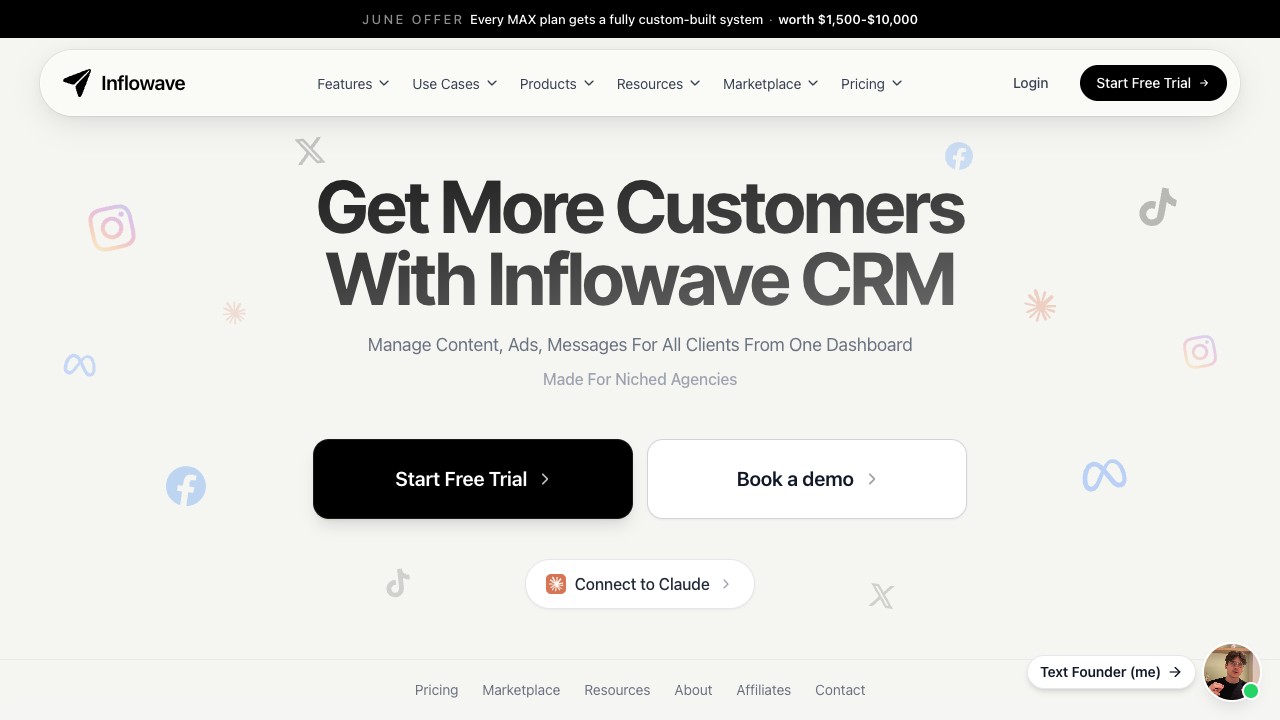
Inflowave approaches email from a different starting point than the rest of this list. Most email tools begin with a list and a send button, then bolt on integrations to reach the rest of your stack. Inflowave begins with a CRM and a unified inbox, and treats email as one of several channels that all fire off the same underlying behavior. The practical result is that an Inflowave email can be triggered not just by a click or an open, but by a tag applied to a lead, a move between pipeline stages, a form submission, or activity on a connected Instagram account. For businesses whose customers first show up in the DMs and comments, that connection between social signals and email is genuinely hard to reproduce anywhere else.
Under the hood, native email broadcasts sit alongside behavior-triggered flows that read directly from the AI CRM. Because the contact record already knows who a lead is, where they came from, which stage they are in, and what they have said across channels, segmentation stops being a manual export-and-filter chore. A flow can wait for someone to reply in the unified inbox, branch on whether they booked a call, then hand off to SMS or a DM if email goes unanswered, all inside one workflow. That multichannel handoff is the payoff: email does the heavy lifting, and the other channels catch the people email misses. Teams that came to Inflowave from Instagram outreach often pair this with its DM automation, and the overlap with the best Instagram DM automation tools is part of why the platform exists.
Pros: Email that reacts to CRM tags, pipeline moves, form fills and Instagram activity, not just email events; native multichannel handoff to SMS and DMs from a single workflow; a real CRM and unified inbox underneath so segmentation and personalization draw on rich, live data; flat pricing that does not punish list growth; strong fit for agencies and Instagram-first businesses.
Cons: Overkill if you only ever want to send a plain newsletter and nothing else; the breadth of the platform means a steeper first week than a single-purpose tool; less relevant if your business has no social or CRM motion to tie email to.
Best for: Agencies, creators, and service businesses that live on Instagram and want email, DMs, CRM software and pipeline working as one behavior-driven system rather than four disconnected tools.
Pricing: $149/mo flat, which includes the CRM, unified inbox, workflows and multichannel sending rather than metering you per contact.
2. Brevo
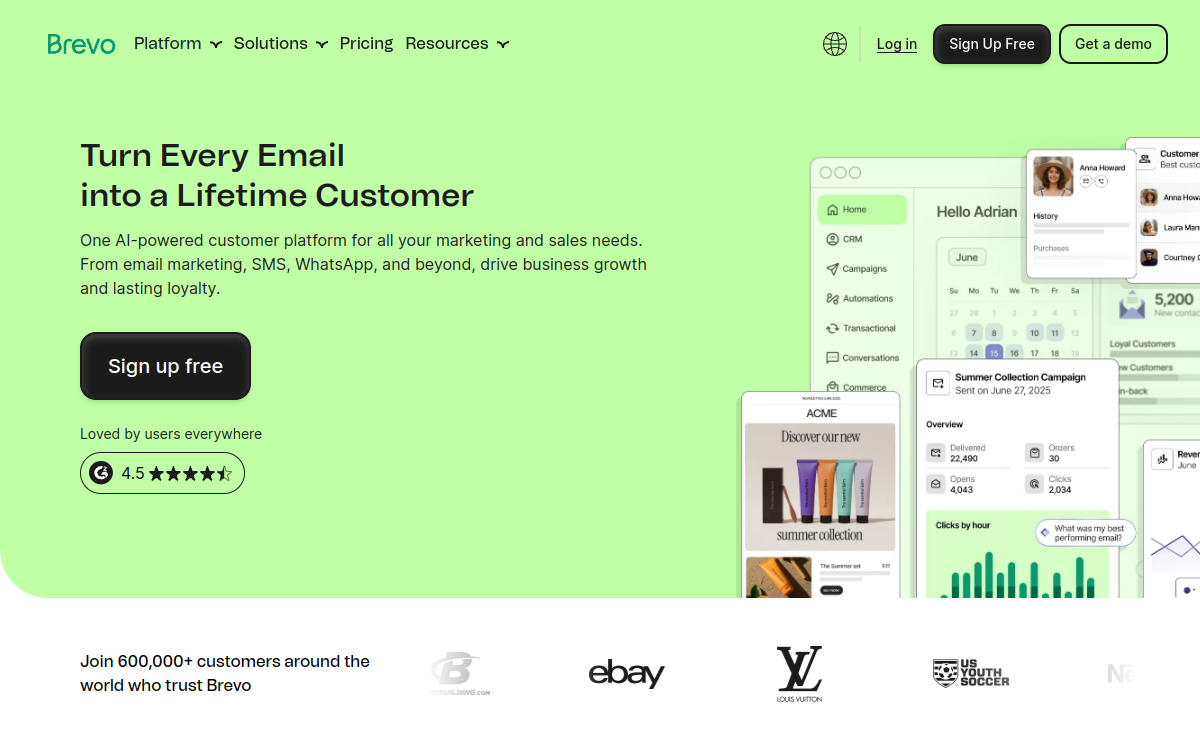
Brevo, formerly Sendinblue, has quietly become one of the best-value platforms on the market, largely thanks to a pricing model that charges by emails sent rather than contacts stored. If you have a large list you email infrequently, that alone can cut your bill dramatically compared to per-contact competitors. Brevo bundles email, SMS, a light CRM, and transactional sending into one account, which makes it a natural fit for small and mid-sized businesses that want more than a newsletter tool without paying enterprise prices.
The automation builder is capable without being intimidating, covering the common lifecycle flows most businesses actually run: welcome series, abandoned browse, re-engagement. It will not out-branch ActiveCampaign, but it covers the essentials cleanly, and the built-in SMS makes basic multichannel follow-up easy to set up.
Pros: Send-based pricing rewards large, low-frequency lists; email plus SMS plus transactional in one account; genuinely usable free tier; strong deliverability for the price.
Cons: The CRM is lightweight compared to a dedicated one; automation depth trails the specialists; the interface can feel busy as you use more modules.
Best for: Cost-conscious small and mid-market teams that want email and SMS together and send in bursts rather than constantly.
Pricing: Free tier available; paid plans start around $9/mo and scale with monthly send volume.
3. Mailchimp
Mailchimp is the name most people reach for first, and for good reason: it is the friendliest on-ramp in the category. The template library is deep, the drag-and-drop editor is forgiving, and the ecosystem of integrations, agencies, and tutorials is unmatched. For a small business sending its first campaigns, the path from signup to a good-looking, delivered email is about as short as it gets.
Where Mailchimp draws criticism is at scale. Per-contact pricing climbs quickly as your list grows, and the automation, while much improved, still trails the dedicated automation platforms once your flows get complex. It remains an excellent starting point; it is just one many businesses eventually outgrow as their needs get more behavioral.
Pros: Easiest learning curve in the category; enormous template and integration ecosystem; polished editor; strong brand and support resources.
Cons: Per-contact pricing gets expensive as lists grow; automation is capable but not best-in-class; advanced segmentation costs more.
Best for: Beginners and small businesses that value ease and templates over deep automation, at least to start.
Pricing: Free tier available; paid plans start around $13/mo and rise with contact count.
4. ActiveCampaign
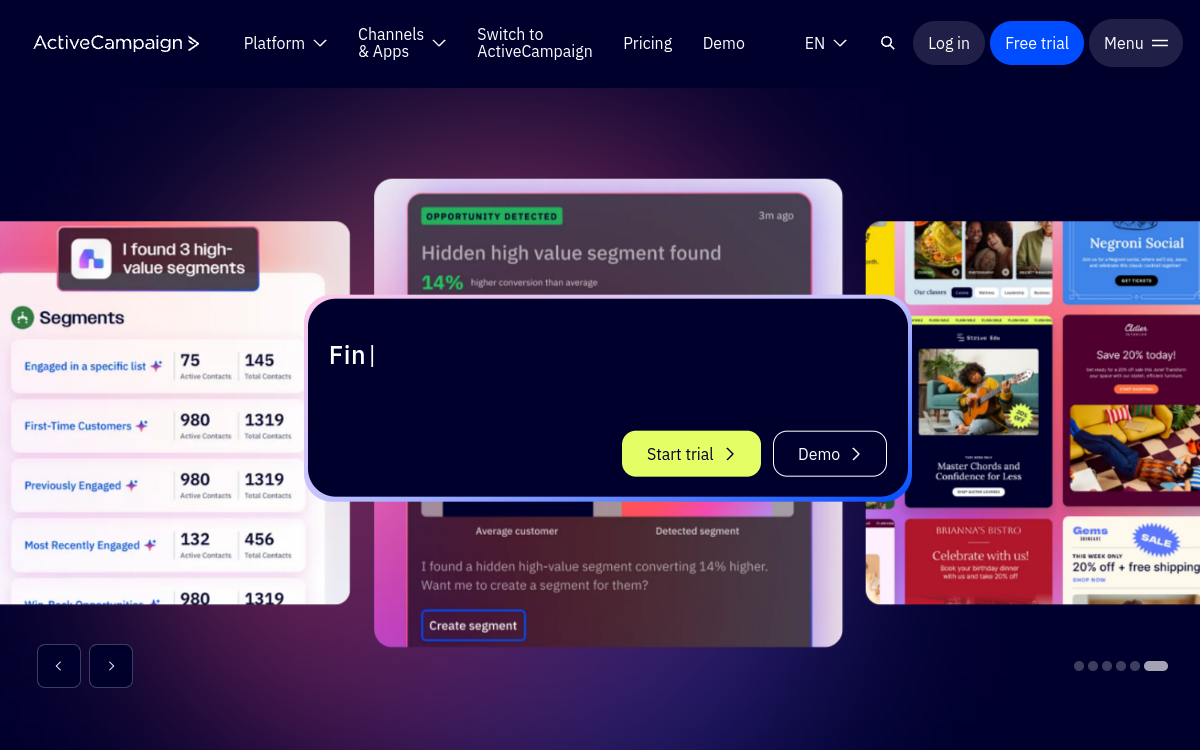
ActiveCampaign is the automation purist's choice. Its visual builder handles branching, conditional logic, and multi-path journeys better than almost anything else at its price point, and it pairs that engine with a genuine sales CRM rather than a token contact list. That combination makes it a favorite of B2B teams and consultants who need email, lead scoring, and a pipeline to talk to each other.
The depth comes with a learning curve. The interface rewards people who invest time in it and can overwhelm those who just want to send a broadcast. But if your value comes from sophisticated, condition-driven journeys, few tools give you more room to build them, and the CRM keeps everything anchored to the contact.
Pros: Best-in-class branching and conditional automation; a real CRM with lead scoring built in; strong segmentation; large template and recipe library.
Cons: Steeper learning curve than the beginner tools; per-contact pricing adds up; can be more than a simple newsletter sender needs.
Best for: B2B and service businesses that want deep automation and a sales CRM in the same platform.
Pricing: Plans start around $15-29/mo depending on tier and contact count.
5. MailerLite
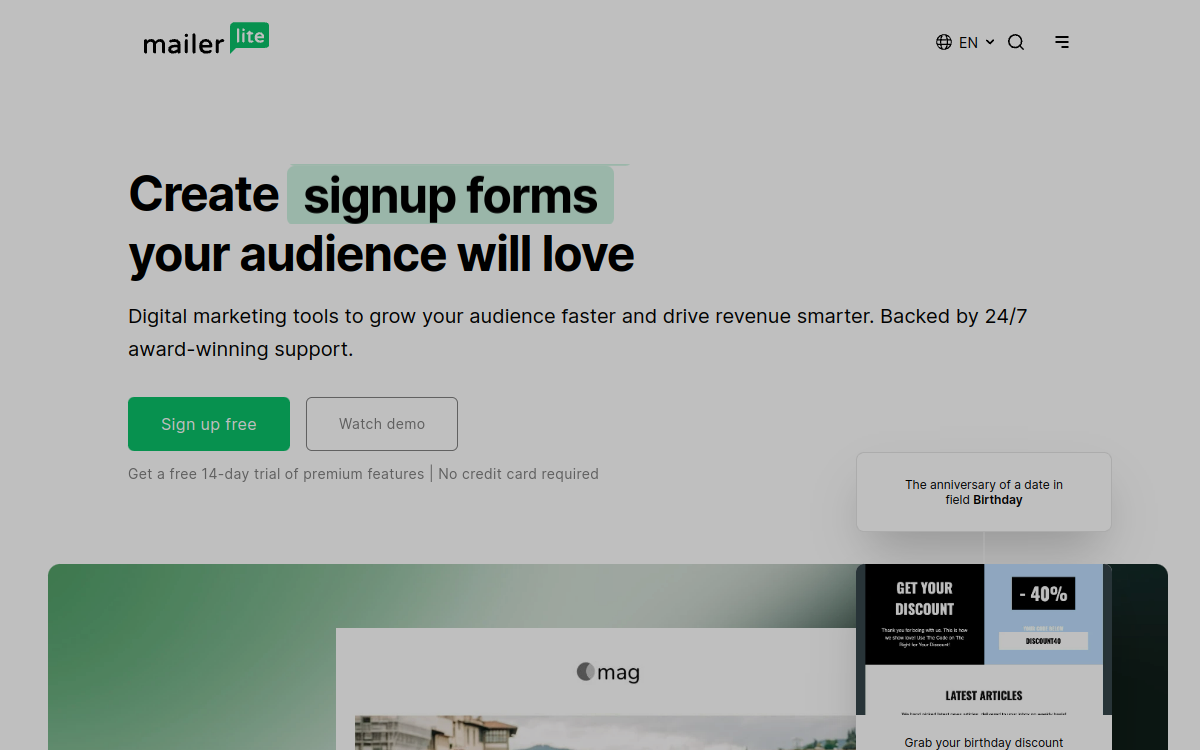
MailerLite wins on restraint. Where others pile on modules, MailerLite keeps the interface clean, the pricing low, and the core email experience fast. Creators, bloggers, and solo operators love it because it does the essentials, newsletters, simple automations, landing pages, sign-up forms, without asking them to learn a platform. The free tier is generous, and the paid plans stay affordable well into meaningful list sizes.
The trade-off is ceiling. If you need intricate branching or deep CRM-driven segmentation, you will feel the limits. But for the large group of senders whose needs are a great-looking newsletter and a couple of automated sequences, MailerLite delivers that with less friction and lower cost than almost anyone.
Pros: Clean, fast interface; very affordable; generous free tier; built-in landing pages and forms; excellent for straightforward newsletter sending.
Cons: Automation and segmentation are shallower than the specialists; limited native multichannel; not built for complex lifecycle programs.
Best for: Creators, bloggers, and solo businesses that want a clean, cheap, simple newsletter tool.
Pricing: Free tier available; paid plans start around $10/mo.
6. Klaviyo
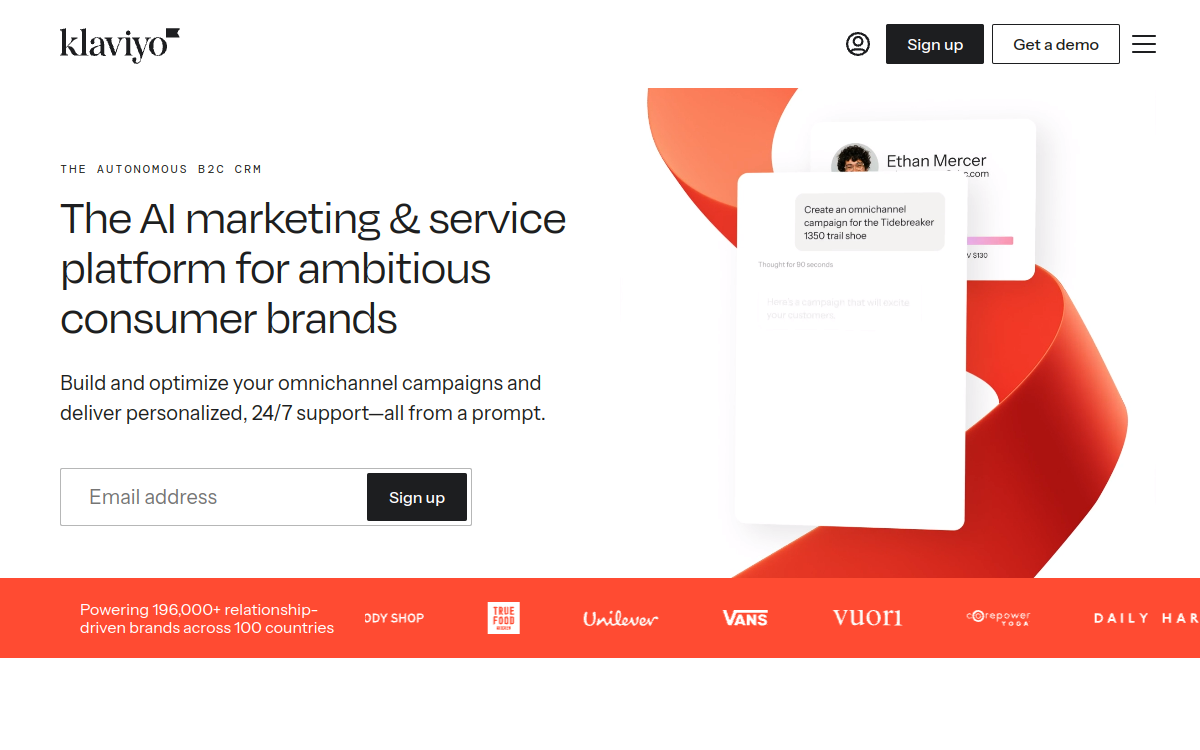
Klaviyo is the default for ecommerce, and it earns the position. Its deep, native integrations with the major storefronts pull in purchase history, browse behavior, and product catalogs, then let you build flows that read directly off that data: abandoned cart, post-purchase, win-back, replenishment reminders keyed to how often someone actually buys. The predictive analytics, like estimated customer lifetime value and next-order date, are genuinely useful for revenue-focused teams.
That power is tuned for stores. If you run an ecommerce business, Klaviyo's purchase-data flows are hard to beat. If you do not, much of what you pay for goes unused, and the per-contact pricing can climb steeply as your list and send volume grow.
Pros: Deep ecommerce integrations and product-aware flows; strong predictive analytics; excellent segmentation on purchase behavior; SMS built in.
Cons: Overbuilt and pricey for non-ecommerce use; per-contact costs rise fast at scale; steeper setup than a simple newsletter tool.
Best for: Ecommerce brands that want email and SMS flows driven by real purchase data.
Pricing: Free tier available; paid plans start around $20/mo and scale with contacts and sends.
7. Customer.io
Customer.io is built for product and lifecycle teams who think in events, not campaigns. Instead of starting with a list, you pipe in behavioral events from your app, "user upgraded," "feature used," "trial expiring," and build messaging that fires precisely off those signals. For SaaS and product-led businesses that want onboarding, activation, and retention messaging tied to what users actually do inside the product, that event-driven model is exactly right.
The cost of that precision is that it expects engineering involvement to send events cleanly, and its starting price sits above the beginner tools. It is not the pick for a small business that just wants a monthly newsletter, but for a product team it is one of the most capable lifecycle engines available.
Pros: True event-driven messaging off product data; powerful, developer-friendly segmentation and triggers; multichannel including email, SMS and push; excellent for onboarding and retention.
Cons: Requires event instrumentation and often engineering help; higher entry price; more than a marketing-only team typically needs.
Best for: SaaS and product-led teams that want lifecycle messaging driven by in-app behavior.
Pricing: Plans start around $100/mo.
More Email Tools Worth Knowing
The seven above cover most buyers, but the category is wide, and a few other names are worth a look depending on your niche. Campaigner is a long-standing platform with strong advanced automation and reporting for mid-market senders. AI Assistica leans into AI-assisted copy and campaign generation for teams that want help writing. SelectHub is not a sender at all but a software-selection resource that can help you shortlist and compare vendors with structured scoring. Ad-vertly focuses on the advertising side and is useful if your email program sits next to paid acquisition. EmailSchool is an education resource for leveling up your team's email skills rather than a tool to send with, and EmailChaser targets cold outreach and follow-up sequences for sales teams. None replace a core platform, but each can round out a specific corner of your program.
How We Evaluated These Tools
We assessed every platform against the six criteria laid out earlier: trigger depth and behavioral data, automation and branching logic, deliverability, multichannel reach, segmentation and personalization, and pricing model. Rather than reward the longest feature list, we weighted how well each tool serves a clearly defined buyer, because the best email platform for an ecommerce brand is the wrong one for a solo creator, and vice versa. We looked at the underlying data model each tool builds on, since email is only as smart as the contact record behind it, and we paid particular attention to what happens after the send: whether non-openers can be reached on another channel, and whether the platform can react to signals from outside email at all. Pricing was judged on model and total cost at realistic scale, not just the advertised entry price, because per-contact billing and flat billing can diverge wildly twelve months into a growing list. The result is a ranking meant to help you match a tool to your motion, not to crown a single universal winner.
How to Choose the Right Email Platform
Start with your motion, not the feature comparison. If you run a store, begin with Klaviyo and let purchase data drive your flows. If you are a solo creator or blogger who wants a clean newsletter and a couple of sequences, MailerLite or Mailchimp will get you sending fast and cheap. If your value comes from sophisticated, condition-driven B2B journeys with a sales pipeline attached, ActiveCampaign rewards the time you put into it. If you are a product team that thinks in events and can instrument them, Customer.io is purpose-built for you. And if you need email that reacts to what contacts do across the DMs, the CRM and the pipeline, with automatic handoff to SMS when email goes unanswered, Inflowave is designed around exactly that behavioral, multichannel model.
Then pressure-test three things before you commit. First, model your cost at your real list size and send frequency a year out, and note whether the pricing model works with or against your growth. Second, map a single real workflow you want to run end to end, and confirm the tool can trigger it off the signal you care about, whether that is a purchase, a tag, a pipeline move, or a DM reply. Third, decide honestly whether email needs to stand alone or connect to your other channels, because that one answer eliminates half the list. A business whose customers arrive through Instagram and get nurtured across DM automation, a unified inbox, and a CRM has fundamentally different needs than one sending a weekly digest, and the right tool respects that difference. Most buyers should shortlist two, run a real campaign through each on a free or trial plan, and let their own data decide.
Frequently Asked Questions
What is the best email marketing software in 2026?
There is no single winner for everyone, because the right tool depends on your business. For behavior-triggered, multichannel programs tied to a CRM and social activity, Inflowave leads at a flat $149/mo. Ecommerce brands are best served by Klaviyo, deep B2B automation belongs to ActiveCampaign, creators love MailerLite, beginners start with Mailchimp, value-seekers pick Brevo, and product teams choose Customer.io.
Does email marketing still deliver a good return in 2026?
Yes. Email consistently returns more revenue per dollar spent than paid search, social ads or display, and it remains a channel you own outright with no algorithm between you and your list. The catch is that the strongest returns go to senders who time messages off real behavior and relevance rather than blasting the same newsletter to everyone on a fixed schedule.
What makes behavior-triggered email different from a regular newsletter?
A newsletter goes to everyone on a schedule. Behavior-triggered email fires when a contact does something meaningful: views a page, abandons a cart, replies in the DMs, gets a tag applied, or moves through a pipeline stage. Because it lands the moment intent is shown, it is far more relevant and converts better. Tools like Inflowave, ActiveCampaign, Klaviyo and Customer.io are built around this model.
How does pricing differ between email platforms?
There are three common models. Per-contact pricing (Mailchimp, Klaviyo, ActiveCampaign) charges by list size, so your bill rises as you grow even for contacts who never open. Send-based pricing (Brevo) charges for emails actually sent, which suits large, low-frequency lists. Flat pricing (Inflowave at $149/mo) removes metering entirely. Always model your cost at your real list size and send frequency a year out.
Which email tool is best for a business that runs on Instagram?
Inflowave is purpose-built for this. It ties email to a CRM, a unified inbox and Instagram activity, so an email can be triggered by a DM reply, a tag or a pipeline move, then hand off to SMS or a DM if email goes unanswered. Businesses whose customers first appear in comments and DMs get a connection between social signals and email that standalone email tools cannot easily reproduce.
Do I need a separate CRM alongside my email tool?
It depends on how rich your segmentation needs to be. Simple newsletter senders can rely on the light CRM built into tools like Brevo or MailerLite. But if you want email personalized on lead score, lifecycle stage, past purchases or cross-channel activity, you need a real CRM underneath. Platforms like Inflowave and ActiveCampaign include one, so email draws on a live, detailed contact record rather than a static list.
Can I switch email platforms without losing my list or deliverability?
Yes, but plan the migration. You can export contacts and most templates from any reputable provider and import them into a new one. The main risk is deliverability: a new sending domain or IP needs a gradual warm-up so mailbox providers trust it. Authenticate your domain with SPF, DKIM and DMARC first, migrate in stages rather than all at once, and monitor inbox placement closely for the first few weeks.
Related Reading
- AI CRM - how a live contact record makes email segmentation and personalization actually work.
- Unified inbox - see every email, DM and message thread in one place so follow-up never falls through.
- Best Instagram DM automation tools - the social side of a behavior-driven, multichannel program.
Email is still the highest-return channel you own, but only when it stops guessing and starts reacting to what people actually do. If your customers arrive through Instagram and move through a CRM and a pipeline, email that fires off tags, stage changes and social activity, then hands off to SMS and DMs when it goes unanswered, will outperform any standalone broadcast tool. That is the system Inflowave is built to run at a flat $149/mo. Pick the tool that matches your motion, and if that motion is multichannel and behavior-driven, start there.
Explore More
- Email Marketing Automation - What email marketing automation is, the core automated flows that drive revenue, real examples
- Small Business Email Marketing - A practical email marketing guide for small businesses: the strategies that actually drive
- Feature: Workflow Automation - Automate the follow-up you keep forgetting
- Feature: Analytics - See which content and channels actually convert
- Pricing - Plans built for Instagram businesses