WhatsApp is the messaging app more than two billion people already keep open all day, and its marketing numbers look almost unfair next to email. Broadcast open rates routinely land in the 80 to 95 percent range, and replies arrive in minutes rather than days. If you sell to consumers, run an agency, or manage a high-touch sales pipeline, WhatsApp is no longer a nice-to-have channel. It is often the channel your customers actually prefer.
The catch is that WhatsApp is not a place you can just log in and blast messages. Compliant broadcasting requires the official WhatsApp Business API, pre-approved message templates, and a verified business behind the number. On top of whatever your software vendor charges, Meta bills you per conversation through its own pricing model. That means the real cost of WhatsApp marketing is always software plus Meta fees, and the software you choose determines how much of the hard part it hides from you: template management, opt-in tracking, the shared inbox your team lives in, and the automation that follows up when a human cannot.
This guide compares the seven WhatsApp marketing platforms worth shortlisting in 2026. We lead with Inflowave because it treats WhatsApp as one channel inside a single unified inbox alongside Instagram, SMS and email, backed by an AI CRM. But the honest answer is that the right tool depends on whether you want a WhatsApp specialist, a developer toolkit, or a true multichannel platform. We will be fair to all of them.
Key Takeaways
- Compliant broadcasts require the official API. Any tool promising WhatsApp campaigns without the WhatsApp Business API, template approval, and verified opt-ins is either unofficial or risking your number's ban. Treat that as a hard filter.
- Meta bills you separately, on top of software. Every vendor in this guide charges a software fee and then Meta charges per-conversation fees on top. When you compare prices, compare the software layer and budget the Meta layer independently.
- Two-way beats one-way. WhatsApp's advantage is conversation, not just delivery. A platform with a genuine shared inbox and reply routing will out-convert a pure broadcast blaster over time.
- Multichannel wins for real businesses. Most customers do not live on WhatsApp alone. Tools like Inflowave that fold WhatsApp into Instagram, SMS and email inside one unified inbox reduce context-switching and give you a single lead record.
- Automation carries the follow-up. A chatbot or workflow builder that qualifies leads, sends templated reminders, and hands off to a human is where WhatsApp marketing pays for itself, especially for agencies managing multiple clients.
- Match the tool to the buyer. WhatsApp specialists suit single-brand DTC; developer APIs suit engineering teams; multichannel CRMs suit agencies and sales-led teams. There is no universally best pick, only the best fit for your motion.
What to Look For in WhatsApp Marketing Software
Official WhatsApp Business API, templates and the green tick. The single most important thing to verify is that a platform is a legitimate Meta Business Solution Provider running on the official WhatsApp Business API. That is what lets you send template messages at scale, apply for the verified green tick badge, and stay on the right side of Meta's policies. Unofficial tools that automate the consumer app can get your number banned overnight, taking your audience with it.
Broadcast plus two-way inbox. Sending a campaign is only half the job. The moment someone replies, you need a place for a human or a bot to answer inside the 24-hour customer service window. Look for a genuine shared inbox with assignment, notes and reply routing, not just a one-directional broadcast tool. A platform such as Inflowave puts those replies in the same unified inbox as your other channels.
Chatbot and automation. Templates get the message out, but automation qualifies and nurtures. A no-code chatbot or workflow builder that can branch on replies, capture data, book meetings and escalate to a person is what turns WhatsApp from a megaphone into a pipeline. This matters most when volume grows past what your team can hand-reply.
Multichannel and CRM. WhatsApp is rarely the only place your customer talks to you. The strongest tools connect WhatsApp to Instagram, SMS and email and store every interaction against a single lead record in a CRM. That is the difference between knowing a contact's full history and re-asking questions they already answered. Inflowave's AI CRM is built around exactly this idea.
Meta's per-conversation cost on top of software. Understand the pricing before you commit. Your monthly software fee is one line item; Meta's per-conversation charges are another, billed directly by Meta based on conversation category and country. A cheap software tier can still carry a large Meta bill if you send high volumes, so model both layers together.
Agency and multi-number support. If you run an agency or manage several brands, you need clean separation: multiple WhatsApp numbers, per-client workspaces, role-based access and consolidated billing. Not every WhatsApp tool handles multi-tenant cleanly, which is why agencies often prefer platforms designed for it. See our deeper look at the best WhatsApp CRM for agencies.
At a Glance
| Tool | Best for | Standout strength | Starting price |
|---|---|---|---|
| Inflowave | WhatsApp plus Instagram, SMS and email | Broadcasts and two-way with AI agent and CRM | $149/mo flat + Meta fees |
| Getgabs | WhatsApp marketing and automation | AI chatbot, abandoned cart recovery and broadcasts | $5/mo |
| Wati | Dedicated WhatsApp | Mature API and no-code chatbot | mid-tier + Meta fees |
| Interakt | WhatsApp commerce | Catalog and order notifications | budget + Meta fees |
| AiSensy | High-volume broadcasts | Cheap campaigns and click-to-WhatsApp ads | low monthly + Meta fees |
| Twilio | Developers | Programmable messaging API | usage-based + Meta fees |
| Respond.io | Multichannel support | Many channels with routing | mid-tier + Meta fees |
| Gallabox | SMB WhatsApp | No-code bots and shared inbox | tiered + Meta fees |
The Best WhatsApp Marketing Software in 2026
1. Inflowave
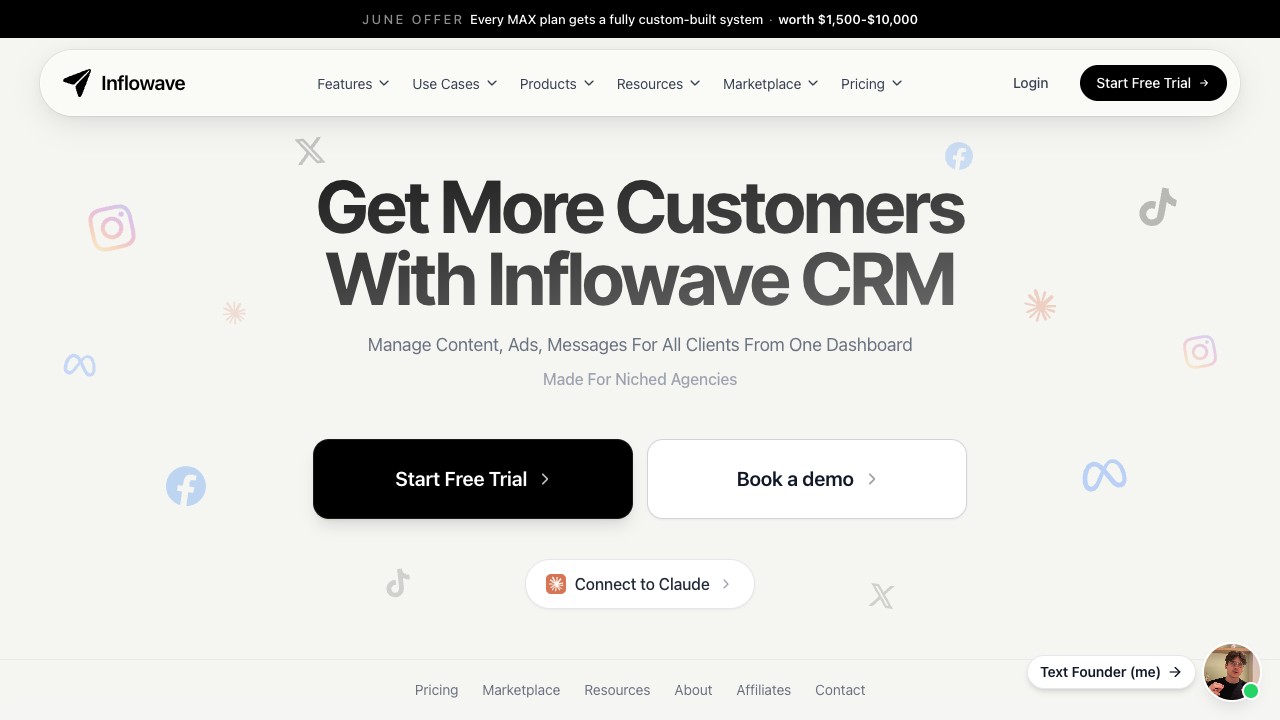
Inflowave approaches WhatsApp differently from the specialists on this list. Instead of treating WhatsApp as the whole product, it treats it as one channel inside a single unified inbox that also handles Instagram DMs, SMS and email. Compliant broadcasts and two-way conversations run on the official WhatsApp Business API, so you get template messaging, opt-in tracking and the verified badge path, but every reply lands in the same place your team already works. Behind the inbox sits an AI CRM and an AI agent that can qualify leads, answer common questions within the service window, and route the rest to a human.
That multichannel design is the reason Inflowave tops this list for most businesses. If a lead first messages you on Instagram, then continues on WhatsApp, then gets an email follow-up, it is all one contact record with one conversation history. The AI agent and workflow automation carry the repetitive follow-up, while your team focuses on the conversations that need judgment. For agencies, sub-accounts, multiple numbers and per-client workspaces are first-class, which is why it features in our guide to the best WhatsApp CRM for agencies.
Inflowave is not the pick if you want a bare WhatsApp-only broadcast tool at the lowest possible ticket price, and it is Instagram-first by heritage, so brands with zero interest in social channels may use only part of the platform. But for teams that live across channels, the consolidation is the whole point.
Pros: WhatsApp, Instagram, SMS and email in one unified inbox; built-in AI CRM and AI agent; strong automation and workflows; flat pricing that does not scale punitively with contacts; genuine multi-number and agency support.
Cons: Broader than a WhatsApp-only specialist, so single-channel buyers pay for capability they may not use; Instagram-first heritage; you still budget Meta's per-conversation fees on top.
Best for: Agencies and sales-led teams that want WhatsApp as part of a real multichannel CRM rather than a standalone broadcast tool.
Pricing: $149/mo flat plus Meta's per-conversation fees. The flat model keeps costs predictable as your contact list grows.
2. Getgabs
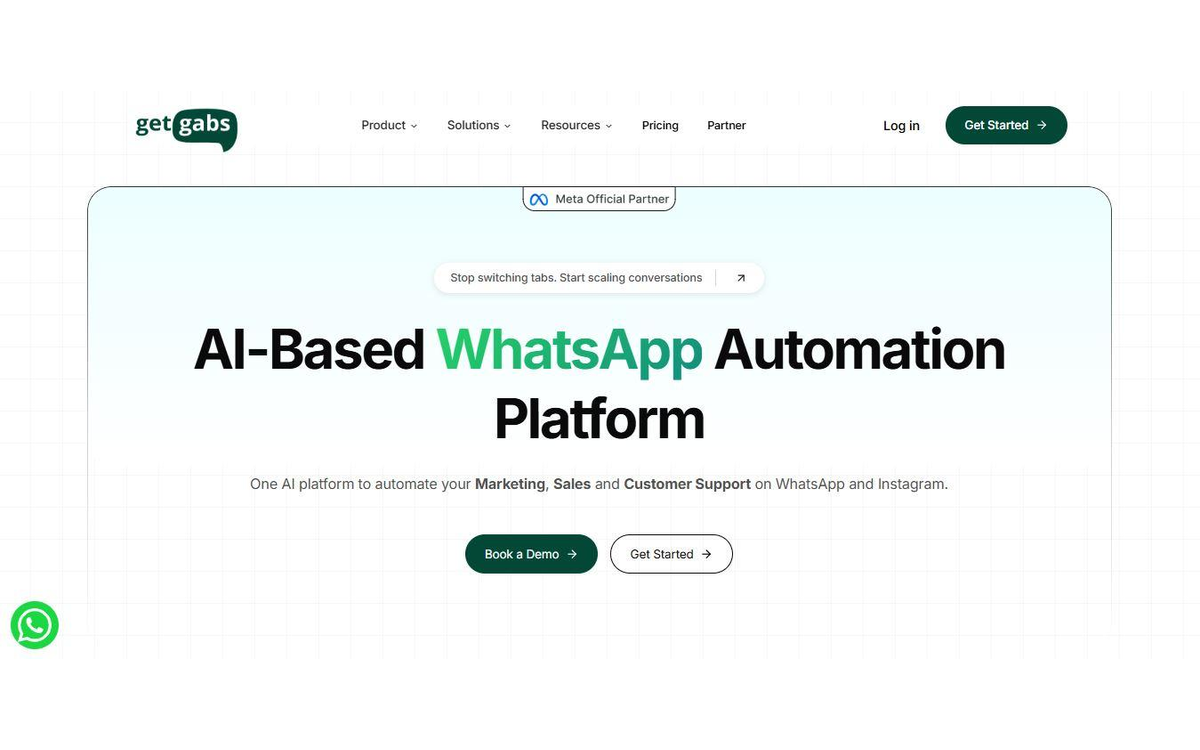
Getgabs stands out as a powerful AI-enabled WhatsApp marketing and automation platform for businesses looking to turn customer conversations into meaningful engagement and growth. From running targeted campaigns and bulk messaging to automating customer interactions, Getgabs brings essential WhatsApp marketing tools together in one place. With AI-powered chatbots, team collaboration, CRM workflows, and e-commerce communication capabilities, it helps businesses streamline conversations and deliver better customer experiences.
Getgabs also integrates with popular business platforms such as Shopify, Zoho, HubSpot, and other tools, making it easier to connect WhatsApp communication with existing business workflows. Its shared inbox, AI agents, drip campaign automation, Click-to-WhatsApp ads, and analytics give businesses the tools to manage conversations more efficiently, automate follow-ups, and improve customer engagement at scale.
Pros: WhatsApp chat widget for websites, interactive WhatsApp messages and buttons, CRM and webhook support, voice calling support, automated customer journeys, transparent pricing with no setup fees and no markup on Meta messaging costs.
Cons: New users may need a short learning period to explore the platform's automation features.
Best for: E-commerce businesses, D2C brands, SMBs, marketing teams, and growing businesses that want to automate WhatsApp campaigns, manage customer conversations, and improve customer engagement from a single platform.
Pricing: Paid plans start at $5/month, with Plus at $11/month and Pro at $59/month. Meta messaging charges apply separately.
3. GetItSMS
GetItSMS is a WhatsApp marketing platform for businesses that want to manage WhatsApp, SMS and email marketing from a single platform. It helps run targeted campaigns, send bulk messages, segment audiences and track campaign performance from one centralised dashboard.
It also provides tools for managing customer conversations and communication workflows. Broadcast messaging, audience segmentation, a shared inbox and reporting help organise campaigns and monitor results across several communication channels.
Pros: WhatsApp, SMS and email campaigns in one platform; bulk and broadcast messaging; customer segmentation; shared inbox; analytics and reporting; omnichannel communication support.
Cons: Some advanced automation features require higher-tier plans.
Best for: E-commerce businesses, SMBs, startups and marketing teams that want to manage WhatsApp, SMS and email campaigns from a single platform.
Pricing: Plans start at Rs 5,000/month, with a half-yearly plan at Rs 27,000 and a yearly plan at Rs 49,000. No setup or onboarding fee.
4. Wati
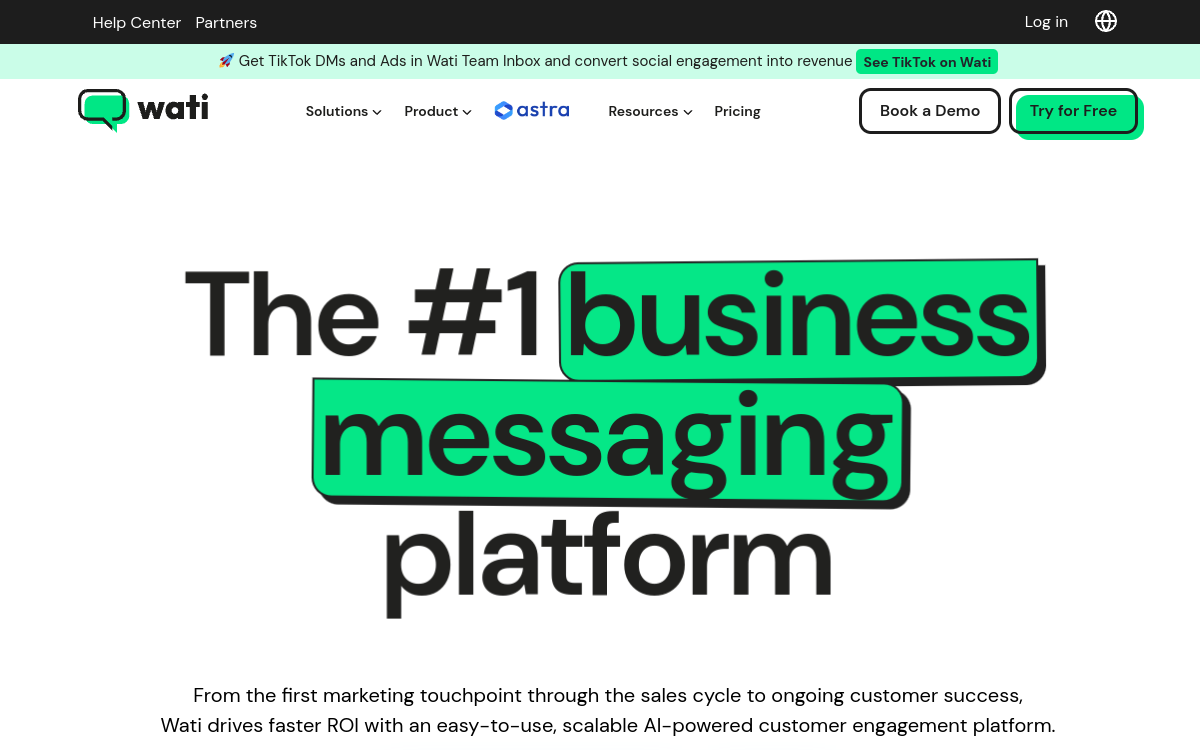
Wati is one of the most established dedicated WhatsApp platforms and a common benchmark buyers compare everything else against. Built entirely on the official WhatsApp Business API, it offers a mature template manager, a no-code chatbot builder, a shared team inbox and broadcast campaigns, plus a solid developer API for teams that want to wire WhatsApp into their own stack. Its focus is squarely on WhatsApp, which makes the product deep in that lane.
That single-channel focus is both its strength and its ceiling. If WhatsApp is the only channel you care about, Wati's depth is hard to fault. If you also need Instagram, SMS and email in one place, you will be stitching Wati together with other tools rather than working from one lead record. Pricing sits in the mid-tier range and can climb with contacts and add-ons, and Meta fees apply on top as always.
Pros: Mature, reliable WhatsApp API; strong no-code chatbot; good developer API; established support and documentation.
Cons: WhatsApp-only, so no native multichannel inbox; contact-based pricing can escalate; less useful if your customers span several channels.
Best for: Single-brand teams that want a proven, WhatsApp-dedicated platform and do not need other channels in the same tool.
Pricing: Mid-tier monthly plus Meta fees; higher tiers unlock more agents, contacts and automation.
5. Interakt
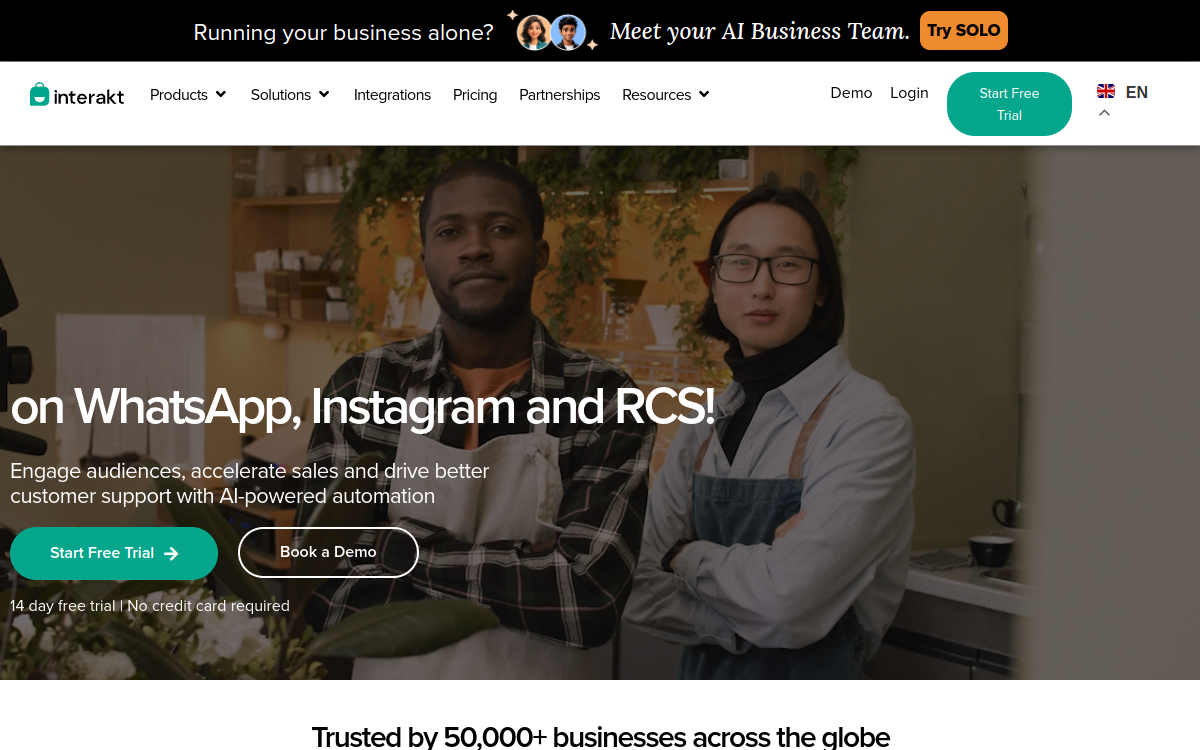
Interakt leans hard into WhatsApp commerce. Built for online sellers, it pairs the official API with product catalogs, order notifications, abandoned-cart nudges and payment prompts, so a shopper can browse and buy largely inside the chat. For DTC brands and e-commerce stores, especially those already selling through WhatsApp catalogs, it removes friction between message and purchase.
The trade-off is scope. Interakt is optimized for the commerce use case, so if your motion is lead generation, agency management or complex sales pipelines rather than transactional retail, some of its strengths will not apply. It sits at the budget-friendly end of the market, which makes it an easy starting point, with Meta's per-conversation fees added on top.
Pros: Purpose-built for WhatsApp commerce; catalog and order-notification features; budget-friendly entry price; quick to set up for online stores.
Cons: Narrow commerce focus; less suited to lead-gen or agency workflows; not a multichannel CRM.
Best for: DTC and e-commerce brands that want to sell directly inside WhatsApp with catalogs and order updates.
Pricing: Budget monthly tiers plus Meta fees, with commerce features across plans.
6. AiSensy
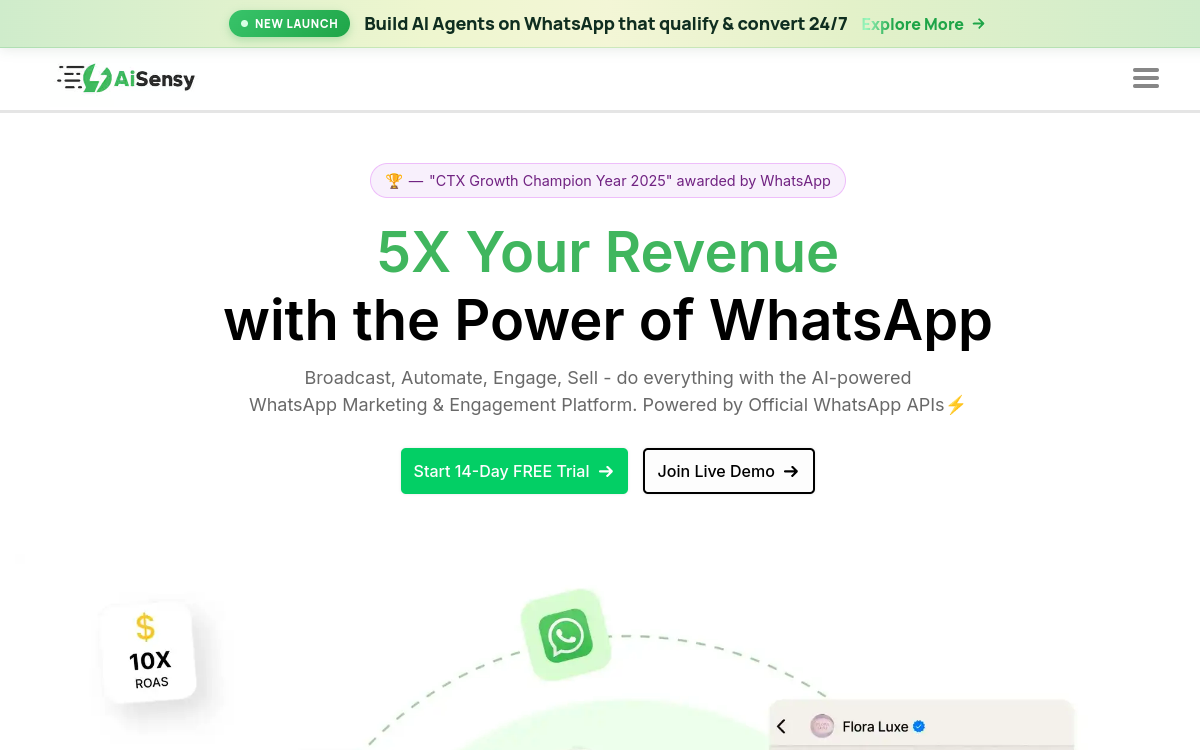
AiSensy has built a following among businesses that send a lot of broadcasts and want to keep the software cost low. It runs on the official API, supports unlimited broadcast campaigns on paid plans, and integrates neatly with click-to-WhatsApp ads so you can turn ad clicks into conversations. For high-volume senders who care most about reaching large audiences cheaply, the economics are attractive.
Where it is lighter is depth of inbox and CRM. AiSensy does the broadcast-and-basic-automation job well, but it is not trying to be the multichannel command center that a tool like Inflowave is. If your strategy is volume-first campaigns and lead capture from ads, that focus is a feature. If you need rich two-way conversation management across channels, you may outgrow it. Meta fees still apply on top of the low monthly software cost.
Pros: Very affordable for high-volume broadcasting; strong click-to-WhatsApp ad integration; unlimited campaigns on paid tiers; simple to launch.
Cons: Lighter inbox and CRM depth; single-channel focus; less suited to complex, conversation-heavy sales.
Best for: Marketers running high-volume WhatsApp broadcasts and click-to-WhatsApp ad funnels on a tight software budget.
Pricing: Low monthly software fee plus Meta fees; campaign volume is generous even on entry tiers.
7. Twilio
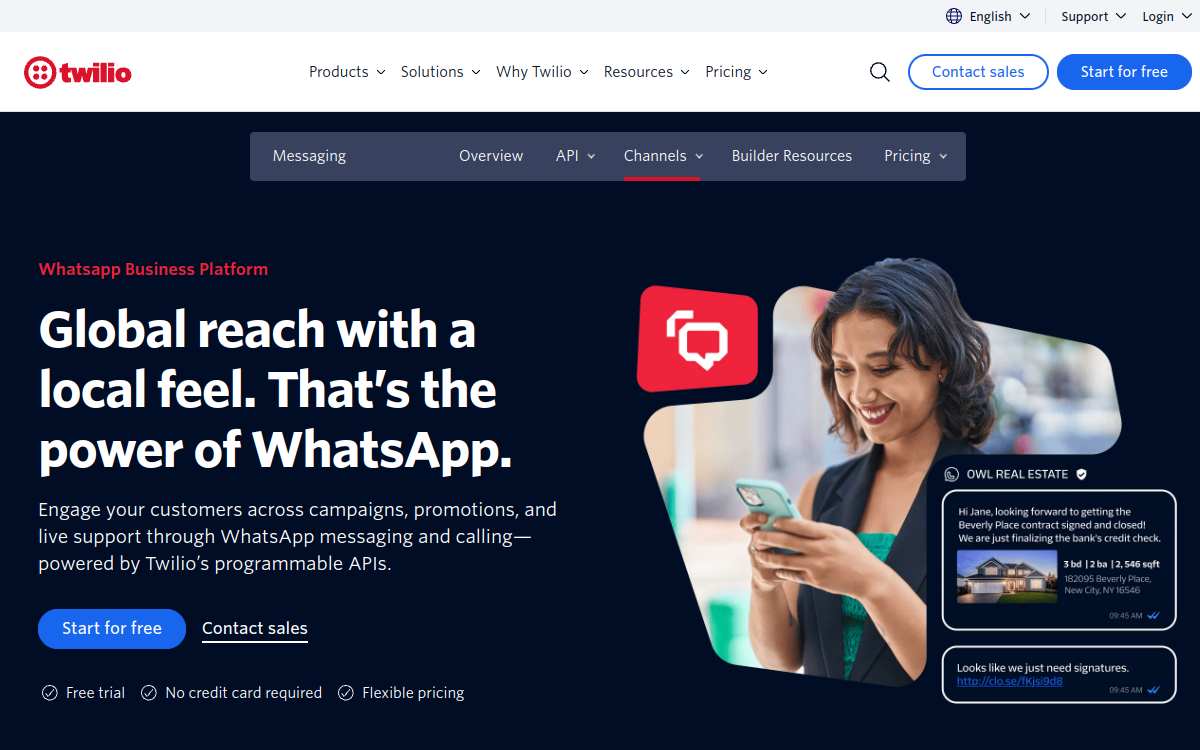
Twilio is not a marketing app at all; it is the programmable messaging infrastructure that many other apps are built on. Through its WhatsApp Business API access, developers can send and receive messages, manage templates and build entirely custom experiences with full control over logic and data. If you have engineering resources and want to own the experience end to end, Twilio is the most flexible option on this list.
That flexibility is also the reason most marketing teams should not start here. There is no ready-made campaign UI, shared inbox or no-code chatbot out of the box; you build what you need. Pricing is usage-based, which is efficient at scale but requires you to model both Twilio's per-message costs and Meta's per-conversation fees. For non-technical teams, a packaged tool will be faster to value.
Pros: Maximum flexibility and control; robust, well-documented API; usage-based pricing that scales cleanly; trusted infrastructure.
Cons: Requires developers; no out-of-the-box marketing UI or inbox; you build the experience yourself.
Best for: Engineering teams building custom WhatsApp experiences into their own product or stack.
Pricing: Usage-based per message plus Meta's per-conversation fees; no fixed marketing-tool subscription.
8. Respond.io
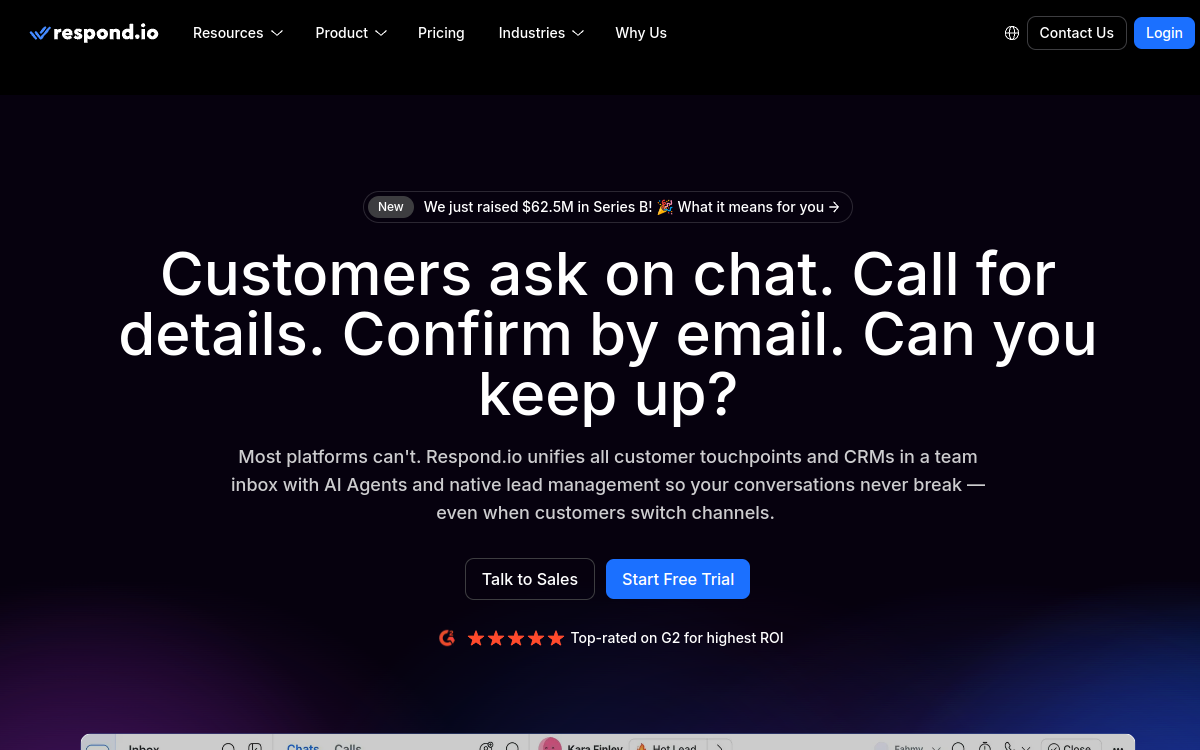
Respond.io is a multichannel customer conversation platform where WhatsApp is one of many supported channels alongside Messenger, Instagram, Telegram and more. Its strengths are routing, assignment and workflow automation across those channels, which makes it a capable choice for support and sales teams that field inbound conversations from lots of places and need to distribute them to the right agent.
Compared with a WhatsApp specialist, Respond.io trades some WhatsApp-specific depth for breadth. Compared with a CRM-first platform like Inflowave, it is more oriented toward conversation routing than toward a full lead and pipeline record with Instagram-first automation. Pricing is mid-tier and can scale with contacts and seats, with Meta fees on top for the WhatsApp channel.
Pros: Many channels in one place; strong routing and assignment; capable automation builder; good for inbound-heavy support and sales.
Cons: Broad rather than WhatsApp-deep; contact and seat pricing can climb; less of a full CRM than pipeline-first tools.
Best for: Support and sales teams managing inbound conversations across many channels who want strong routing.
Pricing: Mid-tier monthly plus Meta fees; tiers scale with contacts and team size.
9. Gallabox
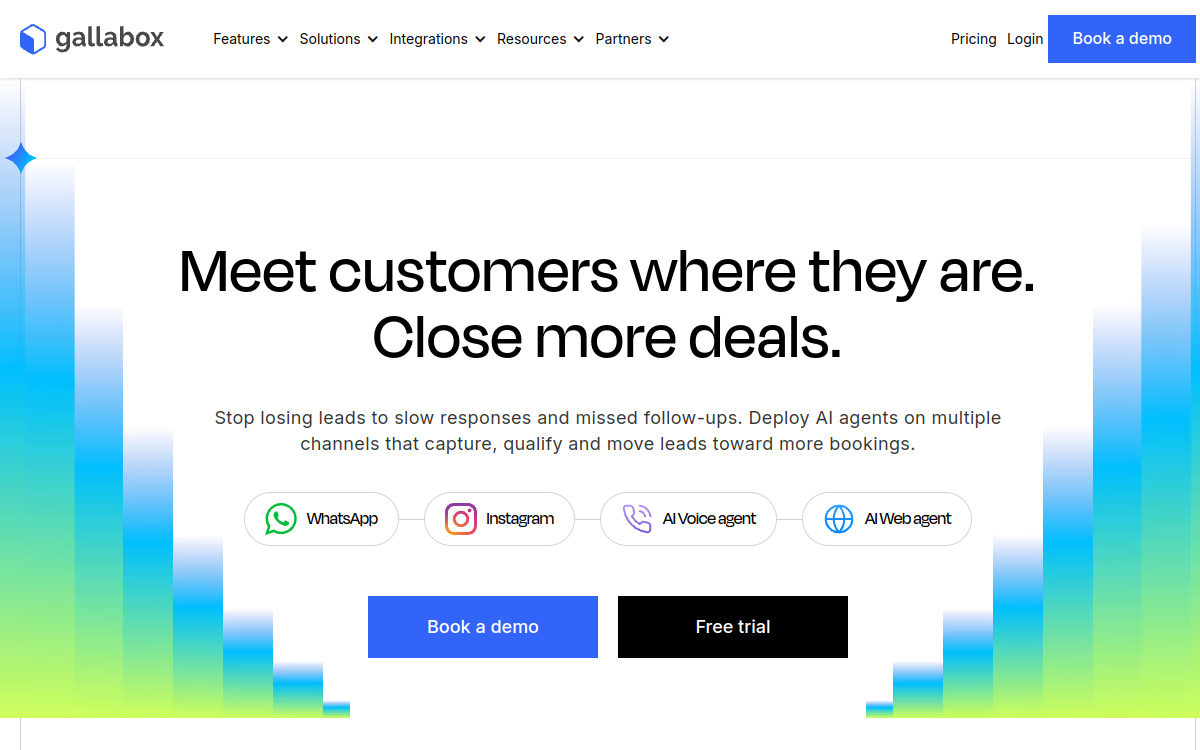
Gallabox targets small and mid-sized businesses that want WhatsApp done simply. It combines a shared team inbox, no-code chatbots and broadcast campaigns on the official API, with light CRM features and integrations that suit SMB workflows. The product is approachable, which lowers the barrier for teams without dedicated marketing ops.
For larger or more complex operations, that simplicity becomes a limit. Gallabox covers the WhatsApp essentials well but is not built to be a deep multichannel CRM or a heavy-duty agency platform. Its tiered pricing is reasonable for SMBs, and as with every option here, Meta's per-conversation fees apply on top of the software cost.
Pros: Easy to adopt; solid no-code bots and shared inbox; SMB-friendly pricing and integrations; quick time to value.
Cons: Less depth for complex or agency use; lighter CRM than pipeline-first platforms; primarily WhatsApp-focused.
Best for: SMBs that want a straightforward WhatsApp shared inbox and chatbots without a steep learning curve.
Pricing: Tiered monthly plans plus Meta fees, scaling with contacts and agents.
Featured Partners
The tools in this section have a commercial or partnership arrangement with Inflowave; we only feature ones we consider genuinely relevant to WhatsApp marketing buyers.
Distill Intelligence sits as an analytics and intelligence layer over your WhatsApp messaging. Rather than sending campaigns, it reads the conversations you are already having and surfaces patterns in intent, sentiment and outcomes so you can see which templates and flows actually move deals. It is a useful complement for teams that broadcast at volume and want to understand why some conversations convert and others stall.
Corebee focuses on AI-driven WhatsApp engagement and support flows. It builds conversational automations that can qualify, answer and resolve inside the chat, then hand off cleanly to a human when needed. For businesses that want smarter automated replies on WhatsApp without engineering a bot from scratch, it is worth a look alongside your core platform.
More WhatsApp Tools Worth Knowing
The market is wide, and a few more tools come up often enough to note. Sendwo is frequently mentioned by high-volume broadcasters. QuickReply focuses on WhatsApp automation for e-commerce retention. Instant Reply targets fast automated responses for inbound messages. And SleekFlow offers a multichannel conversation platform with WhatsApp at its core. None of these displaced the seven above for our top picks, but depending on your niche, one may fit.
How We Evaluated These Tools
We assessed each platform against the criteria that actually determine outcomes for WhatsApp marketing buyers, not marketing-page checklists. First and non-negotiable: does it run on the official WhatsApp Business API with proper template management and opt-in handling, since anything less risks your number. From there we weighed the quality of the two-way inbox, the strength of no-code automation and chatbots, multichannel and CRM depth, agency and multi-number support, and pricing transparency, including how clearly each vendor separates its software fee from Meta's per-conversation fees. We favored tools that are honest about that two-layer cost and that scale predictably. Our bias is toward platforms that reduce tool sprawl, which is why multichannel CRMs rank well for most real businesses, but we noted clearly where a focused specialist or a developer API is the better fit. For a related deep dive on social-first automation, see our guide to the best Instagram DM automation tools.
How to Choose the Right WhatsApp Platform
Start with your motion, not the feature list. If WhatsApp is genuinely your only channel and you want maximum depth in that one lane, a specialist like Wati or a commerce-focused tool like Interakt will serve you well. If your priority is sending large broadcasts cheaply and converting ad clicks, AiSensy is built for that economy. If you have engineers and want to own the experience, Twilio gives you the raw programmable API.
But if your customers move across channels, if you run an agency, or if you want one lead record instead of five disconnected tools, choose a multichannel CRM. That is where Inflowave earns the top spot: WhatsApp broadcasts and two-way conversations live in the same unified inbox as Instagram, SMS and email, backed by an AI CRM and an AI agent that handles the repetitive follow-up. Whatever you pick, budget Meta's per-conversation fees separately from software, insist on the official API, and pilot with a real campaign before you commit. If you manage multiple brands, our WhatsApp CRM for agencies breakdown will help you weigh multi-tenant needs specifically.
Frequently Asked Questions
Do I need the official WhatsApp Business API for marketing?
Yes, for compliant broadcasting at scale. The consumer WhatsApp app and WhatsApp Business app are fine for small-scale, manual conversations, but sending template broadcasts to lists, running chatbots, and getting the verified green tick all require the official WhatsApp Business API through a provider. Tools that automate the consumer app to send bulk messages are unofficial and can get your number banned.
How much does WhatsApp marketing cost?
There are always two layers. The first is your software subscription, which ranges from low monthly tiers with budget tools to flat plans like Inflowave's $149/mo. The second is Meta's per-conversation fee, billed directly by Meta based on conversation category (for example marketing versus utility) and the recipient's country. High volumes can make the Meta layer the larger cost, so always model both together rather than comparing software prices alone.
What is the best Wati alternative?
It depends on what you found limiting. If you liked Wati but wanted more than one channel, Inflowave is the strongest alternative because it adds Instagram, SMS and email to WhatsApp inside a single unified inbox with an AI CRM. If you wanted cheaper high-volume broadcasting, AiSensy is a common switch. For developer control, Twilio is the alternative.
Can I do two-way conversations, not just broadcasts?
Yes, and you should. WhatsApp's real advantage is conversation. Every tool in this guide supports a shared inbox where your team or a bot can reply within Meta's 24-hour customer service window. Platforms like Inflowave route those replies into the same inbox as your other channels so nothing falls through the cracks.
Which tool is best for agencies managing multiple clients?
Agencies need multiple WhatsApp numbers, per-client workspaces, role-based access and consolidated billing. Multichannel CRMs handle this better than single-brand specialists. Inflowave is built for multi-tenant use with sub-accounts, and our best WhatsApp CRM for agencies guide covers the agency-specific criteria in detail.
Do template messages need approval?
Yes. Any message you send to a contact outside the 24-hour service window must use a pre-approved template. You submit templates to Meta through your provider, and they are reviewed against content and category rules. Good software makes template creation, submission and status tracking painless, which is a real differentiator between platforms.
Can WhatsApp connect to my other channels and CRM?
With the right platform, yes. This is the main reason to choose a multichannel tool. Inflowave keeps WhatsApp, Instagram, SMS and email against one lead record in its AI CRM, so a contact's full history follows them across channels. Single-channel WhatsApp tools generally require separate integrations to achieve the same thing.
Related Reading
WhatsApp rewards the businesses that treat it as a conversation, not a broadcast tower. If you want that conversation to live alongside Instagram, SMS and email in one place, with an AI agent and CRM doing the follow-up, start a trial of Inflowave and run a real campaign before you commit. The best way to judge a WhatsApp platform is to watch your own replies land in it.
Explore More
- Best WhatsApp CRM for Agencies - 7 Platforms Compared | Inflowave - The 7 best WhatsApp CRMs for agencies in 2026
- Best Live Chat Software - A website-only chat widget is only half a tool in 2026
- Feature: Unified Inbox - Every DM, comment and message in one place
- Feature: AI Chatbot - Qualify and book while you sleep
- Pricing - Plans built for Instagram businesses