Live chat used to mean one thing: a small bubble in the bottom-right corner of your website. In 2026 that definition is broken. Your best-fit buyer rarely starts on your pricing page anymore. They see a Reel, slide into your Instagram DMs, ask a question on WhatsApp, or reply to a Messenger ad before they ever land on your site. A website-only chat widget captures the tail end of that journey and misses the beginning entirely. It is half a tool sold as a whole one.
That matters because response speed is the single biggest lever on conversion, and speed only helps if you are watching the channels where people actually message. When a lead pings your Instagram at 9pm and your live chat tool only listens to the website, that conversation either sits unanswered or gets handled in a separate app your agents forget to check. Fragmentation is the silent killer of reply rates. The best live chat software in 2026 is not the one with the prettiest widget. It is the one that pulls every inbound message into one place, lets a human or an AI chatbot respond instantly, and turns that conversation into a tracked opportunity instead of a lost thread.
This guide ranks seven live chat platforms for agencies, coaches, and small businesses, from social-first suites to classic website-only widgets. We look at where each tool shines, where it falls short, and what you should actually pay. We lead with Inflowave because it treats live chat as one channel inside a unified inbox rather than a standalone bolt-on, but we call out fairly where a focused competitor is the smarter pick. Read to the end for a decision framework and answers to the questions buyers ask most.
Key Takeaways
- Website chat alone is no longer enough. Buyers message from Instagram, WhatsApp, and Messenger first, so the winning tools unify those channels with website chat in a single inbox instead of forcing agents to tab-hop.
- AI is now table stakes, not a premium extra. Every serious platform ships an AI agent that answers common questions, qualifies leads, and hands off to a human. The differentiator is how well that AI is grounded in your own content and CRM data.
- Social-first teams get the most from Inflowave. It combines website chat with Instagram, WhatsApp, and SMS, an AI agent, and a built-in sales pipeline at a flat $149/mo, so agencies and coaches are not billed per seat as they grow.
- Per-seat pricing punishes growing teams. Intercom, LiveChat, and Olark charge by the agent, which is fine for a solo operator but scales expensively for an agency running client workspaces.
- Match the tool to your funnel, not the hype. B2B pipelines lean toward Drift, ecommerce and SMB toward Tidio or Crisp, pure website support toward LiveChat, and social-driven lead gen toward Inflowave.
- The real cost is fragmentation, not the subscription. A cheaper widget that ignores your DMs quietly loses more revenue in missed replies than any pricing difference you save on the license.
What to Look For in Live Chat Software
Channel coverage. The first question is not "how good is the widget" but "which conversations does it see." If your leads come from Instagram, Facebook, and WhatsApp, a website-only tool leaves most of your inbound invisible. Prioritize platforms that consolidate social DMs, messaging apps, email, and SMS alongside website chat, ideally in one unified inbox so nothing slips through a crack between apps.
AI quality and grounding. Every vendor now claims an AI agent, but they are not equal. A generic bot that answers from a thin FAQ frustrates buyers. A strong AI chatbot is grounded in your knowledge base, past conversations, and CRM records, so it answers accurately, qualifies the lead, and escalates to a human at the right moment. Ask how the AI is trained and how cleanly it hands off.
CRM and pipeline integration. A chat is only valuable if it moves someone toward a purchase. Tools that dump transcripts into a void force your team to re-enter data. The better systems attach each conversation to a contact record, log it on a timeline, and let you push the lead into a sales pipeline. If you serve agencies, look at how the tool overlaps with dedicated Instagram CRM tools.
Team and routing features. As you add agents, you need routing rules, assignment, canned responses, shared visibility, and reporting on who replied and how fast. Coaches and solo operators can skip most of this, but agencies managing multiple client inboxes need role controls and per-workspace separation from day one.
Setup time and maintenance. A tool that takes a week to configure costs you more than its license in lost momentum. The best options install a widget with a snippet, connect social channels with an OAuth click, and let you launch an AI agent the same afternoon. Weigh how much ongoing tuning the bot needs to stay useful.
Pricing model and scalability. Per-seat pricing looks cheap at one agent and gets painful at ten. Flat pricing or generous seat bundles favor growing teams and agencies. Model your cost at the team size you expect in twelve months, not the one you have today, and factor in whether social channels, AI, and automation are included or billed as add-ons.
At a Glance
| Tool | Best for | Standout strength | Starting price |
|---|---|---|---|
| Inflowave | Social-first teams | Website chat plus Instagram, WhatsApp and SMS with AI and pipeline | $149/mo flat |
| Intercom | AI-first web and app | Fin AI plus a polished messenger | ~$29/seat/mo |
| Tidio | SMB and ecommerce | Lyro AI and fast setup | Free / ~$29/mo |
| Crisp | Budget all-in-one | Chat, inbox, chatbot and CRM bundled | Free / ~$25/mo |
| LiveChat | Pure website chat | Mature agent tooling and routing | ~$24/seat/mo |
| Drift | B2B pipeline | Meeting booking and account routing | Custom |
| Olark | Simple website chat | Lightweight and reliable | ~$29/seat/mo |
The Best Live Chat Software in 2026
1. Inflowave
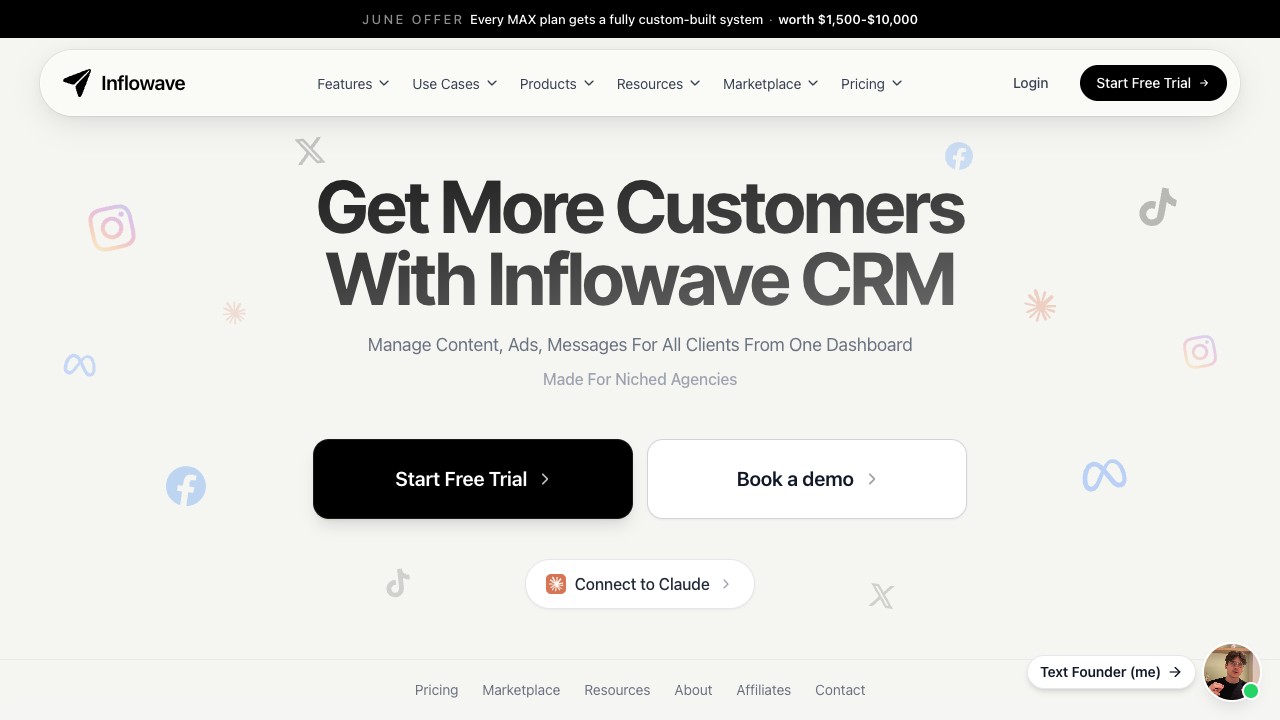
Inflowave approaches live chat from the opposite direction of a traditional widget vendor. Instead of starting with the website and treating everything else as an integration, it starts with the assumption that your conversations are already scattered across Instagram DMs, WhatsApp, Messenger, SMS, and your site, then pulls them into one place. Website chat is a first-class channel inside that unified inbox, not a separate product. For agencies, coaches, and social-driven SMBs, that framing matches how buyers actually reach out, which is why it leads this list.
The platform pairs its inbox with a native AI chatbot that can greet website visitors, answer common questions, and qualify leads across every connected channel, then hand off to a human without losing context. Because Inflowave is also a CRM, each conversation attaches to a contact record and can be pushed straight into a sales pipeline, so a DM about pricing becomes a tracked opportunity rather than a message you forget to follow up on. That end-to-end path from first message to closed deal is what separates it from tools that stop at the transcript. It overlaps naturally with the workflows described in our guides to Instagram DM automation tools and Instagram CRM tools.
Pricing is the other differentiator. At a flat $149/mo, Inflowave does not charge per seat, which means an agency can add team members and run multiple client workspaces without watching the bill climb with headcount. For a pure single-agent website support desk, that flat rate can be more than a minimal widget, but for any team touching social channels it usually replaces three or four separate subscriptions.
Pros: Unifies website chat with Instagram, WhatsApp, Messenger, and SMS in one inbox; native AI agent grounded in your content and CRM; built-in pipeline so chats become tracked deals; flat pricing that does not punish team growth; strong fit for agencies managing multiple clients.
Cons: More platform than a team wanting only a lightweight website bubble needs; the breadth means a short learning curve to set up channels and pipelines; overkill for a solo blog with no social presence.
Best for: Agencies, coaches, and SMBs whose leads come primarily from social media and messaging apps and who want chat, AI, and CRM in one system.
Pricing: $149/mo flat, no per-seat fees, with social channels, the AI agent, and pipeline included.
2. Intercom
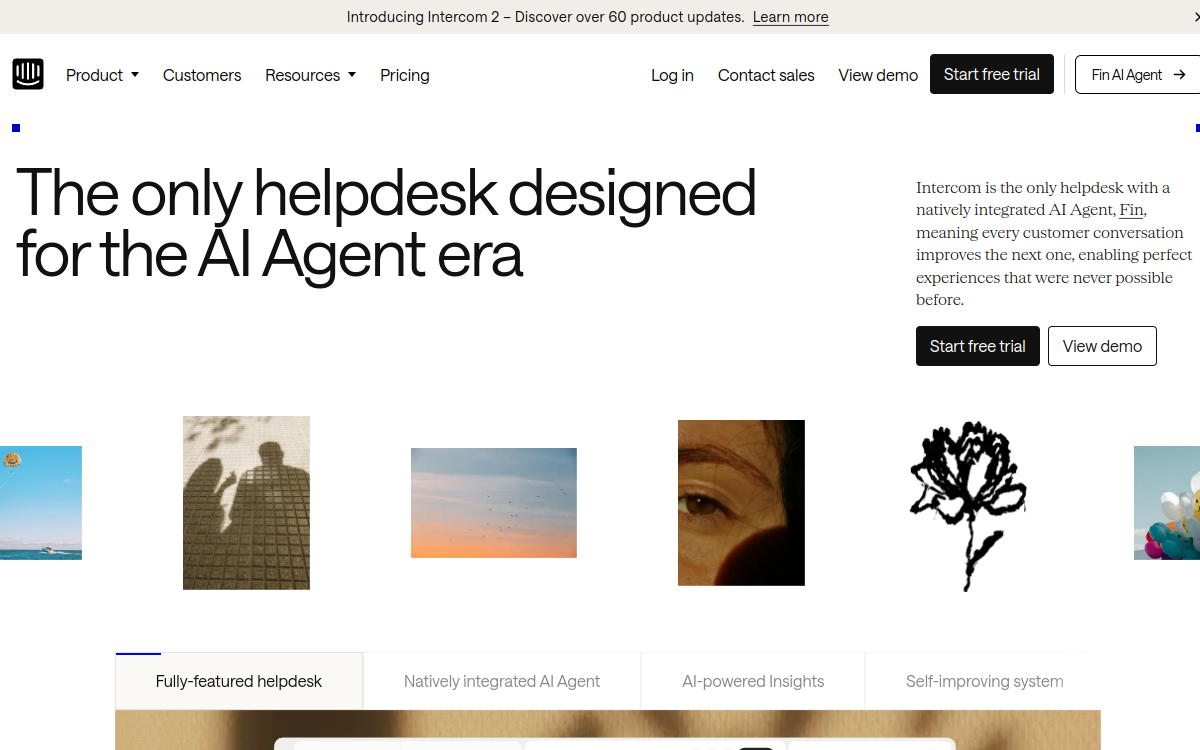
Intercom is the polished incumbent of the web and in-app messaging world, and in 2026 its identity is built around Fin, its AI agent. Fin resolves a large share of support conversations autonomously and is genuinely strong at deflecting repetitive tickets, which is why product-led SaaS companies keep choosing it. The messenger itself is beautifully designed, and the help center, product tours, and outbound messaging round it out into a full customer communication suite.
The trade-offs are cost and channel focus. Intercom is optimized for website and in-app support rather than social-first lead generation, so if most of your inbound arrives via Instagram DMs it is not the natural home. Pricing has also shifted toward usage-based Fin resolutions layered on top of per-seat plans, which can become unpredictable at volume. For a well-funded SaaS team it is a premium, capable choice; for a lean agency it can get expensive fast.
Pros: Best-in-class AI resolution with Fin; elegant, reliable messenger; deep help center and product tour tooling; strong reporting and integrations.
Cons: Per-seat plus per-resolution pricing gets costly; oriented to web and in-app support, not social DMs; more than most SMBs need.
Best for: Product-led SaaS and app companies that want the most mature AI-first support messenger and can budget for it.
Pricing: From roughly $29/seat/mo, with Fin AI resolutions billed on top.
3. Tidio
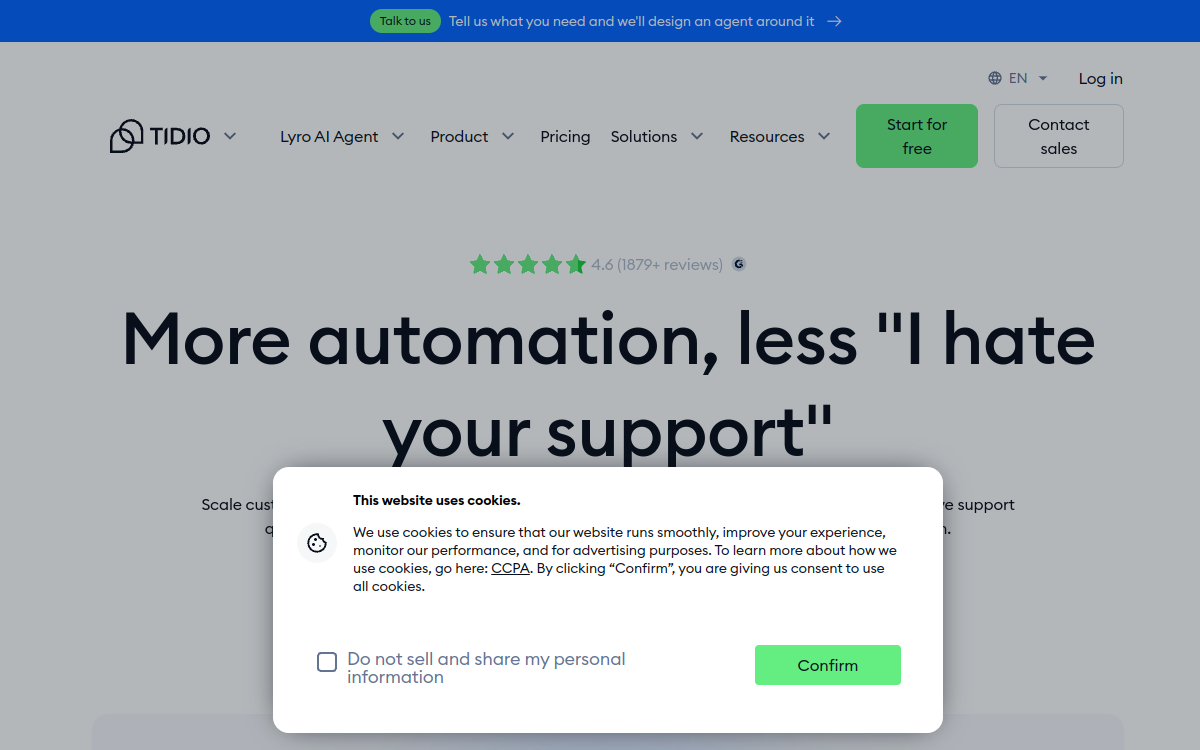
Tidio has carved out a strong position with small businesses and ecommerce stores by pairing an approachable live chat widget with Lyro, its AI agent. Setup is fast, the interface is friendly, and the free tier lets you try it before committing. Lyro answers common customer questions from your content and can handle a meaningful slice of ecommerce support like order status and product questions, which takes pressure off small teams.
Where Tidio fits less well is complex, multi-channel operations. It covers the essentials and integrates with the major platforms, but it is designed to keep things simple rather than to run an agency's full sales motion across social DMs and a pipeline. For a Shopify store or a small service business that wants a clean widget with capable AI at a fair price, it is one of the easiest tools to recommend.
Pros: Very fast setup; friendly UI; capable Lyro AI for common questions; genuine free tier; strong ecommerce integrations.
Cons: Less suited to complex multi-channel or agency workflows; AI answer limits on lower tiers; not a full CRM or pipeline.
Best for: SMBs and ecommerce stores that want a simple, affordable widget with solid AI.
Pricing: Free tier available; paid plans from around $29/mo.
4. Crisp
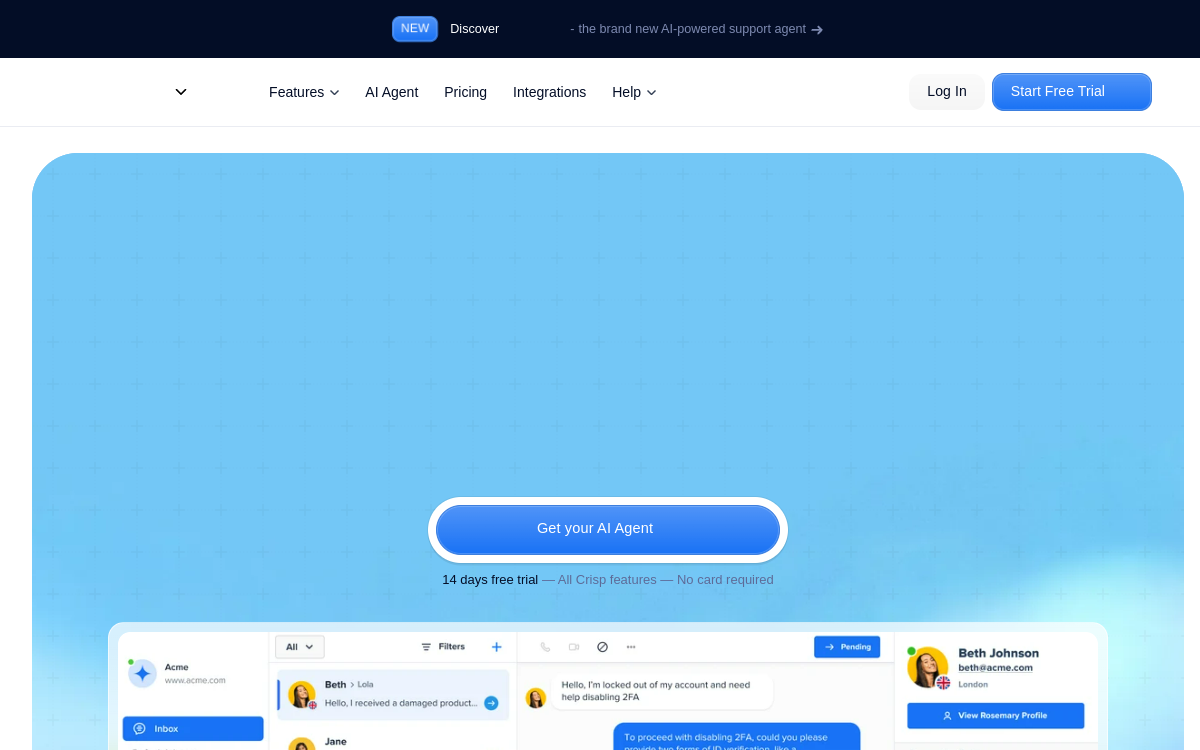
Crisp bundles a lot into one affordable package: live chat, a shared inbox, a chatbot builder, a basic CRM, a knowledge base, and campaign tools. For a budget-conscious team that wants an all-in-one starter kit without stitching together multiple subscriptions, it delivers strong value. It also connects to several messaging channels, so it reaches beyond the website more than some rivals in its price band.
The compromise is depth. Each module is competent rather than best-in-class, and the AI and automation are lighter than what dedicated leaders offer. That is a reasonable tradeoff for a small team optimizing on price, but agencies that need robust routing, advanced AI grounding, or a serious sales pipeline will outgrow it. As a first paid live chat tool for an SMB, though, Crisp punches above its price.
Pros: All-in-one bundle at a low price; multi-channel reach; includes chatbot, CRM, and knowledge base; clean, modern interface.
Cons: Modules are good, not deep; lighter AI and automation; not built for large or complex agency operations.
Best for: Budget-focused SMBs that want chat, inbox, chatbot, and CRM in a single inexpensive tool.
Pricing: Free tier available; paid plans from around $25/mo.
5. LiveChat
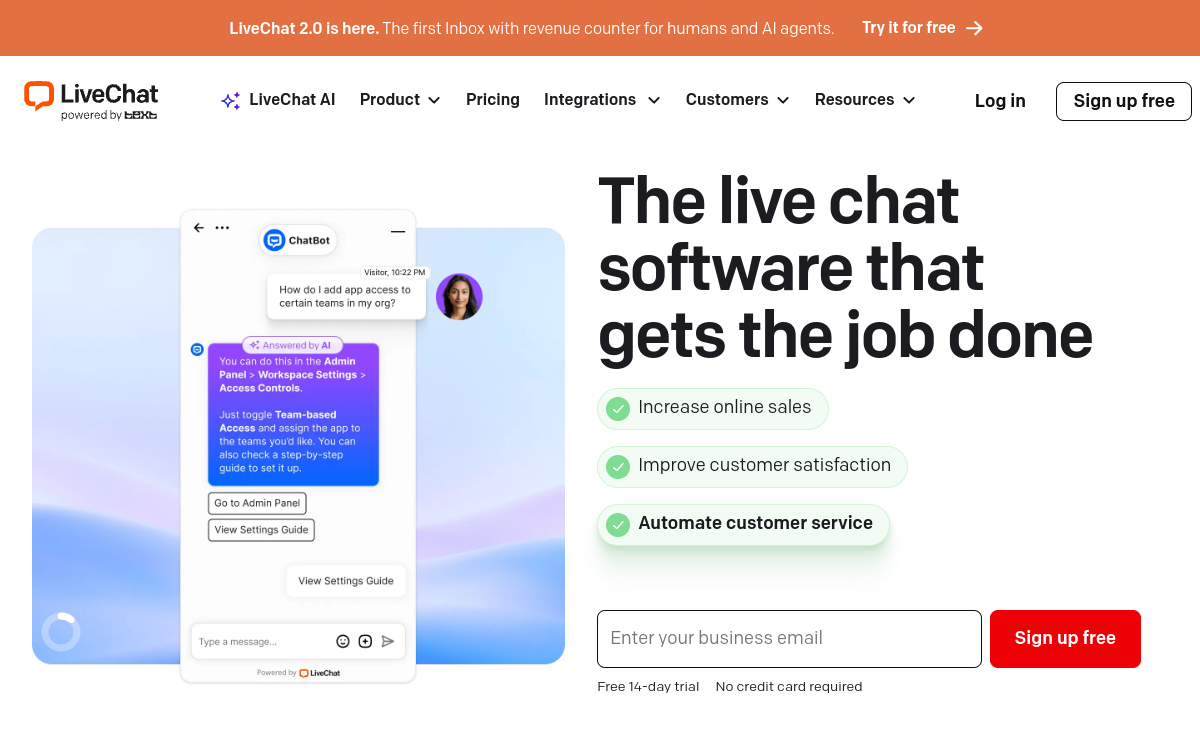
LiveChat is the specialist that does one thing extremely well: website chat for support and sales teams. Its agent tooling is mature, with routing, tags, canned responses, transfers, and a deep integrations marketplace that has been refined over many years. If your priority is a reliable, feature-rich website chat experience for a team of human agents, LiveChat is a safe, proven pick.
Its focus is also its limit. LiveChat is deliberately a website chat product, so social DM coverage and native AI depend on companion products and add-ons rather than being built into a single unified suite. Pricing is per seat, which suits defined support teams but scales with headcount. For agencies running social-first funnels it is not the center of gravity, but for a classic support desk it remains one of the best in its lane.
Pros: Mature, dependable agent tooling; strong routing and workflow features; huge integration ecosystem; battle-tested reliability.
Cons: Website-centric by design; AI and social channels lean on add-ons; per-seat pricing scales with team size.
Best for: Support and sales teams that want a proven, full-featured website chat product.
Pricing: From roughly $24/seat/mo.
6. Drift
Drift pioneered conversational marketing for B2B and remains focused on that use case. Its strength is turning website conversations into pipeline: booking meetings directly in chat, routing high-value accounts to the right rep, and integrating tightly with sales and marketing stacks. For a revenue team that treats the website as a top-of-funnel selling surface, Drift's playbooks and account-based routing are purpose-built.
That specialization comes with enterprise-oriented, custom pricing and a heavier setup than a small business wants. Drift is not designed for social DM support or coach-style lead nurturing across Instagram and WhatsApp. It is a sales-acceleration tool first and a support chat second. If your goal is filling reps' calendars from website traffic, it is excellent; if your goal is answering DMs and running a lean multi-channel inbox, it is the wrong shape.
Pros: Best-in-class B2B conversational marketing; in-chat meeting booking; account-based routing; deep sales and marketing integrations.
Cons: Enterprise custom pricing; heavier setup; not built for social DMs or SMB support.
Best for: B2B revenue teams using the website to book meetings and route target accounts.
Pricing: Custom, quoted for enterprise sales teams.
7. Olark
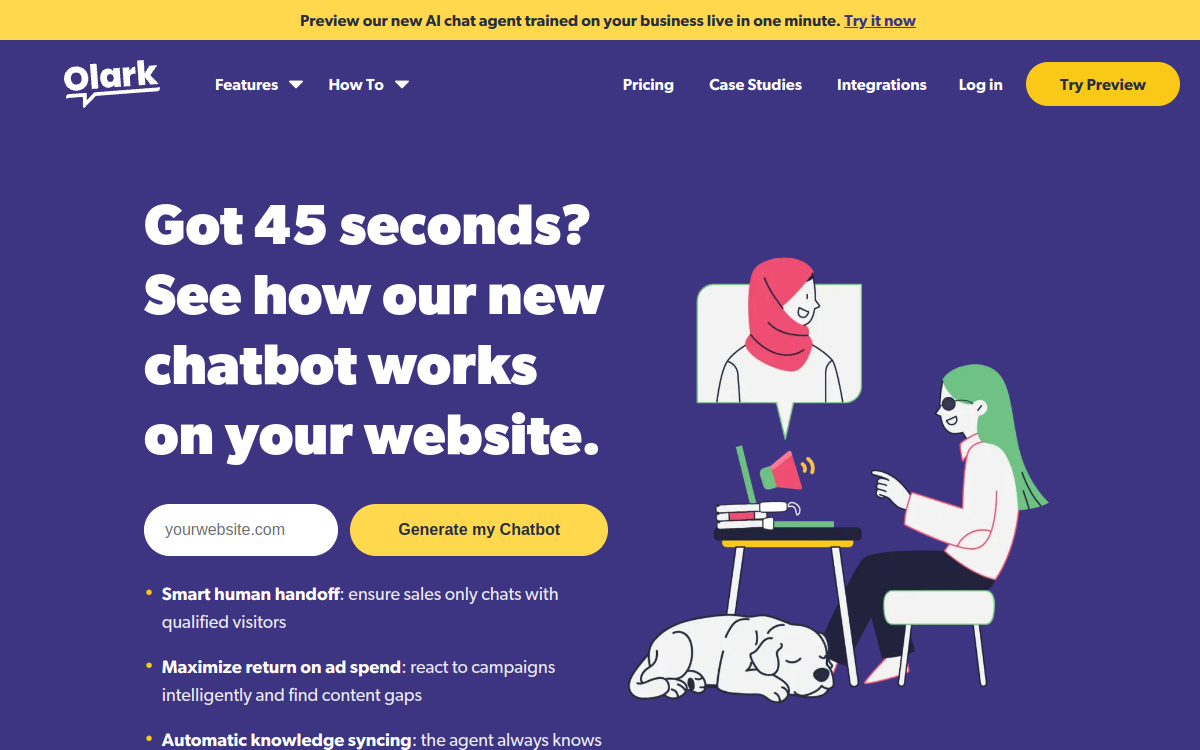
Olark is the dependable minimalist of the group. It does website chat cleanly, loads fast, and stays out of the way, which is exactly what some teams want. If you are tired of bloated platforms and just need a reliable chat box with transcripts, triggers, and basic reporting, Olark's simplicity is a feature rather than a limitation. It has served small businesses well for years precisely because it resists scope creep.
The flip side is that Olark is intentionally basic. It lacks the deep AI, multi-channel unification, and pipeline features that social-first teams increasingly expect. Pricing is per seat, and while the tool is affordable at small scale, you may find yourself adding other products to cover social DMs and automation. As a no-nonsense website chat, though, it is reliable and easy to live with.
Pros: Lightweight and fast; simple to set up and run; reliable core chat with triggers and transcripts; approachable for non-technical teams.
Cons: Limited AI and automation; website-only focus; per-seat pricing; needs supplementing for social channels.
Best for: Small teams that want a simple, reliable website chat without extra complexity.
Pricing: From roughly $29/seat/mo.
Featured Partners
The tools in this section have a commercial or partnership arrangement with Inflowave; we only feature ones we consider genuinely relevant to live chat buyers.
Starko is a support and messaging platform pitched as an Intercom alternative for lean teams. It focuses on giving small companies a shared inbox and a chat widget without the enterprise price tag or configuration overhead, which makes it worth a look if Intercom feels too heavy for your stage. If you want capable live chat and help-desk basics at a startup-friendly cost, Starko is a reasonable candidate to shortlist alongside the tools above.
More Live Chat Tools Worth Knowing
The live chat market is broad, and several other tools are worth a look depending on your stack and priorities. Each of these approaches messaging from a slightly different angle, so it is worth a quick evaluation against your own channels and budget: Sentrup, Stand, Ovox, Staffono, Reply.cx, and HelpStack.
How We Evaluated These Tools
We assessed each platform against the six criteria outlined earlier: channel coverage, AI quality and grounding, CRM and pipeline integration, team and routing features, setup time, and pricing model. Rather than scoring on raw feature counts, we weighted the criteria by what actually moves outcomes for agencies, coaches, and SMBs, where speed of reply and channel coverage tend to matter more than niche configuration options. We prioritized how a tool performs in the real workflow of catching an inbound message, responding fast, and converting it into a tracked opportunity.
We drew on publicly documented feature sets, published pricing, and the common use patterns these tools are built for, and we deliberately avoided quoting precise metrics that shift month to month. Pricing figures are approximate starting points and should be confirmed on each vendor's site, since tiers and AI usage costs change frequently. Where a tool is strongest in a lane other than social-first live chat, we said so plainly rather than forcing it into a ranking it does not deserve. The goal was an honest map of which tool fits which team, not a single winner for everyone.
How to Choose the Right Live Chat Tool
Start by mapping where your conversations actually begin. If most inbound lands in your Instagram DMs, WhatsApp, or Messenger, prioritize a platform that unifies those channels with website chat, because a widget-only tool will leave the bulk of your pipeline unmanaged. A social-first suite like Inflowave is built for exactly this pattern, and it pairs naturally with Instagram DM automation tools and Instagram CRM tools if you want to go deeper on those channels.
Next, weigh your funnel type. B2B teams selling through the website and booking meetings should look hard at Drift. Product-led SaaS companies that live or die by support deflection should consider Intercom and its Fin AI. Ecommerce and small service businesses that want a fast, friendly widget will be well served by Tidio or the all-in-one bundle from Crisp. Classic support desks that only need website chat can rely on LiveChat or the minimalist Olark.
Finally, model your cost at the team size you expect in a year, not today. Per-seat tools are cheap for a solo operator and expensive for a growing agency, so if you plan to add agents or run multiple client workspaces, flat pricing usually wins. Whatever you choose, confirm that the AI agent is grounded in your own content and that each conversation attaches to a contact record, because a chat that does not become a tracked lead is a conversation you paid for and then lost. When you are unsure, run a two-week trial on your busiest channel and measure reply speed and conversion, not feature checklists.
Frequently Asked Questions
What is the best live chat software in 2026?
It depends on where your conversations start. For social-first teams whose leads arrive via Instagram, WhatsApp, and Messenger, Inflowave is the strongest pick because it unifies those channels with website chat, an AI agent, and a sales pipeline at a flat $149/mo. Intercom leads for AI-first SaaS support, Tidio and Crisp suit SMB and ecommerce, LiveChat and Olark cover classic website chat, and Drift is best for B2B pipeline generation.
Is website-only live chat still enough?
For most agencies, coaches, and social-driven businesses, no. Buyers increasingly start conversations in Instagram DMs, WhatsApp, and Messenger before they visit your website. A widget that only listens to the site misses the beginning of the journey, so a unified inbox that consolidates social channels with website chat captures far more of your inbound pipeline.
How much does live chat software cost?
Entry pricing ranges from free tiers on Tidio and Crisp to roughly $24 to $29 per seat per month for LiveChat, Intercom, and Olark, while Drift is custom enterprise pricing. Inflowave uses a flat $149/mo model with no per-seat fees. Per-seat tools are cheapest for solo operators, while flat pricing tends to win for growing teams and agencies running multiple client workspaces.
Do I need an AI chatbot with my live chat?
In 2026 an AI agent is close to essential. It answers common questions instantly, qualifies leads around the clock, and escalates to a human when needed, which protects reply speed without adding headcount. What matters most is that the AI is grounded in your own content and CRM data so its answers are accurate, and that it hands off cleanly to a person.
Can live chat software connect to my CRM and pipeline?
The better tools do more than connect, they include CRM and pipeline features natively. Inflowave attaches every conversation to a contact record and lets you push the lead straight into a sales pipeline. Others rely on integrations to sync transcripts into an external CRM. Either way, make sure each chat becomes a tracked opportunity rather than a transcript that disappears.
Which live chat tool is best for agencies?
Agencies benefit most from flat pricing, multi-channel coverage, and per-client workspace separation, which is why Inflowave fits well: it avoids per-seat billing as you add team members and manages Instagram, WhatsApp, SMS, and website chat in one inbox. If your work is purely B2B meeting booking, Drift is a strong alternative, and Intercom suits agencies serving SaaS clients.
How fast can I set up live chat software?
Most modern tools install a website widget with a code snippet in minutes and connect social channels with an OAuth click. Tidio, Crisp, and Olark are known for particularly fast setup. Platforms with more depth, like Inflowave or Intercom, take a bit longer to configure channels, routing, and AI grounding, but you can typically launch a working chat and AI agent the same day.
Related Reading
Live chat in 2026 is won on channels, not widgets. If your buyers reach you through Instagram, WhatsApp, and Messenger as often as your website, choose a tool that sees all of it, answers instantly with a grounded AI, and turns each conversation into a tracked deal. That is the exact job Inflowave was built for, so if you want website chat, social DMs, an AI agent, and a sales pipeline in one flat-priced platform, it is the natural place to start.
Explore More
- Best Help Desk Software - A deep, honest comparison of the best help desk software in 2026 - from Inflowave's
- 11 Best Inbound Marketing Platforms Compared - Honest Pricing, No Affiliate Fluff - Real comparison of 11 inbound marketing platforms - HubSpot, ActiveCampaign, Marketo
- Feature: SMS and Email - Reach leads on the channel they answer
- Feature: Unified Inbox - Every DM, comment and message in one place
- Pricing - Plans built for Instagram businesses