Most of what separates these products is not the product. It is the Instagram Messaging API, which all of them sit on top of, and which imposes the same rules on everyone. Once you know those rules you can tell within five minutes whether a demo is showing you something real or something that will quietly stop working in week three.
So this page does the constraints first, states the criteria second, and only then names tools in the order those criteria produce. Every price below was re-read on the vendor's own pricing page on 15 September 2026, and every one carries its billing basis, because an annual-billing rate presented as a monthly one understates what you actually pay. Every price and every Meta platform limit is sourced at the bottom. Every claim about what Instagram will and will not let a tool do is taken from Meta's developer documentation. Inflowave is one of the tools listed, and the criteria were chosen by us, so weight that when the ranking flatters us.
First, what Instagram actually permits
Every tool here that touches Instagram DMs is calling the same Meta endpoints. The constraints are published, and they shape what any Instagram CRM can honestly promise.
You need a professional account and a connected Facebook Page. Meta's getting-started guide lists the prerequisites as an Instagram professional account, a Facebook Page connected to that account, and at least Moderate-level access on that Page. The account owner also has to switch on a toggle inside the Instagram app: Settings, then Messages and story replies, then Message controls, then Connected Tools, then Allow Access to Messages. If a client has not flipped that toggle, no tool on this page can read their inbox, and the step is one only the account owner can perform, not you.
You have 24 hours to reply, then the rules change. Meta's messaging policy gives businesses up to 24 hours to respond to a user, and inside that window the reply can include promotional content. Outside it, you are restricted to approved message tags. The Human Agent tag lets a person, not a bot, respond manually within a 7-day period. So any vendor promising unlimited automated follow-up sequences to cold Instagram leads is promising something Meta does not allow. Automation is for the first 24 hours. After that it is a human, and only for a week.
Comment-to-DM is one message, for seven days. The private replies documentation is explicit: only one message can be sent to the user who commented, and it must be sent within 7 days of the comment being created. For comments on a live stream, the reply can only be sent while the broadcast is still running. Once the user replies to that private message, you are back in the 24-hour window and the conversation continues normally. Any comment automation feature is working inside those limits, whatever the marketing page says.
The rate limits are per Instagram account, which is good news for agencies. The Conversations API allows 2 calls per second per Instagram professional account. Private replies allow 750 calls per hour per account for comments on posts and reels. The Send API allows 100 calls per second per account for text, links, reactions and stickers, and 10 calls per second for audio or video. Meta's own pages are not consistent here: some paths list 300 calls per second for text rather than 100, so check the section that matches the integration you are actually on. Because the ceiling is per account rather than per app, managing twenty client accounts does not make you twenty times more likely to get throttled. It does mean a single viral client post can hit the private-reply ceiling on its own.
What Meta App Review means for you, and why it is a buying criterion
Reading and replying to Instagram DMs requires the instagram_manage_messages permission, and Meta requires App Review plus Advanced Access before an app can use it against accounts the developer does not own. That review sits with whoever built the app, and there are two shapes it takes.
Either the vendor holds the reviewed app, in which case your client clicks one authorize screen and is done, or you hold it, in which case you create a Meta app and submit it yourself: weeks of calendar time, a screencast walkthrough, a privacy policy and an annual Data Use Checkup. GoHighLevel and Inflowave both state that they hold their own reviewed app. For the others we are inferring the same shape rather than citing it, because the second shape would not scale to their customer base, so treat that as inference and confirm it on a call. That is the buying question, and it is narrower than partner badges. Kommo is the only vendor here that publicly claims one, stating on its own site that it is a badged Meta Business Partner. We could not independently confirm directory listings for the others and have not asserted any, so do not read a missing badge as a deficiency.
How we judged each Instagram CRM, stated before the tools
An agency running ten client accounts needs four things a solo operator does not, because most CRMs were designed for one company selling to many customers rather than one company operating many companies.
- Hard separation between clients. Not tags, not filters, not a custom field called "client". A boundary, so that a VA assigned to client A cannot see client B's leads, and so that client A's numbers are not quietly averaged into client B's report. Tag-based separation fails the first time someone forgets to tag.
- Per-client reporting that a client will accept. Their leads, their conversations, their revenue, for their month. If you are exporting to a spreadsheet to produce that, you are paying a person to do what the tool should do.
- Routing and ownership inside one inbox. Ten client accounts in one inbox is only useful if a conversation can be assigned to a specific person and stay assigned. Otherwise a shared inbox is just a shared mess with a nicer interface.
- Native Instagram DMs, through the vendor's own reviewed Meta app.
The order below is what those four criteria produce, and nothing else. Tools that satisfy all four come first, alphabetically within the group. Then tools that handle Instagram DMs natively but hold one organisation's data rather than many clients'. Then tools where Instagram DM handling is partial or absent.
The best Instagram CRMs for agencies: all four criteria met
GoHighLevel
An agency platform built around sub-accounts and rebilling. Starter $97 per month billed monthly, or $970 a year, with 3 sub-accounts. Unlimited $297 per month billed monthly, or $2,970 a year, with unlimited sub-accounts and rebilling of phone and email at no markup. Agency Pro $497 per month billed monthly, or $4,970 a year, with rebilling at markup. Enterprise is custom. All three named plans quote unlimited contacts and unlimited users. White-labelling the desktop web app is presented as a general platform capability rather than a paid tier. Separate from the plan price sit two add-ons: the White Label Mobile App add-on at $497 per month per agency, and the Branded Client Portal App at $49 per month per sub-account.
Instagram DMs: yes, through HighLevel's own Meta app.
What it does well: the sub-account model is the correct shape for an agency, and rebilling with markup is a real revenue line.
What it cannot do: Instagram is one channel among dozens rather than the centre of the product, and the breadth comes with a learning curve that shows up as unbilled hours. Our white-label CRM guide covers what the per-sub-account add-on pricing does to the margin maths, including the fact that Agency Pro lets you resell most of those add-ons at your own markup.
Inflowave
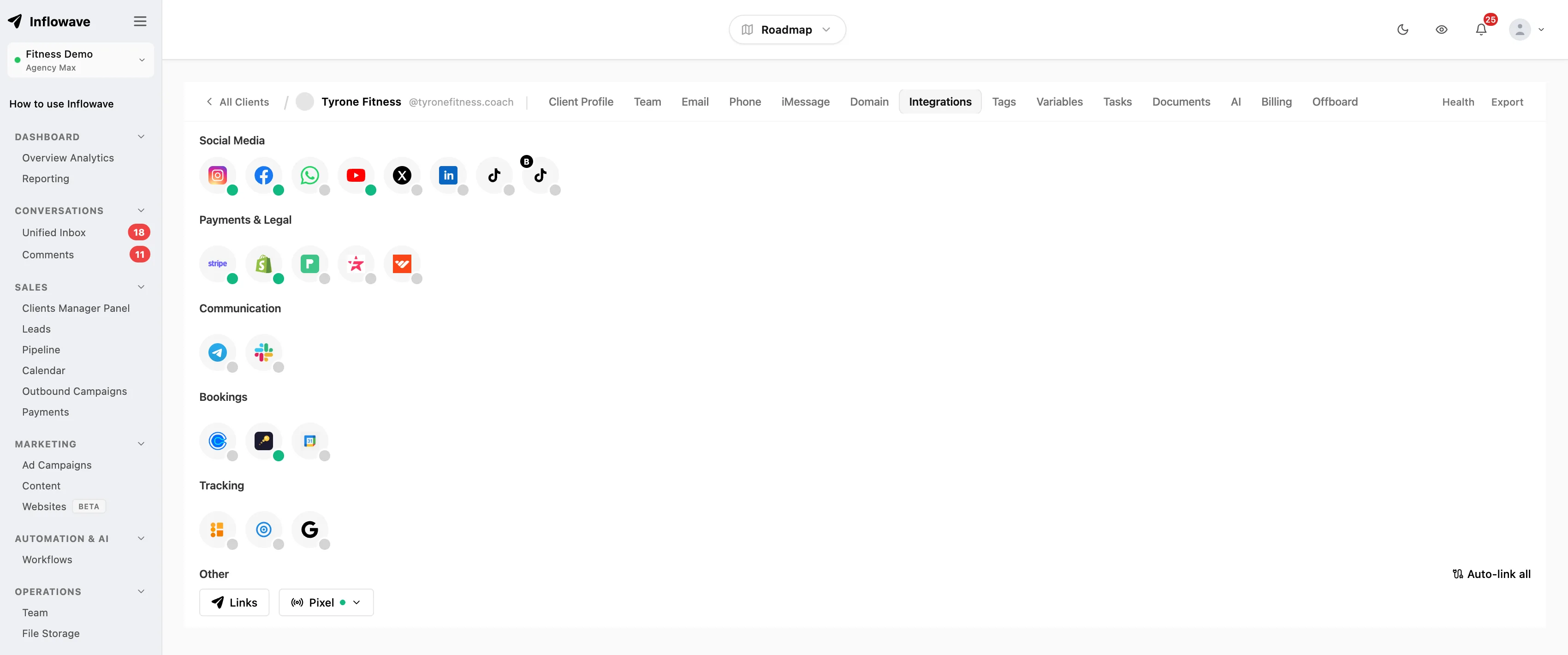
Ours. Built for agencies running Instagram and other messaging channels for multiple clients. Influencer $27, Business $149, Pro $297 and Max $497, all per month billed monthly. Influencer and Business each cover 1 connected social account and 1 client workspace, with 1 team seat and 2,000 and 1,000 contacts respectively. Pro covers 10 social accounts, 10 client workspaces, 5 team seats and 10,000 contacts. Max covers 50 social accounts, 50 client workspaces, uncapped team seats and uncapped contacts. White-label branding sits on Max, and covers your own domain, logo, colours, support email and your own Stripe Connect account for collecting client payments.
Instagram DMs: yes, through Inflowave's own Meta app with Advanced Access on instagram_manage_messages.
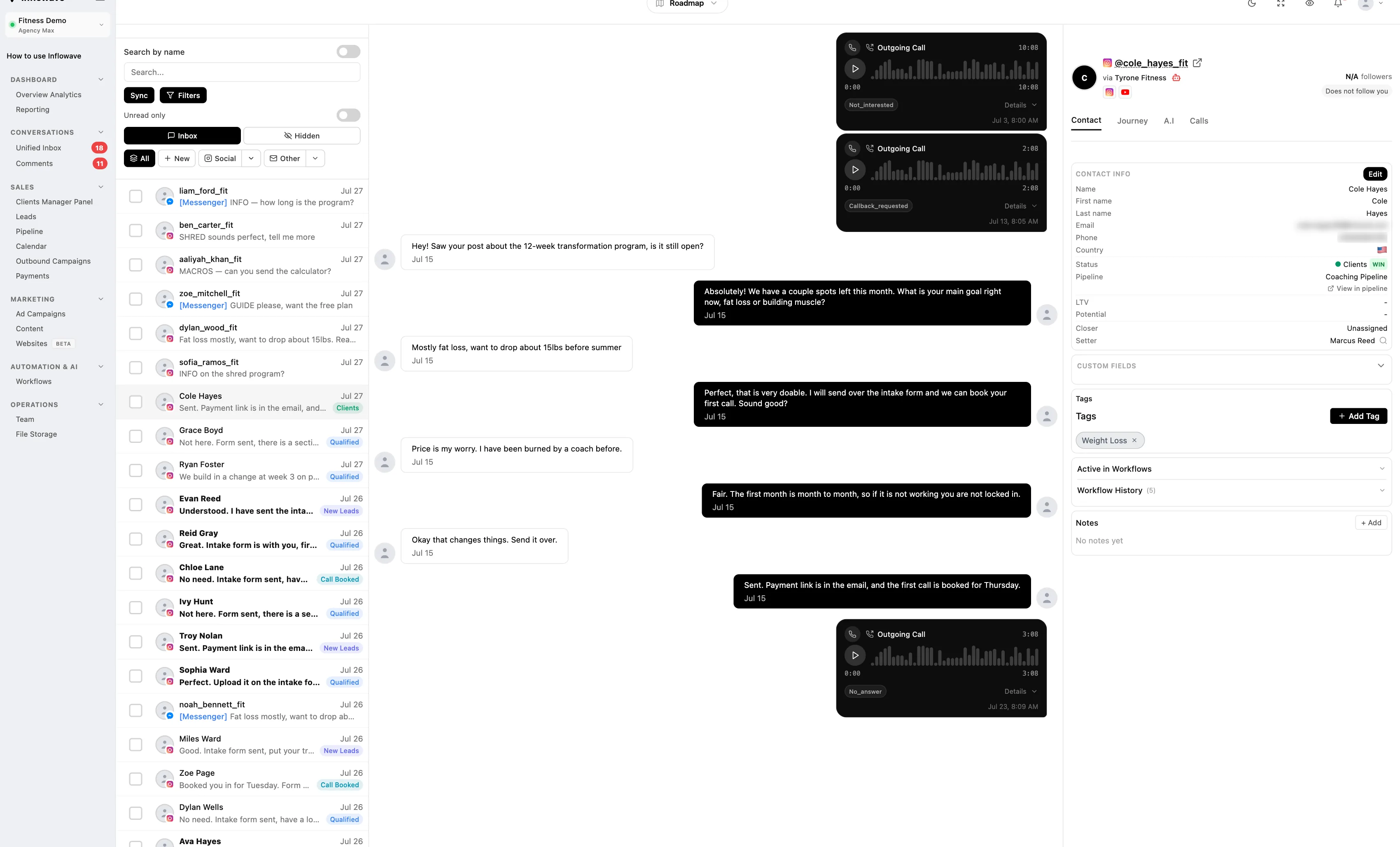
What it does well for this use case: each client is a separate workspace with its own pipelines, inbox scope and reporting, so separation is structural rather than a tagging convention. The inbox mixes Instagram, Messenger, WhatsApp, SMS, email and calls in one thread view, with per-thread assignment.
What it cannot do: it is not a general-purpose enterprise CRM. If your requirement list includes deep Salesforce-style object customisation, procurement-grade compliance paperwork or an established partner ecosystem, this is the wrong shelf. The two lower plans are single-workspace and single-account, so the agency use case genuinely starts at Pro.
Instagram CRMs with native DMs but no client layer
These four are conversation platforms or CRMs you would operate on one client's behalf. You can run several clients in them, but the separation is a convention you maintain, not a boundary the product enforces, and there is no native client-facing reporting layer.
Kommo
A messenger-first CRM with a long history in the Instagram and WhatsApp space. Base $25, Advanced $35 and Pro $45 per user per month, with Enterprise quoted on setup. Read the billing terms carefully: there is no monthly-billing option at all. Kommo's own pricing page states a six-month minimum subscription period and that monthly payments are not currently available, so Base is really $150 per user up front. Base includes 1 Instagram account and 1 WhatsApp number, Advanced includes 3 of each, and both add one more per additional user. Pro and Enterprise are unlimited on both channels.
Instagram DMs: yes. Kommo states on its own site that it is a badged Meta Business Partner.
What it does well: the messaging pipeline model is mature and the Instagram DM handling is a first-class feature rather than a bolt-on. Its own support docs describe the 24-hour window and the 1-to-7-day Human Agent tag accurately, which is a good sign.
What it cannot do: it is built around one organisation's pipeline. Ten clients means ten sets of pipelines inside one account, and the six-month prepay makes a genuine trial-and-discard cycle expensive.
NetHunt CRM
A CRM that lives inside Gmail. Basic $24 and Basic Plus $34 per user per month billed annually, or $30 and $42 per user per month billed monthly. Business $60 and Business Plus $84 per user per month on annual billing; monthly billing on those two tiers is quoted by sales. Messenger accounts are metered per workspace: 1 on Basic, 3 on Basic Plus, 7 on Business and 15 on Business Plus, across Facebook Messenger, Instagram, Viber, Telegram and WhatsApp.
Instagram DMs: yes, inside the messenger-account allowance, which starts at 1 on Basic.
What it does well: if your team already lives in Gmail, adoption is close to free. Nobody has to learn a new inbox.
What it cannot do: the messenger-account metering is the constraint, and it is tighter than it looks. Fifteen client Instagram accounts puts you at the ceiling of the top named plan on channel count alone, before you count seats.
respond.io
An omnichannel conversation platform, and a case where the headline number needs care. The page opens on the yearly toggle, so the prices you see first are annual-billing rates: Starter $79 per month billed annually at $948 a year with 5 users, Growth $159 per month billed annually at $1,908 a year with 10 users, Advanced $279 per month billed annually at $3,348 a year with 10 users. Billed monthly, the same tiers are $99, $199 and $349 per month. Enterprise is custom with unlimited users. Yearly billing is quoted as saving up to 20 per cent. The number that matters is Monthly Active Contacts, defined by respond.io as someone you have talked to over calls or chat during the billing month. Starter is quoted as unlimited MACs; Growth and Advanced each start at 1,000 and bill overage on demand in increments of 100, at $12 per 100 on Growth and $15 per 100 on Advanced. Additional users cost $12, $20 and $24 per month on the three named tiers.
Instagram DMs: yes.
What it does well: genuinely strong multi-channel routing and a serious automation builder.
What it cannot do: on Growth and Advanced, MAC pricing and agency economics pull against each other. A month where three clients run a campaign is a month where your bill moves without your revenue moving. Model that before you sign.
SleekFlow
Same care needed as with respond.io. Pro at US$109 per month billed yearly, which the page states as US$1,308 a year against a US$1,668 list, with 10 seats and starting at 500 monthly active contacts. Premium at US$279 per month billed yearly, stated as US$3,348 a year against a US$4,188 list, with 10 seats and starting at 1,000 monthly active contacts. Enterprise is custom. SleekFlow does not publish a separate per-month figure for monthly billing on its pricing page, only the annual list price those yearly rates are discounted from.
Instagram DMs: yes.
What it does well: ten seats included at the entry tier is generous if you have setters and VAs rather than a two-person team.
What it cannot do: the same MAC-based exposure as respond.io, and the same absence of a native agency layer.
Tools with partial or no Instagram DM handling
HubSpot
Free tools for up to 2 users at no cost, with no credit card required, so HubSpot's entry point is $0 rather than the Starter figure. Above that, Sales Hub Starter $7 per seat per month billed annually, or $20 per seat per month billed monthly. Professional $90 per seat per month billed annually, or $100 billed monthly. Enterprise $150 per seat per month billed annually, with no separate monthly-billing figure published. A mandatory one-time onboarding fee sits outside the per-seat price: $1,500 on Professional and $3,500 on Enterprise.
Instagram DMs: partial, and the detail is worth stating precisely. HubSpot does have a native Instagram DM surface. On Marketing Hub Professional and Enterprise, the social tool's Reply tab includes a Direct messages view where you can read and reply to Instagram DMs, including image, PDF, audio and video attachments. Two documented limits define it: on connecting or reconnecting the account, only DMs from the last 7 days are retrieved, and only the 200 most recent messages per thread are shown, with the rest reviewable only on Instagram. It is also Instagram-only among the social channels.
What it cannot do is the CRM part. The DMs live in the social inbox, not the Conversations inbox, so they do not become contact records on their own and they are not a workflow trigger. If what you want is "a DM arrives, a contact is created, an owner is assigned, a sequence starts, it shows on a deal", that is the part you will still be bridging with third-party tooling, and the bridge is where the data loss happens. We wrote up the specific failure modes in why HubSpot's Instagram DM integration fails.
What it does well: everything a CRM did before messaging became the primary channel. Reporting, deal management, sequences, integrations. Add the onboarding fee to year one before you compare per-seat numbers with anything else on this page.
folk
Standard $24, Premium $48 and Enterprise from $80 per member per month billed annually, or $30, $60 and from $100 per member per month billed monthly.
Instagram DMs: no. Its own pricing page lists email, calendar and WhatsApp sync, and the LinkedIn extension for contact management. Instagram direct messaging is not listed.
What it does well: it is a pleasant, fast, relationship-first CRM and the LinkedIn workflow is excellent.
What it cannot do: if Instagram is where your clients' leads arrive, folk is not the tool, however good it is at everything else.
What does this cost at agency shape?
Headline prices are not comparable because the metering differs. Take your real numbers: client Instagram accounts, people who need a login, and contacts you will actually message in a busy month. Then price each tool three times, at today's numbers, at 2x and at 4x.
The pattern that falls out is consistent. Per-seat tools punish you for hiring setters and VAs. Per-contact and per-MAC tools punish you for a client having a good month. Per-sub-account tools punish you for winning clients. Channel-metered tools punish you for the thing an Instagram agency does by definition. There is no free axis. The question is only which axis you are most likely to grow on in the next twelve months, and then which tool charges least along that axis.
Three specific traps worth naming. HubSpot Professional's $1,500 onboarding fee is a real year-one cost that never appears in a per-seat table. Kommo's six-month minimum term means the cost of finding out you were wrong is six months, not one. GoHighLevel's branded client portal is priced per sub-account, so it scales with exactly the thing you are trying to grow, though on Agency Pro you can resell it to the client at your own markup rather than absorbing it.
How to trial an Instagram CRM so it tells you something
A trial proves nothing if it tests the wrong thing. Someone connects their own Instagram account, sends themselves a DM, sees it appear, and calls it proven. That tests nothing an agency cares about.
Run these five instead, on a real client account with permission.
One: connect two client accounts, not one. Everything interesting breaks on the second account. Check whether the second connection is as smooth as the first, whether the two inboxes are actually separate, and whether a filter or a tag is the only thing keeping them apart.
Two: create a restricted user and try to see the wrong client. Add a VA-level login scoped to client A and then try, deliberately, to reach client B's leads. If you can, the separation is cosmetic. This is the test that disqualifies tools fastest.
Three: reply to a comment and watch the window. Post on a test account, comment from a second account, and trigger the comment-to-DM flow. Confirm that exactly one message goes out, that the tool tells you honestly when the 7-day private-reply window has closed, and that the conversation opens properly once the user replies. A tool that silently fails here will silently fail in production.
Four: leave a conversation alone for 25 hours. Then try to send an automated follow-up. The correct behaviour is a clear refusal or a switch to manual handling, because Meta's 24-hour window has closed. A tool that appears to send it either is not really sending it or is doing something that will cost the client's account.
Five: produce the client report. End of trial, generate the thing you would actually email a client. If you have to open a spreadsheet, add the cost of that spreadsheet, every month, for every client, to the price of the tool.
Instagram CRM for agencies FAQ
Which CRM integrates with Instagram?
Kommo, respond.io, SleekFlow, NetHunt (inside its messenger-account allowance), GoHighLevel and Inflowave all connect to Instagram direct messages through Meta's Instagram Messaging API. HubSpot has a native Instagram DM view in the social tool on Marketing Hub Professional and Enterprise, but it retrieves only the last 7 days on connection and shows only the 200 most recent messages per thread, and those DMs do not land in the Conversations inbox or create contact records on their own. folk does not list Instagram DMs at all. Every one of these integrations requires the same three things on the client side: an Instagram professional account, a connected Facebook Page, and the Connected Tools toggle switched on in the Instagram app under Message controls.
Which CRM is best for social media marketing?
It depends on whether you are publishing or conversing. If the work is scheduling posts and reporting on reach, a social media management tool beats any CRM. If the work is turning DMs and comments into tracked conversations, leads and revenue, you want a messaging-first CRM such as Kommo, respond.io, SleekFlow or Inflowave. For agencies running several client accounts, the deciding factor is usually whether clients are separated structurally or only by tags.
What is the best Instagram DM automation tool?
There is no single best one, because Meta caps what all of them can do identically. Automation is allowed inside the 24-hour window after a user messages you, and comment-to-DM allows exactly one private reply within 7 days of the comment. Judge tools on how honestly they handle those limits, how clearly they hand a conversation to a human when the window closes, and whether automation can be configured separately per client account.
What is the best CRM for agencies?
For agencies, the deciding features are sub-account or workspace separation, per-client reporting, role-based access for VAs and setters, and white-label. GoHighLevel and Inflowave are both built around that shape, with Inflowave's white-label branding on its Max plan. Kommo, respond.io, SleekFlow, NetHunt and folk are built for one organisation and can be operated on a client's behalf, but do not give you a native client layer. HubSpot is strong on reporting and deal management, and its Instagram DM support is a social-inbox feature rather than a CRM channel.
What is a CRM for social media?
It is a CRM whose primary contact channel is a messaging or social platform rather than email or phone. Practically, that means the direct message thread is the record, not an attachment to the record. Conversations from Instagram, Messenger, WhatsApp and similar channels arrive automatically, become contacts, and move through a pipeline without anyone copying and pasting. The distinction matters because pipelines, automations and reporting in traditional CRMs all assume email as the default channel.
Which CRM software is best for texting?
If SMS is the main channel, look for a platform that owns the number, handles compliance and opt-outs, and keeps texts in the same thread as other channels. GoHighLevel rebills phone usage to clients, at no markup on its Unlimited plan and with markup on Agency Pro. respond.io and SleekFlow handle SMS alongside messaging apps. A CRM that treats SMS as a notification feature rather than a conversation channel will not survive real two-way volume.
What are the top 5 CRM platforms?
By market presence the usual names are Salesforce, HubSpot, Zoho, Pipedrive and Microsoft Dynamics. Of those, only HubSpot has any native Instagram DM surface at all, and it is a social-inbox reply tool rather than a CRM channel, which is why these names rarely top an Instagram-specific shortlist. Market share is a poor proxy for fit here. The right comparison set for an Instagram agency is messaging-first platforms, and the right question is which one separates clients properly and prices sanely at your shape.
Which CRM is best for beginners?
Judge this by how quickly a new team member becomes useful without a training call, not by the size of the feature list. folk and Pipedrive are commonly chosen for simplicity, and NetHunt has an unusually short learning curve because it lives inside Gmail. GoHighLevel is the opposite end: powerful and genuinely slow to learn. If you are hiring VAs regularly, weight ease of onboarding heavily, because you will pay that cost again with every hire.
Sources
Every price above was re-read on the vendor's own pricing page on 15 September 2026, with its billing basis taken from that same page. Where a vendor publishes no figure for a billing mode, that is said rather than estimated. Pricing drifts, so check the vendor page before you budget.
- Meta, Instagram Messaging: get started - professional account, connected Facebook Page, permissions and the Connected Tools toggle
- Meta, Messenger Platform policy overview - 24-hour standard messaging window and the 7-day Human Agent tag
- Meta, Private replies - one message per commenter, 7-day limit, live-stream exception
- Meta, Instagram Messaging rate limits - per-account call limits for the Conversations, Private Replies and Send APIs, and the section that lists 300 rather than 100 calls per second for text
- Meta, instagram_manage_messages permission reference - App Review and Advanced Access requirement
- HubSpot, Manage social direct messages - Marketing Hub Professional and Enterprise, 7-day retrieval on connect, 200 most recent messages per thread
- Kommo pricing and Kommo Instagram overview
- respond.io pricing
- SleekFlow pricing
- NetHunt CRM pricing
- folk pricing
- HubSpot Sales Hub pricing
- GoHighLevel pricing
- Inflowave pricing