Search for a competitive analysis example and what comes back is output without input. You get a filled-in grid, four competitors down the side, six criteria across the top, and cells reading "strong brand presence" or "limited social proof". Nobody tells you where any of that came from. So you copy the grid, sit down in front of it, and discover the hard part was never the grid. The hard part is the list of competitors, and after that it is finding anything true enough to put in a cell.
This article goes the other way. One finished grid you can check line by line, then three worked examples with the exact inputs each one used: which tool, which query, which field. Then the honest note on what each example could not answer.
Example one: a finished grid, every cell sourced and dated
Here is a completed competitive analysis of the competitive intelligence category itself. No Inflowave data is involved. Every number comes from the vendor's own live pricing page, checked on 15 September 2026, and where a vendor publishes no price the cell says so rather than borrowing a figure from somewhere else. You can re-check all six in about ten minutes.
| Competitor | Entry price | Top published price | Pricing published? | Question it answers | Source URL | Date checked |
|---|---|---|---|---|---|---|
| Semrush | $139/mo billed monthly, or $117.33/mo billed annually (SEO plan, 5 websites, 500 keywords daily) | $549/mo billed monthly, or $455.67/mo billed annually (Advanced, 40 websites, 5,000 keywords daily); Enterprise is custom | Yes, full tier table in both billing modes | Why does that domain outrank mine | semrush.com/pricing/ | 15 September 2026 |
| Ahrefs | Free tier (Ahrefs Free), then $29/mo billed monthly (Starter) and $129/mo billed monthly (Lite) | $1,499/mo (Enterprise), annual commitment required | Yes, but monthly only. The page says annual saves up to 17% and lists no per-tier annual figure | Backlinks, rankings, traffic estimates | ahrefs.com/pricing | 15 September 2026 |
| Foreplay | $59/mo billed monthly, or $49/mo billed annually (Basic) | $459/mo billed monthly, or $389/mo billed annually (Agency); Enterprise is custom | Yes, both billing modes | What ad creative is working in my niche | foreplay.co/pricing | 15 September 2026 |
| Similarweb | $125/mo billed annually, or $199/mo billed monthly (Competitive Intelligence, 1 user) | $542/mo billed annually, or $649/mo billed monthly (Competitive Intel, SEO & AEO & Ads, 1 user); Businesses & Enterprises is custom | Yes, for self-service, but only behind the "Entrepreneurs" toggle. The page opens on "Businesses & Enterprises", which shows no prices at all: "If you're interested in our solutions for businesses and enterprises, please contact our sales team to discuss a custom package tailored to your needs." The middle self-service tier is $333/mo billed annually, or $399/mo billed monthly | Traffic and market share estimates | similarweb.com/packages/web/ (similarweb.com/corp/pricing/ redirects here) | 15 September 2026 |
| Crayon | Not published | Not published | No. "Crayon's pricing is tailored to the needs of your competitive intelligence program." | Battlecards for a sales team | crayon.co/pricing-inquiry (crayon.co/pricing redirects here) | 15 September 2026 |
| Klue | Not published | Not published | No, and there is no pricing page to check. klue.com/pricing redirects to the homepage, which carries a demo request and no prices. | Battlecards for a sales team | klue.com | 15 September 2026 |
Three things fall out of that grid that no adjective would have produced.
First, two of the six will not tell you what it costs, and both are the battlecard tools. That is a finding, not a gap in your research. It means you cannot scope a project against a known price before a sales call. A second finding sits next to it: a price can be published and still be invisible to you, because Similarweb's self-service tiers only render once you switch the toggle away from the enterprise default. If you check a pricing page and see nothing, click everything before you write "not published".
Second, the published paid prices span roughly fifty times, from $29 to $1,499, and the floor is lower still because Ahrefs lists a free tier above Starter on the same page. The two paid ends are not quoted on the same basis either: $29 Starter is billed monthly with no commitment, while $1,499 Enterprise requires an annual commitment. Even allowing for that, a category this wide is not one category. Ahrefs at Starter and Klue are not competing for the same buyer.
Third, the "question it answers" column is doing more work than the price columns. Two of these six are sales-enablement tools and four are research tools, and no amount of feature comparison would have surfaced that if the column had said "competitive intelligence" for all six.
The SWOT that comes out of the grid
A SWOT is a summary of evidence, not a substitute for it. This one is written against the grid above, from the point of view of a small agency deciding what to buy. Every line points at a cell.
Strengths (ours). We already know our clients' markets by name, which is the input the search tools cannot supply.
Weaknesses (ours). Nothing in our stack produces backlinks, keyword rankings, traffic estimates or share of voice. Those are Semrush and Ahrefs capabilities and buying one is cheaper than approximating it.
Opportunities. Crayon and Klue, the two that publish no price at all, both require a sales conversation before a buyer can get a figure at all. Anything we can deliver in week one beats a tool a client cannot even price in week one.
Threats. Foreplay at $59/mo billed monthly covers ad creative research well enough that a client could do that part themselves.
Notice what is missing: no cell says "strong brand". Every line either cites a number from the grid or states a capability that is absent.
The template, empty
Copy this and fill it the same way. The rule is that every evidence cell holds a number, a URL, a verbatim quote or a date. If a cell wants an adjective, the research is not finished.
| Competitor | Entry price | Top published price | Pricing published? | Question it answers | Source URL | Date checked |
|---|
What the free sources cover before you buy anything
The Meta Ad Library and the Google Ads Transparency Center cost nothing. If your question is "what is this one named business running right now", start there and stop.
One real constraint worth knowing before you build a workflow on the Meta side: the ads archive API documentation states that "Ads that did not reach any location in the EU will only return if they are about social issues, elections or politics." So a US-only advertiser running ordinary commercial ads is visible in the web interface but not necessarily through the API in the way people assume.
Inflowave's competitor intelligence sits in a gap the paid tools leave: the market is a place or an audience rather than a set of domains, and you do not yet know who the competitors are. That is the situation the three examples below are in.
Example two: a local service business that could name four competitors
The brief was a mobile physiotherapy practice covering one metropolitan area. The owner's own list had four names on it, all of them clinics she had worked at or trained with.
Inputs used. Trade plus a location, with a radius sweep. The default radius is about eight kilometres and it goes up to forty for sparser areas. Her own website and social handles went in as the exclusion, so she is kept out of her own competitor list and used as the benchmark instead. Her four known names went in as seeds, so they get researched alongside whatever discovery finds.
Columns collected per business. Name, website, address, category, Google rating, review count, distance, local rank, and whether the listing was sponsored. Then: sample reviews, recent organic posts, whether the business runs Meta ads and which ones, whether it runs Google ads, and third-party mentions.
The cell that changed the decision. Not the competitor list. The share of the market running paid advertising at all. It is one number and it reframes the whole budget conversation. If seven of forty local competitors are advertising, paid is an opening nobody has taken. If thirty-two of forty are, the organic work has to be far better than you assumed. Working it out by hand means opening forty ad libraries one at a time.
The second cell. Median review count, not average rating. Compute both for your own sweep before you lean on either. Ratings often cluster tightly enough that they separate almost nobody, while review counts spread much wider, but that is a pattern to test in your own radius rather than one to assume: a 4.6 feels fine until you know the median in your own market, and ninety reviews sounds like a lot until you see what the top three hold.
What this example could not answer. Nothing about keyword rankings or backlinks. If the question had been "why does that clinic outrank me for the head term", this was the wrong tool and Semrush was the right one.
Seeding is the sanity check. Put in the competitors you already know. If the four you named come back looking right, you can trust the ones you had never heard of. This is a high-value habit, and it costs nothing.
Example three: a creator brand where the market is a hashtag, not a postcode
The second shape has no location at all, because for a coach or a creator the honest definition of a competitor is not whoever ranks for a keyword. It is whoever your audience is also following.
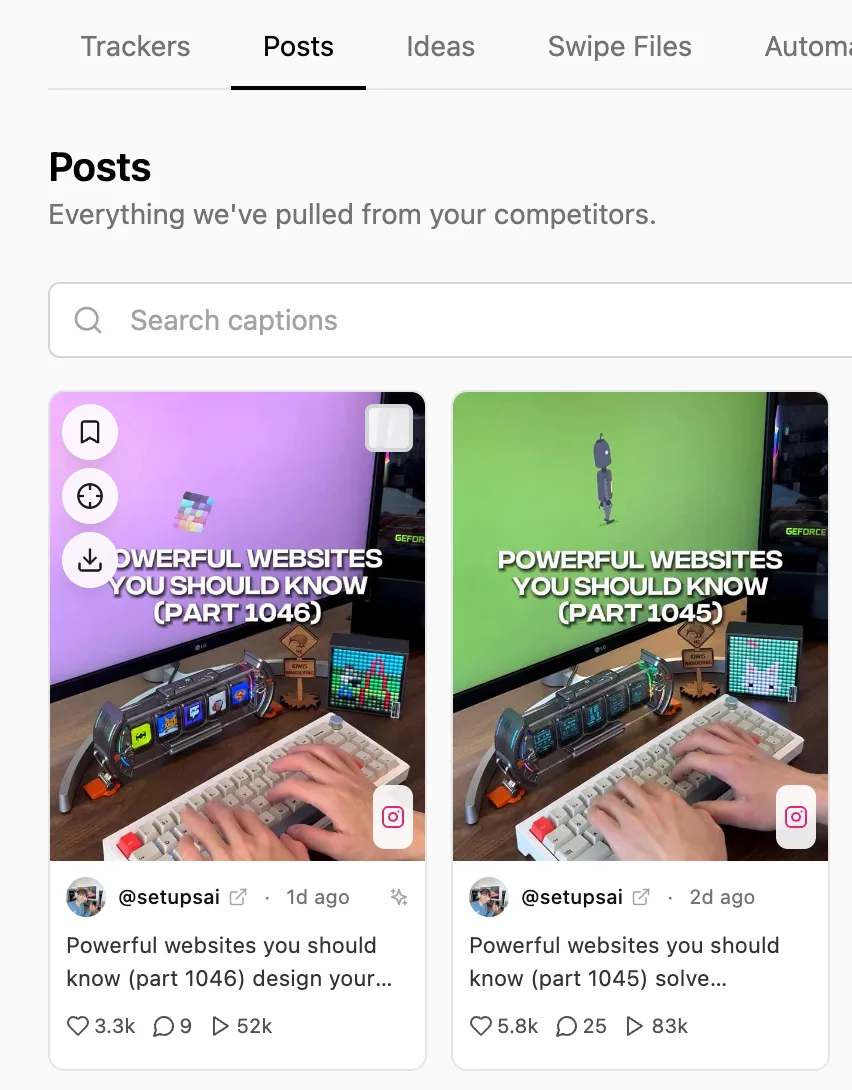
The posts view. Every tracked account's recent content in one list, with the engagement numbers attached, which is what turns "they post a lot" into a sortable column.
Inputs used. Hashtags, a handful of seed accounts already considered peers, and the free-text phrases people in that space put in their bios and captions. No location field is involved.
The field that does the work. A performance multiplier, computed per post against that account's own baseline. Raw like counts compare accounts, which is meaningless when one has 400,000 followers and another has 9,000. The multiplier compares a post to its own account's normal, which is the only comparison that tells you the format worked rather than that the audience was already big. The interesting rows are usually the outliers within one account, rather than the biggest accounts.
Where the criticism actually lives. Competitor mentions do not come from where people expect. In an Inflowave production sample of 936 external mention rows, to 15 September 2026, the largest single source was Reddit at 369 rows, ahead of general search results at 201 and YouTube at 131, with Facebook, Quora, TikTok, Instagram, Trustpilot, LinkedIn and X making up the remainder. That is one platform's sample and not a claim about the internet, but it is enough to change where you look first. The honest account of a competitor's weaknesses can sit in a Reddit thread rather than on their pricing page, so check the forums before you conclude there is no criticism.
What this example could not answer. Nothing about revenue, audience overlap or who actually buys. Engagement and mentions describe what an audience reacts to, not what it pays for, and no field here closes that gap.
Example four: an agency running the analysis as a first-week deliverable
The awkward part of a new client engagement is the gap between signing and the first campaign results. A competitive analysis fills it with something concrete that exists before you have spent any of their budget.
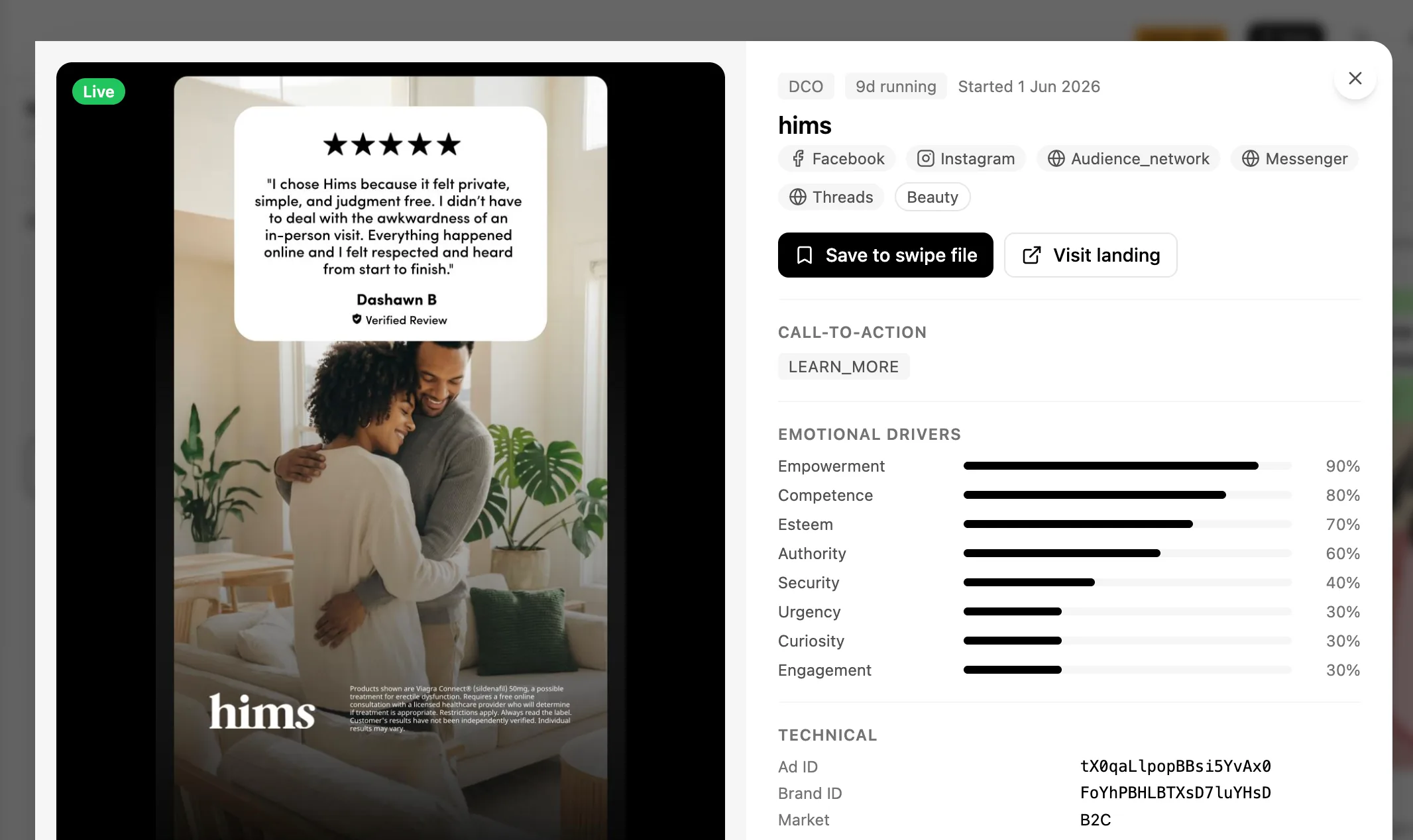
A single competitor ad, opened, captured on 9 June 2026. The two fields that matter in a deliverable are the run duration and the placements. An ad that had been paying for nine days and counting at capture is a claim somebody is backing with money.
Inputs used. The same sweep, scoped per client and per workspace so one agency can run it repeatedly without results bleeding between accounts. Client workspaces are capped by plan: 1 on Influencer and Business, 10 on Pro, 50 on Max, per Inflowave's own plan data as of 15 September 2026. That is a first-party figure rather than a vendor page like the six in the grid above, so it is the one number here you cannot check the same way. Scope the engagement to what your plan actually holds before you promise thirty clients a monthly sweep.
The signal that holds up best. How long an ad has been running. A creative that keeps running is one the advertiser is still choosing to pay for. Ad duration beats any amount of opinion about what converts in a market, including yours and including the client's. It is also the easiest thing to put in front of a client, because it requires no interpretation: this competitor has been paying to say this specific sentence for two months.
The second deliverable nobody expects. The same crawl that maps competitors also surfaces adjacent businesses serving the same customer at a different moment, plus the chambers, networks and directories worth being listed in. That list can be worth more than the competitor list, because it is actionable this week and does not require out-spending anybody.
Write your own numbers down first. Your rating, review count, posting cadence, reply time and conversion rate, dated, before you look at anyone else. A competitive analysis with no baseline underneath it cannot be shown to have changed anything.
The hard limits, stated plainly. No backlinks. No keyword rankings. No traffic estimates. No share of voice. Any example that needs those four needs a search intelligence tool, and the right move is to buy one rather than pretend this covers it.
The two sources worth reading before you write yours
The US Small Business Administration's market research and competitive analysis guide (sba.gov/business-guide/plan-your-business/market-research-competitive-analysis redirects here) lists what a competitive analysis should evaluate: "Market share", "Strengths and weaknesses", "Your window of opportunity to enter the market", "The importance of your target market to your competitors", "Any barriers that may hinder you as you enter the market", and "Indirect or secondary competitors who may impact your success". That last line is the one most examples drop, and it is usually where the surprise is. It also points at free federal data including Statistics of U.S. Businesses and the Census Business Builder for industry counts by geography.
For the framework underneath all of this, Michael Porter's The Five Competitive Forces That Shape Strategy is the original and still the reason a competitive analysis is not just a list of rivals. Buyer power, supplier power, substitutes and new entrants shape profitability as much as the direct competition does, and none of them show up in a four-column grid.
If you want the tool comparison in more depth rather than the worked examples, we keep a separate breakdown of the best competitive intelligence tools.
Frequently asked questions
What are the four P's of competitive analysis?
Product, price, place and promotion, borrowed from the marketing mix and turned on your rivals instead of yourself. You describe what each competitor sells, what they charge, the channels they sell and deliver through, and how they promote it. It is a useful structure because all four are externally observable without any inside information. Its weakness is that it says nothing about how a competitor is actually performing, so pair it with review counts, ad duration and engagement data.
What are the 5 steps of a competitive analysis?
Identify who your competitors actually are, including indirect ones. Gather observable evidence on each: pricing, positioning, reviews, content, live ads. Organise it into comparable columns so the same field exists for every competitor. Interpret it, which means finding the gaps and the places you are behind. Then decide what changes, and write down your current numbers first so the analysis can be shown to have changed something later.
How to prepare a competitive analysis?
Start with the baseline, not the competitors. Record your own rating, review count, posting cadence, reply time and conversion numbers before you look at anyone else, because without that the analysis has nothing to compare against. Then fix your competitor list, seeding the ones you already know so you can sanity-check the discovered ones. Collect the same fields for everybody. Resist writing adjectives in cells: put numbers, URLs and dates in them instead.
Is competitive analysis the same as SWOT analysis?
No. A SWOT is about your own business, with two internal quadrants and two external ones, and it is a summary format rather than a research method. A competitive analysis is research into other companies and produces evidence. In practice one feeds the other, as in the worked SWOT above: the threats and opportunities should be conclusions drawn from cells in the grid, not guesses written directly into the box.
How do you write a competitor analysis?
Write it as evidence with a decision attached. Name each competitor, then for each one record only things you can point at: rating and review count with a date, which platforms they post on and how often, whether they are running paid ads and for how long, what their bad reviews complain about. Finish with three specific changes you will make and the number each one is supposed to move. Anything you cannot source, leave out rather than soften into an adjective.
What are some examples of competitive analysis?
The four in this article are four different research shapes. A finished pricing and positioning grid built entirely from public vendor pages. A local service business sweeping a radius and discovering the share of its market running paid ads. A creator brand scoring posts against each account's own baseline rather than raw like counts. An agency running a per-client sweep as a first-week deliverable, leading with how long each competitor ad has been running. The inputs differ completely, which is why one template cannot serve all four of the research shapes.
Where to start
Pick the example closest to your situation and copy its inputs rather than its output. If you just need a grid, take the empty template above and fill six rows from public pricing pages this afternoon. If your market is a place, start with the radius and the exclusion. If it is an audience, start with the hashtags and the seed accounts. If you are an agency, start with the client scoping so the run is reusable. Then write down your own numbers before you look at anyone else's.
See what the competitor sweep returns, or how small businesses use Inflowave if you want the wider context first.