Most guides to competitor benchmarking are written for a software company with five named rivals and a domain that ranks. If you run a clinic, a detailing shop, a med spa, a roofing firm or an agency that manages forty of them, that is not your situation. Your competition is a field of thirty to sixty businesses inside a twenty minute drive, most of them with no meaningful organic search footprint at all, and the metric that decides whether you get the call is usually a review count sitting next to a map pin.
This guide covers how to benchmark that kind of business: which four numbers are worth tracking, which one is a trap, how often to re-measure each, and how to tell a real gap from noise. It starts with the tools you are probably already comparing, because that is the decision in front of you.
The tools you are comparing, and what each one actually measures
Competitor benchmarking is not one product category. The four things people buy under that name measure genuinely different objects, and picking the wrong one is the most common and most expensive mistake in this whole exercise.
Rival IQ is the incumbent for social benchmarking and it ranks first for this term for a reason: it is good at what it does. Its pricing page lists Drive at $239 per month for 10 tracked companies, 6 months of data history and 1 user account; Engage at $349 per month for 20 companies, 12 months of history and 2 users; and Engage Pro at $559 per month for 40 companies, 24 months of history and 5 users. Extra capacity is sold in blocks of 5 companies for $50 per month. That is a clean, honest model and the 24 month history on the top tier is something we do not have. The constraint is in the unit: you pay per tracked company, and you have to already know which companies to track. If your real question is "who are the thirty businesses competing with my client in this postcode", a seat that bills per handle is the wrong shape of tool before you have even started.
Sprout Social sells benchmarking inside a broader social management suite. Its pricing page lists Essentials at $99 per seat per month billed monthly, or $79 per seat per month on the annual plan. Per seat pricing is the thing to watch here if you are an agency putting three people on the account. Sprout is stronger than us at publishing workflow, approvals and inbox routing at enterprise scale.
Semrush is a different animal and it is important to be fair about it. Semrush benchmarks domains: keyword rankings, backlink profiles, traffic estimates, paid keyword history. On every one of those it is vastly deeper than we will ever be, and if SEO competitive analysis is genuinely the job you should buy Semrush or Ahrefs and stop reading. Current tiers are on the Semrush pricing page. The mismatch is structural rather than a weakness: Semrush is domain-first, and a hair salon with a one page Squarespace site and 400 Google reviews is close to invisible to a domain-first tool while being the strongest competitor in its market. Similarweb has the same shape of strength and the same shape of mismatch, with tiers listed on its pricing page.
The free first-party sources deserve naming because a lot of benchmarking does not need a product at all. Meta's Ad Library lets you search any advertiser and see their live ads, for free, and it is the authoritative source for Meta ad data. Google's Ads Transparency Center does the same for Google advertisers. Both are first-party and neither costs anything. If you have five competitors and you already know their names, open those two tabs and you are done. Do not buy a tool to do something Meta gives away.
The gap none of them fill is the one this guide is about: you cannot benchmark a field you have not identified, and for a local business, identifying the field is most of the work. That is the specific problem Inflowave's competitor intelligence is shaped around, and it is worth being equally clear about what it does not do, which comes later in this piece.
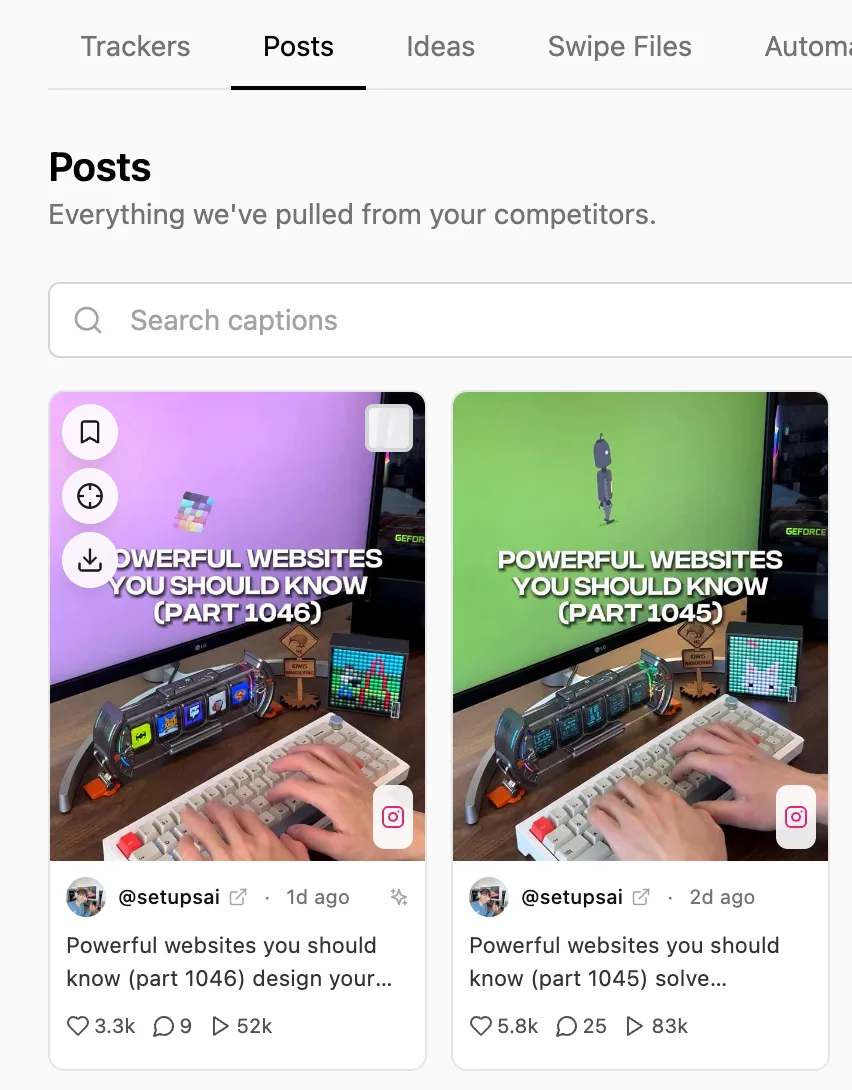
Competitor organic posts collected on a schedule. The engagement numbers matter less than the multiple: a post that pulled four times its account's own median is the interesting one.
Benchmarking is not competitor analysis, and confusing them wastes months
Competitor analysis is a qualitative exercise you do once. You read their site, you look at their offer, you form a view. It produces a document.
Benchmarking is a quantitative exercise you repeat. You pick a small number of measurable variables, you record where you sit against a field, and you re-measure on a fixed interval so that movement is visible. It produces a trend line.
The practical difference is that a competitor analysis document is stale within a quarter and nobody reads it twice, while a benchmark that has been re-measured eight times tells you whether the thing you changed in March worked. If you only have time for one, do the benchmark. It is less interesting and far more useful.
The second practical difference is scope. A good competitor analysis goes deep on three rivals. A good benchmark goes shallow on the whole field, because the number you need is a median, and a median of three is not a median.
The four numbers worth benchmarking locally, and the one that is a trap
1. Review count and rating, measured as a median
This is the single highest-leverage benchmark for a local business and it is the one most often measured wrong. People take the average review count of their competitors. Averages in a local field are dominated by one twenty-year-old incumbent with 1,400 reviews, which makes every newer business look hopeless and produces a target nobody will hit.
Use the median instead. If the median business in your radius has 87 reviews and you have 31, that is a concrete, closeable gap with an obvious next action. If the median is 87 and you have 140, review volume is not your problem and you should stop spending on it.
Rating is the second half and behaves differently. In most local categories ratings cluster tightly between 4.4 and 4.9, so a 0.2 difference is close to noise while a 4.1 against a field median of 4.7 is a genuine operational signal. Google's own guidance on local ranking states that local results are based mainly on relevance, distance and prominence, and that prominence is based partly on how many reviews you have and how positive they are. The same page states plainly that there is no way to request or pay for better local ranking, which is worth quoting to any client who asks. Google's guidance on getting more reviews is the boring correct answer, and it is worth remembering that the FTC's final rule banning fake reviews and testimonials makes the interesting shortcut illegal.
2. Posting cadence, and the hit rate underneath it
Cadence is how often a competitor publishes. On its own it is almost useless, because a business posting daily to an audience that ignores it is losing, not winning.
Benchmark cadence together with a hit rate: what share of their posts materially outperform their own baseline. That pairing tells you something cadence alone cannot, which is whether volume is working for them. A competitor posting three times a week with a third of those posts outperforming is running a format worth copying. A competitor posting daily with nothing outperforming is running a treadmill, and copying their cadence will put you on it.
3. Share of the field running paid
The useful paid benchmark is not "how much are they spending", which you cannot see and should not pretend to. It is a proportion: what percentage of the businesses in your field are running ads at all, on Meta and on Google.
That number reframes the decision. In a field where 15 percent run ads, paid is a differentiator and a modest budget buys real relative presence. In a field where 70 percent run ads, paid is table stakes and the interesting question moves to creative and offer, not to whether you should be there.
Both Meta's Ad Library and the Google Ads Transparency Center will tell you this per advertiser for free. The work is doing it for forty businesses instead of four.
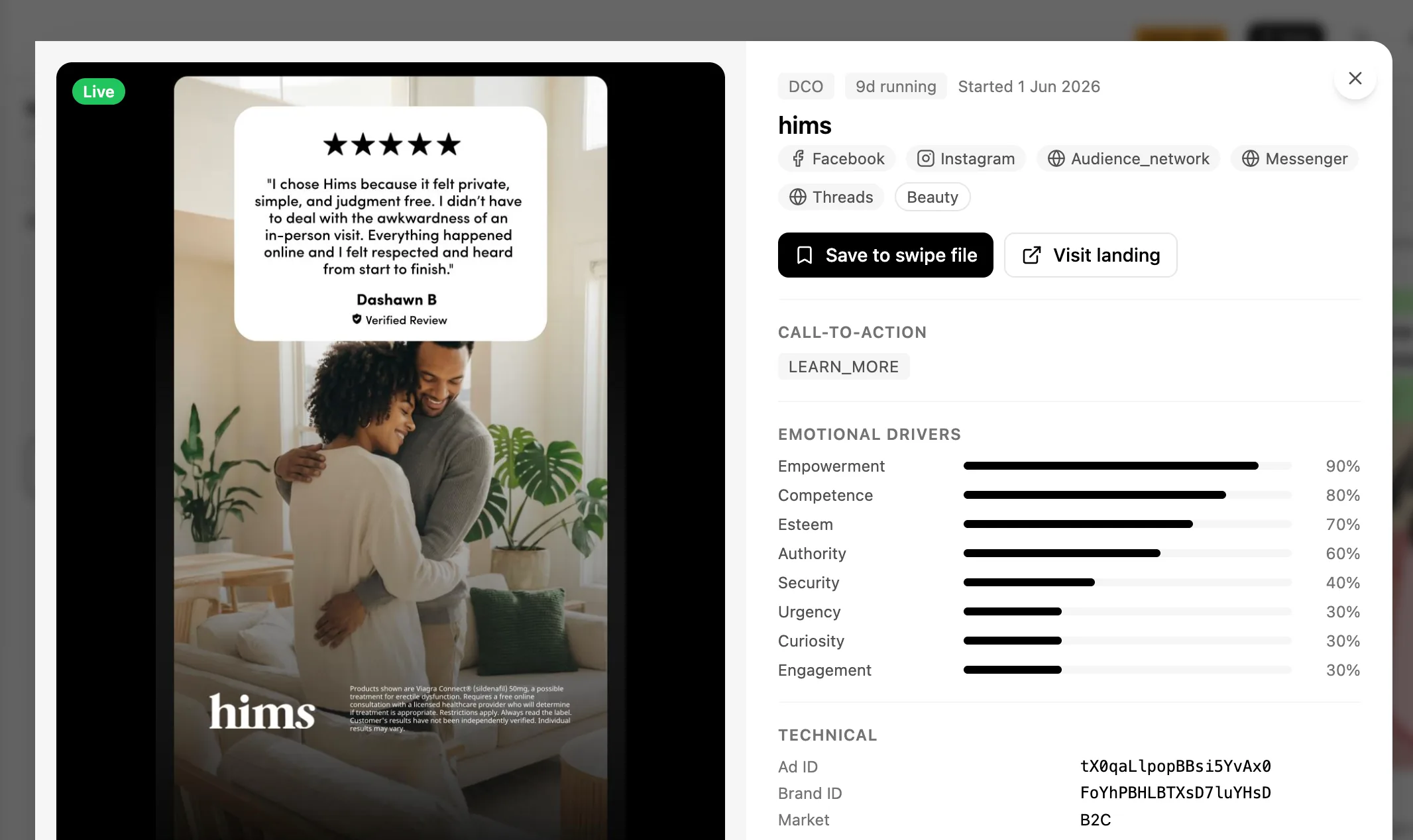
Live competitor ads pulled together in one view. The benchmark is not any single ad, it is what share of the field is running any at all.
4. Whether you get cited when an AI answers the category question
This is new and it is increasingly the thing that decides whether anyone reaches your site. When someone asks an AI assistant or sees an AI Overview for "best physio in Leeds", specific sources get cited. Benchmark presence or absence in that citation set, and record which pages are being pulled in. It is a binary you can act on, and it moves faster than organic rankings do.
The trap: price
Price monitoring is the benchmark everybody asks for and it is the one you should skip for a local service business. Three reasons. Local service pricing is rarely published, so what you can scrape is a starting-from number that nobody pays. It changes constantly and untraceably, so a monitoring feed is mostly noise. And of everything on this list it is the one where knowing the competitor's number least changes what you should do, because in a local market with a tight rating spread the winner is usually not the cheapest.
Inflowave does not do price monitoring or price change alerts, and this guide is not going to pretend otherwise. If price tracking is your actual requirement, this is not the category to shop in.
How often to re-measure each one
Re-measurement interval is where most benchmarking programmes quietly die. Measure too often and you drown in noise and pay for calls you did not need. Measure too rarely and a change takes a quarter to show up.
Our production data has a clear revealed preference here. Across the 647 competitors currently under active tracking on Inflowave, 548 of them, about 85 percent, are set to a 168 hour refresh. Weekly. Ninety seven are on a 24 hour refresh, one is on 6 hours and one is on 72. Nobody converged on daily by default. The businesses running this seriously settled on weekly for almost everything and reserved daily for a small set of accounts they were actively working against.
That maps cleanly onto the four benchmarks:
| Benchmark | Sensible interval | Why |
|---|---|---|
| Review count and rating | Weekly | Review volume moves in single digits per week. Daily checks return the same number six times. |
| Posting cadence and hit rate | Weekly, daily during a campaign | A week is roughly one content cycle. Daily is worth it only while you are actively testing against someone. |
| Share of the field running paid | Monthly | Advertisers turn campaigns on and off, but the proportion of a field that advertises is a slow-moving number. |
| AI and local pack citation presence | Monthly | Volatile day to day and genuinely directional over a quarter. |
| Field composition, who is even in it | Quarterly | New entrants and closures. Worth a full re-sweep, not a refresh. |
The one interval worth arguing about is the last. Most people never re-run discovery, which means their benchmark field slowly becomes a list of who used to compete with them.
A worked example
A mobile dog grooming business in a mid-size US city. The owner believes she is losing to one named rival and wants to benchmark against that rival.
Sweeping an 8 km radius returns 34 businesses in the category. The named rival is in there, at position 11 by review count. That is the first finding and it cost nothing: the competitor she was worried about is mid-field.
The field median is 62 reviews at 4.7. She has 44 at 4.8. So her rating is fine and slightly above median, and her review gap is 18 reviews, which is roughly three months of asking every customer. A concrete target replaces an anxiety.
Of the 34, six are running Meta ads and two are running Google ads. That is 18 percent paid penetration, which means paid is still a differentiator in this field rather than table stakes. Worth a test budget.
On organic, the top performer by engagement posts twice a week, not daily, and the posts that outperform are all the same format. That is a copyable finding, and it is the opposite of the "post every day" advice she had been given.
None of that required knowing anything about the rival she started out worried about. It required knowing the field.
How this works inside Inflowave, concretely
This is the part a generic guide cannot give you, so here is what actually happens, including where it stops.
Discovery runs in one of two modes. Local mode takes a location and a radius between 1 and 40 km, defaulting to 8 km, and sweeps for businesses in the category. Creator mode takes hashtags and free-text bio phrases and takes no location at all, for people whose market is not a place. You can also seed competitors you already know, by name, handle or URL, and they are enriched alongside whatever the sweep finds. If you supply the client's own website and social handles, they are excluded from the results and benchmarked against the field instead of appearing inside it.
Enrichment is fail-soft, per competitor. Each discovered business goes through a series of enrichers for website, socials, Google rating and review count with sample reviews, third-party mentions, AI Overview citation presence, Meta ads with samples, Google ads, and recent Instagram posts. Each competitor carries its own status of pending, enriching, done, partial or failed. One dead website does not kill the run, and a partial result is labelled partial rather than quietly presented as complete.
What gets written and where it lands. Discovered businesses are stored as business entities with the identifying fields you would expect, plus rating value, rating vote count, when the rating was last checked and when the next check is due. Competitors you put under ongoing tracking become tracked competitor records carrying the refresh interval in hours, a visibility setting, and the workspace and client they belong to, which is how an agency keeps one client's competitor set out of another's. Per handle, the platform stores follower count and post count snapshots over time; there are currently 19,331 of those on production. Individual competitor posts are stored with engagement counts, caption, hashtags, media type and posted-at, and each one is scored against its own account's baseline. Of the 2,287 competitor posts held right now, 1,775 carry a performance percentile, which is the field that lets you say "this post did four times their normal" instead of "this post got 900 likes".
Heat scoring is deliberately three numbers, not a black box. Each heat snapshot records a score and a tier alongside its components, and there are exactly three components: posting rate, hit rate and follower growth. That is it. Across 199,333 snapshots the components are always those three, so if an account's heat rises you can open it and see which of the three moved. A composite score you cannot decompose is not a benchmark, it is a horoscope.
Where it connects to the rest of the system. Competitor records are scoped to a workspace and a client, the same boundary the CRM uses, so a competitor set travels with the client rather than with the agency. Discovery output also feeds the prospecting side: a radius sweep with a maximum rating and a minimum review count filter is stored as a prospect scan, which is how agencies turn "who competes with my client" into "who in this category has a weak rating and would take my call". Competitor content connects out to social media scheduling when a format is worth copying, and reporting surfaces the field-level numbers alongside your own in the analytics views.
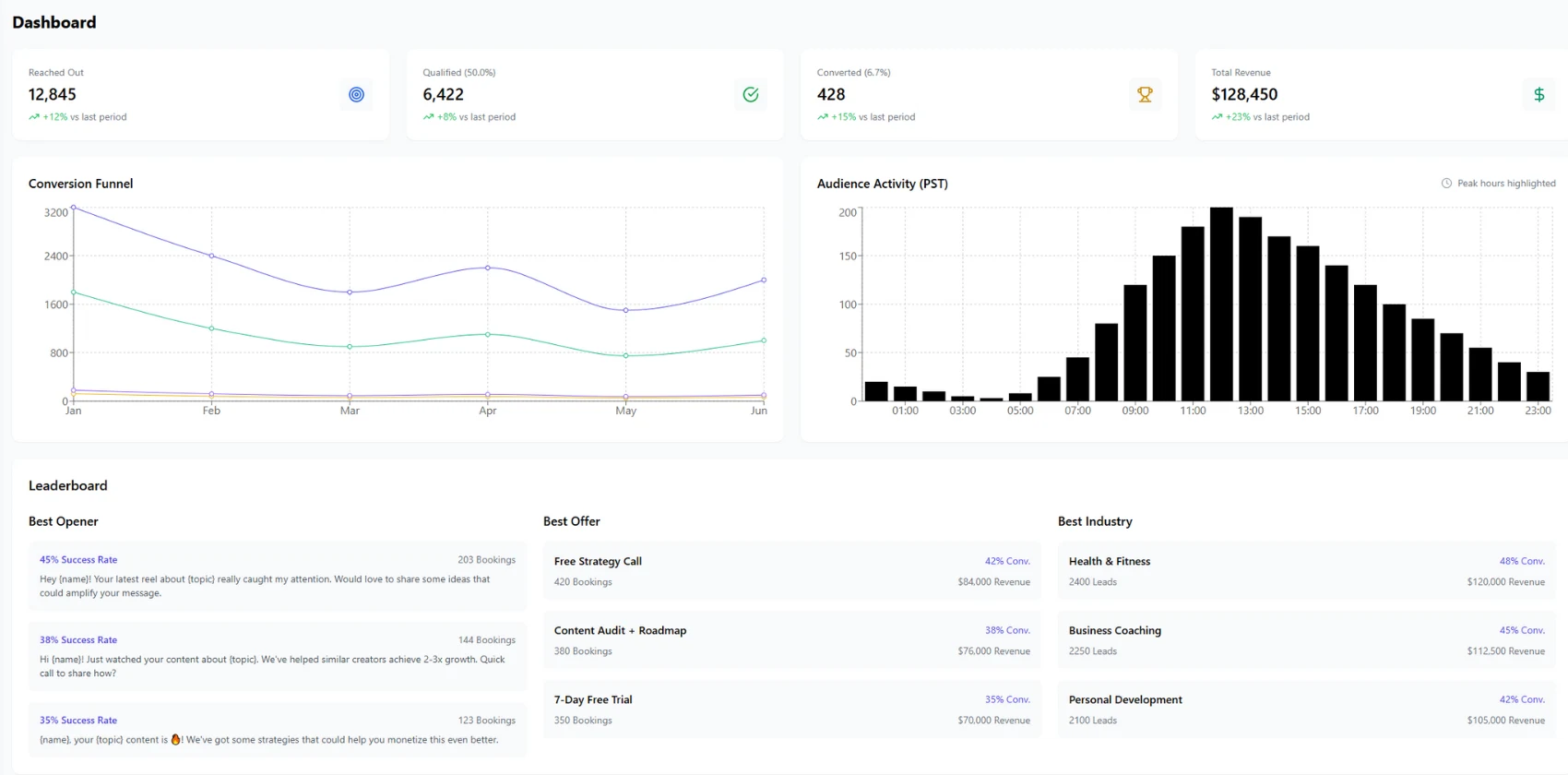
Field-level benchmarks are only useful next to your own numbers, which is why they land in the same reporting surface rather than in a separate tool.
What it does at the boundary with external platforms, honestly. Meta ad data comes from Meta's public Ad Library. It is the same source anybody else reads, it is free, and dressing it up as proprietary would be a lie. What we add is breadth: running it across a whole discovered field rather than one advertiser at a time. Google review data comes through Google's Business Profile surfaces; Google documents its own review data model and reviews API if you want to see the shape of what is available. Structured data on your own site affects how Google understands your business, and Google's LocalBusiness structured data guidance is the primary reference there.

Meta's Ad Library is the source for Meta ad data, for us and for every other tool in this category. It is free and first-party.
The limits, stated plainly
No backlinks, no keyword rankings, no traffic estimates, no share of voice. Semrush and Ahrefs own that ground and we do not compete for it.
No price monitoring and no price change alerts.
No battlecards, no win/loss tracking, no sales enablement workflow. That is what Klue and Crayon sell to product marketing teams at software companies and it is a different product for a different buyer.
Review sentiment and topic analysis exists and works, and is currently lightly used: 37 stored reviews carry sentiment and topics, against 17 business entities on a weekly review check. Treat that as available rather than battle-tested. The handle tracking and post benchmarking side, by contrast, is where the production volume sits.
If you want a broader survey of the category before deciding, we maintain a comparison of competitive intelligence tools and a narrower one on Instagram competitor tools.
Frequently asked questions
What are the four P's of competitor analysis?
The four P's are the marketing mix applied to a rival rather than to yourself: product, price, place and promotion. You describe what they sell, what they charge, where and how customers can get it, and how they market it. For a local service business the framework is a reasonable checklist for a one-off qualitative analysis, but only promotion and place produce numbers you can re-measure, which is why a benchmark usually tracks something narrower.
Can you give me an example of competitive benchmarking?
A mobile dog groomer sweeps an 8 km radius and finds 34 businesses in her category. The field median is 62 Google reviews at a 4.7 rating; she has 44 at 4.8. Six of the 34 run Meta ads and two run Google ads, so 18 percent of the field advertises. She now has three comparable numbers with a clear read: rating fine, review volume 18 short of median, paid still a differentiator.
What are the 7 types of benchmarking?
The count varies between sources, so treat any list of exactly seven as a convention rather than a standard. The types usually named are internal, competitive, functional, generic, process, performance and strategic benchmarking. For a business competing inside one town only two of those do real work: competitive benchmarking against the field around you, and performance benchmarking of your own numbers over time.
What are the 5 steps of a competitive analysis?
A workable five step version is: identify the field rather than assuming it, pick a small number of measurable variables, gather the same variables for every business in the field, compare yourself against the median rather than the leader, and set a re-measurement interval. The fifth step is the one that is usually skipped, and skipping it converts a benchmark into a document that nobody opens again.
How do I conduct a competitor analysis?
Start by establishing who is actually in your field, which for a local business means everyone in a realistic travel radius offering the same category, not the two names you already worry about. Then collect comparable public data for all of them: reviews and rating, posting cadence, whether they advertise. Compare against the median. Write down what you would change if a gap appeared, before you look, so the finding drives an action rather than a rationalisation.
What are comparative benchmarks?
Comparative benchmarks are measures that only mean something relative to a reference group. Forty four reviews is not a benchmark; 44 reviews against a field median of 62 is. The reference group is the part that does the work, which is why field selection matters more than metric selection. A benchmark against the wrong twelve businesses is worse than no benchmark, because it produces confident wrong targets.
Is competitive analysis the same as SWOT analysis?
No. A SWOT analysis is about one organisation and mixes internal factors, strengths and weaknesses, with external ones, opportunities and threats. Competitive analysis looks outward at named rivals. They are often done together, with competitive analysis feeding the threats and opportunities half of a SWOT, but SWOT produces a qualitative internal picture while benchmarking produces comparable numbers you can re-measure.
Sources
- Rival IQ pricing: https://www.rivaliq.com/pricing/
- Sprout Social pricing: https://sproutsocial.com/pricing/
- Semrush pricing: https://www.semrush.com/pricing/
- Similarweb pricing: https://www.similarweb.com/corp/pricing/
- Google Ads Transparency Center: https://adstransparency.google.com/
- Google Business Profile, tips to improve your local ranking: https://support.google.com/business/answer/7091
- Google Business Profile, tips to get more reviews: https://support.google.com/business/answer/3474122
- Google Business Profile APIs, work with review data: https://developers.google.com/my-business/content/review-data
- Google Business Profile API, reviews reference: https://developers.google.com/my-business/reference/rest/v4/accounts.locations.reviews
- Google Search Central, LocalBusiness structured data: https://developers.google.com/search/docs/appearance/structured-data/local-business
- FTC final rule banning fake reviews and testimonials: https://www.ftc.gov/news-events/news/press-releases/2024/08/federal-trade-commission-announces-final-rule-banning-fake-reviews-testimonials