GoHighLevel runs an affiliate programme, so a review of it can be written by someone who earns a commission on your signup. This one is not. It is written for an agency owner deciding whether to put client delivery, phone numbers and recurring revenue inside one platform, and who wants to know what that costs and what it constrains before committing.
Disclosure: Inflowave is a CRM and we compete with GoHighLevel in part of the market. Because of that, every price below is sourced from HighLevel's own pricing page and support documentation, or from the carrier and mailbox-provider documentation that actually governs delivery. Every price carries the date it was last verified so you can check it yourself. Where a judgement is ours rather than a published figure, such as ramp time, it is labelled as an author estimate.
All GoHighLevel prices in this review were last verified on 12 October 2026 against HighLevel's own pages: subscription and add-on prices against gohighlevel.com/pricing, and usage prices against HighLevel's own pricing-guide help article. Where HighLevel publishes no figure, as with Enterprise, no number is given.
Quick verdict
| Our score | 4 out of 5 |
| Best for | Agencies selling SMS and email led services to local businesses, and agencies that want to resell the platform under their own brand |
| Not for | Solo consultants with a few clients, and agencies whose leads mainly come in through Instagram or other DMs |
| Price | $97, $297 or $497 a month, plus wallet usage and per-client add-ons |
| Biggest strength | One sub-account per client, cloned from a template and billed from inside the platform |
| Biggest weakness | The real monthly bill grows with every client you add, and it is hard to predict |
Pros and cons at a glance
Pros
- Clean separation between clients: each sub-account has its own contacts, numbers, users and automations
- Rebilling: pass phone, email and AI costs on to clients, with your markup on Agency Pro
- SaaS Mode lets you sell the platform as your own product
- CRM, funnels, email, SMS, calendars and review requests in one login
- A large ecosystem of snapshots, marketplace apps and tutorials
Cons
- Per-client add-ons and wallet usage push the real cost well past the headline price
- Slow to learn, because settings are split between agency and sub-account level
- Email deliverability and SMS registration are your job, client by client
- Client-facing revenue reporting is thin
- Instagram and DM selling is generic compared with the SMS and email tools
What is GoHighLevel, actually
GoHighLevel (marketed as HighLevel, shortened to GHL) is a multi-tenant agency platform. Multi-tenant is the important word. You get an agency-level account, and inside it you create sub-accounts, which HighLevel also calls locations. Each sub-account is self-contained: its own contacts, pipelines, calendars, phone numbers, workflows and users.
That architecture is the product. The CRM inside a sub-account is competent rather than remarkable. The hard-to-replicate part is the layer above it: create a sub-account per client, clone a configured setup into it, bill the client from inside the platform, and put your own logo on the login screen.
The published feature list on the agency plans covers CRM and pipelines, a website and funnel builder, domain management, email and SMS marketing, inbound and outbound calling, a unified conversations inbox, social media management, workflow automation, forms and surveys, booking calendars, an ad manager, reputation management, payments and invoicing, courses, communities and API access. The same published list also includes five AI features as core rather than as add-ons: Conversation AI, Voice AI, Content AI, Funnel AI and Reviews AI. Several of those carry usage charges on top of the subscription.
GoHighLevel pricing: the published tiers and what separates them
Published structure, verified on gohighlevel.com/pricing on 12 October 2026.
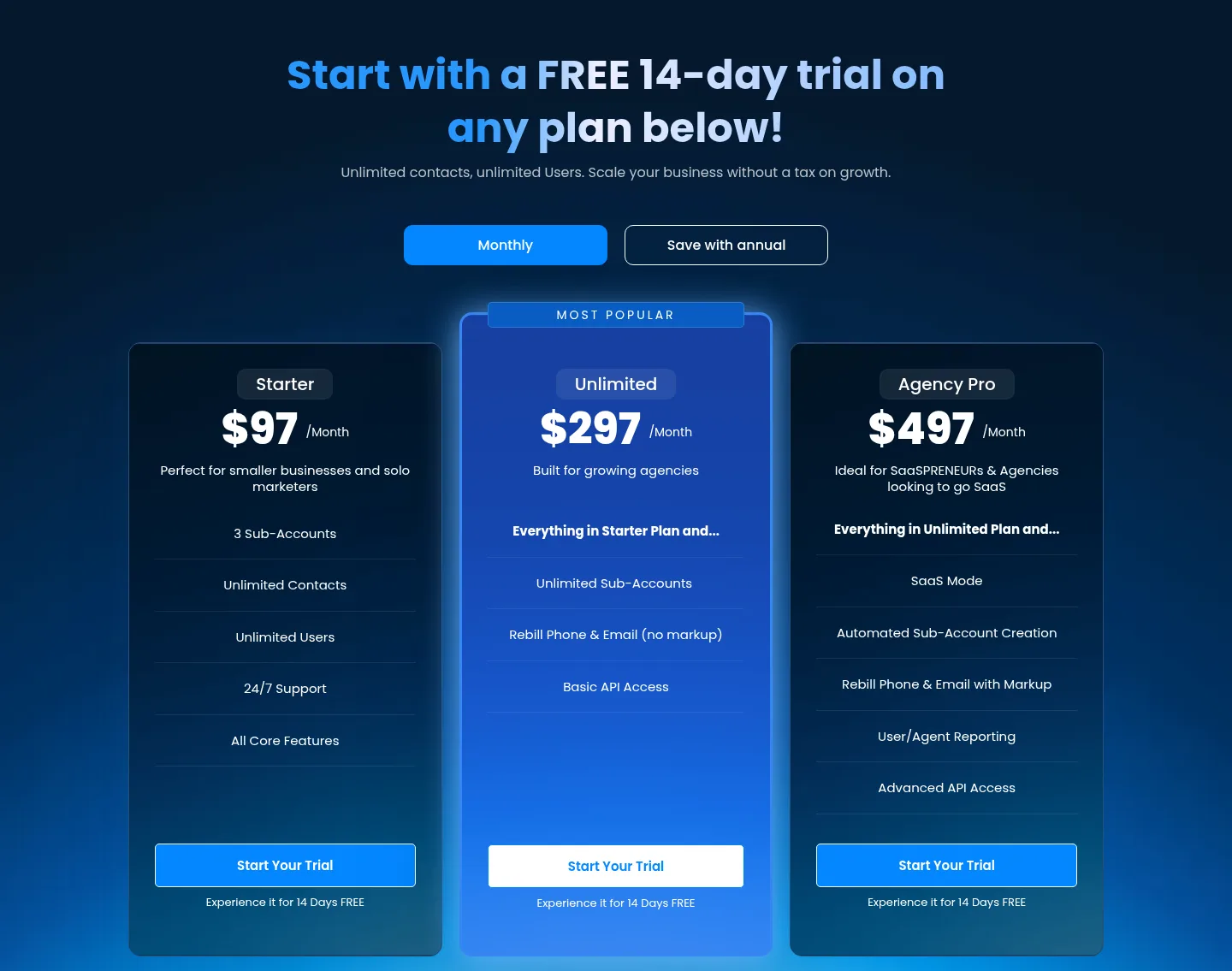
HighLevel's own pricing page, captured 12 October 2026.
| Plan | Billed monthly | Billed annually | Sub-accounts | What you are actually buying |
|---|---|---|---|---|
| Starter | $97 per month | $970 per year | 3 | Core platform for your own business or a handful of clients |
| Unlimited | $297 per month | $2,970 per year | Unlimited | Unlimited sub-accounts, rebill phone and email at cost, basic API |
| Agency Pro | $497 per month | $4,970 per year | Unlimited | SaaS Mode, automated sub-account creation, rebill with markup, user and agent reporting, advanced API |
| Enterprise | Not published, quoted by sales | Not published, quoted by sales | Not published | The "full feature set of highest available platform subscription", plus ten published inclusions: Premium Support, White Label Mobile App and HIPAA compliance all included rather than bought as add-ons, a dedicated customer success and account manager, custom development, a dedicated Slack channel, increased API limit on request, quarterly business reviews and enterprise reporting |
Enterprise carries no published price and no published sub-account figure on gohighlevel.com/pricing, so there is no number here to quote. Treat any Enterprise figure you see in a third-party review as unsourced.
All three published plans are listed as including unlimited contacts and unlimited users, on month-to-month contracts (verified 12 October 2026). Enterprise publishes no limits at all.
One caveat on the trial: gohighlevel.com/pricing advertises a "14 Day Free Trial" on every plan card, while gohighlevel.com/trial concurrently advertises a "30 Day Free Trial" (both checked 12 October 2026). HighLevel publishes both figures at the same time, so confirm which one your signup link actually grants before you plan your evaluation around it.
The gap that matters is between Unlimited and Agency Pro. On Unlimited you can pass phone and email costs through to clients at cost. On Agency Pro you can pass them through with a markup, and you get SaaS Mode, the automated sign-up-and-provision flow that lets you sell the platform as your own product. If your model is "resell the platform", you are on the $497 a month billed monthly plan whether you like it or not. If your model is "run my own delivery in it", $297 a month billed monthly is usually the right stop.
The add-ons are where the real price lives
Several capabilities that read as core are priced separately. From the same pricing page, verified 12 October 2026. Most are published as recurring monthly charges, though HighLevel's pricing guide also publishes longer terms for some of them, Premium Support at "$500/mo or $5000/yr" and the white label mobile app at "$497/mo or $1491/quarter":
| Add-on | Published price |
|---|---|
| Branded client portal app | $49 per sub-account per month |
| Dedicated email IP | $59 per month per IP |
| $10 per sub-account per month | |
| Listings management | $30 per sub-account per month |
| SEO | $79 per sub-account per month |
| White label mobile app | $497 per month |
| HIPAA compliance | $297 per month |
| Premium support | $500 per month |
| AI Employee | $50 per enabled sub-account per month on the AI Employee Growth Plan, $97 on the AI Employee Unlimited Plan, or pay-per-use at token cost. These are add-on plans priced per sub-account, not agency subscription tiers |
Read that with your client count in front of you. The branded client portal at $49 per sub-account per month across twenty sub-accounts is $980 a month on top of a $497 a month billed monthly subscription. Read that as gross cost rather than net: gohighlevel.com/pricing describes these add-ons as ones "most of which can be resold with your own markup in the Agency Pro plan", and HighLevel's pricing guide lists the branded client portal, online listings, SEO and WhatsApp in a reselling table where you set the client-facing price. So the question is not whether you pay $980, it is whether you rebill it. This is where GoHighLevel's real price diverges from its advertised price, and it diverges per client, not per agency.
What it really costs at 5, 10 and 20 clients
Take the two add-ons most client-facing agencies switch on, the branded client portal at $49 and WhatsApp at $10, and put them on every sub-account. This is published prices only, before a single text, email or AI reply is drawn from the wallet:
| Clients | Unlimited ($297) | Agency Pro ($497) |
|---|---|---|
| 5 | $592 a month | $792 a month |
| 10 | $887 a month | $1,087 a month |
| 20 | $1,477 a month | $1,677 a month |
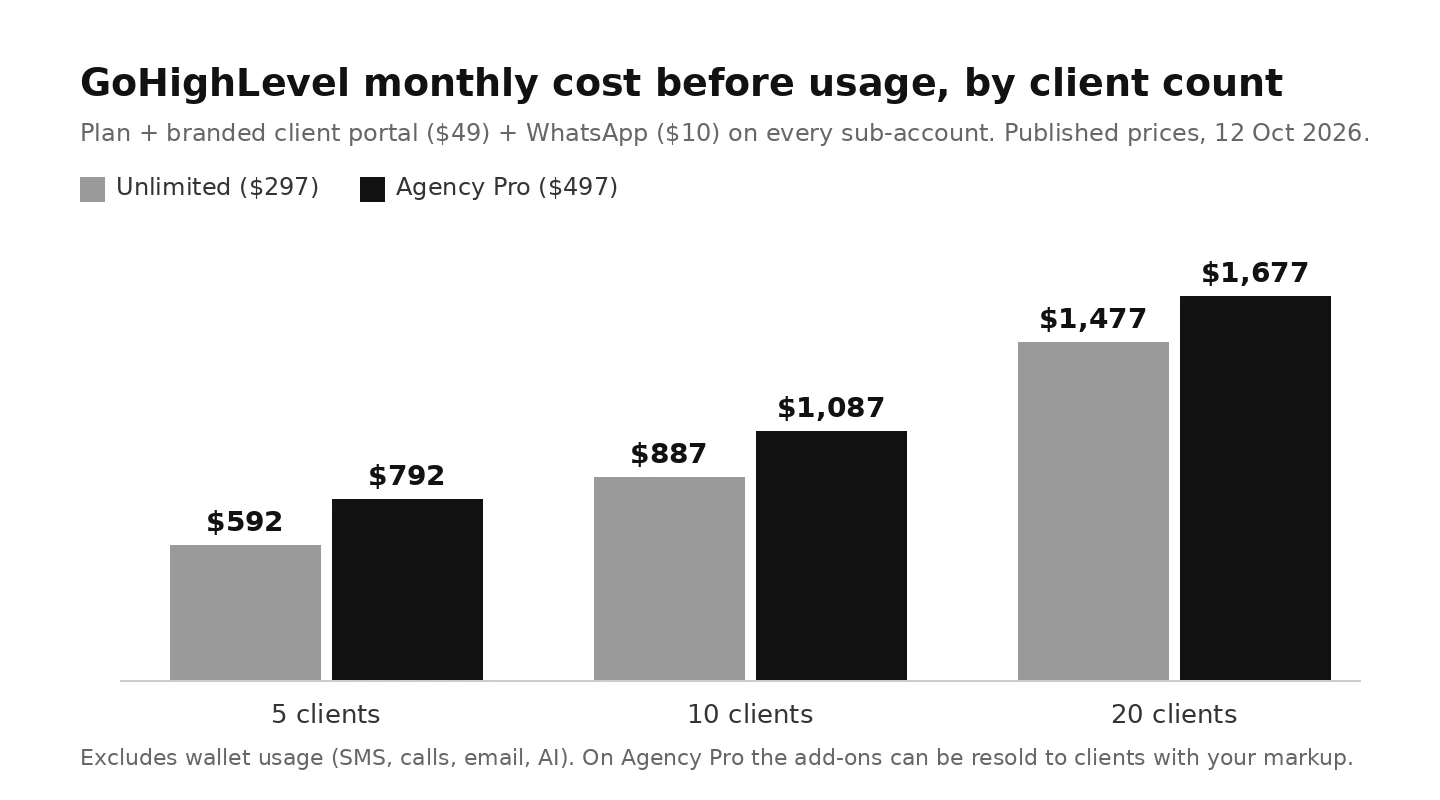
At twenty clients the add-ons alone cost more than double the Agency Pro subscription. On Agency Pro you can resell them with your markup, so the honest question is not what the line costs but whether every client's retainer actually covers it.
The usage model: the wallet, and why your bill moves
Usage-based services are funded from an Agency Wallet. You set a minimum balance, and when it drops below that HighLevel charges your card on file to top it up. Phone, email, email validation, AI usage, address autocomplete and premium workflow actions all draw from it.
Email is billed at $0.675 per 1,000 emails across all plans (verified 12 October 2026). For telephony, HighLevel's pricing guide says only that "the pricing for LC Phone System is precisely the same amount as Twilio"; it quotes no surcharge terms. The surcharges come from Twilio's own side: Twilio's US SMS pricing page states that "carrier fees and destination rates apply" and describes "additional carrier fees per message that are automatically applied based on the end-user's destination and carrier" (both checked 15 September 2026). So the surcharge is Twilio's published term, inherited because HighLevel resells those rails, not something HighLevel documents. Twilio's US rates move, and the carrier surcharges move independently of them, so price your campaigns against Twilio's live US SMS pricing page on the day you quote rather than against a figure in any review, including this one.
Per-segment billing is the mechanism that moves the number. A 200-character message is two segments. An emoji anywhere in the body switches the encoding and cuts the segment length roughly in half. A three-message reminder sequence to 2,000 contacts is not 6,000 messages, it is however many segments those messages decompose into, plus inbound replies, plus carrier fees.
The structural consequence: your platform bill is not a fixed line item. It moves with campaign volume you do not fully control, and it is charged to a card rather than invoiced. On the $297 plan, where you can only rebill at cost, you absorb the variance.
Deliverability: the complaint that is half true
Email reputation is assessed by mailbox providers against your sending domain and the IP you send from. Google's published sender requirements apply to every sender: SPF or DKIM authentication, valid forward and reverse DNS on the sending host, TLS in transit, RFC 5322 compliant formatting, and spam rates in Postmaster Tools kept below 0.3%. Cross 5,000 messages a day to Gmail and a stricter set applies: both SPF and DKIM, DMARC on the sending domain, From-header alignment with the SPF or DKIM domain, and one-click unsubscribe on marketing mail. Google's guidance asks senders to stay under 0.10% and never reach 0.30%. Yahoo publishes an equivalent set. DMARC is a published standard, RFC 7489, not a vendor feature.
None of that is specific to GoHighLevel. What is specific is the shared-infrastructure default. New sub-accounts send over shared sending infrastructure, so your inbox placement is partly a function of how other agencies on that infrastructure behave. HighLevel sells dedicated email IPs at $59 per month per IP (verified 12 October 2026), and the existence of that add-on is the honest admission that the default is shared.
The practical reading: budget for a dedicated sending domain per client, authenticate it, warm it, and treat the dedicated IP as a real cost for any client sending at volume. Do that and deliverability here is unremarkable in the good sense.
SMS has its own version. US application-to-person messaging over 10-digit long codes requires A2P 10DLC brand and campaign registration with the carriers, with onboarding fees, and unregistered traffic is filtered. Because HighLevel resells Twilio's rails, you inherit this requirement per client brand. It is a real onboarding step that takes days, not minutes, and it sits outside the platform subscription entirely.
The learning curve
GoHighLevel is hard to learn, and the reason is structural rather than cosmetic. The platform has two levels of settings, agency and sub-account, and many behaviours are decided at the level you are not currently looking at. Rebilling, wallet limits, SaaS configuration, white-label domains and several integration credentials live at agency level. Pipelines, calendars, custom values, workflows and numbers live at sub-account level. That split is why a "why is this not working" moment can resolve to a setting one level up.
The second source of difficulty is that the same job can be done three ways. A follow-up can be a workflow, a campaign, or a trigger link. Snapshots let you clone a configured sub-account, which is powerful and also means you can inherit somebody else's decisions without understanding them.
Author estimate, not a vendor-published figure: for someone who already understands CRMs and automation, expect roughly two to four weeks to a working first client setup, and a further month before you would trust yourself to build a snapshot you resell. HighLevel publishes no ramp-time guidance, so this is our judgement from running the platform, not a sourced number. Budget it as onboarding cost.
What GoHighLevel is genuinely good at
Sub-account isolation. One client per sub-account, cleanly separated, with its own numbers and users. This is the right shape for agency work, and a general-purpose CRM is not built around it.
Rebilling as a product. Marking up phone, email and AI usage and billing the client inside the same system is a real margin lever. On Agency Pro it is the whole point of the tier.
Automation breadth. The workflow builder reaches across email, SMS, voice, tasks and webhooks, and the trigger library is wide. Past the ramp, the automations are business-running rather than decorative.
Consolidation that is real. CRM, funnel builder, email, SMS, scheduler and review requests in one login is a defensible consolidation for a local-services agency.
Ecosystem. The App Marketplace, the snapshot economy and the volume of published tutorials give you a large body of third-party material and prebuilt configuration to work from.
Where it hurts
Several add-ons are billed per sub-account, and usage scales with clients. The subscription itself is not charged per sub-account, and sub-accounts are unlimited from $297. But between per-sub-account add-ons and wallet usage, a twenty-client agency's real monthly cost bears little relationship to the $497 a month billed monthly headline. On Agency Pro most of those add-ons can be resold at your own markup, so the exposure is the gap between what you pay and what you actually pass on, not the gross figure.
Reporting is thin where it matters most. Activity reporting is comfortable. Reporting revenue by source, across sub-accounts, in a form a client will accept, is not something the reporting module produces out of the box. Test this specifically during the trial.
Support depth lags platform breadth. Included support is first-line and organised per module, while the problems that cost you time cross modules, or sit in deliverability, rebilling and white-label configuration. HighLevel sells Premium Support as a separate $500 a month line item (verified 12 October 2026), which tells you where the paid-support line sits.
Change velocity. Features ship constantly. That is mostly good, and it also means the UI moves under your documented processes and client-facing training material.
Social messaging is a channel, not a speciality. Instagram and Facebook messages land in the conversations inbox and can be automated, but the depth is generic compared with the SMS and email tooling. If DM-led selling is your primary acquisition channel rather than a supporting one, test that flow hard.
What users say
Two review sites carry most of the public opinion, and they say different things. Both were checked on 12 October 2026.
| Site | Rating | Reviews |
|---|---|---|
| G2 | 4.6 out of 5 | 650 |
| Trustpilot | 4.9 out of 5 | 15,199 |
Trustpilot's own summary of recent reviews says customers mostly praise the support staff for walking them through setup and onboarding. That is a real strength, and it is worth weighing against the support point above: HighLevel's first-line, how-do-I help is widely liked. The gaps we describe are the problems that cross modules, such as deliverability, rebilling and white-label setup, and those rarely end up in a five-star review written straight after a helpful chat.
G2 groups its reviews into themes, and the counts are more useful than the star rating:
| Most mentioned positives | Mentions | Most mentioned negatives | Mentions |
|---|---|---|---|
| Features | 155 | Learning curve | 140 |
| Helpful | 138 | Missing features | 91 |
| Customer support | 135 | Steep learning curve | 89 |
| Feature richness | 125 | Not intuitive | 56 |
| Automation | 122 | Poor customer support | 52 |
Two things stand out. The learning curve appears twice on the negative side, 229 mentions between the two labels, which matches what we found. And support splits: 135 reviewers praise it and 52 complain, so most people get good help and a sizeable minority do not. Read both sites, then run the trial below.
The verdict table
| Your situation | Verdict |
|---|---|
| You want to resell the platform as your own product for recurring revenue | Buy it. Agency Pro at $497 a month billed monthly. SaaS Mode plus marked-up rebilling is a rare combination in one product, though not a unique one. Branding the desktop app itself is not what this tier unlocks. |
| Local-services agency, 5 to 50 clients, SMS and email led | Strong fit. Unlimited at $297 a month billed monthly, and model the usage and add-ons honestly. |
| Solo consultant with a handful of clients | Starter at $97 a month billed monthly works, but you will use a fraction of it. A focused CRM is often better value. |
| Deliverability is mission critical and you do not want to manage it | Only with dedicated domains and dedicated IPs budgeted in. Not a set-and-forget platform. |
| Acquisition runs mainly on Instagram or other DM channels | Test the DM flow in the trial before committing. This is the weakest part of the stack. |
| You need client-facing revenue attribution reporting out of the box | Check this first. If the module cannot produce your client report, price a second tool alongside it. |
How to run a trial that tells you something
Whether your signup gives you 14 days or 30, it is enough if you spend it on the right things. Check the length on your own signup confirmation first, because HighLevel publishes both. Building a funnel is the obvious way to spend it and proves nothing.
- Create two sub-accounts and configure them differently. Confirm nothing leaks between them: numbers, users, contacts, calendars.
- Register one A2P 10DLC brand end to end. This is the step that will delay your first real client, so find out now how long it takes.
- Set up a dedicated sending domain with SPF, DKIM and DMARC, send a real campaign to a seed list, and check placement. Not a test to your own inbox.
- Build the single automation your delivery depends on, from scratch, without a marketplace snapshot. If you cannot, that is your ramp time telling you something.
- Produce the report you send clients monthly. If you cannot produce it inside the platform, price the tool you will need alongside it.
- Take a snapshot of the configured sub-account and restore it into a third. Cloning setup is the core agency workflow and you want to know its limits.
The bottom line
GoHighLevel is a serious platform and the multi-tenant architecture is the real product. For an agency selling recurring services to local businesses, or reselling the platform itself, it earns the money.
The costs are also real and mostly unadvertised. The subscription is flat and sub-accounts are unlimited from $297, but per-sub-account add-ons and wallet usage make the real total scale with client count, recoverable through rebilling on Agency Pro and absorbed by you if you do not set that up. The wallet makes the bill variable. Deliverability and A2P registration are your job, per client. Client-facing revenue reporting is the module most likely to send you shopping for a second tool.
Judged as software it is good. Judged as a business decision it comes down to one question: is the platform going to be your product, or your workshop? If it is your product, the Agency Pro tier and its constraints are the cost of a good business model. If it is your workshop, price the add-ons against your real client count and compare it against tools built for the channel you actually win customers on.
Frequently Asked Questions
What are the disadvantages of GoHighLevel?
The main ones are cost opacity, ramp time and support depth. Headline pricing of $97, $297 or $497 a month billed monthly excludes usage drawn from the agency wallet and a list of per-sub-account add-ons, so real cost scales with client count. The two-level settings model, agency and sub-account, makes the platform slow to learn. Deliverability and A2P 10DLC registration are your responsibility per client. Client-facing revenue reporting is thinner than the rest of the platform.
Is GoHighLevel actually good?
For its intended buyer, yes. The multi-tenant sub-account architecture, snapshot cloning and rebilling are well built. Individual modules are competent rather than best in class: the funnel builder is weaker than a dedicated one, the reporting weaker than a dedicated BI tool. GoHighLevel wins on breadth and agency plumbing, not on the quality of any single module.
Is there anything better than GoHighLevel?
Better depends on what you are optimising for. For white-label SaaS resale, the combination of SaaS Mode and marked-up rebilling is strong and there are fewer direct equivalents than in other categories, though competitors do exist. For a single channel, a specialist tool will usually outperform it, and for reporting and attribution the built-in module is thinner than a dedicated BI or attribution tool. Our GoHighLevel alternatives guide breaks the options down by use case.
Is GoHighLevel difficult to learn?
Yes, and mostly for a structural reason. Settings live at two levels, agency and sub-account, and many behaviours are controlled at the level you are not currently viewing, so problems rarely appear where they are caused. The same outcome can also be built several ways. As an author estimate rather than a vendor-published figure, someone already familiar with CRMs and automation should expect roughly two to four weeks to a working first client setup, and longer before they would resell a snapshot they built themselves.
Which is better, GoHighLevel or Zoho?
They target different buyers. Zoho is a broad business software suite covering CRM, finance, HR and productivity for a company running its own operations. GoHighLevel is built for agencies managing many client accounts, with sub-account isolation, white labelling and client rebilling as first-class features. If you run one business, Zoho's breadth is more relevant. If you deliver marketing to many clients under your own brand, GoHighLevel's architecture fits the work.
Is GoHighLevel worth the money?
If you resell it, the $497 a month billed monthly Agency Pro plan lets you mark up phone, email and AI usage and bill clients inside the platform, which is where the return comes from. If you use it purely for your own delivery, work out the real number first: subscription, plus wallet usage, plus per-sub-account add-ons across your client count. Compare that total against what your current stack costs, not the headline subscription against it.
How much does the GoHighLevel app cost?
Published pricing on gohighlevel.com/pricing, verified 12 October 2026, is $97 a month billed monthly for Starter with three sub-accounts, $297 a month billed monthly for Unlimited with unlimited sub-accounts and rebilling at cost, and $497 a month billed monthly for Agency Pro with SaaS Mode and rebilling with markup. Billed annually those are $970, $2,970 and $4,970 per year. Enterprise publishes no price. On top of that sit usage charges, including email at $0.675 per 1,000 messages and phone at Twilio's published rates, to which Twilio's own documentation adds per-message carrier fees, alongside optional add-ons priced per sub-account.
Sources
HighLevel prices and both review sites checked 12 October 2026. Twilio, Google and Yahoo pages checked 15 September 2026.
- HighLevel pricing and plans: gohighlevel.com/pricing
- HighLevel trial page, the source of the conflicting 30-day figure: gohighlevel.com/trial
- HighLevel pricing guide, wallet and usage billing: help.gohighlevel.com
- HighLevel AI product pricing: help.gohighlevel.com
- Twilio US SMS pricing: twilio.com/en-us/sms/pricing/us
- Twilio A2P 10DLC compliance documentation: twilio.com/docs/messaging/compliance/a2p-10dlc
- Google email sender guidelines: support.google.com/a/answer/81126
- Yahoo sender best practices: senders.yahooinc.com/best-practices
- RFC 7489, Domain-based Message Authentication, Reporting and Conformance: datatracker.ietf.org
- HighLevel App Marketplace: marketplace.gohighlevel.com
- HighLevel reviews on G2: g2.com
- HighLevel reviews on Trustpilot: trustpilot.com
Related reading
- GoHighLevel alternatives
- GoHighLevel pricing, explained
- GoHighLevel SMS and usage fees
- GoHighLevel white label, plan by plan
- GoHighLevel email deliverability problems
- Why agencies are leaving GoHighLevel
- GoHighLevel was not built for Instagram
- Best Instagram CRM for agencies
- How to grow a marketing agency