AI SDR tools demo well. An agent researches a prospect, writes something that reads like a human wrote it, books a meeting, and the demo ends on the booked meeting. The problems start in week two, when the list runs out, when the meeting shows up in a vendor dashboard instead of your CRM, when nobody can explain why the connect rate halved, and when the invoice arrives priced in a unit you did not model.
So this comparison is organised around the four things that actually decide whether a tool survives a quarter: what the pricing unit is, which channels it covers, whether the output lands on your contact record, and what it does when the prospect pushes back.
Disclosure and methodology, before anything else
Inflowave publishes this page and Inflowave is one of the tools listed on it. That is a conflict of interest, and you should read the Inflowave section with the same suspicion you would apply to any vendor writing about itself. We have tried to earn the read by being specific about what our own product has and has not proven, including a production usage number that is unflattering.
How the list was built:
- Inclusion. Tools were included if they appear repeatedly in search results for "AI SDR tools". Where a vendor publishes no price at all, the row says so rather than carrying a number. No vendor paid to be here and no affiliate links appear on this page.
- Pricing. Every figure below was read from the vendor's own live pricing page on 15 September 2026, with the billing toggle set to monthly billing unless the row says otherwise. Annual-equivalent prices are labelled as such. Where a vendor's table could not be read at source, the row says so and carries no number. This matters: an earlier draft quoted Salesforge at $48 and $96 and described $40 and $80 as annual-effective rates, when the vendor's page in fact prints "$40 / Month, billed monthly" and "$80 / Month, billed monthly"; that is corrected below. An earlier draft also quoted Instantly Hypergrowth at $358, which is the Light Speed price, and presented Apollo as credits-only pricing with $0.025 as a price per credit, when it is the divisor in Apollo's fair-use credit cap and Apollo in fact charges per seat. Where a vendor publishes nothing, the row says so rather than guessing.
- What is not measured. No ranking position, review score, win rate or customer count appears anywhere on this page, because we have no way to verify one. There is no "number one pick". The categories below are not substitutes for each other, so a single ranked list would be misleading by construction.
- Verify it yourself. Pricing pages change without notice. Treat every number here as a starting point and confirm on the vendor's page before you sign.
The three kinds of AI SDR tool, and why they are not substitutes
People search for AI SDR tools and get a list that mixes three different product shapes. Buying across the shapes without noticing is an expensive mistake.
Outbound AI agents. Artisan, 11x, AiSDR, Regie.ai, Salesforge, Instantly. These research a list, write the sequence, send it, and hand you replies. They are email-first, usually with LinkedIn tasks attached, and some add phone and SMS.
Inbound AI agents. Qualified. These sit on your website, engage traffic that is already there, qualify it and book it. The economics are completely different: the prospect arrived voluntarily, so there is no list, no consent problem and no deliverability problem. If most of your pipeline comes from your own site, this is the category you actually want, and an outbound agent will disappoint you.
Platforms with an AI SDR inside them. GoHighLevel and Inflowave sit here. The calling or the sequencing is one feature inside a system that already holds the contact, the pipeline stage and the inbox.
Sidebar: voice infrastructure is not an AI SDR
Vapi, Retell AI, Bland and Synthflow turn up in AI SDR listicles, including earlier versions of this one. They do not belong in the comparison, and putting them in it produces bad buying decisions.
These are developer platforms for building voice agents. They give you an agent builder, telephony, model routing and a per-minute bill. They do not give you a CRM, a pipeline, a contact record or a list. You cannot buy one and have an SDR; you can buy one and build one, with an engineer, over weeks.
They are genuinely better than everything else at one thing: if you want a bespoke conversational design with your own logic, your own model choice and your own telephony, these will let you do things a platform will not. Retell's pricing page lists its model menu line by line, so you can pick a cheap model for a simple qualification script and an expensive one for a complex call. That is real control, and it is a build project rather than a purchase. Their prices are in the second table below, kept separate on purpose.
AI SDR pricing: what the vendors actually charge
Read from each vendor's own live pricing page on 15 September 2026, monthly billing unless noted.
AI SDR tools
| Tool | Published price (monthly billing) | Pricing unit |
|---|---|---|
| Regie.ai | Free tier with 250 one-time credits; Pro $49/mo billed monthly, including 5,000 credits/mo, with 17% off on annual billing; Enterprise custom | Seat plus credits |
| Salesforge | Pro $40/mo billed monthly, Growth $80/mo billed monthly or $64/mo billed annually. Agent Frank AI SDR add-on $499/mo billed quarterly. A separate Email Infrastructure add-on, Tier 3, covering up to 1,000 active contacts, is listed at $416/mo billed quarterly | Plan plus AI agent add-on |
| Instantly | Outreach plans: Growth $47/mo, Hypergrowth $97/mo, Light Speed $358/mo, all billed monthly. On yearly billing the same plans are published at $37.6/mo, $77.6/mo and $286.3/mo, which is 20 percent below the monthly rates. Lead credits and CRM are separate subscriptions | Plan plus credits, modular |
| AiSDR | Solo $250/mo billed monthly; Explore $900/mo and Scale $2,500/mo, billed monthly on a quarterly commitment with payment in advance. Annual billing is 20% less: $2,400, $8,640 and $24,000 a year | Per AI-researched contact per month |
| Apollo | Priced per seat per month across Free, Basic, Professional and Organization tiers, with credits granted per seat with the plan. Apollo's pricing table is rendered in the browser and no dollar figure could be read from the vendor's own page on 15 September 2026, so no number is quoted here; confirm the current per-seat rates on apollo.io/pricing. The $0.025 on Apollo's page is not a price per credit: it is the divisor in the fair-use cap on Unlimited plans, "the lesser of $ Paid / $0.025 or 1 Million credits per account per year" | Per seat plus credits |
| Artisan | No published price. Pricing page describes credit-based pricing across startup-to-enterprise tiers; demo required | Quote |
| 11x | No published price. Demo-gated | Quote |
| Qualified | No published price. Premier, Enterprise and Ultimate tiers named, all scoped by sales | Quote |
| GoHighLevel | Starter $97/mo, Unlimited $297/mo, Agency Pro $497/mo, all billed monthly; AI Employee add-on $50/mo or $97/mo per sub-account, billed monthly | Plan plus per sub-account add-ons |
| Inflowave | Influencer $27/mo, Business $149/mo, Pro $297/mo, Max $497/mo, all billed monthly | Plan, with caps on connected accounts, workspaces, contacts and seats |
On Inflowave's own row, since we are on the hook for it: the plans cap connected social accounts and client workspaces at 1 on Influencer, 1 on Business, 10 on Pro and 50 on Max. Contacts are 2,000, 1,000, 10,000 and uncapped on Max. Team seats are 1, 1, 5 and uncapped on Max. Nothing on any plan is unlimited social accounts, and any page that says otherwise is wrong.
Voice infrastructure, for reference only
| Tool | Published price | Pricing unit |
|---|---|---|
| Vapi | $0.05/min platform fee pay-as-you-go; Core $29/mo billed monthly; Pro at 10% of the hosting fee with a $999/mo minimum; models passed through at provider cost | Per minute plus pass-through |
| Retell AI | Pay as you go with $10 free credits; published range $0.07 to $0.31 per minute; its own worked example totals $0.11/min | Per minute, itemised |
| Bland | Start $0.14/min with no platform fee; Build $0.12/min plus a $299/mo platform fee, with model, speech-to-text and text-to-speech included in the rate | Per minute, flat rate |
| Synthflow | "Enterprise contracts start at $30,000 annually" | Annual contract |
Two things worth pulling out of those tables
The per-minute vendors are not comparable at face value. Bland's pricing page argues that the advertised rates at Vapi and Retell are platform fees only, and that a realistic production stack lands meaningfully higher once you add the model, speech-to-text, text-to-speech and telephony. That is a competitor's claim on a competitor's page, so treat it as a hypothesis. But both vendors' own pages support the shape of it. Vapi's own estimator, for 1,000 minutes a month at default settings, gives $82 to $129 all-in against a $50 headline platform fee. Retell's own worked example breaks $0.11 into $0.055 infrastructure, $0.04 model and $0.015 text-to-speech. In both cases the headline rate is roughly half the all-in rate, by the vendor's own arithmetic.
The pricing unit determines who absorbs a bad list. On a per-minute bill, a list full of dead numbers is cheap, because nobody answers and no minutes burn. On a per-seat or per-plan bill, a bad list costs the same as a good one. On a per-researched-contact bill like AiSDR's, you pay for the research whether or not the contact was worth researching. If a vendor quotes you per meeting, a bad list is free to you and expensive to them, which is the one arrangement where the vendor carries the list risk rather than you.
Ask every vendor the same question before you sign: what happens to my bill in a month where the list underperforms by half. If the answer is "nothing changes", you are carrying the risk.
AI SDR channel coverage is where the category quietly stops
The category name says SDR, but the coverage is narrower than the name suggests. Artisan, Regie.ai, Salesforge and Instantly are email-first with LinkedIn attached. 11x and AiSDR claim more channels; make them demo each one separately rather than accepting the list on the website. The voice platforms are voice-only by design.
A real SDR does not work one channel. They email, they call the ones who opened, they send a DM to the ones who ignored the email, and they text the ones who booked. That gap is why covering the full motion can take two tools and a spreadsheet joining them. It is also why the interesting question is not "which AI SDR writes the best email" but "which system can see that this person ignored two emails and answered the phone".
The write-back question, which is easy to skip in a demo
Here is the test. Ask the vendor: after the agent finishes a call or a sequence, where does the outcome live?
There are three honest answers. It lives in our dashboard. It lives in our dashboard and syncs to your CRM through an integration. Or it is written directly onto the contact record because there is no separate dashboard.
The first answer means your reps work in two systems permanently. The third is the only one where the CRM record is correct by construction. The second is the one that needs interrogating, and the right question is not "does the sync work" but "what happens when it does not". Ask specifically: does a failed sync raise an alert or fail quietly, how long are failed records retained before they are dropped, and does an opt-out recorded in your system propagate back to the vendor's sending list or only forward. A vendor with good answers to those three will answer them immediately. That is the signal.
Objection handling is the real differentiator, and it is hard to evaluate in a demo
Every vendor will show you the agent handling "I'm not interested". That is the easy one. The ones that matter are second-order: "send me an email", which is a polite no that an agent can log as a win; "we already have someone", which needs a different question rather than a rebuttal; and "how did you get my number", which needs a truthful answer.
Two evaluation steps that cost nothing:
Ask for twenty transcripts of calls or threads that did not convert, not the highlight reel. Read what the agent said after the prospect pushed back a second time. A script with one branch per objection can only answer once, so the first pushback is handled and the second one has nowhere to go.
Then ask what happens when the prospect says something the script has no branch for. The good answer is a defined fallback, usually a handoff or a scheduled callback, with the record flagged for review. The bad answer is that it improvises, because an improvising agent on an outbound call is a compliance exposure and a brand exposure at the same time.
Compliance is not a footnote, and it applies to software callers
US rules here are specific and they do not care whether a human or a model is speaking. Under 47 CFR 64.1200, telemarketing calls delivered by an artificial or prerecorded voice require the called party's prior express written consent. The same rule requires that the message clearly state the identity of the business responsible for initiating the call, and that an automated, interactive voice- or key-press-activated opt-out mechanism be available so the recipient can make a do-not-call request before the call ends. Revocation is strict: requests to revoke consent made by any reasonable means must be honoured within a reasonable time not to exceed ten business days.
On top of that, the FCC has a proposed rule, published in the Federal Register on 10 September 2024, that would define AI-generated calls as a category and require callers to disclose to consumers when a call is AI-generated. It is a proposal, not a final rule, so do not build a compliance programme around it, but do assume disclosure is where this is heading and pick a tool that can already say the line.
Three questions for any vendor, in order. Does an opt-out recorded on one client account suppress that number across every other list in my account, or only that campaign? Can I enforce a calling window per timezone rather than per account? And is the recording disclosure a setting I control, or text the vendor wrote?
Why these tools do better on lists that are not actually cold
This is the most useful thing in the article and it is an argument, not a measurement, so here is the reasoning rather than a number.
Start with the rule above. Prior express written consent is a prerequisite for artificial-voice telemarketing, and a purchased or scraped list cannot satisfy it, because nobody on that list ever gave you anything in writing. Your own unanswered enquiries, dormant leads, expired trials and past customers can, depending entirely on what your form and your terms captured at the time. So the regulatory floor is not a matter of appetite: one list category is usable by a software caller and the other is not, before you consider response rates at all.
The second half of the argument is mechanical. An AI agent's weakest moment is the unscripted branch, as above. On a cold list, the call opens on the hardest possible unscripted branch, which is a stranger asking who you are and why you have their number. On a re-engagement list, the opening is a fact the agent can state and the prospect can verify: you asked us about X in March, is that still live. That is a scripted branch with a known answer set, which is exactly the shape these agents handle well.
So the recommendation follows from the design of the tools and the text of the rule, not from a benchmark: point them at the list where consent already exists and the opening line is a fact. If a vendor tells you their agent performs identically on a purchased list, ask them which of those two problems they solved.
Inflowave, kept short and with the numbers that are not flattering
We build the platform option. Here is the narrow case for it and the honest state of it.
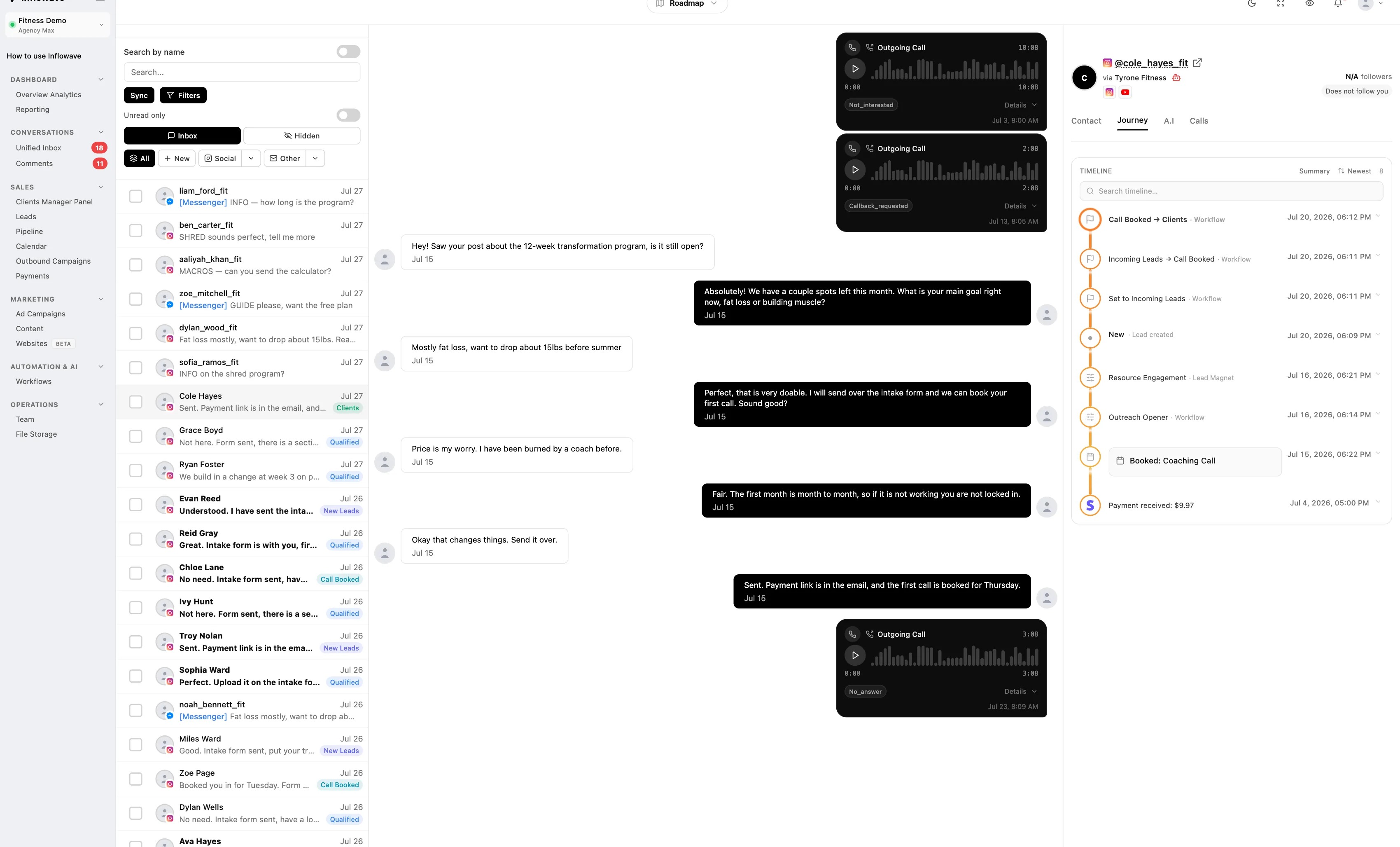
The case is write-back. Calls, DMs, emails and form submissions land on the same contact record, so the call recording sits in the message thread with its outcome and the pipeline timeline records what caused each stage change. That is not possible when calls live in a voice vendor's dashboard and it is the only reason to consider a platform over a specialist.
What is proven. Inflowave production sample of 2,319 call records, whole-platform counts to 15 September 2026: the human-assisted dialling side is well used, with 2,117 of those records (about 91 percent) attached to a lead and 1,809 carrying an AI classification with summary, sentiment, key topics, confidence score and callback date, across 3,001 transcript lines and 157 dial sessions covering 995 dialled items. If you want a rep on the line, the power dialer is the mature part.
What is not. Inflowave production sample of 51 AI agent call records, to 15 September 2026: there are 51 AI agent calls on production in total, of which 34 are attached to a lead, 43 were transcribed, 39 were recorded, 31 were outbound and 12 were started by a workflow, with an average length of about 49 seconds. That is a working feature at early volume, and we do not claim it is battle-tested at 51 calls.
What exists but is unproven. A per-workspace do-not-call list, compliance settings covering recording disclosure text and an enforced calling window with start and end hours in a chosen timezone, monthly spend caps with an optional hard stop, and batch call scheduling are all built and configurable, and carry no production usage in the samples above. Treat them as available, not proven.
Background reading: what an SDR does, outbound sales, AI cold calling, the unified inbox and the pipeline.
Choosing an AI SDR tool, in one paragraph each
Go with an outbound AI agent (Artisan, 11x, AiSDR, Regie.ai, Salesforge, Instantly) if the motion is email-led, the list is large, and you measure success in replies. Three of them publish a self-serve entry tier at monthly billing: Salesforge Pro at $40/mo, Instantly Growth at $47/mo and Regie.ai Pro at $49/mo. Any of the three is a cheap way to find out whether this category works for you before anyone quotes an annual number. Artisan, 11x and AiSDR sit at the managed end, and AiSDR is the only one of the three that publishes a starting price at all.
Go with an inbound AI agent (Qualified) if most of your pipeline already arrives on your website and the job is to engage and qualify it rather than to find it. Do not buy an outbound agent for this problem.
Go with voice infrastructure (Vapi, Retell, Bland, Synthflow) if you have an engineer, a specific conversational design in mind, and a CRM you are happy to integrate against. You get the most control and the cheapest marginal minute, and you own the integration, the retry logic and the compliance plumbing.
Go with a platform (Inflowave, GoHighLevel) if you run outbound for several clients, need calls and DMs and emails on one contact record, and need to rebill the usage. The trade is depth of voice configuration for having one system of record.
AI SDR tools FAQ
What is an AI SDR?
An AI SDR is software that performs the sales development role: building or filtering a target list, making first contact, responding to the first few replies or objections, qualifying whether there is a real need, and booking a meeting for a human closer. It runs on a defined script and qualification bar rather than judgement. A given product may cover only one channel, email or voice, so the term describes a job rather than a single product shape.
What is an AI SDR tool?
An AI SDR tool is the software that does that work, and the label covers three different things. Outbound agents research and send sequences, mostly over email. Inbound agents engage traffic already on your website. Platforms embed the agent inside a system that already holds the contact, the pipeline stage and the inbox. Separately, voice infrastructure such as Vapi or Retell is often filed under this label but is a developer platform for building an agent, not an agent you can buy. Deciding which of these you are buying is the first useful step.
How much does an AI SDR cost?
It depends entirely on the pricing unit, and the following were read from the vendors' own pricing pages on 15 September 2026 at monthly billing. Self-serve outbound tools start low: Salesforge Pro at $40/mo, Instantly Growth at $47/mo, Regie.ai Pro at $49/mo. Mid tiers climb quickly: Salesforge Growth $80/mo, Instantly Hypergrowth $97/mo, Instantly Light Speed $358/mo. Apollo is priced per seat rather than per plan, but its pricing table could not be read from the vendor's own page on that date, so no Apollo figure is quoted here. Managed AI SDR services are a different bracket, with AiSDR from $250/mo for 200 researched contacts up to $2,500/mo, and Salesforge's Agent Frank add-on at $499/mo billed quarterly. Artisan, 11x and Qualified publish nothing and require a demo. Voice platforms bill per minute: Bland lists $0.14/min on its entry plan, Retell publishes $0.07 to $0.31/min, and Synthflow states enterprise contracts start at $30,000 annually.
Is AI replacing SDRs?
Not in the way the marketing implies. The parts that automate well are the mechanical ones: dialling through a list, absorbing no-answers, logging what happened and sending the follow-up. The parts that do not automate well are the second and third objections, the discovery question nobody scripted, and the judgement about which prospect is worth chasing. The realistic outcome is fewer people doing the dialling and the same people doing the qualifying.
Will SDR be replaced by AI?
The role is changing shape rather than disappearing. Work that used to be volume activity becomes review work: reading the transcripts of calls that failed, rewriting the opener that underperformed, and deciding which qualified conversations a closer should take. That is a more senior job than dialling, and it needs fewer people per unit of pipeline, which is the uncomfortable part. Treating the AI as a first-contact layer rather than a replacement keeps the judgement work with the people who can do it.
Are AI SDRs illegal?
No, but they are regulated the same as any other automated caller. In the US, 47 CFR 64.1200 requires prior express written consent for telemarketing calls using an artificial or prerecorded voice, requires the message to clearly identify the business responsible for the call, and requires an automated opt-out mechanism during the call. Opt-out requests made by any reasonable means must be honoured within ten business days. Rules differ by country and by state, so check your own markets.
Which AI SDR software is the best?
There is no single best, because outbound agents, inbound agents and platforms are not substitutes, which is also why this page does not rank them. Judge on four things instead: what the pricing unit is and who absorbs a bad list, how many channels it genuinely covers, whether outcomes are written onto your contact record or trapped in a vendor dashboard, and how it behaves on the second objection rather than the first. Ask for twenty transcripts of conversations that did not convert. That single request separates the products faster than any feature table.