
A coaching or training business does two very different jobs. One is commercial: answering enquiries, qualifying people, booking calls, taking payment and renewing clients. The other is delivery: seeing what clients are actually doing, then adjusting their workouts and diets to match.
Most coaches, trainers and nutritionists end up running both on a patchwork of DMs, spreadsheets and screenshots of meal logs. A CRM for personal trainers fixes the commercial half, but it can't show you what a client ate on Tuesday.
Two platforms split the work cleanly. Inflowave runs the business: enquiries, sales calls, payments and client communication. Pomelo Fitness is an all-in-one fitness platform with two sides. Consumers use the app to track their exercise and macros, with or without a professional. Gyms, coaches, trainers and nutritionists use its business side to see what their clients are doing and update workout plans or diets accordingly.
A quick note on words. In this guide, a user is anyone tracking in Pomelo Fitness, a client is a user who works with you, and a professional is the gym, coach, trainer or nutritionist running the business.
Who does what
| Stage of the client relationship | Where it lives | What happens there |
|---|---|---|
| Enquiries | Inflowave | Every DM, text and email lands in one shared inbox |
| Qualifying | Inflowave | A form sorts good fits from bad fits |
| Sales calls | Inflowave | Booking, reminders and no-show follow-up |
| Payment | Inflowave | Invoices, recurring payments and quotes |
| Daily tracking | Pomelo Fitness | Users log lifts, runs, macros and weight |
| Reviewing client activity | Pomelo Fitness, business side | You see what your clients are doing |
| Updating workouts and diets | Pomelo Fitness, business side | Plans change based on real activity |
| Accountability | Pomelo Fitness | Streaks, monthly challenges and leaderboards |
| Client communication | Inflowave | One thread per client, across every channel |
| Renewal and referrals | Inflowave | Workflows and pipeline stages |
The CRM side for personal trainers and coaches: Inflowave
For a coach, trainer or nutritionist, the expensive failures are often commercial. A lead asks about price on Instagram and nobody replies until the next day. A booked call doesn't show. A client's program ends and nobody brings up what comes next.
One inbox for every enquiry
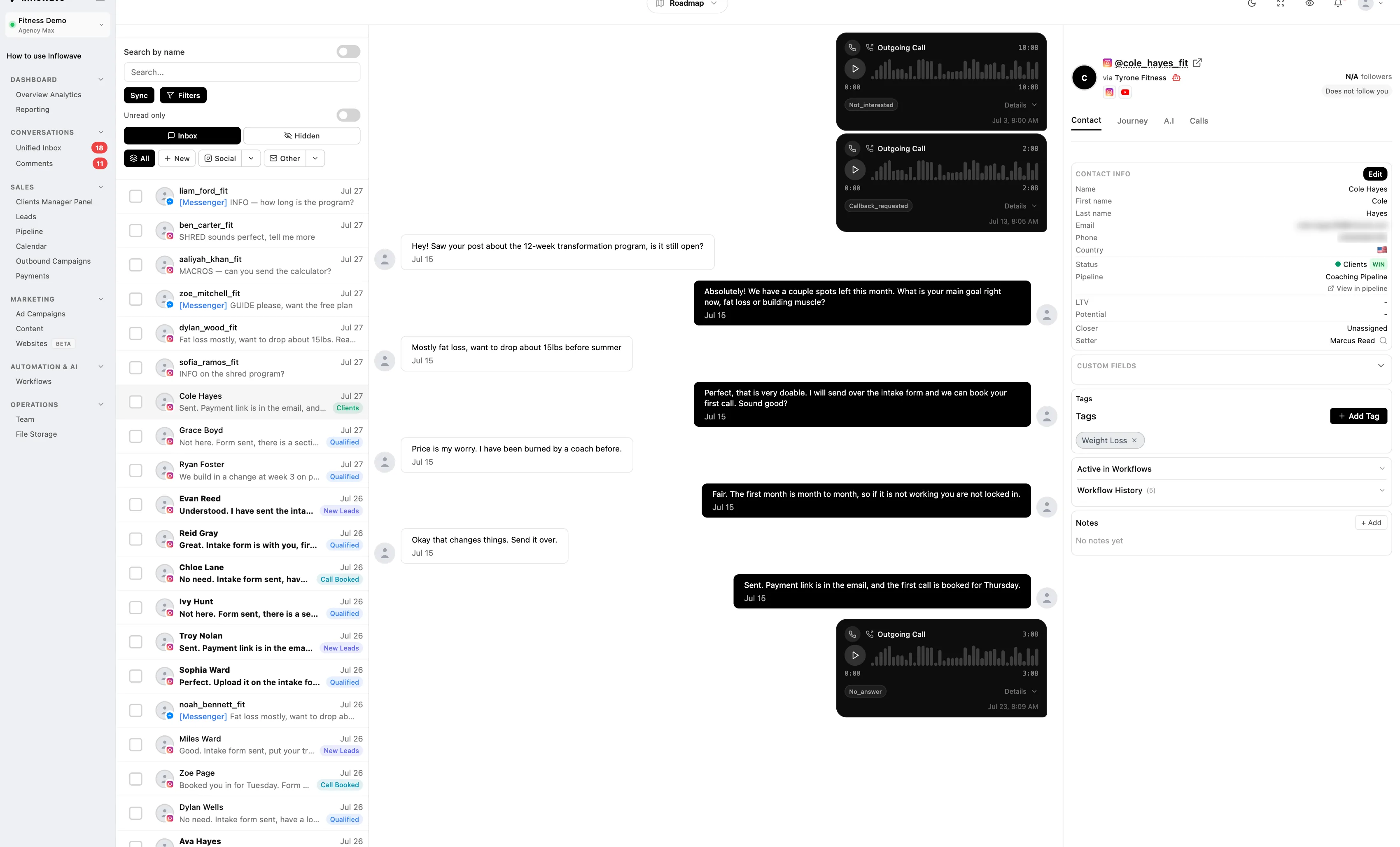
Leads rarely arrive in one place. The unified inbox brings Instagram, Facebook, WhatsApp, Telegram, iMessage, SMS and email into a single thread per person, so you or a setter can see the full history before replying.
Speed matters here, though not in the way most people quote it. The popular speed-to-lead numbers trace back to a 2011 Harvard Business Review study from the phone era. So we measured Instagram directly, in our study of 43,971 inbound DM conversations on Inflowave:
| Time to first reply | Lead replied again |
|---|---|
| Under 1 minute | 89.6% |
| 1 to 5 minutes | 87.8% |
| 4 to 24 hours | 76.3% |
| 1 to 3 days | 71.9% |
A slow reply rarely kills the conversation, but it shrinks it. In 2026, leads answered inside a minute sent about 19 messages over the next seven days, against about 4.5 when the reply took more than a day. That measures conversation, not closed deals, and the study covers all kinds of businesses rather than coaches alone. Still, a coaching sale usually depends on a long conversation about someone's body, schedule and doubts, so the depth is what you want to protect. Instagram DM automation can cover the first reply while you are with a client. If you run lead ads, connect them to your CRM so those leads land in the same place.
Qualify before you give up a call slot
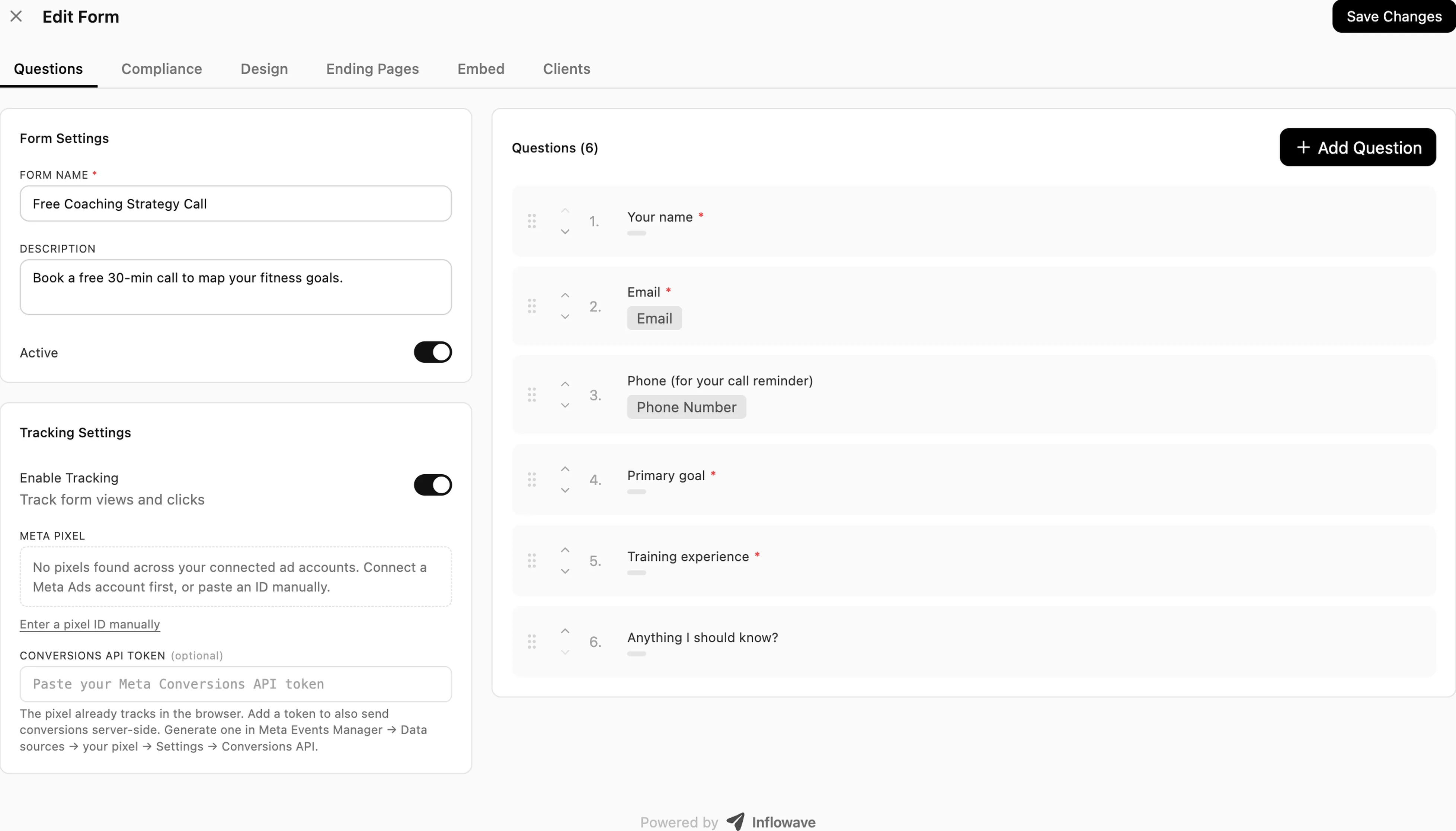
Your calendar is your inventory. A form can ask for the person's main goal and training experience, then use qualifying rules to send poor fits to a different ending, with the reason recorded. If you are deciding where that form should live, see landing page vs sales funnel.
Book the call and chase the no-shows
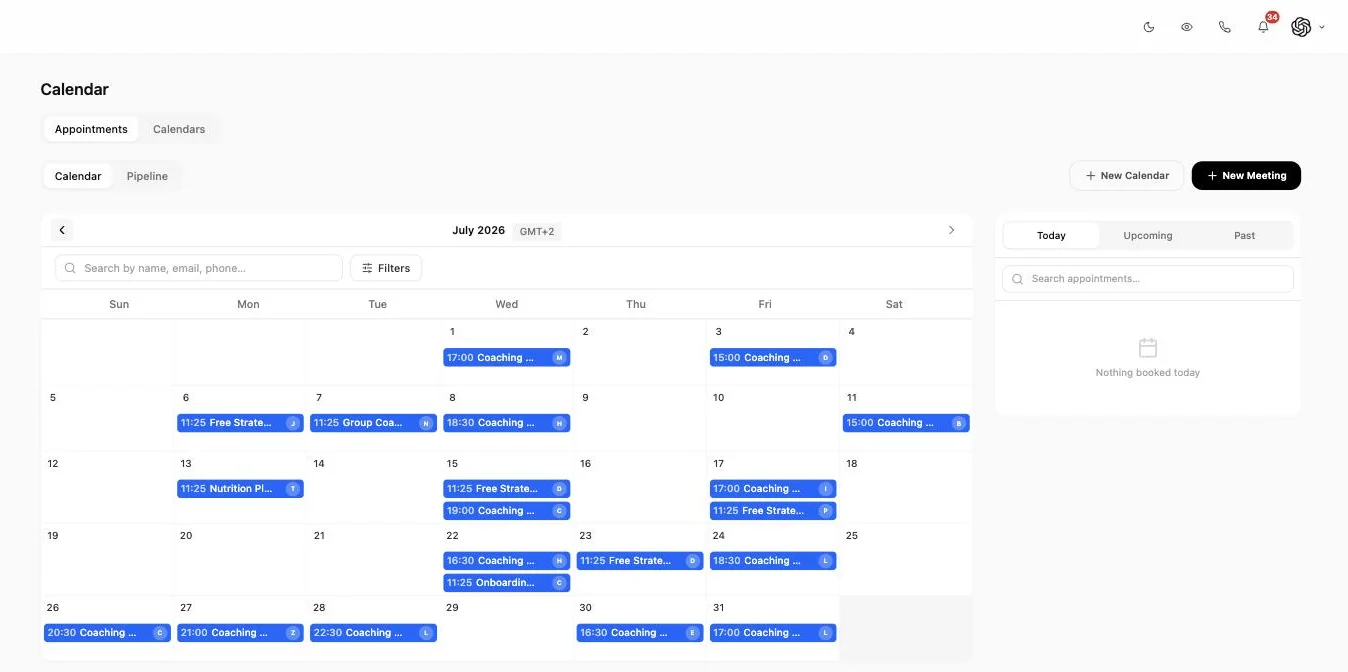
Appointment booking puts strategy calls next to the recurring sessions of signed clients. Reminders go out on the channel the person actually uses, which for an Instagram lead is often a DM. A no-show can start its own follow-up, so a missed call doesn't quietly become a lost lead.
The evidence for reminders is solid, even if it comes from healthcare rather than coaching. A Cochrane review found attendance of 78.6% with text reminders against 67.8% with none. Our guide to appointment reminder automation covers timing and wording.
See the whole sales pipeline
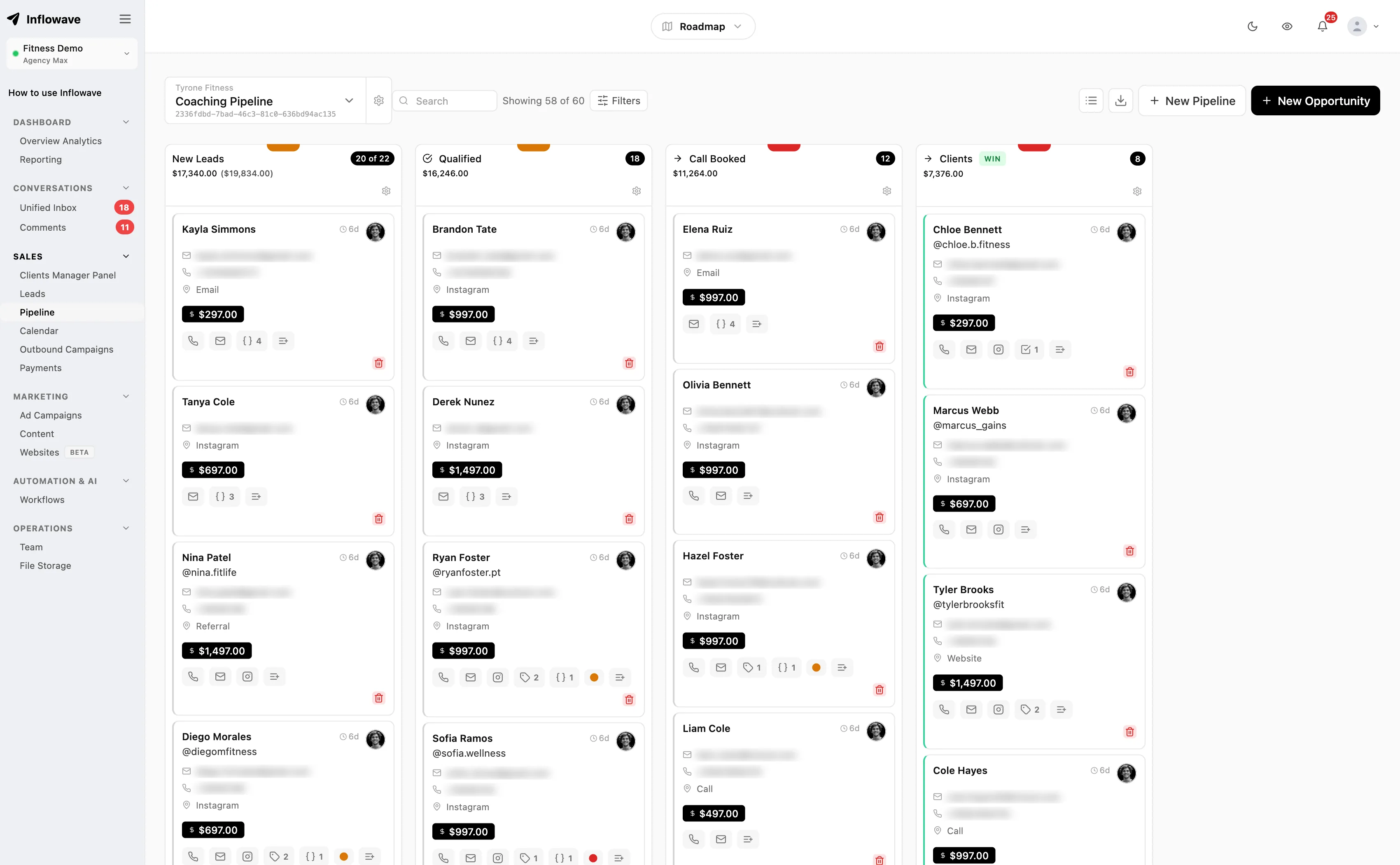
A pipeline shows every prospect by stage, for example New Leads, Qualified, Call Booked and Clients, with the value of each deal. That tells you whether a slow month is a lead problem, a show-up problem or a closing problem. Each of those has a different fix.
Get paid in the same place
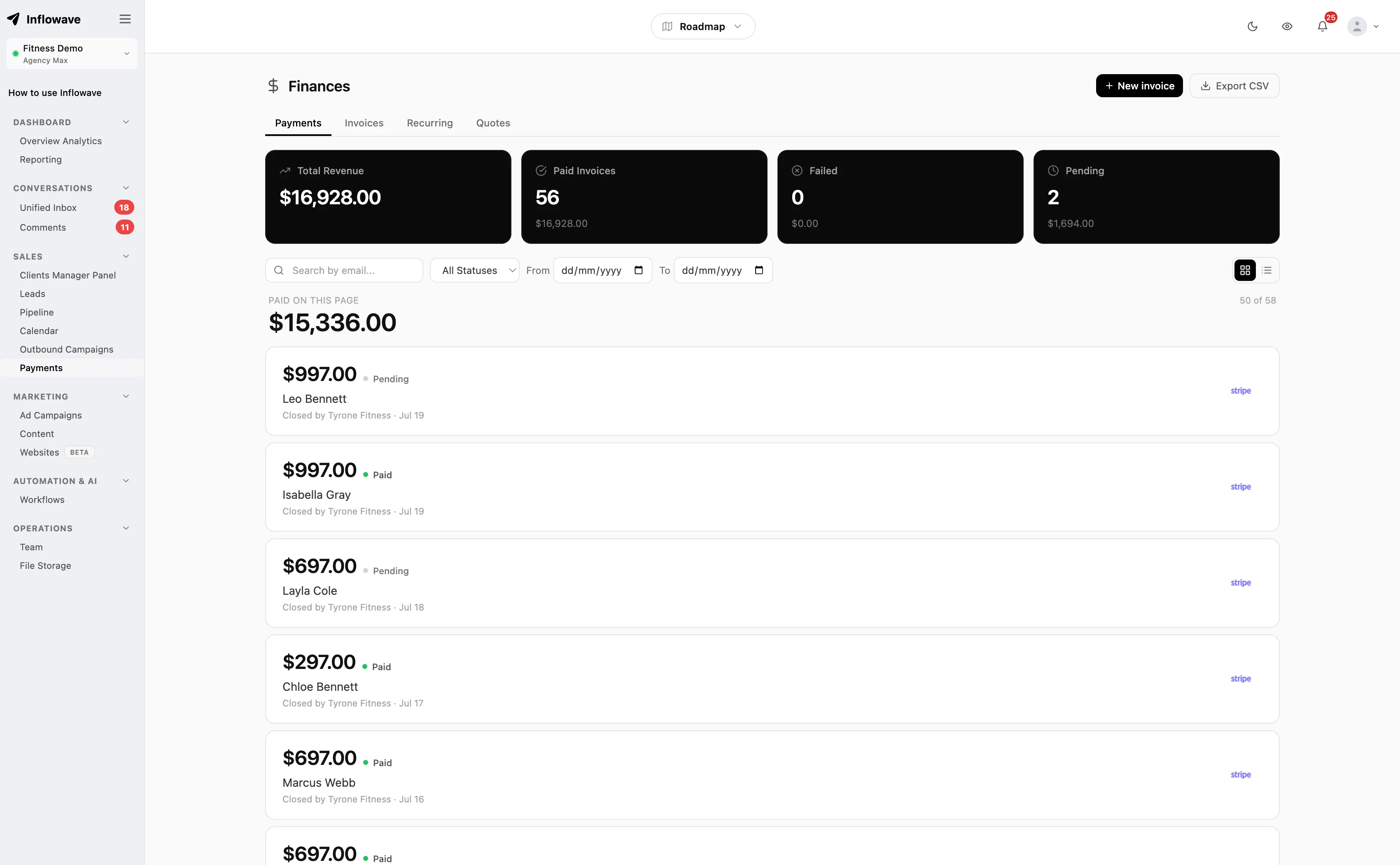
Payments, invoices, recurring billing and quotes sit in Finances, attached to the same contact as the conversation. When someone asks whether a client is paid up, the answer is one click from their chat.
If you are comparing sales tools, our guide to the best CRM for coaches goes deeper on that decision.
Delivering the work: Pomelo Fitness
Delivery is where clients decide whether to renew. It depends on habits you can't enforce from a distance, and on knowing what actually happens between sessions. Pomelo Fitness covers both, with one side for users and one for professionals.
Anyone can use the consumer app, with or without a gym membership, coach, trainer or nutritionist. According to Pomelo Fitness's website, it is free on iPhone, with no subscription and no ads.
For professionals: see what clients do, then adjust
On Pomelo Fitness's business side, gyms, coaches, trainers and nutritionists can see what their clients are doing in the app. That changes the weekly conversation. Instead of asking how the week went and getting a best guess, you can look at what was logged and update the plan to match. A trainer might rework next week's sessions after a run of missed lifts. A nutritionist might adjust a diet when the food log and weight trend tell different stories.
For users: lifts and macros without friction
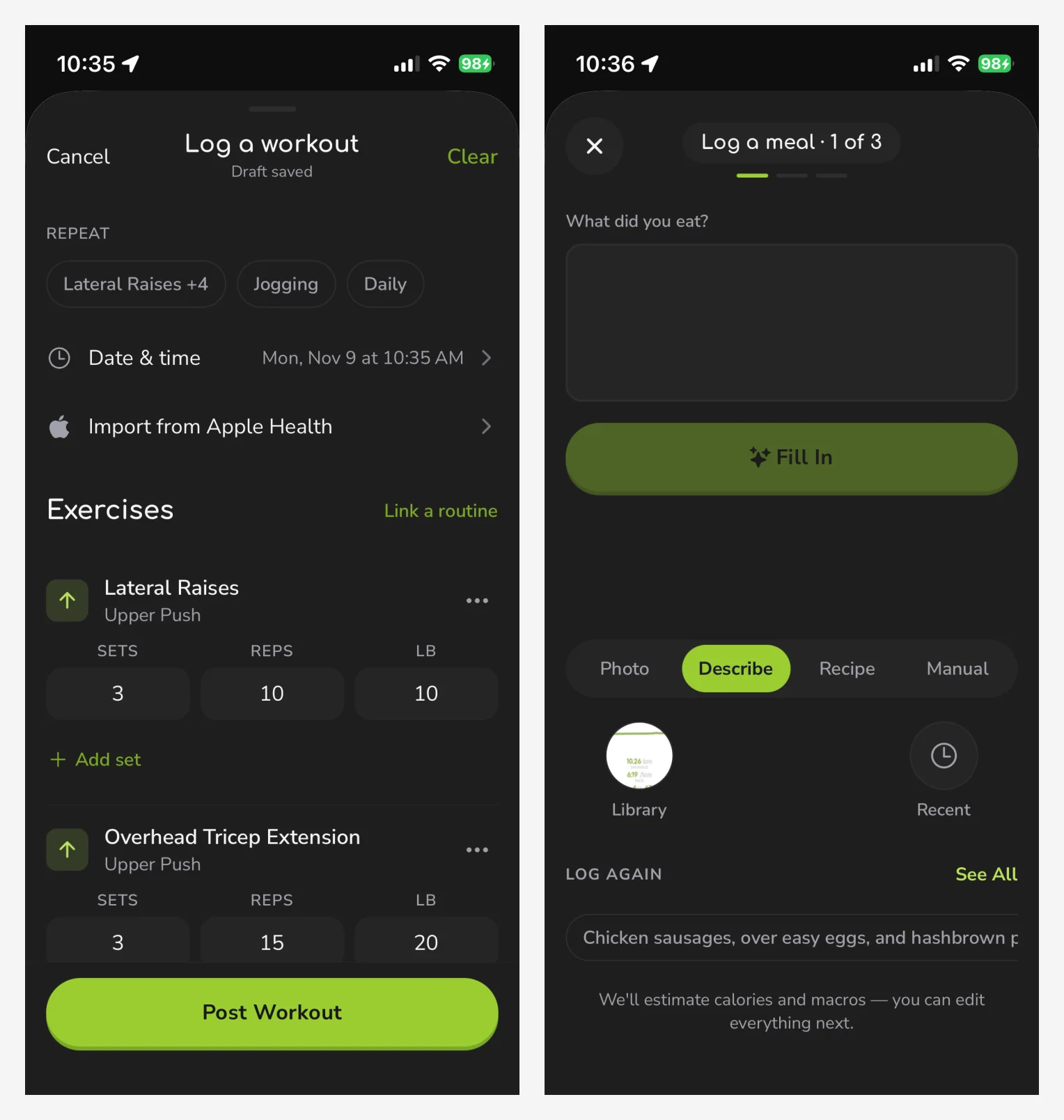
Users log reps and weight set by set, link a saved routine so it comes back already filled in, and can import from Apple Health. For food, they can photograph a plate, describe the meal and let Pomelo Fitness's AI fill in calories and macros, or enter it by hand. The lower the effort, the better the data you get back. It also matters for results: a systematic review of 22 studies consistently linked self-monitoring with weight loss, though its authors rated the evidence weak because of study limitations.
For users: progress they can see
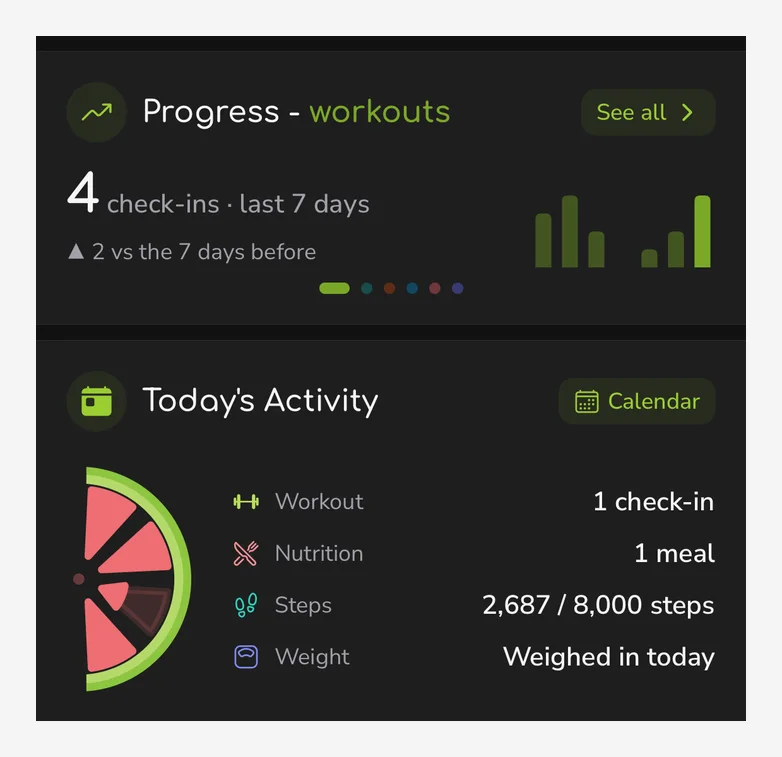
Check-ins, workouts, nutrition, steps and weight sit on one screen, and streaks and a weight trend give users visible proof that the week counted. That matters most in the slow stretch, when the mirror isn't showing much yet. The closest large-scale evidence comes from wearables: an umbrella review covering 163,992 participants found activity trackers added about 1,800 steps a day. Pomelo Fitness is a logging app rather than a wearable, so treat that as supporting evidence and not a promise.
Routines and plans
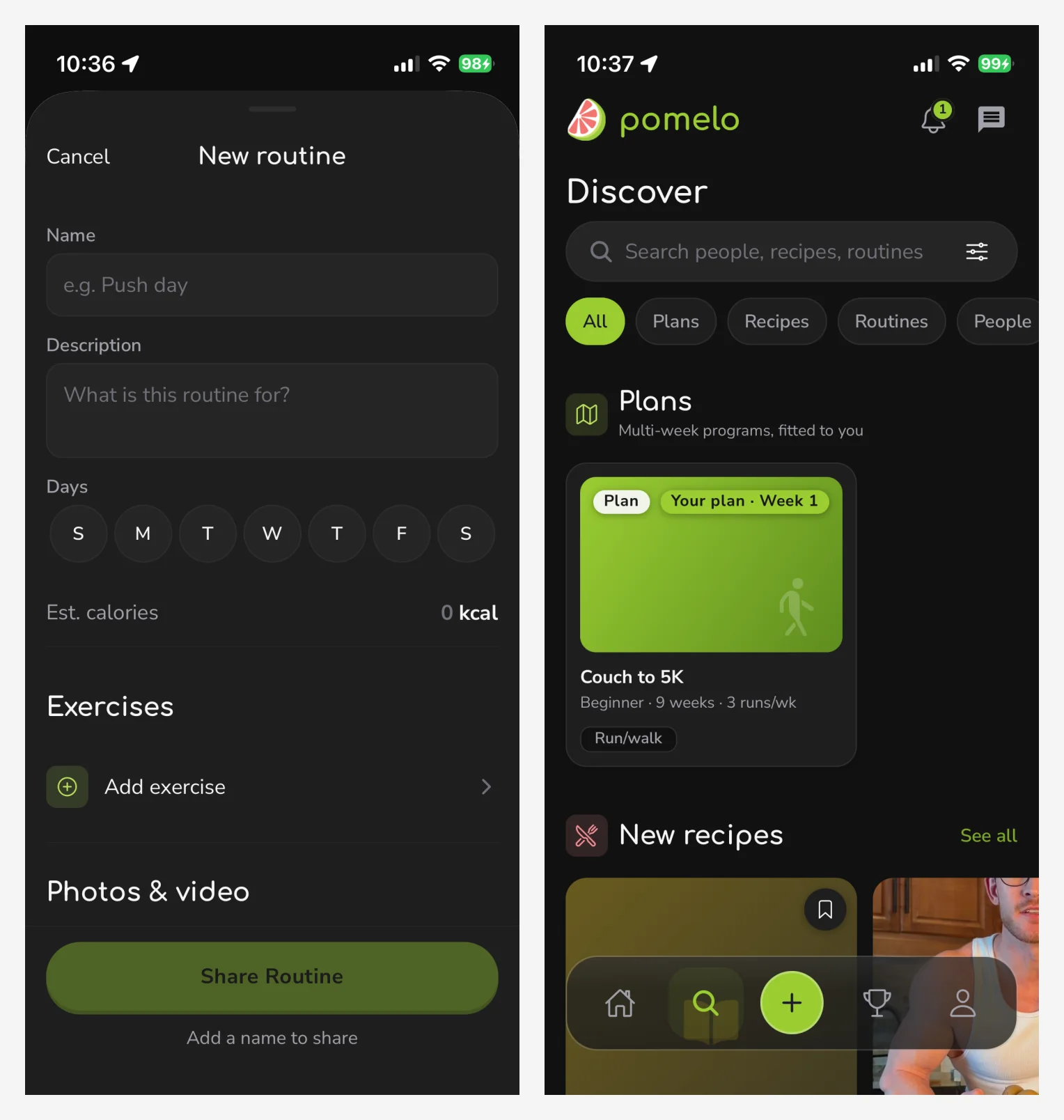
Pomelo Fitness's routine builder takes days, exercises, photos and video, and a routine can be shared. Users can also browse multi-week plans such as Couch to 5K. For a professional, that means signature sessions can be built once, and a new client has something to start on the day they sign.
An AI coach for the small questions
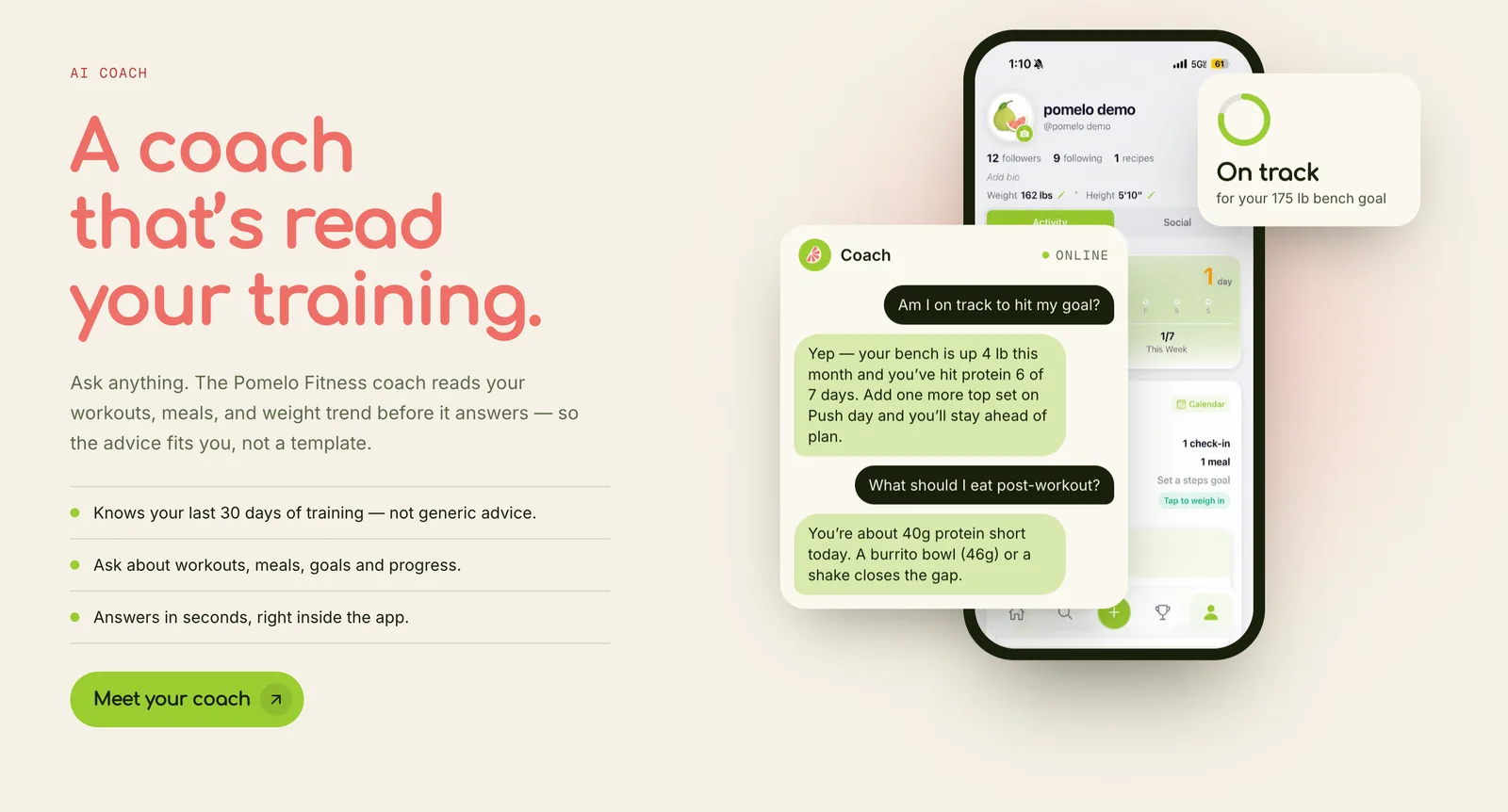
Pomelo Fitness's AI coach reads the client's workouts, meals and weight trend before it answers. It suits the questions that would otherwise fill your DMs, like what to eat after training. Professionals keep the decisions that need a human: changing the program, working around an injury, or noticing that someone's motivation has dropped.
A crew that keeps people showing up
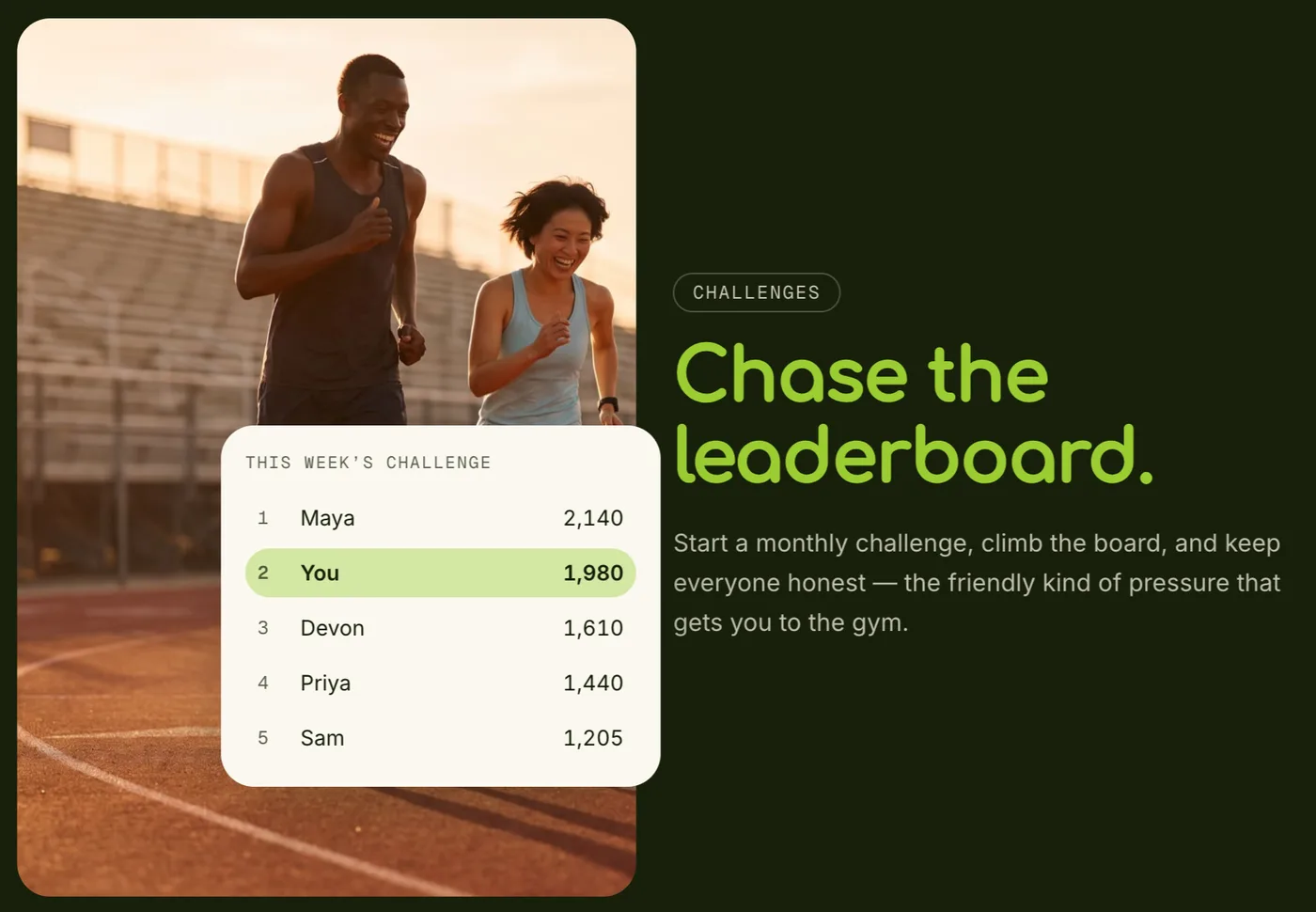
Users can start monthly challenges, climb a leaderboard, follow each other and trade kudos. For a gym or group program, a shared monthly challenge gives people a reason to open the app that has nothing to do with you chasing them.
The competition matters. In a randomized trial of 790 university students, exercise class attendance was 90% higher in groups with social comparison than in groups without it, and support on its own did not produce that lift. Students aren't your clients, but it is a good reason to test a leaderboard before adding another motivational group chat.
Connecting the two: a weekly loop
Inflowave and Pomelo Fitness are separate products with no data connection between them, so each keeps its own job. Pomelo Fitness holds the training and nutrition record. Inflowave holds the relationship and the revenue. An Inflowave workflow keeps the routine moving.
- Onboard. When a deal moves to Clients, a workflow sends a welcome message explaining how to join you on Pomelo Fitness and what to log.
- Review. Each week, look at the client's activity in Pomelo Fitness and update the workout plan or diet where it needs to change.
- Explain. Send the update in the client's Inflowave thread, so the reasoning sits alongside the rest of their history.
- Ask what logs can't show. A short weekly form can cover how training felt, sleep, stress and the hardest moment of the week.
- Catch the drop-off. Workflows can wait and branch. If the form doesn't come back, or you see logging stop in Pomelo Fitness, tag the contact and assign a follow-up before the client goes quiet for good.
- Renew. Set a reminder a few weeks before the program ends, and open that conversation with their own progress. A real weight trend and a long streak make a stronger renewal pitch than any discount.
- Ask for referrals. Right after a strong challenge month is the best time to ask, and the pipeline can record where each new lead came from.
Tell clients up front what you can see in Pomelo Fitness and why you look at it. Weight and food logs are personal. Keep that information out of your ad audiences too: the FTC's health app guidance treats unauthorized sharing of health data, including with advertising platforms, as a breach. Which rules apply to you depends on where you operate, so check with a lawyer if you hold this data at scale.
Good onboarding does a lot of the retention work. See our notes on client onboarding software, and on reducing client churn, which is written for agencies but applies just as well to a coaching roster.
Advertising your program without getting flagged
Fitness offers run straight into Meta's health advertising rules, so check your ads before you spend. Inflowave's ad policy check compares each ad against a catalogue of 77 rules built from Meta's advertising standards. These are the health and beauty rules a coach is most likely to hit:
- A specific weight-loss amount or timeframe, like "lose 20 lb in 6 weeks"
- Guaranteed weight loss or unrealistic body results
- Before-and-after comparisons and imagery
- Zoomed-in body parts or body-shaming pictures
- Claims to cure or treat a disease
- Supplements described as FDA approved
Your best proof, a client's transformation, is often what the rules restrict most in an ad. Keep the ad about the routine, the support and the lifestyle, then share results in the sales conversation with the client's permission. Facebook and Instagram ads can run from the same place as the rest of your pipeline.
The numbers worth running the business on
Inflowave follows a client from first message to payment and renewal, and Pomelo Fitness shows what happens in between. Track these monthly:
- Response time to new enquiries
- Show rate on booked calls
- Close rate on calls that happened
- Logging consistency in Pomelo Fitness across active clients
- Renewal rate by program
- Referrals per active client
Falling logging consistency is the one to watch closest. Treat it as an early warning: a client who stops logging may have started to drift. For ads, measure cost per booked appointment rather than cost per lead.
What one better number is worth
Here is a worked example. These are made-up inputs, not benchmarks, so replace them with your own. Say you book 40 calls a month, close 25% of the calls that happen, and sell a $500 a month program.
| Without reminders | With reminders | |
|---|---|---|
| Show rate (Cochrane figures) | 67.8% | 78.6% |
| Calls that happen | 27 | 31 |
| New clients at 25% close | about 7 | about 8 |
That is roughly one extra client a month from a single automation, or about $500 of new monthly revenue each month. The show rates come from healthcare appointments, so your own lift may be larger or smaller. The method is what to keep: find the weakest step and work out what fixing it pays.
Where this setup falls short
- The two platforms aren't connected. Sales and client history live in Inflowave, and training and nutrition data live in Pomelo Fitness, so you will work across two tools.
- Check what the professional side includes. Pomelo Fitness's public website focuses on the consumer app, so confirm access, features and pricing with Pomelo Fitness before you build an offer around it.
- Device coverage. Pomelo Fitness's website lists the consumer app on iPhone. If you have Android clients, ask Pomelo Fitness what is available for them.
- An AI coach is not medical advice. Injuries, eating disorders and medical conditions need a qualified person.
A one-week setup
- Day 1: Connect your Instagram and other channels to Inflowave.
- Day 2: Build a pipeline and your qualifying form.
- Day 3: Set up your booking calendar and reminders.
- Day 4: Turn on invoices and recurring payments.
- Day 5: Set up with Pomelo Fitness and decide what clients should log.
- Day 6: Build the onboarding and weekly follow-up workflows.
- Day 7: Bring your current clients across and run the first weekly review.
Frequently asked questions
Is there data on fitness coaches specifically?
Not enough to publish. Our response-time data covers all kinds of businesses on Inflowave, and the coaching share is too small to report on its own. The research cited here comes from healthcare, weight management and fitness settings, so use it as a guide and measure your own numbers.
Do personal trainers need a CRM?
Once you have more enquiries and clients than you can keep in your head, yes. A CRM keeps every conversation, call, payment and follow-up on one record, so leads stop slipping through DMs and renewals don't get forgotten.
What software do nutritionists need?
Usually two things: a way to see what clients are eating and adjust their plans, and a way to manage enquiries, bookings and payments. In this setup Pomelo Fitness covers the first and Inflowave covers the second. Dietitians handling medical records should check their local rules.
Do Inflowave and Pomelo Fitness integrate?
No. They are separate products with no data connection. You review client activity in Pomelo Fitness and manage the sale and the relationship in Inflowave.
Can people use Pomelo Fitness without a coach?
Yes. Users can track exercise and macros on their own, without a gym membership, coach, trainer or nutritionist.
Who is the business side of Pomelo Fitness for?
Gyms, coaches, trainers and nutritionists who want to see what their clients are doing and update workout plans or diets accordingly.
What does Pomelo Fitness cost?
Pomelo Fitness's website describes the consumer app as free on iPhone, with no subscription. Ask Pomelo Fitness directly about pricing for the professional side.
Pomelo Fitness is an independent product, and its name, logo, app screens and website images belong to its owners. Inflowave screenshots show a demo workspace with sample data.
Sources
- Inflowave, Instagram DM response time study, 43,971 conversations, January 2025 to September 2026.
- Inflowave, Meta ad policy catalogue, 77 rules.
- Oldroyd, McElheran and Elkington, The Short Life of Online Sales Leads, Harvard Business Review, 2011.
- Gurol-Urganci et al., Mobile phone messaging reminders for attendance at healthcare appointments, Cochrane Database of Systematic Reviews, 2013.
- Burke, Wang and Sevick, Self-monitoring in weight loss: a systematic review of the literature, Journal of the American Dietetic Association, 2011.
- Ferguson et al., Effectiveness of wearable activity trackers to increase physical activity and improve health, The Lancet Digital Health, 2022.
- Zhang et al., Support or competition? How online social networks increase physical activity, Preventive Medicine Reports, 2016.
- US Federal Trade Commission, Updated Health Breach Notification Rule guidance, 2024.
- Meta, Advertising Standards.
- Pomelo Fitness, product website, iPhone app and product information provided by Pomelo Fitness, November 2026.