If you searched "ManyChat comment-to-DM not working," you're not alone, and you're not doing anything wrong. ManyChat's own community forum is full of the exact same threads: automations that respond to some comments but not others, DMs that silently never send, keyword triggers that worked yesterday and stopped today, Facebook ad comments that get nothing.
This guide does two things. First, it walks through every real cause of ManyChat comment-to-DM failures and how to fix each one, so if you can save your current setup, you can. Second, it explains why this keeps happening, and what a more reliable comment-to-DM setup looks like, because for a lot of creators and agencies the honest answer is that they've outgrown the tool that keeps breaking.
We're not here to trash ManyChat, it's a capable product that introduced a lot of people to comment-to-DM. But if it's costing you leads, you deserve to know exactly why and what your options are.
First, confirm it's actually broken (and not just delayed)
Before you tear your flow apart, rule out the boring explanations, because three out of four "not working" reports are one of these:
- Instagram delay. Meta's API can lag. A DM that "didn't send" sometimes lands 5-15 minutes later. Test, then wait a few minutes before concluding it failed.
- You're testing with your own or admin account. Instagram often won't deliver automated DMs to accounts associated with the page, or to people who've never messaged you and don't follow you. Always test with a clean account that follows you and has interacted before.
- The comment didn't actually match. Keyword triggers are literal. An exact-match rule for "price" won't fire on "pricing," "price?", "how much," or "💰". Most "not working" reports are match-logic mismatches, not delivery failures.
- You forgot to publish or re-publish. Edits to a flow don't always go live until you re-publish. A flow stuck in draft looks active in the builder but never fires.
If you've ruled those out and it's genuinely not firing, work through the seven causes below in order, they're ranked by how often they're the culprit.
The 7 real reasons ManyChat comment-to-DM stops working
1. The Instagram connection silently expired
This is the single most common cause. Instagram access tokens and Page connections drop, after a password change, a Meta security event, a permission revocation, a Meta API version deprecation, or just Meta invalidating the session. ManyChat keeps showing your flow as "live," but the underlying connection is dead, so nothing fires and you get no error.
The insidious part: there's often no loud alert. You only discover it when you notice your DMs stopped, which might be days of lost leads later.
Fix: Reconnect the Instagram account in settings, fully, not a soft refresh. Disconnect, reconnect, re-grant every permission on the Meta screen (it's easy to miss one), and re-publish the automation. If you manage multiple accounts, check each one, they expire independently, and one expired connection won't flag the others.
Prevent it: Get in the habit of a weekly connection check, or use a system that re-authenticates gracefully and warns you the moment a connection drops instead of failing silently.
2. The account isn't eligible for the API
Instagram comment-to-DM automation requires a Professional account (Business or Creator) connected to a Facebook Page, with messaging permissions granted. A personal account, or a Professional account missing the Page link or the right messaging permission, will look connected but won't deliver DMs.
This bites people who recently switched account types, migrated Pages, or had a team member set up the connection without the full permission set.
Fix: Confirm the account is Business or Creator, linked to a Facebook Page, and that "Allow access to messages" is enabled in Instagram's privacy/messaging settings and that messaging permission was granted in the Meta permission screen during connection. Re-grant if in doubt.
3. The 24-hour messaging window closed
Meta enforces a strict messaging policy: outside a 24-hour window from the user's last interaction, you can't send arbitrary messages. Comment-to-DM generally works because the comment itself counts as the interaction, but follow-up sequences, delayed sends, and multi-step flows frequently hit the window and silently stop midway.
So the first DM sends, but the "didn't hear back, here's more info" message two hours later, or the next-day nurture, never arrives.
Fix: Keep the first DM immediate, don't stack long delays before the initial message. For legitimate follow-ups beyond the window you need a compliant message tag (e.g., a human-agent or specific use-case tag), and misusing tags risks your account, so use them correctly and sparingly. Design flows so the value lands inside the window.
4. Keyword and trigger logic is too strict or conflicting
Exact-match triggers miss plurals, typos, emojis, capitalization, and natural variations. Real people comment "price?", "PRICE", "pricing", "how much??", "info pls", "💸". An exact-match "price" rule catches almost none of those.
Worse, overlapping rules cause unpredictable firing: two automations watching the same post, or a broad "all comments" rule swallowing a specific keyword rule, mean some comments get a DM and others get nothing with no obvious reason.
Fix: Use "contains" matching rather than exact match wherever possible, and add the obvious variations and synonyms. Add a sensible default/fallback for comments that don't match any keyword. Make sure only one automation is bound to a given post, and audit for rules that conflict or shadow each other.
5. The post or ad isn't included in the automation's scope
ManyChat automations target specific posts, or "all posts," depending on plan and configuration. A brand-new post, a boosted post, or an ad often isn't covered by the rule you built for your organic posts, so comments on it trigger nothing.
Comment-to-DM on Facebook and Instagram ads specifically is one of the most common failure points, because the ad's underlying post is a different object than the organic posts your rule was scoped to.
Fix: Confirm the automation's scope explicitly includes the post or ad in question. For ads, verify the ad's underlying post object is covered by a rule. If you run ads regularly, you need comment-to-DM that treats ad comments as first-class, not an afterthought.
6. Rate limits and volume throttling
When a post goes viral or you run high comment volume, Meta throttles API traffic. ManyChat queues sends and drops some under load, so the comments that matter most, the ones on your best-performing content or a winning ad, are exactly the ones most likely to get no DM.
This is the cruelest failure mode: the moment you finally get reach, the automation that's supposed to capitalize on it buckles.
Fix: There's no clean fix inside the tool, this is a platform plus architecture limit. Spreading triggers, simplifying flows, and avoiding mass simultaneous sends helps at the margin. But persistent throttling on your best content is the clearest signal that you've outgrown a setup that wasn't built for your volume.
7. A plan limit or billing lapse quietly paused it
Free and lower ManyChat tiers cap contacts and active automations. Hit the contact cap, or have a failed payment, and automations pause, often without a loud, unmissable warning. As your audience grows, ManyChat's contact-based pricing also climbs, and a lot of people hit the ceiling right as their content starts working.
Fix: Check your plan usage and billing status. If you're constantly bumping the contact ceiling, or the bill keeps growing as you grow, that's a cost conversation, covered below.
Instagram vs Facebook: the comment-to-DM differences
The two platforms behave differently and fail differently:
- Instagram is stricter on the 24-hour window and on who you can DM (followers and prior-interactors deliver far more reliably). Story-reply and live-comment triggers add more surface area to break.
- Facebook comment-to-DM (especially on ads) is notoriously flaky under volume, and Page-role and permission issues cause more silent failures. If you run Meta ads, Facebook ad-comment automation is where you'll feel fragility most.
A setup that handles both in one place, with consistent delivery, removes a whole category of "works on IG but not FB" debugging.
Why does this keep happening?
Notice the pattern: most of these failures aren't bugs you caused, they're the friction of bolting one automation tool onto Meta's API through a connection that breaks, a messaging window that closes, scopes that don't cover ads, and rate limits that throttle your best content. Every reconnection, every "why did only half my comments get a DM," every silent pause is the same underlying fragility surfacing in a different place.
For a hobby account, that's an annoyance. For a creator running offers, or an agency running client accounts, every missed comment is a missed lead you paid, in content effort or ad spend, to generate. A comment-to-DM flow that works 80% of the time isn't 80% as good, it's quietly leaking a fifth of your warmest prospects, and you can't even see the ones you lost because they never entered a system.
There's a second cost most people miss. Comments aren't just DM triggers, they're public engagement that lowers your ad CPM and builds social proof. When your automation only fires a private DM and never manages the public comment, you leave the cheaper-reach benefit on the table too. (We go deep on that in how comments lower your Facebook ad CPM and CAC.)
What a more reliable comment-to-DM setup looks like
If you're going to depend on comment-to-DM for real revenue, the setup needs to be built for it, not retrofitted:
- Resilient connections that re-authenticate gracefully and warn you the instant something drops, instead of failing silently for days.
- Comment capture that doesn't drop under load, so a viral post or a winning ad is an opportunity, not a failure point.
- Every comment in one inbox, across all your posts, your ads, and (for agencies) all your client accounts, so nothing falls through the cracks.
- Hot comments captured as leads in a CRM, not just a DM fired into the void, so you can follow up, sequence, and actually attribute the sale back to the comment.
- Public reply plus DM together, because the public reply lowers your ad CPM and builds social proof while the DM does the converting.
This is exactly why we built Inflowave. It does comment-to-DM, but it treats comments as leads: every comment across Instagram and Facebook (organic and ads) lands in one unified inbox, buying-intent comments become tracked leads in the CRM, and replies and DMs fire reliably at scale. It's the difference between an automation that sometimes sends a DM and a system that turns your comment section into pipeline you can measure.
If you're a solo creator
Our Influencer plan is built for exactly this: comment-to-DM, the unified inbox, and lead capture at a price that makes sense for one person growing an offer. If ManyChat keeps breaking on you and the bill keeps climbing as your contacts grow, this is the cleaner switch, predictable pricing and a setup that doesn't leak your best leads. You can start a free trial and have your first comment-to-DM flow live today, no credit card required to test it.
If you're an agency
Running comment-to-DM across many client accounts is where ManyChat's per-account fragility hurts most, you're the one who fields the "why didn't my ad comments get DMs?" message from a client, and you're debugging connections across a dozen accounts that each expire independently. Inflowave puts every client's comments in one place with reliable delivery, and comment management becomes a billable, defensible service line instead of a thing that quietly breaks on a Friday. Start a free trial and connect one client account to feel the difference, then roll it out across the book.
What good comment-to-DM copy looks like (so the switch pays off)
Reliability gets the DM delivered; copy gets it converted. A few principles that carry over no matter which tool you use:
- Reply in the comment publicly first, then DM. "Just sent you a DM! 🙌" The public reply adds engagement (cheaper reach) and shows other readers you're responsive. The DM does the private conversion.
- Open the DM with the thing they asked for, not a wall of text. If they commented "PRICE," lead with a one-line answer or the link, then a single qualifying question.
- Ask one question, not five. The goal of the first DM is a reply, momentum beats interrogation.
- Have a fallback for non-matching comments. A friendly catch-all ("Thanks for commenting! Want the details? Reply 'YES'.") recovers intent that strict keywords miss.
- Capture and follow up. Most comment leads don't convert on message one. A light 3-touch follow-up over a week recovers a real share, but only if the lead is tracked somewhere, which is the piece a bare DM automation never gives you.
How to migrate without losing your flows
Switching is less painful than staying on something that breaks:
- Export your keyword triggers and DM copy. You've already done the hard thinking, the messages and matching logic carry straight over.
- Connect your Instagram and Facebook accounts to the new system and grant messaging permissions once, properly.
- Rebuild your top 2-3 flows first, the ones tied to revenue, and test each with a clean account that follows you.
- Run both tools in parallel for a few days if you want a safety net, then cut over once you see comments converting reliably.
- Add lead capture from day one so every comment-sourced conversation is tracked and attributable, the thing ManyChat never gave you, and the thing that lets you prove the channel works.
FAQ
Is ManyChat having issues right now?
ManyChat does have occasional platform incidents, but most "not working" reports trace to the account-level causes above (expired Instagram connection, account eligibility, the 24-hour messaging window, trigger logic, post or ad scope, rate limits, plan caps) rather than a global outage. Work through those seven first, the connection and trigger logic are the usual culprits.
Why is ManyChat not sending messages?
The most common reasons: the Instagram connection silently expired, the recipient is outside the 24-hour messaging window, the account isn't a Professional account with messaging permissions, the post/ad isn't in the automation's scope, or you've hit a plan or contact limit. Reconnect fully, verify eligibility, check scope, and check usage.
How do I send a comment to a DM automatically?
You set up an automation that watches a post for a keyword in the comments and replies with a DM. It works when the connection is healthy, the account is eligible, the trigger logic matches real comment variations, and the post is in scope. The reliability of all of those at once is what separates a setup that works from one that leaks leads.
Can ManyChat reply to comments on Facebook?
Yes, comment automation works on Facebook as well as Instagram, but it carries the same connection, permission, and rate-limit fragility, and many advertisers find Facebook ad-comment automation especially flaky under volume. If ads are core to you, prioritize a tool that treats ad comments as first-class.
Why do only some of my comments get a DM?
Almost always trigger logic (exact-match missing variations), conflicting/overlapping rules on the same post, or rate-limit throttling on a high-volume post. Switch to "contains" matching, add a fallback, ensure one rule per post, and if it only fails on your viral posts, that's throttling, an architecture limit, not something you can fully fix inside the tool.
Is there a more reliable ManyChat alternative for comment-to-DM?
Inflowave is built comment-first: reliable comment-to-DM, every comment in one inbox across Instagram and Facebook (organic and ads), and buying-intent comments captured as CRM leads, with an Influencer plan for solo creators and agency plans for multi-client teams. See our full comparison of ManyChat alternatives, or just start a free trial and connect one account.
See reliable comment-to-DM in action
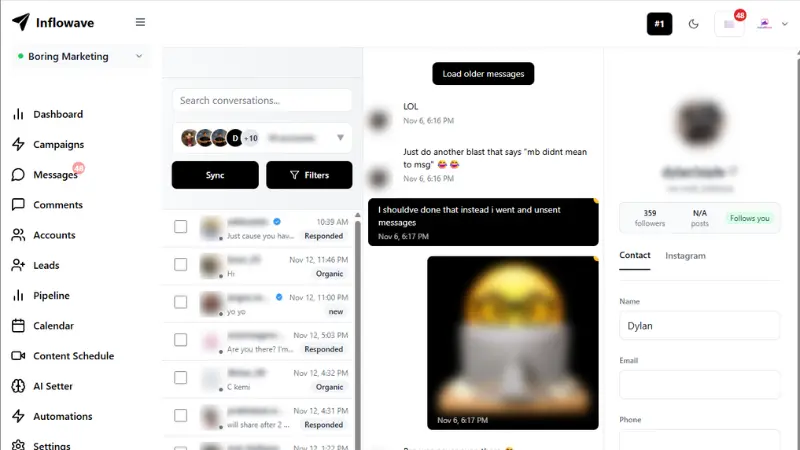
This is the unified inbox where every comment and DM across Instagram and Facebook lands in one place, with buying-intent comments captured as leads, no silent failures, no missed comments, no debugging connections across a dozen accounts:
And here's a real campaign run end-to-end on a live account:
Why creators and agencies switch to Inflowave
- Comment-to-DM that doesn't silently break , resilient connections that warn you instead of failing for days.
- Every comment in one inbox , across all your posts, ads, and (for agencies) every client account.
- Hot comments become CRM leads , so you can follow up and attribute the sale, not just fire a DM into the void.
- Predictable pricing , an Influencer plan for solo creators and agency plans for teams, no contact-based bill that balloons as you grow.
- Reliable at scale , a viral post is an opportunity, not a failure point.
Start your free trial and have your first comment-to-DM flow live today, no card required to test it.