If you run Facebook ads, for your own business or for clients, you've spent more hours than you'd like trying to drag your CPM down. Split-tested creatives. Narrowed and broadened audiences. Rebuilt campaigns from scratch, moved to Advantage+, turned it off again. Almost nobody touches the one lever that compounds across every one of those efforts: the comment section under your ads.
This isn't an "engagement is nice to have" pep talk. There's a direct, mechanical chain that runs from comments to lower CPM to lower customer acquisition cost (CAC), and a second parallel path where comments turn into leads you'd otherwise pay an entire CPM cycle to acquire. Most advertisers ignore both because comment management is tedious, easy to forget, and doesn't show up as a line item in Ads Manager. That's exactly why it's an edge.
Why CPM is the metric that quietly controls everything
CPM (cost per mille) is what you pay for 1,000 impressions. It feels like a vanity metric, but it sits upstream of every number you actually care about. Walk the chain: CPM determines how many people you reach per dollar, reach determines clicks (at a given CTR), clicks determine leads (at a given landing-page conversion rate), and leads determine your customer acquisition cost (at a given close rate).
If your CPM drops 30% and nothing else changes, you get ~30% more impressions for the same spend, ~30% more clicks, ~30% more leads, and your CAC drops by roughly the same proportion. You didn't write a better ad. You bought attention more cheaply, and the savings flowed all the way down the funnel. That's the leverage, and most people treat CPM as an output they're stuck with rather than an input they can move. (Plug your own numbers into our free CPM calculator to see the cascade.)
CPM is an auction price, not a rate card
Meta doesn't price impressions on a fixed rate card, it runs an auction, and your effective CPM is a function of how much Meta wants to show your ad. The platform makes more when it shows ads people engage with, so it rewards ads that keep users interacting. Your bid is only part of the story, the rest is your estimated action rate and ad quality. Improve those and you win impressions more cheaply than a competitor bidding the same amount. Comments are one of the most direct ways to improve them.
Why is my CPM so high? The 7 real causes
Before you can lower CPM, you need to know what's inflating it. In practice it's almost always one or several of these:
- Audience too narrow. A tiny audience means Meta shows the same ad to the same people repeatedly. Frequency climbs, engagement decays, CPM rises because the auction pool is shallow.
- Creative fatigue / high frequency. When the same people have seen your ad 5+ times, they stop engaging and start hiding it. Both push CPM up.
- Weak engagement signals. Low likes/comments/shares relative to reach tells Meta the ad isn't compelling, so impressions cost more. This is the lever this guide is about.
- High negative feedback. Hides and "report ad" are the fastest CPM killers.
- Seasonality and auction competition. Q4 and other high-demand periods raise everyone's CPM. You can't control this, only your relative position in it.
- Objective / optimization mismatch. Optimizing for a rare event on a small pixel makes Meta work harder and costs more.
- Placement and format. Some placements and formats earn cheaper, more engaged reach than others.
Four of the seven, engagement signals, negative feedback, creative fatigue, and relative auction position, are directly influenced by how your comment section is managed. That's why comments aren't a footnote.
The three rankings Meta prices you on
Open any ad in Ads Manager and you'll see three diagnostic rankings (Above Average, Average, Below Average, relative to ads competing for the same audience):
- Quality ranking, perceived quality vs competitors. Negative feedback drags it down; genuine engagement lifts it.
- Engagement rate ranking, expected engagement (clicks, likes, comments, shares). Comments feed this directly.
- Conversion rate ranking, expected conversions vs competitors on the same objective.
Ads ranked "Below Average" on quality or engagement pay a premium to win the same impressions an "Above Average" ad wins cheaply. An active comment section is one of the fastest ways to move the engagement-rate ranking up and pull quality with it.
The mechanism: how comments lower your CPM
1. Comments raise engagement rate, which Meta rewards with cheaper impressions. Meta reads a heavily-commented ad as content users want to interact with, so it's cheaper to win the auction for it. Run the same creative side by side, dead comments vs an active thread, and the active one routinely runs a lower CPM.
2. Comments create social proof that lifts CTR. A user who sees "412 comments" reads it as other people care about this. Higher CTR improves your rankings, which again pressures CPM down. It's a flywheel: comments, CTR, ranking, CPM, more reach, more comments.
3. Comments suppress the kill-switch: negative feedback. A moderated comment section makes an ad feel like organic content (lower instinct to hide it), and moderation lets you remove toxic comments before a pile-on tanks the ad. Moderation is CPM defense.
4. Comments extend the lifespan of a winning ad. A steadily-commented ad decays more slowly, so you get more profitable days out of every winner before paying the "learning phase tax" on a replacement.
5. Comments help organic reach, which subsidizes paid. Shares and conversation earn organic distribution that effectively lowers your blended CPM across paid plus organic.
Which comments actually move the needle
Not all comments are equal. Here's the taxonomy worth understanding:
- Buying question ("How much?", "Do you ship to X?") - high intent. Reply publicly in minutes, then DM.
- Objection ("Isn't this like [competitor]?") - answer in public; it builds trust for every reader.
- Hand-raise ("Interested", "DM me", tags a friend) - capture as a lead, follow up fast.
- Social proof (a happy customer vouching) - like, reply, pin it.
- Low-signal positive (emojis, "nice") - quick like keeps the thread warm.
- Spam / toxic - hide or delete, auto-filter where possible.
The first three are where revenue lives. The next two keep the flywheel spinning. The last is pure downside if left unmanaged.
Should you just turn off comments on your Facebook ads?
It's one of the most common questions advertisers ask, usually right after a wave of trolls. Meta lets you limit or hide comments, and the temptation to switch them off entirely is real. Don't.
Turning off comments throws away every benefit above: you kill the engagement signal that lowers CPM, delete the social proof that lifts CTR, and slam shut your warmest lead source. You're not removing a problem, you're amputating a profit center to avoid a moderation task.
The right move is management, not amputation: hide or delete the genuinely toxic comments (Meta lets you hide so only the author sees it, no public pile-on), answer legitimate criticism in public, and set a Page-level keyword/profanity filter to auto-hide spam. You keep the CPM and lead benefits and lose the headaches.
The second path: comments are leads you already paid for
Every comment on a lead-gen or e-commerce ad is a buying question, an objection, a hand-raise, or social proof. You already paid the CPM to put that ad in front of that person. They engaged. They're warmer than someone who clicked and bounced off a landing page. And then most advertisers let the comment sit for six hours, or forever.
If your CPM is $15 and your engagement rate is 2%, you spent roughly $0.75 in media to generate that single engaged comment. A buying-intent comment is worth multiples of a cold click. Letting it rot is lighting money you already spent on fire.
A fast, helpful public reply does three jobs at once: it converts that commenter, it adds another comment to the thread (more engagement, lower CPM), and it answers the same objection for the next 500 silent readers who never asked. And speed is the whole game, a "how much?" answered in 5 minutes converts dramatically better than the same comment answered the next morning.
The comment-to-lead capture playbook
Replying is half of it. The other half is making sure a hot comment becomes a tracked lead instead of a notification you swipe away:
- Public reply first. Answer where everyone can see it, this does the CPM and social-proof work and pre-empts the question for the next reader.
- Move to DM for the conversion. "Sent you a DM with the details!" The DM is where you qualify and book.
- Capture the lead. Log the handle, the source ad/campaign, and the intent so you can follow up and attribute the sale, which is how you prove the strategy's ROI.
- Follow up on a cadence. Most comment leads don't convert on the first message; a simple 3-touch follow-up recovers a meaningful share.
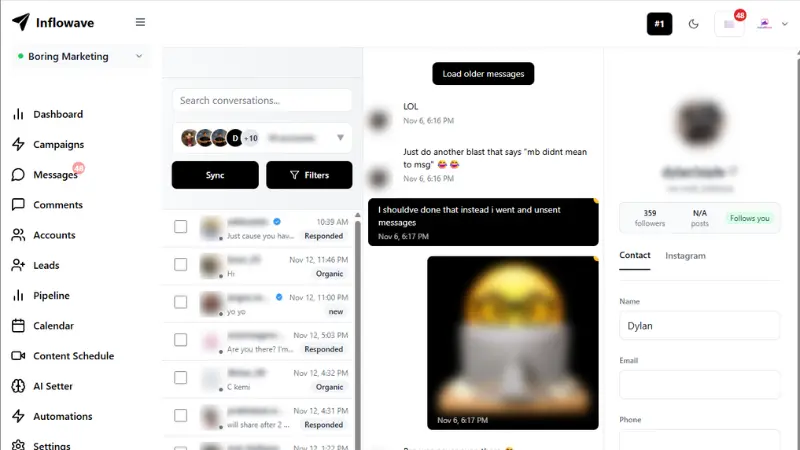
This is precisely the workflow Inflowave automates: every comment across your Facebook and Instagram ads lands in one inbox, buying-intent comments get captured as leads in your CRM, and you can trigger instant replies and DMs, at a scale that's impossible by hand across many ads or many clients.
The math: what this actually does to CAC
Take a modest lead-gen account: $10,000/month budget, starting CPM $20, CTR 1.5%, landing-page conversion 10% (click to lead), close rate 20% (lead to customer). That yields 500,000 impressions, 7,500 clicks, 750 leads, 150 customers. CAC = $66.67.
A) Drop CPM from $20 to $15 (a 25% reduction, well within range for moving an ad from dead to actively engaged): 666,667 impressions, 10,000 clicks, 1,000 leads, 200 customers. CAC = $50.00, a 25% cut with zero change to budget, creative, or targeting.
B) Add direct comment-to-lead conversion. Say your ads generate 800 comments/month and you convert a conservative 10% of buying-intent comments into leads that wouldn't have come through the landing page, 80 extra leads, ~16 extra customers, 216 customers from the same $10,000. CAC = $46.30, a 30% cut versus where you started. Same spend. Same ads.
The exact percentages vary by niche, run your own numbers, but the direction is reliable: engaged comment sections lower CPM, worked comments add leads, and both push CAC down. (The free CPM and CAC calculator shows the full cascade.)
Scenario playbooks by business type
E-commerce / DTC. Comments skew to product questions and social proof. Pin a verified-customer review; answer sizing/shipping publicly, it converts browsers with the same doubt.
Lead generation / services. Comments skew to "how does this work?" and "what's the price?". The public-reply-then-DM motion is the core play; lead capture is essential because the sale happens in conversation.
Local / brick-and-mortar. Expect "are you open Sundays?" and friend tags. Fast replies build local trust and tags expand organic reach in your exact geography. Pin hours, location, and a booking link.
Info-products / coaching. High skepticism, high volume. Public objection handling is your best asset, every answered "is this legit?" reassures dozens of silent readers.
What a "good CPM" even looks like (and why comparison is a trap)
People constantly ask what a good CPM is. The honest answer: it depends entirely on country, audience, season, objective, and niche. Chasing a benchmark is the wrong frame. The right frame is relative: is this ad's CPM lower than the same ad with a dead comment section? Is your account's CPM trending down month over month as you systematize engagement? Those are the comparisons you control.
The operational playbook (for businesses)
- Seed the comment section on day one. Pin a comment that pre-empts the #1 objection, have a teammate leave a genuine first comment to break the seal, and ask a question in the ad copy that invites a reply.
- Reply to everything, fast. Every comment gets a reply within minutes during business hours, publicly, then DM where appropriate.
- Moderate ruthlessly. Hide spam and toxic comments before they snowball; answer legitimate criticism in public. Set a Page-level keyword/profanity filter.
- Mine comments for objections and creative. Objections are your next ad's hooks; repeated questions are your next FAQ; customer phrases are your next headlines.
- Route hot comments into your CRM. Capture handle, context, and intent so you can follow up and attribute.
Your first 30 days
- Week 1, baseline. Note current CPM, CTR, CPL, CAC per campaign. Turn on a keyword/profanity filter. Pin a comment on top-spending ads.
- Week 2, response discipline. Reply to every comment within business hours; start the public-reply-then-DM motion.
- Week 3, capture. Log hot comments as leads with their source ad; build a 3-touch DM follow-up; pin your best social-proof comment.
- Week 4, measure and systematize. Compare metrics vs Week 1. Where the manual process breaks (missed comments, slow replies, too many ads), that's your signal to put a system in place so it scales.
The agency angle: this is a service, not a chore
If you run a Facebook ads agency, everything above multiplies by your client count, and that's an opportunity. Most agencies sell media buying and creative; comment management quietly determines whether the media buying performs, and almost nobody packages it as a deliverable.
- It's a retention moat. Clients who see CPM trending down and comment sections full of converted leads don't churn.
- It's a margin opportunity. "Community and comment management" is a legitimate, defensible line item, you're already in the account.
- It's a reporting win. "We converted 47 ad comments into booked leads this month, leads that would otherwise have been lost" is a slide that renews contracts.
The catch is scale. One person cannot watch 30 client ads across 12 ad accounts and reply in five minutes. That's where systematizing it, one inbox for every comment, automatic lead capture, instant replies and DMs, turns a chore that doesn't get done into a service that prints retention.
Common mistakes that quietly raise your CPM
- Letting comments sit. Dead threads forfeit the engagement signal and let the rare negative comment dominate.
- Turning comments off at the first troll. The most expensive overreaction in paid social.
- Deleting all criticism. Hiding toxic comments is smart; deleting honest objections looks evasive and wastes a trust-building moment.
- Over-narrow audiences. Shrinks the auction pool and spikes frequency.
- Refreshing winners too late. Riding a fatigued ad until CPM balloons.
- Ignoring the DM step. Replying publicly but never moving buying-intent comments to a conversion conversation.
- No attribution. If you can't tie comment-sourced leads back to the ad, you can't prove it works.
Where this fits with the rest of your CPM toolkit
Comments aren't a replacement for the fundamentals. You still want strong creative with varied hooks, broad-enough audiences, good account structure so the algorithm exits learning fast, and a clean Conversions API signal (see our CAPI setup guide). Comments are the lever that compounds all of those, and the one almost nobody pulls.
FAQ
What is a good CPM on Facebook ads?
There's no universal number, it depends on country, audience, niche, objective, and season. Compare relatively: is your CPM lower than the same ad with no engagement, and is it trending down as you systematize comments?
Why is my Facebook CPM so high?
Usually an audience too narrow, creative fatigue, weak engagement signals, high negative feedback, seasonal competition, an objective mismatch, or poor placements. Four of those are directly improved by an active, moderated comment section.
Do comments really lower CPM, or is that a myth?
Comments raise engagement rate and improve Meta's rankings, which pressures your effective CPM down in the auction. They also lift CTR via social proof and reduce negative feedback. It's not magic; it's feeding the auction the signals it rewards.
How fast do I need to reply to ad comments?
For buying-intent comments, minutes, not hours. Intent decays fast. At volume this is an operations problem best solved with a system, not willpower.
Should I turn off comments on my Facebook ads to avoid trolls?
Almost never. Disabling comments kills the engagement signal that lowers CPM, removes social proof, and shuts off your warmest lead source. Hide the toxic ones, auto-filter spam, and answer real criticism in public.
Can comment management lower my customer acquisition cost?
Yes, on two paths: lower CPM flows down to lower CAC at constant spend, and buying-intent comments converted directly into leads add customers you already paid to reach.
See it in action
Here's the unified inbox where every comment across your Facebook and Instagram ads becomes a managed conversation and a captured lead, instead of a notification that rots:
And a real Facebook ads breakdown using this exact comment-first approach on a live account over 30 days:
Why businesses and agencies run their ad comments on Inflowave
- Every comment in one inbox , across all your ads and, for agencies, all your clients, so no warm comment ever goes unanswered.
- Buying-intent comments become CRM leads automatically , captured with their source ad, not lost in a notification feed.
- Instant public replies + DMs , the public reply lowers your CPM and builds social proof; the DM does the converting.
- Lower CPM, lower CAC , an engaged, well-moderated comment section earns cheaper impressions and more leads from the same spend.
- Built for scale , one person can manage comments across dozens of ads or client accounts without anything slipping.
Start your 7-day free trial and turn the comments you already pay for into pipeline.